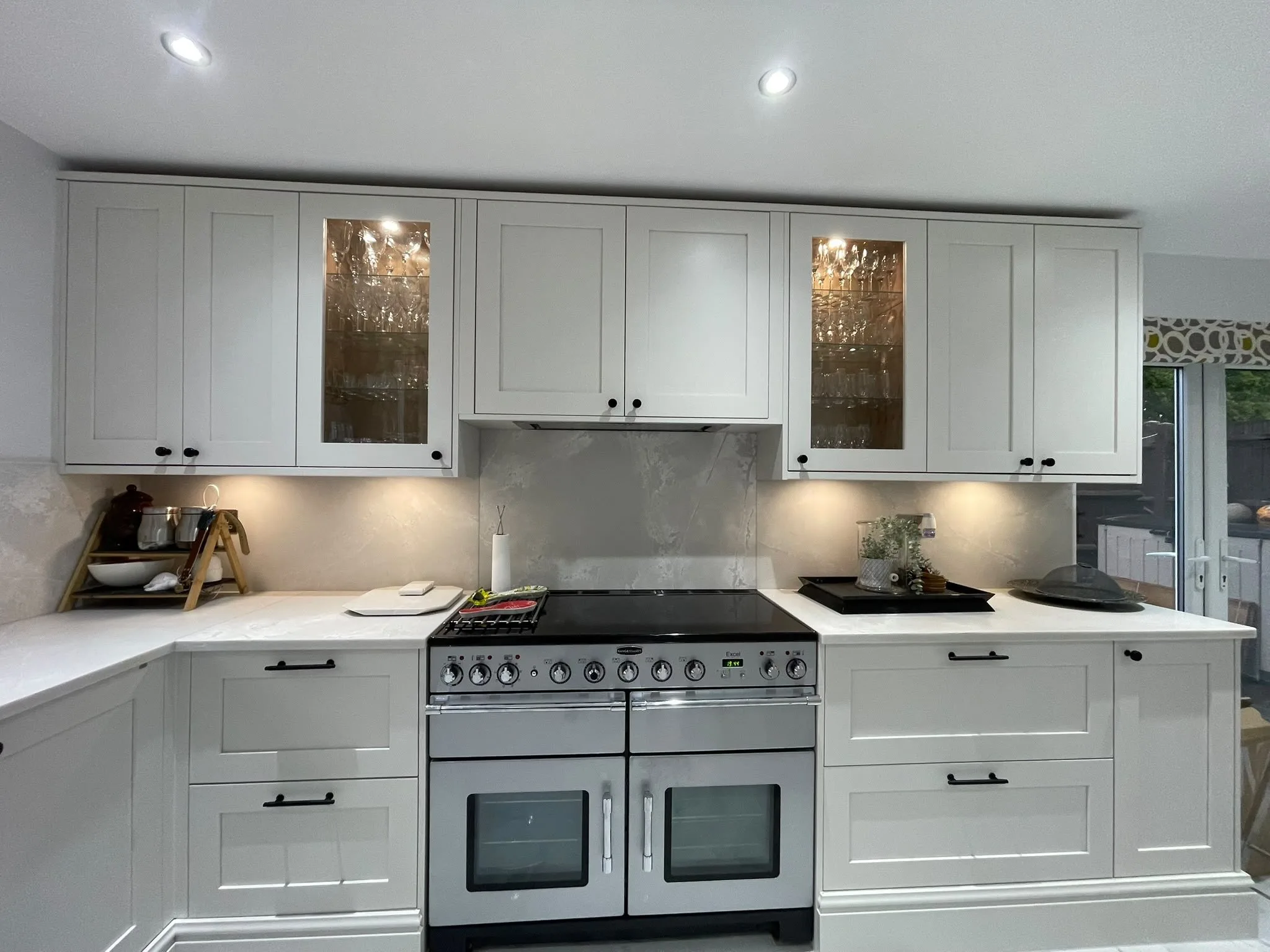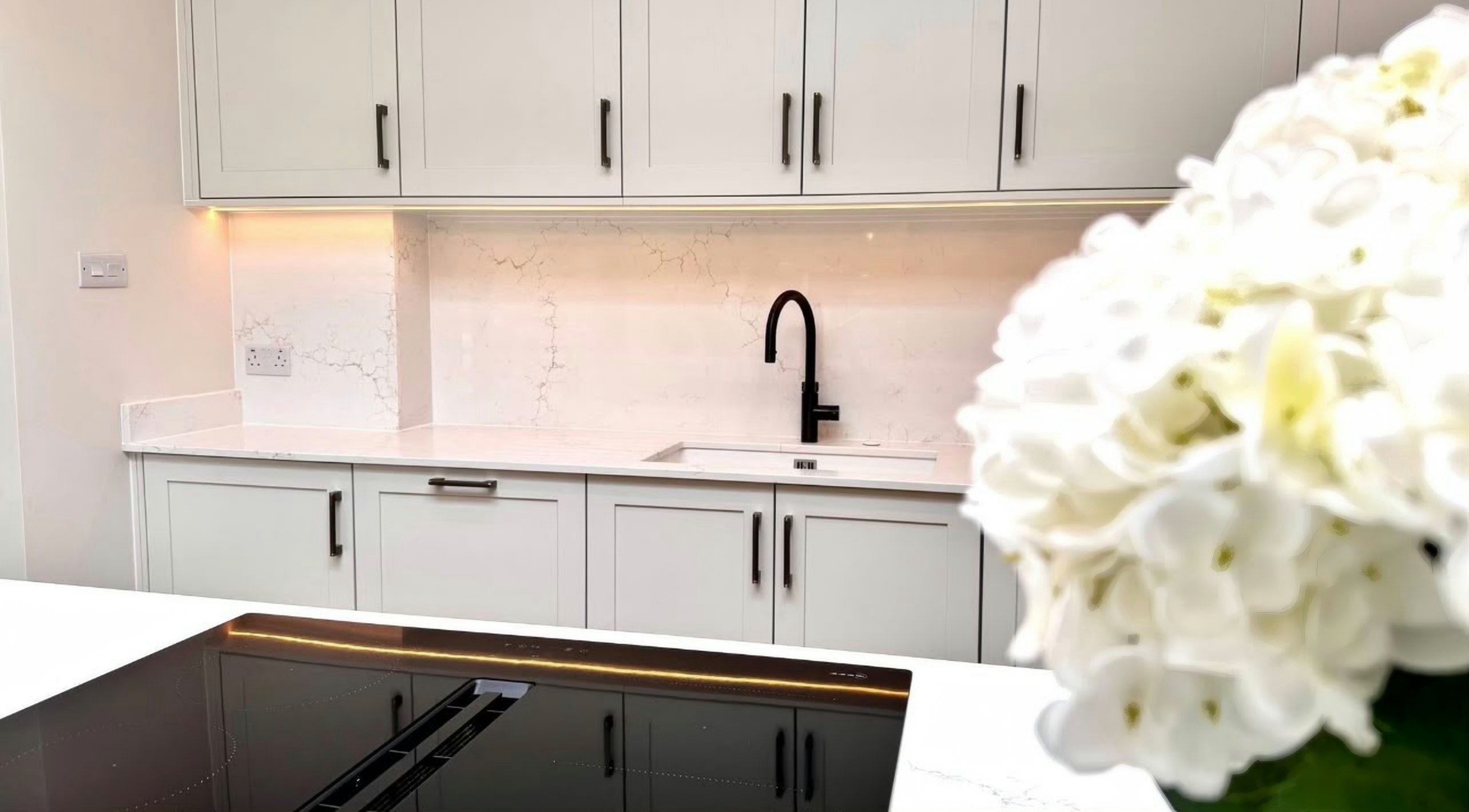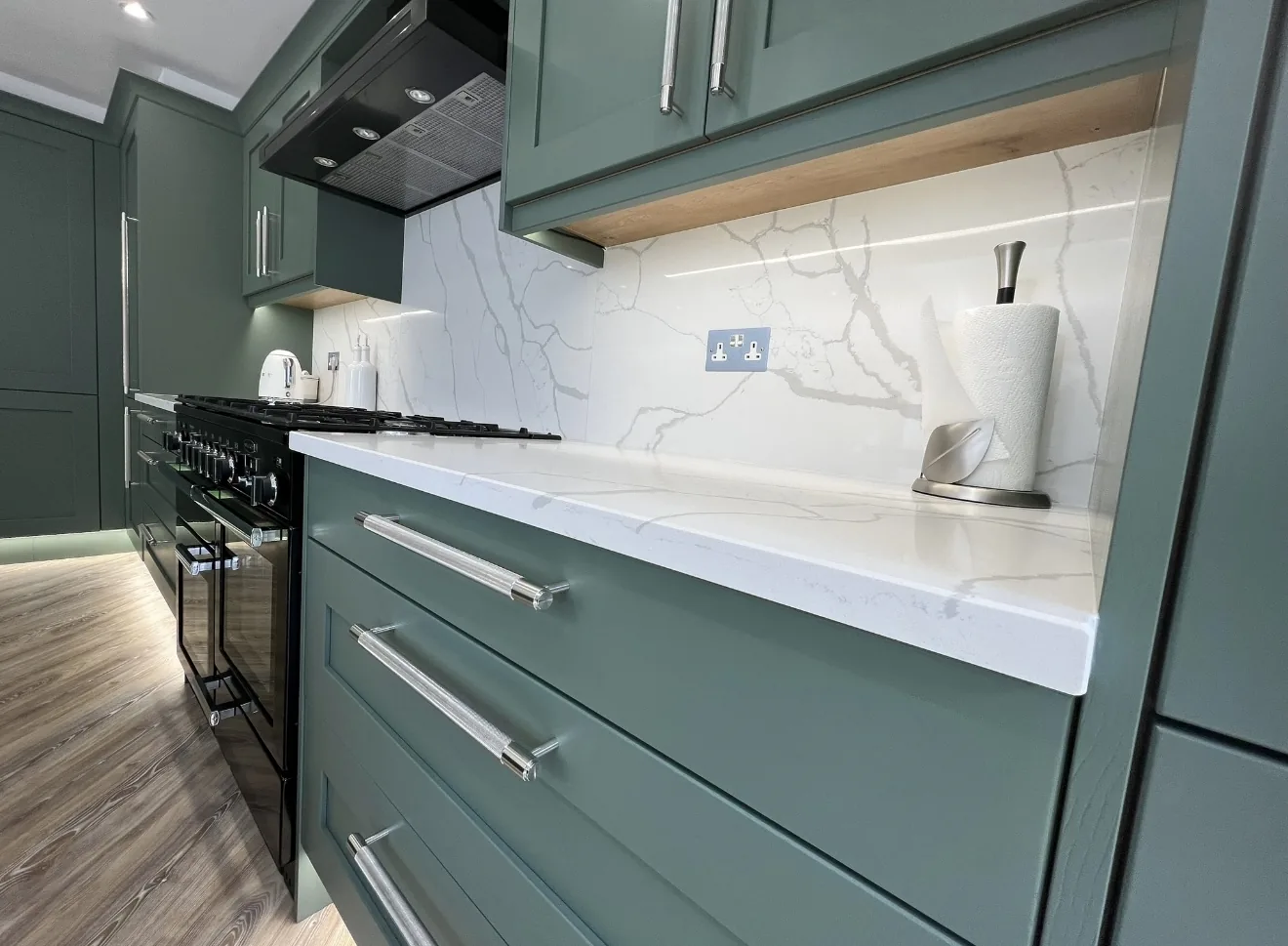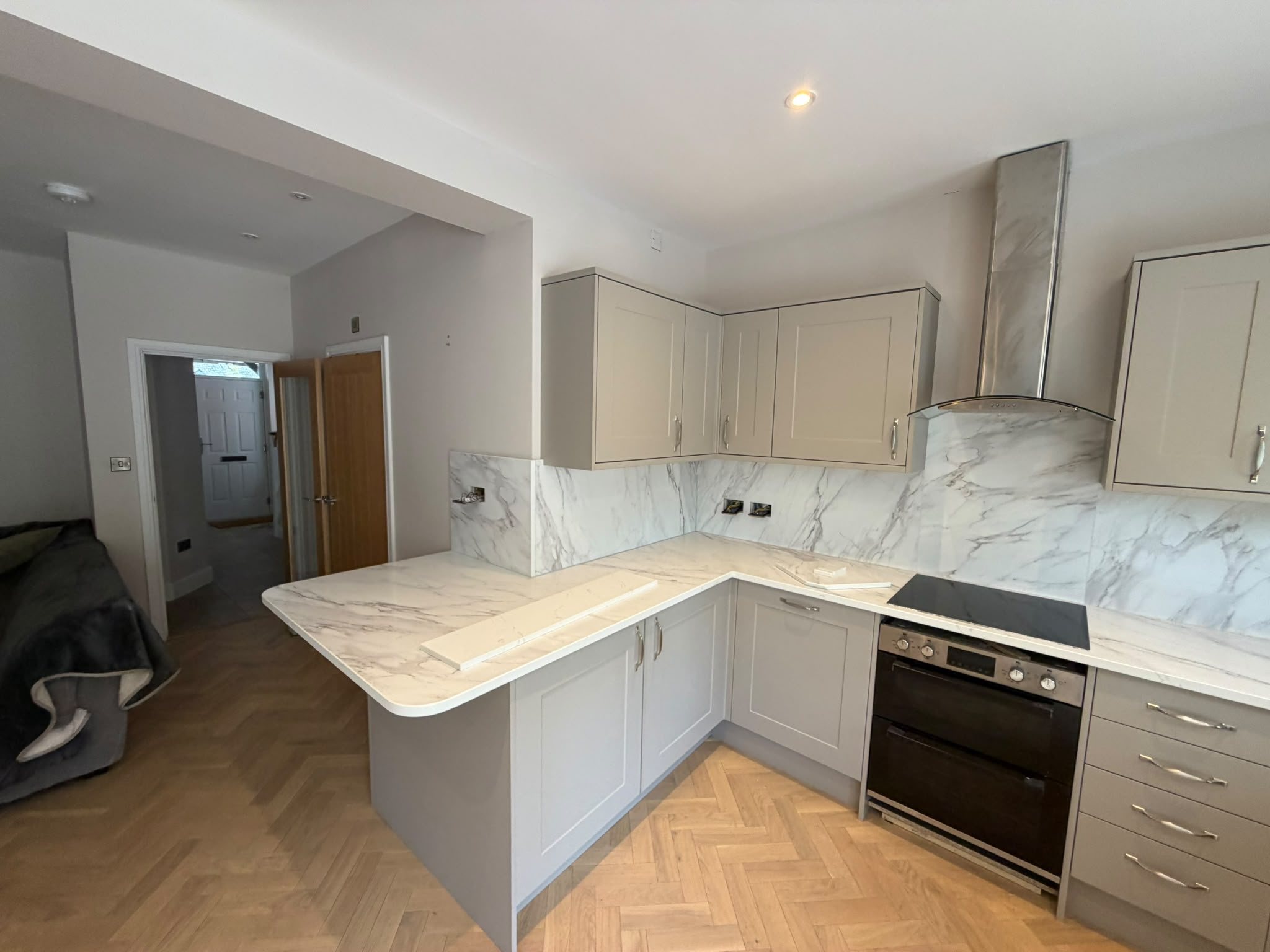
People agonise over this one longest, usually because both sides of it are argued by someone with something to sell. Marble is the most beautiful surface you can put in a kitchen and the least convenient. A good marble-effect quartz gets most of the way to the look with none of the anxiety, and falls short in one specific, visible way. Worktop Worx fits marble-effect quartz and does not stock real marble, which is worth knowing before you weigh our view.
Key points
- Etching is physical dulling of the surface by acid; staining is something absorbed into the stone. They need different fixes
- Sealing marble slows staining and does nothing at all about etching
- Marble-effect quartz removes etching, staining and sealing, but not the depth and randomness of real veining
- Judge a marble-look from a full slab: find the repeat and check whether the vein runs through the body
- Quartz is not heat-proof. The resin scorches, so a hot pan still wants a trivet
01 / 11
The short answer
If it is a family kitchen with a hob, a sink and children, and a dull ring where a lemon sat would upset you, buy a marble-effect quartz. If you have looked at real marble properly, accepted that it will mark, and decided you like a surface that records ten years of cooking, buy marble and stop reading comparisons. The wrong outcome is buying marble expecting quartz behaviour, which is where nearly every unhappy marble owner comes from.
What decides it is not durability in the abstract. It is that marble reacts chemically to ordinary kitchen acids, and no amount of sealing, care or money changes that. The rest of this page expands on that one fact.
02 / 11
What is marble, and why does it behave the way it does?
Marble is limestone that has been recrystallised under heat and pressure. That means it is calcareous: chemically it is mostly calcium carbonate, the same family of compound as chalk and as the limescale in your kettle. Everything difficult about marble follows from that one line of chemistry.
Calcium carbonate reacts with acid. Lemon juice, lime, vinegar, wine, tomato, some fizzy drinks, and a good number of ordinary household cleaners will react with the surface of a polished marble on contact. The reaction is quick, often visible within a minute or two, and it does not need a spill to be left overnight to do it.
Marble is also soft and porous. Soft means it scuffs from things that would not mark quartz or granite: a dragged casserole dish, the base of an unglazed pot. Porous means liquids move into the stone rather than sitting on it. Both are separate problems from the acid reaction, and people run all three together.
03 / 11
Etching and staining are not the same thing
An etch is physical damage to the surface. The acid has dissolved a shallow layer of polished stone, leaving a patch duller than the polish around it. Nothing has been added; the finish itself has changed. That is why an etch reads as a matt ghost appearing and disappearing as you move your head, and why it shows worst on a dark polished marble and least on a pale honed one.
A stain is the opposite: something has gone into the stone. Oil, red wine, beetroot, turmeric, coffee. A stain is usually darker than the surrounding stone, has a soft edge, and sits below a polish that is still intact.
They need opposite responses. Scrubbing an etch achieves nothing, because there is nothing to remove; the fix is re-polishing that area back to match, with a marble polishing powder for something light or a professional refinish for anything deep. A stain is drawn back out instead, usually with a poultice left on for hours, and polishing will not touch it. The wrong remedy is how a small mark becomes a patch visible from the doorway.
How to tell which one you are looking at
- Wet the mark: an etch usually vanishes while wet and returns as it dries
- Look from a low angle across the surface rather than straight down: etching shows that way, staining hides
- A mark that is lighter and matt is almost always an etch; a mark that is darker with a soft edge is almost always a stain
04 / 11
The case for marble, made properly
Marble accumulates a patina. Etches soften, the sharp new polish gives way to something more even, and after a few years the surface stops looking damaged and starts looking used. In a period house, a pantry, or a kitchen built to look fifty years old, that is the point rather than a defect. No engineered material does it, because it is designed specifically not to change.
Marble is also genuinely cool, which matters if you do serious pastry work, and its veining runs through the body of the stone in three dimensions rather than being a pattern applied to a slab. On a thick edge, on a mitre, or on a waterfall end, that difference is visible to anyone who looks closely.
The people happy with marble are, almost without exception, the ones who accepted before ordering that it would mark. The unhappy ones were told it would be fine if they sealed it. The first group did not buy a better marble than the second.
05 / 11
What sealing does, and what it does not
A modern stone sealer is an impregnator. It soaks into the stone and lines the pores so liquids bead and sit for longer before they are absorbed. It is not a varnish and puts no film over the top. What it buys you is time against staining: a wine spill wiped up promptly on sealed marble will usually leave nothing, and on unsealed marble it may not. That is a real benefit, and it is why sealing marble is worth doing and worth repeating.
A sealer does nothing whatsoever about etching. The acid does not need to penetrate the stone to etch it; it reacts with the surface it is sitting on. This is where most bad advice originates, and where marble owners feel misled: they did the maintenance correctly and on schedule and the surface dulled anyway. It was always going to. Nobody had drawn them the distinction.
06 / 11
What a marble-effect quartz genuinely achieves
Engineered quartz is ground quartz bound with pigment and resin, pressed and cured, and the veining is designed into the slab rather than being an accident of geology. With no calcium carbonate in it and effectively no porosity, the two behaviours that make marble difficult are not present at all.
What you actually get
- No etching. Citrus, wine and vinegar do nothing to the finish, ever
- No sealing, on day one or in year ten
- Very high stain resistance: there is nowhere for a liquid to go
- Consistency: the sample is a fair guide to the slab, and a long run stays uniform across joins
- A pattern chosen deliberately, rather than whichever slab the quarry produced
What it does not replicate is depth and randomness. Real marble veining runs through the block, so it behaves unpredictably and continues into the thickness of the stone. Engineered veining is designed, which can read as slightly too deliberate, and on many ranges it is a surface event rather than one carrying through the body. That is why the mitre is where a look-alike gives itself away: on a body-veined slab the vein turns the corner and keeps going, and on a surface-veined one it does not.
The thing not to overstate is heat. Quartz contains resin, and resin scorches and can crack under thermal shock, so a pan straight off the hob wants a trivet. Marble is more tolerant of a hot pan than quartz is: a rare point where the natural stone wins on practicality. Anyone telling you engineered quartz is heat-proof is selling.
07 / 11
Side by side
| Compared | Marble | Marble-effect quartz |
|---|---|---|
| Etching from acids | Yes, on contact, permanently | None |
| Staining | Readily, sealing slows it | Very high resistance |
| Sealing | On install and repeated over time | Never |
| Pattern consistency | Every slab different | Consistent, and repeats |
| Repairability | Re-polishable and re-honeable in place | Chips filled; a dulled area is not re-polished |
| Hot pan straight on it | Tolerant | No: the resin scorches |
| Scratching | Marks comparatively easily | Good, though not scratch-proof |
| How it ages | Develops a patina | Looks the same in year ten |
The repairability row surprises people, and it cuts in marble’s favour. Marble is homogeneous stone, so a specialist can hone and re-polish a whole worktop back to a uniform finish on site. Quartz cannot be refinished that way. It avoids the damage rather than repairing it.
08 / 11
How to judge a marble-look quartz well
There is an enormous quality range within marble-effect quartz, and price is only a rough guide to where a particular slab sits in it. Judge it like this.
Step by step
Step 1: Never decide from a sample
A 100mm square of a heavily veined material tells you the colour and nothing else. A vein that reads as elegant at sample scale can be a stripe across your island. Ask to see a full slab, or at the very least a photograph of the actual slab you would be allocated.
Step 2: Look for the repeat
Engineered patterns repeat: the same design appears on every slab of that colour. Stand back from a full slab and find where the motif comes round again. A good marble-look has a long, irregular repeat that is hard to spot. A poor one has a tight repeat that becomes obvious on a big island and impossible to ignore once you have seen it.
Step 3: Ask whether the vein runs through the body
This decides whether a mitred edge, a thick apron or a waterfall end will look right. On a body-veined slab the vein carries into the thickness and around the corner. On a surface-veined one the edge is a plain band of background colour, which reads as fake precisely where people look hardest.
Step 4: Ask how the pattern is being handled across the joins
On a veined material, where the joins fall and how the pieces are cut in sequence matters far more than on a plain colour. It is a fabrication decision, it costs offcut, and it is worth raising at templating rather than discovering on installation day.
Step 5: See it in your own kitchen light
A cool grey vein under warm downlights is not the colour it was in the showroom. Put the shortlist on your own units, look in daylight and again at night, and look at it against your cabinet doors rather than on its own.
Our colour library carries the usual marble-derived families, Carrara and the various Calacattas among them, and the differences between them are worth seeing side by side rather than reading about. If you want a view on which of a shortlist will actually suit the room, that is what a design consultation is for.
09 / 11
Cost, honestly
We cannot give you a marble price because we do not sell it, and inventing one would be worse than saying so. What we can tell you is where the engineered side sits. Across our whole range, material runs from £110/m² supply to around £550/m² supply; the quartz within it runs roughly £150–£270/m² supply for the bulk of the catalogue. Those are supply-only figures: the stone, before fabrication, cut-outs, edge work, delivery and installation.
Two things follow. Marble-effect quartz spans nearly that whole band, so "marble-look" is not itself a price bracket: the heavily veined premium designs sit at the top, quieter ones in the middle, and in a domestic kitchen the difference is pattern rather than performance. And veined material costs more to fabricate whichever way you go, because matching a pattern means cutting in sequence and accepting more waste. That lands on the fabrication line.
10 / 11
Where marble still makes sense, and where it does not
Marble is a reasonable choice here
- A bathroom, where nothing acidic goes near it and the surface is mostly decorative
- A dedicated pastry or baking area, where the coolness is a working advantage
- A low-use island in a large kitchen that has a separate working run elsewhere
- A household that has seen a patinated marble worktop in person and liked it
Marble is the wrong choice here
- The main working run of a family kitchen, particularly beside the hob and the sink
- A household with children old enough to make squash and young enough not to wipe it up
- A kitchen where a single visible mark would genuinely bother you
- Anywhere the honest answer to "will you re-seal this" is no
A hybrid rarely gets suggested and is worth considering: marble on the island or the pastry end, engineered quartz on the working run where the hob and the sink are. The material goes where it is seen and the practicality where the acid is. The two have to be chosen together, which is a design decision rather than a supply one.
11 / 11
Deciding
One question settles most of it. Does anyone in the house cut citrus, open wine or cook with tomato on the worktop, and would a permanent dull patch where they did it bother you? If yes to both, the answer is quartz. If the marking genuinely would not bother you, marble is a legitimate choice, and you should go and look at a ten-year-old one before committing.
And if you have read all this and still want marble, that is a defensible answer rather than a mistake. It is only a mistake when nobody told you what it would do.