Worktop fabrication: stone worktops cut to size in our own workshop

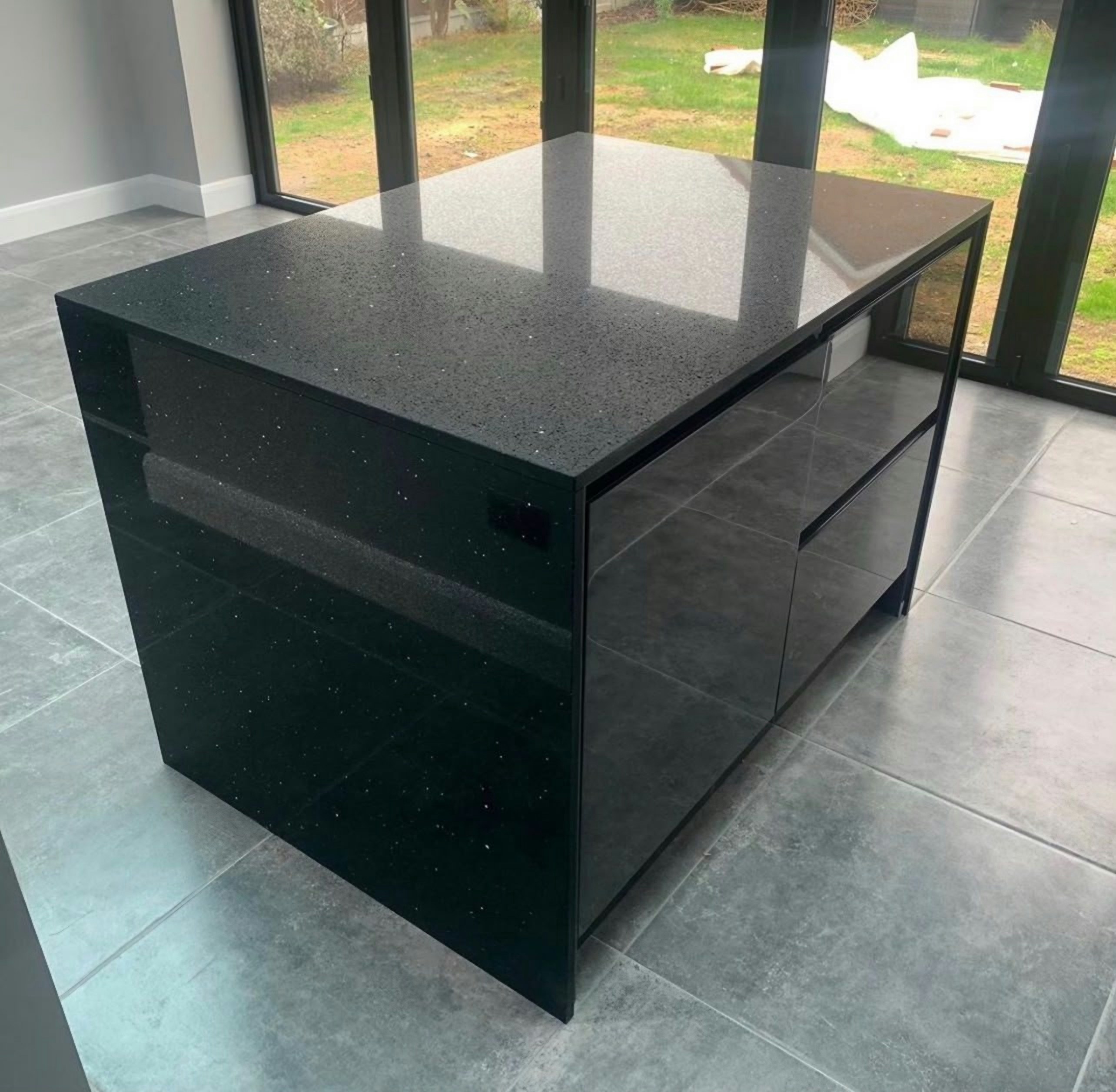
Black Sparkle quartz island with mitred sides, on a grey porcelain floor in front of garden doors
  • 5.0 from 35 Google reviews
  • 25-year material · 5-year workmanship
  • Fitted 5-10 working days from template

Get a fixed quote

Quartz, granite and Dekton worktops cut to size, mitred, polished and dry-assembled in our own workshop, with your sink and hob dry-fitted on the bench before a single piece is loaded onto the van. Then our own installers fit them.

The slab is laid out before it is cut

The template drawing arrives in the workshop and becomes a cutting plan drawn onto your actual slab. That step is called nesting, and it decides more about how the finished kitchen looks than the colour did. On a marble-effect quartz or a granite with real movement, nesting is what determines whether a vein runs across a join or stops dead at it.

Then the kitchen is built on the bench before it is built in your house. Runs are laid out together, joins pulled up tight, the sink dropped in and the hob offered up. Anything wrong is found there, where it costs an hour and a new cut, rather than in your kitchen where it costs a day, a slab and a fitting date.

Everything is machined to the template drawing, not to the plan and not to a tape measure taken on the day. This is the whole reason templating happens after the units are in.

Fitted 5–10 working days from template. The payment stages are set out on your quote.

Where
Our own workshop
Cut to
The signed-off template drawing
Dry-fitted
Sink and hob, before dispatch
Finished joins
Typically 2–3mm, sanded flush

Get a fixed quote

What is involved

What happens between template and fitting day

Six operations, and all of them happen before your 5 to 10 working days are up.

  1. Layout

    Nesting the pieces on your slab

    Your runs are positioned on the slab so the pattern falls where you want it. On materials with directional movement we lay pieces out so the vein continues through a join wherever the template allows it.

  2. Machine

    Cutting to the template drawing

    Runs, returns, islands and all apertures cut from the digital template. Every dimension traces back to the room, not to a measurement anyone wrote down twice.

  3. Bench

    Mitring and edge work

    A mitred edge builds a thick, solid-looking edge out of a thinner slab by cutting two pieces at forty-five degrees and bonding them. Done properly the joint disappears into the corner. Done badly it is a dark line down the front of your kitchen.

  4. Machine

    Cut-outs, drainer grooves and holes

    Sink aperture, tap holes, hob, sockets and any drainer grooves, each machined to the physical item you supplied at template.

  5. Quality check

    Dry assembly and dry-fitting

    The kitchen is assembled on the bench, joins pulled up, and your sink and hob dropped into their apertures to prove the fit before anything leaves the building.

  6. Dispatch

    Final polish, protect and load

    Exposed edges and arrises polished to match the factory face, everything checked over, then protected and labelled by run for the fitting team.

Joins

Why the joins go where they go

A join nobody explained beforehand is easy to be unhappy about, so this is where they go and why.

Long runs need a join. There is no way round it

Slabs are manufactured and quarried in fixed sizes. A four metre run is not one piece of stone in any material we sell, at any price. Anyone implying otherwise is describing a kitchen they are not going to fit.

A join needs a cabinet underneath it

We place joins over a unit gable so there is something structural directly beneath. A join spanning an unsupported gap is the point the worktop will eventually fail at, which is why we will not put one there to save a cut.

Never through a cut-out

A join running through a sink or hob aperture is the weakest geometry in the whole worktop. On a corner run we would rather bring the join to the internal corner, where the eye reads it as part of the shape of the room.

Two to three millimetres, sanded flush

A finished join is typically two to three millimetres wide, filled with a colour-matched adhesive, then sanded and polished flush so you feel nothing at all when you run a hand across it.

It will be visible if you look for it

In quartz, granite or sintered stone, an invisible join does not exist. What we control is where you have to look. Anybody promising you an invisible join is promising something the material does not do.

You agree the positions before we cut

Join positions are shown to you and signed off at template. They are not decided in the workshop and revealed on fitting day.

Supply cost

Workshop work is itemised; the slab is priced by area

Cutting, mitring, cut-outs and polishing are itemised on your quote, because they answer to the pieces and the apertures rather than to area. The slab is the part priced by the square metre, and every colour page sets it against five kitchen layouts, supply only.

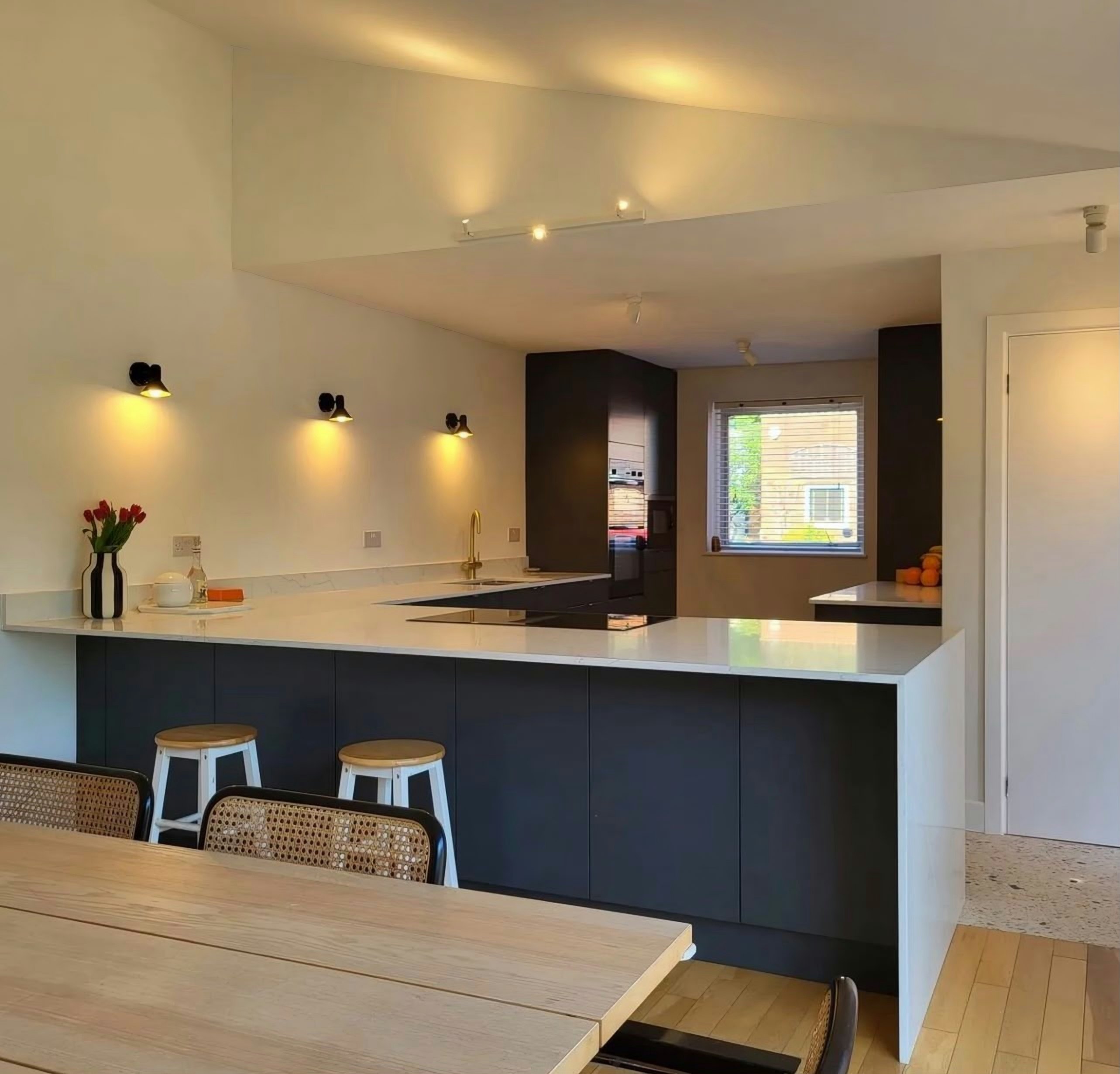
The Alaska peninsula seen from the dining table, stools tucked under the overhang and tall charcoal units behind

Cut to size

Quartz and granite worktops cut to size, to a template we took

Cut to size means cut to your room, not to a list of measurements. Every piece we machine comes off a template taken in the kitchen once the units are fixed and level, so the back edge, the returns, the sink and the hob are set out from the real walls and the real appliances. A dimension that has been written down twice is a dimension that can be wrong twice.

We cut and fit; we do not sell cut stone for somebody else to install. Stone is heavy, brittle across an unsupported cut-out and unforgiving of a carcass that is out of level, so the fabrication drawing and the fitting day belong to the same people. If you are after a laminate or wood worktop cut to length for DIY fitting, that is a different trade from this one. What we offer is the slab, the workshop and the fit, from £110/m² for the stone, across the 185 surfaces we supply.

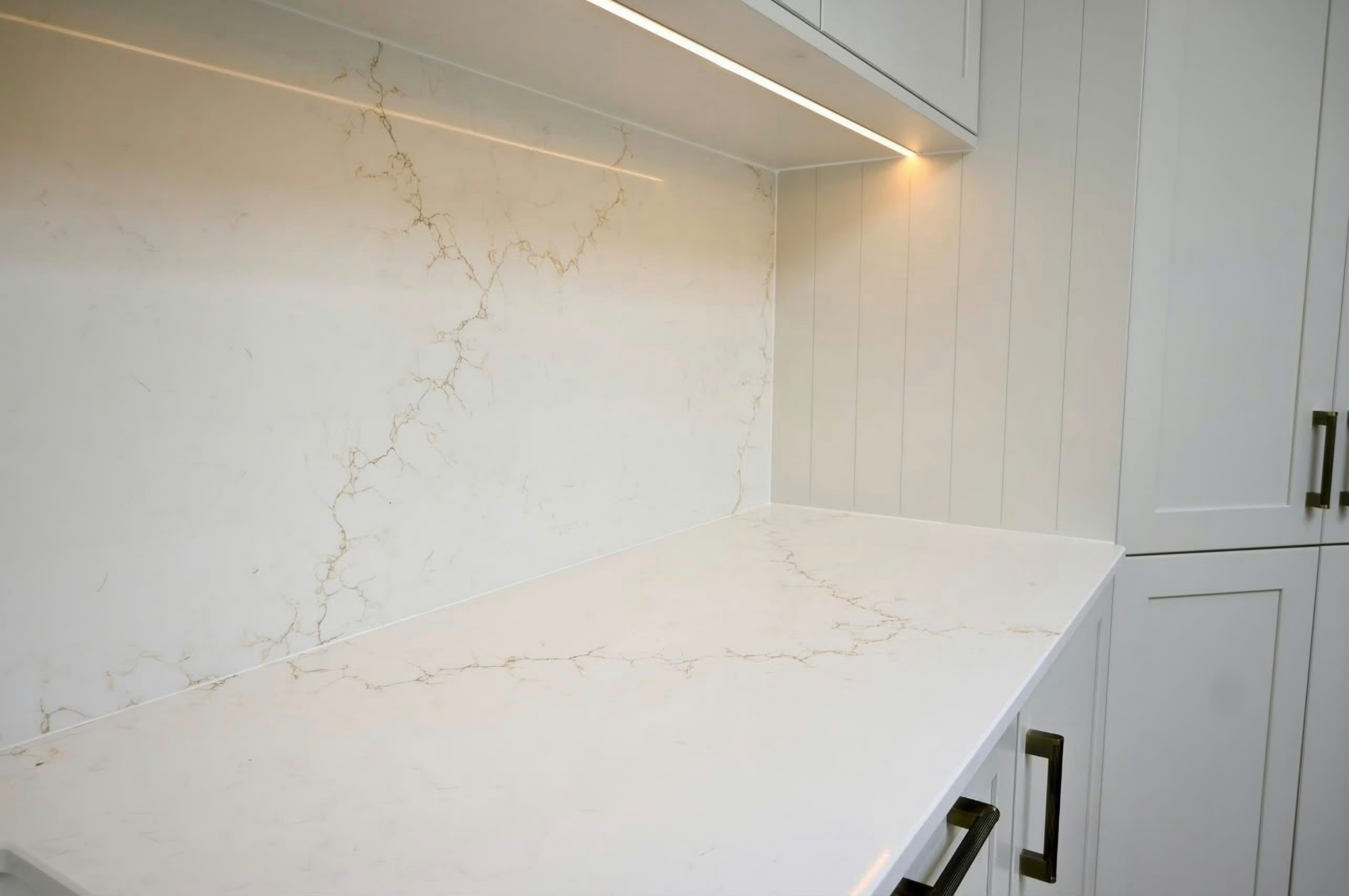
Aurora Gold worktop meeting its splashback in the corner beside a tall housing, lit by an LED strip under the wall units

The workshop stage

What we control, and what the stone decides

Being honest about the second list is what stops a disappointing handover.

What we do at this stage

  • Lay out your pieces on the slab for pattern and vein before cutting
  • Machine every cut-out to the physical sink, tap and hob you supplied
  • Mitre and polish exposed edges and arrises so nothing is left sharp
  • Dry-assemble the runs and dry-fit the sink and hob on the bench
  • Cut upstands and splashbacks from the same slab run, if they were ordered with the worktop
  • Protect and label each piece by run so fitting day is not a puzzle

What cannot be changed here

  • Once a slab is cut, it is cut: a specification change after template means new material
  • Natural granite varies from slab to slab, so no two kitchens are identical even in the same colour
  • Engineered surfaces vary between manufacturing batches, which is why matching pieces are cut together
  • We do not modify the stone on site beyond scribing and fine-fitting on fitting day

Questions

Fabrication: the questions worth asking

If yours is not here, ring and ask. You will get a straight answer rather than a call-back from a salesperson.

01

Can you make the joins invisible?

No, and nobody can. A well-made join in stone is two to three millimetres, filled with colour-matched adhesive and sanded flush so it is smooth to the touch. What we do is place it where you are not looking and agree that position with you at template.

02

How many joins will my kitchen have?

It depends on your run lengths and the slab size of the material you chose. We give you the likely number at quotation and confirm the exact positions with you during the template visit.

03

Can the pattern be matched across a join?

On materials with directional veining, usually yes. Your pieces are laid out on the slab so the vein continues through the join wherever the template geometry allows. On heavily patterned granite there is a limit to how far it can be carried, and we will tell you where that limit is.

04

Why dry-assemble it in the workshop first?

Because it moves the surprise from your kitchen to our bench. A cut-out a couple of millimetres tight is a fifteen minute fix in the workshop. Discovered on fitting day it costs everybody a day and possibly a slab.

05

Can you cut a quartz worktop to size for me to fit myself?

No. We cut to a template we have taken in the room and our own installers fit what we cut, because the two halves of the job answer to each other: a cut-out set out on site is machined in the workshop and seated on fitting day by the same team. We do not sell stone cut to supplied measurements for somebody else to install.

06

How long does fabrication take?

It sits inside the 5 to 10 working days between the template visit and fitting day. Nesting, cutting, edge work, cut-outs and the dry assembly all happen in that window, so the date you are given at template already allows for it.

Where this happens

Fabrication in your part of London

Twelve neighbourhoods whose housing stock asks for this job most often. Each has its own page: the housing, getting stone into the room, and what the stone costs there.

These twelve are a sample, not a coverage boundary. We work in 723 Greater London neighbourhoods and out into Surrey, Hertfordshire, Buckinghamshire, Berkshire and Essex.

Worth reading

Before you book fabrication

The questions that come up most, answered in full rather than in a sentence.

Where the joins go, and whether you will see them

Why joins exist, what decides how many you get, where a good one belongs, and the honest truth about how visible a join is in quartz, granite and sintered stone.

Read the guide

Standard heights, depths and thicknesses

In most UK kitchens the worktop surface sits around 900mm from the floor and finishes 600mm to 650mm deep on standard 600mm base units. Stone tops are usually 20mm or 30mm thick, and the longest single piece is capped by the slab rather than by a standard length.

Read the guide

A window sill cut with the worktop

The best stone for an internal window sill is usually the one your worktop is made of, cut from the same batch at the same template visit. Quartz suits most kitchens and bathrooms, granite suits a sill you will seal, and a notched sill sits neatly inside the reveal.

Read the guide

What an island does to the worktop

Why an island is a slab-yield question before it is a design one, how book-matching and waterfall ends are won or lost at slab selection, and what has to be decided before the cabinetry is fixed.

Read the guide

How far a breakfast bar can overhang

How overhangs actually work, why knee room is measured from the cabinet rather than the stone, what decides a safe unsupported span, and the support options ranked by what each costs you visually.

Read the guide

Why a small kitchen costs what it does

A small kitchen does not cost proportionally less than a big one, and knowing why is the difference between a good decision and a disappointing quote. Where the money really goes in a compact room, where you genuinely save, and what to prioritise.

Read the guide

5.0 from 35 Google reviews

Every one of these is on our Google profile under the reviewer’s own name. Nothing here is written by us, and the link goes straight to the source.

Read all 35   See them on Google

Count as read from Google on 13 November 2026

★★★★★
“I absolutely love my new worktop! 😍 The quality is amazing, and I couldn’t be happier with how everything has turned out. A huge thank you to the Worktop Works team for being so helpful throughout the process. They took the time to listen to all my questions, gave me fantastic advice, and helped me make the right decisions. Their prices are also…”
Sindy ReyesGoogle review
★★★★★
“Professional, polite and friendly service. Very pleased with finished product.”
costas andrewsGoogle review
★★★★★
“We recently had our kitchen worktops supplied and fitted by Worktop WorX using Laurent Gold sintered stone, and we couldn’t be happier with the result. The finish, quality, and attention to detail were outstanding from start to finish. Karem was incredibly helpful throughout the whole process professional, knowledgeable, and always available to answer…”
Gabriel TivadarGoogle review · Laurent Gold sintered stone
★★★★★
“Absolutely delighted with our new worktop from Worktop WorX. The Capri White finish looks incredible, clean, modern, and really brightens up the whole kitchen while pairing beautifully with the darker cabinetry. The quality of the worktop is outstanding, with a flawless finish and seamless installation that really shows the attention to detail. It’s not…”
Dawid MyszorGoogle review · Capri White
★★★★★
“I recently had my kitchen worktop and splashback done by Karem from Worktop WorX and i am very pleased with the result. From the initial consultation and measurements to the final installation, the whole process was smooth and professional. The attention for details and the quality made the difference and everything was finished to a high standard. I…”
Alexandru BalintGoogle review
★★★★★
“We recently had a Calacatta Gold worktop installed by Worktop Worx and are really pleased with the result. It has completely transformed our kitchen, much brighter, modern, and high-end compared to our old wooden surface. The team were professional, efficient, and the finish is excellent with great attention to detail. The worktop looks amazing and is…”
RO74 TVXGoogle review · Calacatta Gold

9 of our 35 Google reviews name Karem, who owns and runs Worktop Worx.

Next step

Send us the kitchen and we will price it properly

Plans, a sketch or photographs with rough run lengths is enough to start. The quote costs nothing.

Get a fixed quote