Behind the hob
The most common glass splashback: one panel from the worktop to the extractor, where splashes and steam land every day. Toughened glass takes the heat of a hob, and behind a gas hob the gap the hob maker asks for is kept.

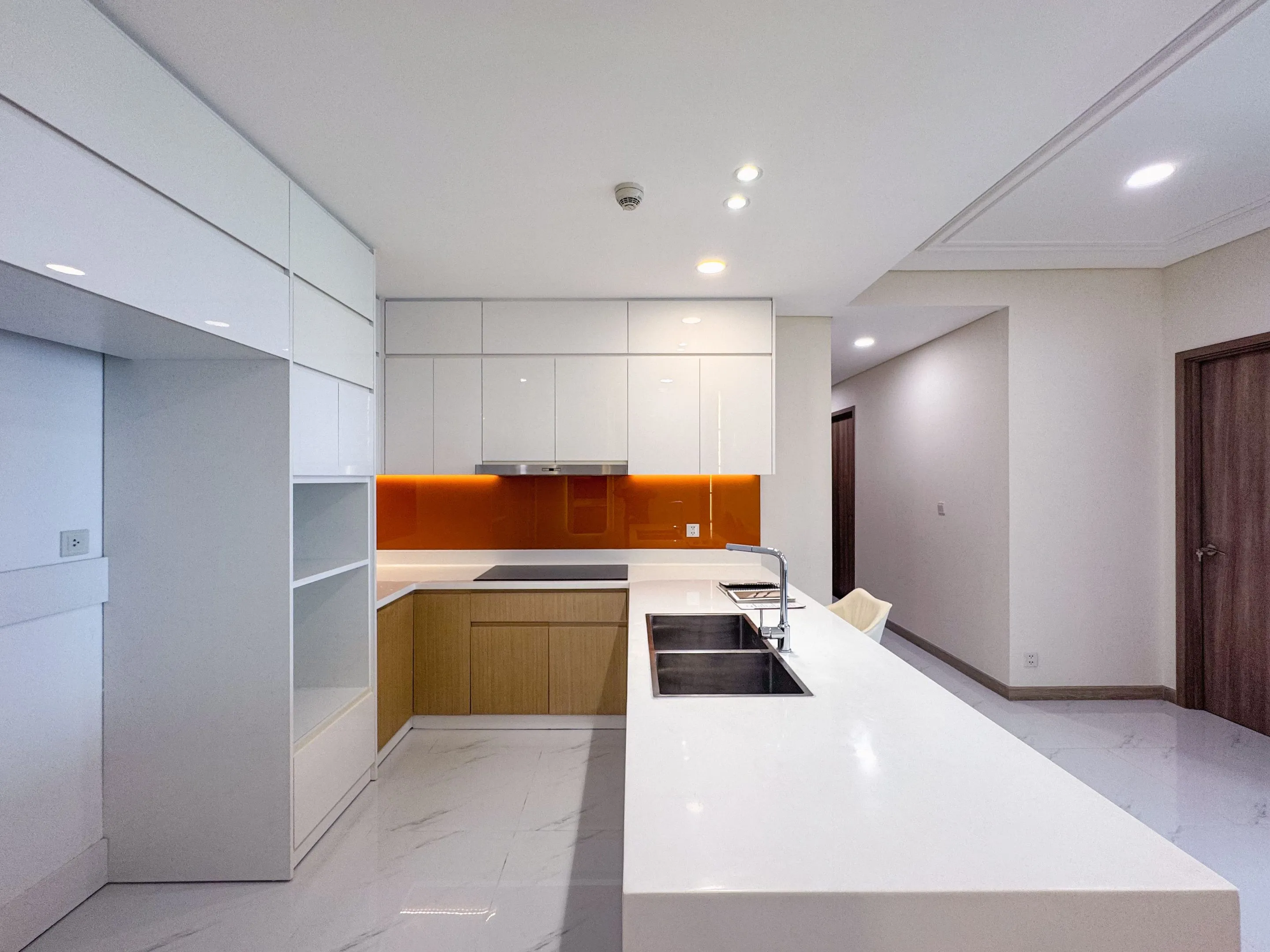
Plain colour glass splashbacks in 6mm toughened safety glass, back-painted in one of twenty colours, each with our own code and the RAL colour it is painted to. Templated once the worktop is down, with every socket and switch cut out before the glass is toughened, then fitted to the wall in as few sheets as the wall allows.
The colour range
Every colour has our code, which is what goes on your quote, and the RAL colour the glass is painted to, which is what the glass maker works from. Not in the twenty? Send us any RAL number and we will check it with the glass maker.
The core of the range, and the colours most kitchens choose.
Warm neutrals for oak, cream and painted shaker kitchens.
From the palest grey to anthracite, for handleless and modern kitchens.
Deep, glossy and dramatic, especially behind a hob.
For a kitchen that should have one strong colour in it.
A glass splashback is a sheet of toughened glass with the colour painted on the back, bonded flat to the wall. From the front you see colour behind a polished glass face: no grout lines, no tile joints, and a surface that wipes clean in one pass, which is the reason most people choose it for the wall behind a hob.
Toughened glass cannot be cut or drilled once it has been toughened. Every socket, switch and edge is therefore measured on site and cut while the glass is still ordinary glass, then it is toughened to size. That is why a glass splashback is templated after the worktop is fitted, and why the sockets have to be where they will stay before we measure.
Glass also goes well with stone. A quartz or granite worktop with a coloured glass splashback above it puts colour in a kitchen where the worktop stays quiet, and the wall behind the hob is one sheet with nothing to scrub.
Made to order once the wall is templated. The timing and the payment stages are set out on your quote.
Where it goes
The same glass for different walls. The position decides how many sheets, how many cut-outs and which colour works.
The most common glass splashback: one panel from the worktop to the extractor, where splashes and steam land every day. Toughened glass takes the heat of a hob, and behind a gas hob the gap the hob maker asks for is kept.
Glass from the worktop to the underside of the wall units along the whole kitchen. Long walls are made in more than one sheet, with the joins placed where they are least seen, usually at a corner, an appliance or the edge of a window.
Glass can run up to a window reveal and stop cleanly at it, or return along the sill. Each return and edge is templated, because a window is rarely square to the worktop below it.
A wipe-clean wall behind a sink and a worktop, in a colour that suits a room you would not tile carefully. The same glass and the same templating as the kitchen.
Behind a basin or along a vanity, where water sits on the wall. Pair it with a stone vanity top from our bathroom worktops page, and the glass takes the wall above.
A low upstand in the worktop stone, with the glass above it, is a common mix. The stone takes the junction with the worktop, and the glass gives the colour. The stone side is on our stone splashbacks and upstands page.
What is involved
Glass is measured last and cut first, because a toughened sheet cannot be altered on site.
Pick from the twenty, or give us a RAL number. Tell us where the glass goes and which hob sits in front of it, because that settles the clearance and the number of sheets.
The worktop goes in first, because the glass sits on it. The wall is plastered flat and dry, and the electrician has put every socket and switch where it will stay.
We measure the wall as built: its height above the worktop, every socket and switch, the window reveal and any corner that is out of square.
The glass is cut to the template, every cut-out made and the edges polished while it can still be worked, then it is toughened and painted on the back in your colour.
Bonded flat to the wall with an adhesive made for painted glass, the sockets refitted over their cut-outs, and the joint with the worktop sealed with silicone.
The parts that decide it
A sheet of glass looks simple. The care is in the measuring and in the wall behind it.
Toughened glass is several times stronger than ordinary glass and, if it ever breaks, it breaks into small blunt pieces rather than shards. It is the only glass we fit behind a hob.
Once toughened, the glass cannot be trimmed or drilled. A socket moved after the template means a new sheet, which is why the wall and the electrics are finished before we measure.
Ordinary glass has a slight green tint that shows most through whites, creams and pale greys. Low-iron glass is clearer, so a white stays white. We recommend it for the pale colours.
Glass is bonded flat, so a wall that bows or has lumps shows as a ripple in the reflection. The wall needs to be flat, sound and dry. Old tiles can stay only if they are flat and firmly fixed, which we check at template.
A long wall is made in more than one sheet. Joins are placed at a corner, an appliance or a window edge wherever the wall allows, and every join is a straight, polished edge.
A plain colour picks up one tone from the worktop: a warm white with a cream quartz, an anthracite with a black granite. Bring the worktop name, or a sample, and we will suggest colours from the range.
It happens: the electrician moves a socket, or a new extractor arrives with a different outline. Toughened glass cannot be cut on site, so a sheet whose cut-outs no longer line up has to be made again. Tell us before the glass goes into production and we re-measure. That is why we ask for the electrics to be finished, not planned, before we template.
Before we template
Most of the first list is the wall. Glass shows every fault behind it, so it has to be right first.
Questions
If yours is not here, ring and ask. You will get a straight answer rather than a call-back from a salesperson.
Our range is twenty plain colours in five families: whites, beige and greige, greys, black, and feature colours such as sage green, navy and terracotta. Each has our own code (GWX-001 to GWX-020) and a RAL number. If the colour you want is not in the range, send us its RAL number and we will check it with the glass maker.
RAL is a standard colour system in which every colour has a four-digit number, such as RAL 9010 Pure white or RAL 7016 Anthracite grey. Glass makers paint to the number, so the colour you choose is the colour that is made. Each colour in our range shows its RAL number next to our code.
Yes. It is toughened glass, which takes the heat of a hob, and behind the hob is where most glass splashbacks go. Behind a gas hob, the hob maker sets the gap between the burners and the wall, and we keep to it.
6mm toughened safety glass, painted on the back. It is thin enough to sit neatly on the worktop and strong enough for the wall behind a hob.
Yes, but only before the glass is toughened, which is why we template the wall with every socket and switch in its final place. Toughened glass cannot be cut or drilled afterwards, so a socket moved after the template means a new sheet.
Sometimes. Glass is bonded flat, so the surface behind it must be flat and sound. Old tiles that are flat and firmly fixed can stay; loose, uneven or heavily textured tiles have to come off first, and that work is not ours. We check it at template.
Very well. Many kitchens have a quartz or granite worktop with a plain glass splashback above it, often over a low upstand in the worktop stone. Bring the worktop name or a sample and we will suggest colours from the range that pick up its tone.
Each one is quoted for your wall: its size, the number of sheets and cut-outs, the colour, and whether it is low-iron glass. Send us the measurements, or photographs with rough sizes, and we will send a written quote.
Where we work
We template and fit across Greater London and out into Essex, Hertfordshire, Surrey, Buckinghamshire and Berkshire. The glass is made to your template and fitted by our own installers, wherever the job is.
Next
Every job runs through more than one of these. Follow the thread rather than guessing which order things go in.
Cut from the same slab run as your worktop, so the match is real.
Read the detailFitted by our own installers, scribed, joined, sealed and cleaned down.
Read the detailVanity tops, shelves and window returns, cut to bathroom depths.
Not sure where you are in the process?
Worth reading
A stone upstand under the glass, or stone instead of it: the two guides on stone at the wall.
A slim stone upstand, a full-height stone splashback or tiles. What genuinely differs between them, why the grout line is the real reason people move to stone, and where tiling is still the better answer.
Read the guideA kitchen upstand is a low strip of the worktop stone, commonly around 100mm high, standing on the worktop against the wall. It is cut from the same slab, siliconed to the worktop rather than grouted, and priced by the linear metre, with tiles or paint above it.
Read the guideEvery one of these is on our Google profile under the reviewer’s own name. Nothing here is written by us, and the link goes straight to the source.
Read all 26 See them on Google
Count as read from Google on 4 September 2026
“I am really happy with the work! He fitted my kitchen granite worktop really nicely and got the job done on time, just as promised. He was friendly, professional, and made sure everything was done the way I wanted. Would definitely recommend Karam to anyone looking for a great job!”
“We recently had our kitchen worktops supplied and fitted by Worktop WorX using Laurent Gold sintered stone, and we couldn’t be happier with the result. The finish, quality, and attention to detail were outstanding from start to finish. Karem was incredibly helpful throughout the whole process professional, knowledgeable, and always available to answer…”
“We have a new kitchen. Our builder recommended Worktop Worx for our worktop. Now we have an amazing worktop very good price too. Really recommend. They were really good to us. 10/10”
“I used Karem’s services 5 years ago for purchasing and fitting the quartz worktop in my then brand new kitchen. The price was reasonable and the service reliable and spot on, no delays in fitting, misunderstanding or excuses. I recommended him to a friend, who also used his services and they were happy too! If I need to order new kitchen work top again,…”
“Absolutely delighted with our new worktop from Worktop WorX. The Capri White finish looks incredible, clean, modern, and really brightens up the whole kitchen while pairing beautifully with the darker cabinetry. The quality of the worktop is outstanding, with a flawless finish and seamless installation that really shows the attention to detail. It’s not…”
“Kareem did the countertops dur8ng my kitchen remodel, and I was so impressed that I had him back to do the laundry room as well, which tells you everything you need to know. He is an absolute gem. Shows up when he says he will (which, let’s be honest, is rarer than it should be), does beautifully work, and clearly takes real pride in what he does. The…”
8 of our 26 Google reviews name Karem, who owns and runs Worktop Worx.
Next step
The colour you like, rough sizes of the wall and photographs showing the sockets and the hob are enough to start. The quote costs nothing.
Free, no obligation
Your details and the wall. A person reads every request and sends a written quote for the glass.
Received
We read every request ourselves and reply with any questions about the wall, then a written quote for the glass.
Look through the twenty colours while you wait