Bar top
The serving surface: the piece people lean on, set drinks on and sit at. Usually one long piece with a profiled front edge and, past about 300mm of overhang, steel or corbels beneath it.

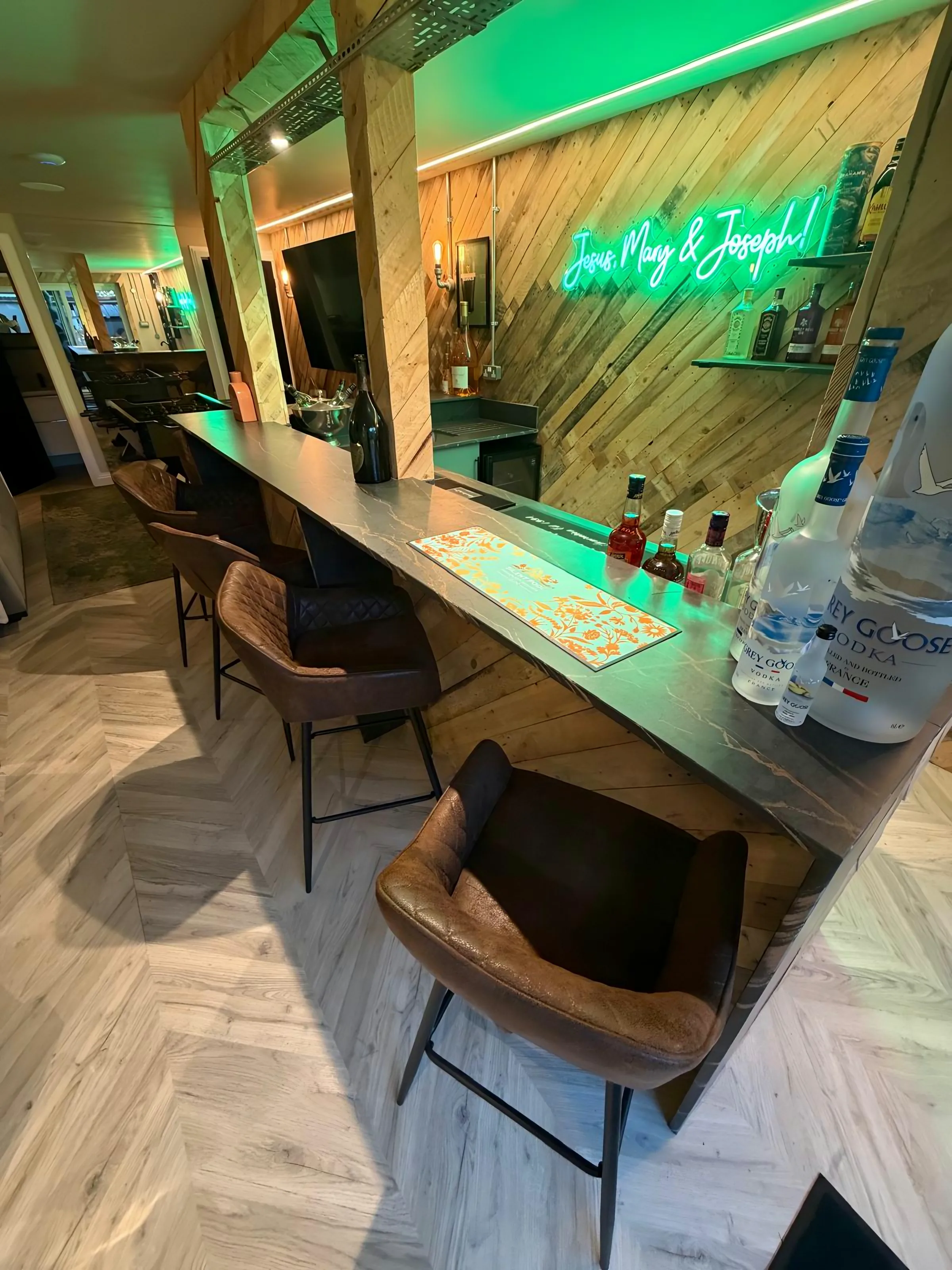
A stone bar top (or bar counter top) is a worktop cut for a bar: quartz, granite, Dekton or other sintered stone, supplied from £110/m² (stone only), templated on the built bar and fitted across London by our own team. The overhang and what carries it matter more than the slab, so that is settled first.
People lean on a bar. They rest their forearms on the front edge, push themselves up off it and sit at it for hours. An unsupported nose that would be perfectly fine on a kitchen island, where nobody applies real force to it, is not fine on something a room full of people pushes against all evening.
So the first conversation is about what sits underneath. Anything past roughly 300mm of unsupported overhang gets steel flat bar or corbels beneath it, let into the carcass rather than screwed onto the face of it. That is a joinery decision as much as a stone one, and it is far cheaper to take before the carcass is built.
The second conversation is about the front edge, because it is the one part of the job everybody in the room touches. It is profiled and polished on every exposed face, including the underside where a knuckle finds it.
Fitted 5–10 working days from template. The payment stages are set out on your quote.
Which bar
Overlapping names for different pieces of stone. Each one changes what the stone has to do.
The serving surface: the piece people lean on, set drinks on and sit at. Usually one long piece with a profiled front edge and, past about 300mm of overhang, steel or corbels beneath it.
The working surface behind the bar, where drinks are made. It sits on base units like a kitchen worktop and takes a sink or ice well, wet glasses and acidic spills, so the material is chosen for what gets spilled rather than what gets leant on.
A bar at counter height, where serving and working happen on one level. One piece, simpler to fabricate, and the overhang is the same question as on breakfast bar worktops.
A bar in a basement, a garden room or a kitchen-diner. The stone questions are the same as on a trade bar, with less wear and more attention to matching the kitchen. It is a residential installation, so the residential material warranty applies.
Quartz is not one for outside. Under open sky, a resin-free sintered stone is the family to look at. If the bar is going outside, say so when you ask for a quote: it narrows the material before colour does, and we will tell you plainly whether it is a job we can take on.
Same slab, same saw and same fitters as a home bar. What differs is the sequencing around other trades and the warranty: in a business, the stone is covered by the maker's commercial warranty rather than the residential one.
Choosing the stone
Supply rates are read from our catalogue and cover the stone only. Fabrication, edges, cut-outs and fitting are quoted as their own lines.
| Material | Colours | Supply from | On a bar |
|---|---|---|---|
| Quartz | 69 | £130/m² | Indoor home bars. No sealing, the widest colour range, and copes with spills in normal use. Anything hot wants a mat. |
| Granite | 45 | £121/m² | A bar that should read as natural stone. Tolerates heat; porous, so it is sealed before use and resealed periodically, which a busy bar can forget. |
| Dekton | 63 | £110/m² | Trade bars where citrus, wine and strong cleaners are constant, and bars in direct sun. No sealing. Brittle where unsupported, so it needs more beneath it, not less. |
| Sintered stone | 8 | £280/m² | Our own sintered stone range. No sealing, copes with acidic spills better than quartz and is stable in sun; like any sintered slab, it is supported properly at the overhang. |
Free samples are posted from the Worktop Worx quartz collection, up to four at a time. Other quartz, granite and sintered stone are judged from the slab.
What is involved
The order matters more here than on a kitchen, because the support has to exist before the stone does.
Tell us the finished overhang you want and we will tell you what has to carry it. Deciding this after the joinery is built is how people end up with corbels bolted onto a finished panel that was never meant to show them.
Quartz suits most indoor bars. Where citrus, wine and strong cleaning products are constant, sintered stone takes it better. That is a difference in behaviour rather than a price tier.
Taken once the carcass is fixed and any support steel is in, not from the drawing. A bar is usually the only thing in the room that is not against a wall, so its geometry answers to nothing but itself.
The front edge and both returns are profiled and polished. A mitred edge builds a thicker looking nose out of a thinner slab, which gives a bar visual weight without making the top impossible to carry in.
The top is set level across its own length rather than parallel to the floor, because floors in older buildings rarely are, and a drink finds the fall long before a spirit level does.
The parts that decide it
A bar is not a worktop with stools at it. These are the differences that change the specification.
Past roughly 300mm of unsupported overhang, the stone is a cantilever with people applying force to the end of it. Steel flat bar let into the carcass is the usual answer and corbels are the visible one. Either is cheaper than the piece that fails.
Belt buckles, watches, glasses set down hard and elbows, all night. A heavier profile with a proper radius survives that better than a sharp arris, which chips at the first knock and then shows it forever, because it is exactly at eye level.
Lime, lemon, wine and a good many bar cleaning products are acidic. Quartz copes well in normal use. Sintered stone copes better, which is why it is the sensible choice behind a trade bar where nothing gets wiped up quickly.
Many bars have a serving level and a lower back counter, or a raised drinking rail behind the working surface. Each is its own piece, and the return that connects them is where the fabrication drawing stops being simple.
A bar is fitted level to itself. If the floor falls away over three metres, the gap under the bar changes along its length, and that is far better known at template than discovered when the plinth is being cut.
In a home, the stone carries our 25-year material warranty, which is written for residential installations. In a business, the stone is covered by the maker's commercial warranty instead, and our 5-year workmanship guarantee covers the fitting either way. Which applies is stated on your quote.
If the joinery is already in and the overhang turns out to be 450mm with nothing under it, there are three ways out of that and none of them is free: add corbels, which are visible; let steel into the carcass, which means opening it up again; or reduce the overhang, which changes how the bar is used. We will tell you which we think suits the room. What we will not do is fit an unsupported nose and call it finished, because the piece that cracks is the one somebody leant on.
Before we template
Most of the first list belongs to the joiner. It is on this page because the stone cannot fix any of it.
Questions
If yours is not here, ring and ask. You will get a straight answer rather than a call-back from a salesperson.
Quartz for most home bars: hard, no sealing, and the widest colour range. Sintered stone where citrus, wine and strong cleaners are constant, which usually means a trade bar, or where the bar sits in direct sun. Granite works as well, but it wants sealing, and a bar is not a surface anyone remembers to seal.
Stone is priced by the square metre, from £110 to £550 across the surfaces we hold. A bar top 2.4m long and 0.6m deep is 1.44m², so at the quartz entry rate of £130/m² the stone alone is about £187. Fabrication, the edge profile, any cut-outs and fitting are quoted as their own lines.
Around 300mm unsupported is the sensible working limit, and less than that on a 20mm slab rather than a 30mm one. Past it the top needs steel or corbels underneath. Nobody enjoys hearing that once the joinery is finished, which is why we ask about the overhang before anything else.
A bar top is the serving surface people lean on and sit at, so its overhang and front edge are the design problem. A bar worktop is the working surface behind it, on base units, where the sink and the spills are. They are often the same stone, cut as separate pieces at different heights.
Not in quartz, which is made with resin and is not one for outside. Sintered stone is the family to look at for a bar under open sky. Tell us at the quotation stage if the bar is outdoors, because it changes the material before anything else, and we will say plainly whether it is a job we can take on.
Ordered together, yes, from the same slab run. Ordered later, engineered stone will have changed batch and granite will be a different slab, so expect a close relative rather than a twin. Where the two are in different rooms that is usually fine. Where they touch, it is not.
Yes. It is the same slab, the same saw and the same fitters as a kitchen. What differs is the sequencing around other trades and the warranty: in a business, the stone is covered by the maker's commercial warranty and our 5-year workmanship guarantee covers the fitting, both stated on the quote.
Where we work
We template and fit across Greater London and out into Essex, Hertfordshire, Surrey, Buckinghamshire and Berkshire. The stone is cut in our workshop and fitted by our own installers, wherever the job is.

Next
Every job runs through more than one of these. Follow the thread rather than guessing which order things go in.
Island and peninsula tops with the seating overhang designed in.
Cut, profiled and drilled to the bases you already own.
Read the detailCounter tops with the transaction shelf and knee recess worked in.
Read the detailWorth reading
The questions that come up most, answered in full rather than in a sentence.
How overhangs actually work, why knee room is measured from the cabinet rather than the stone, what decides a safe unsupported span, and the support options ranked by what each costs you visually.
Read the guideThe edge is the part of the worktop you touch every day and the detail that dates a kitchen fastest. What the common profiles are, what each costs you in labour, and how to pick.
Read the guideSintered stone is a worktop slab made by pressing mineral powders under very high pressure and firing them until they fuse into one dense body, with no resin binding it. That is why nothing in it can scorch, it never needs sealing and it can be made thin.
Read the guideStains and etches look alike and need opposite treatments. How to tell them apart, what to do in the first minute, the poultice method properly explained, and what will make it permanently worse.
Read the guideWhy an island is a slab-yield question before it is a design one, how book-matching and waterfall ends are won or lost at slab selection, and what has to be decided before the cabinetry is fixed.
Read the guideBoth work under a stone worktop, so choose on looks and care. Stainless steel shrugs off a dropped pan and boiling water but shows water spots and fine scratches. A granite composite sink is a matt, solid colour that hides water marks and can match or contrast with the stone.
Read the guideOur own jobs, photographed on site.
Every one of these is on our Google profile under the reviewer’s own name. Nothing here is written by us, and the link goes straight to the source.
Read all 26 See them on Google
Count as read from Google on 4 September 2026
“We have a new kitchen. Our builder recommended Worktop Worx for our worktop. Now we have an amazing worktop very good price too. Really recommend. They were really good to us. 10/10”
“I used Karem’s services 5 years ago for purchasing and fitting the quartz worktop in my then brand new kitchen. The price was reasonable and the service reliable and spot on, no delays in fitting, misunderstanding or excuses. I recommended him to a friend, who also used his services and they were happy too! If I need to order new kitchen work top again,…”
“Absolutely delighted with our new worktop from Worktop WorX. The Capri White finish looks incredible, clean, modern, and really brightens up the whole kitchen while pairing beautifully with the darker cabinetry. The quality of the worktop is outstanding, with a flawless finish and seamless installation that really shows the attention to detail. It’s not…”
“Kareem did the countertops dur8ng my kitchen remodel, and I was so impressed that I had him back to do the laundry room as well, which tells you everything you need to know. He is an absolute gem. Shows up when he says he will (which, let’s be honest, is rarer than it should be), does beautifully work, and clearly takes real pride in what he does. The…”
“We recently had a Calacatta Gold worktop installed by Worktop Worx and are really pleased with the result. It has completely transformed our kitchen, much brighter, modern, and high-end compared to our old wooden surface. The team were professional, efficient, and the finish is excellent with great attention to detail. The worktop looks amazing and is…”
“We recently had the Arctic Starburst worktop installed by Worktop WorX and it looks amazing. The subtle sparkle really catches the light and gives the kitchen a clean, modern feel. The Arctic Starburst surface feels high quality, durable, and is easy to keep clean. The finish and installation from Worktop WorX were spot on. Really happy with the result…”
8 of our 26 Google reviews name Karem, who owns and runs Worktop Worx.
Next step
A joinery drawing, a sketch or photographs with rough dimensions is enough to start. The quote costs nothing.