Most sink advice is written by people who sell sinks, so it compares bowl depths and never mentions the worktop. That is the wrong way round. The sink decides how the stone is cut, how much of the cut-out gets polished by hand, what carries the weight, and whether the templater can work at all on the day. This is the same decision seen from the Worktop Worx workshop.
Key points
- Undermount gives the cleanest surface and costs the most, because the exposed cut edge must be polished
- Inset hides the cut edge and needs no polishing, at the price of a rim you wipe up to rather than through
- A Belfast must be installed and at its final height before templating, and it eats a lot of a short run
- Cut-out corners are radiused and polished; a square internal corner is where stone cracks
- The sink, tap and hob must be physically on site to template, and the carcass carries the weight, not the stone
01 / 13
The short version
An undermount sink is bonded beneath the stone, so the cut edge is exposed and has to be polished to match the top. It wipes the best and it is the most fabrication work of the three. An inset or drop-in hangs from a rim resting on the surface, which covers the cut edge, so nothing needs polishing and the cut-out is cheaper. A Belfast or butler is a deep ceramic bowl in its own unit, with the worktop cut to meet it.
For most stone kitchens the answer is undermount, and the real argument is about the reveal and the drainer. Inset earns its place on a budget or where you want the sink on show. A Belfast has consequences for the run it sits in, so decide it early.
One rule covers all three: the sink must be physically in your kitchen before we template. Not ordered. Not due Thursday. There.
02 / 13
Undermount: the bowl fixed beneath the stone
The bowl is clamped and bonded to the underside of the worktop, so the top reads as one plane with a hole in it and crumbs go straight into the bowl.
What it costs is finishing. You see and touch the cut edge all the way round the opening, so it is machined true and polished to match the top. On an inset cut-out nobody sees the sawn face, so nobody polishes it. That is why an undermount is a dearer line than an inset on the same quote: labour, not a surcharge for the word. That polished return is also where damage starts, since nearly every chip we are asked to look at is on a front edge or a sink cut-out lip.
03 / 13
Inset and drop-in: the rim sits on the surface
An inset sink drops into an opening slightly smaller than itself and hangs from its rim, which covers the cut edge, so the stone beneath can be left as a clean sawn face. Genuinely cheaper, and still a respectable way to fit a sink.
The trade-off is the rim. It stands proud by a few millimetres, so you wipe up to it rather than through it, and a line of grime collects along the seal. That is what people notice two years in, not the money saved at the start.
Inset is the sensible choice when
- The budget is tight and the difference is better spent on the material or the edge
- You have picked a sink with a rim you want visible, or a drainer pressed into it
- You want a drainer without paying for grooves milled into the stone
04 / 13
Belfast and butler: the worktop works around the bowl
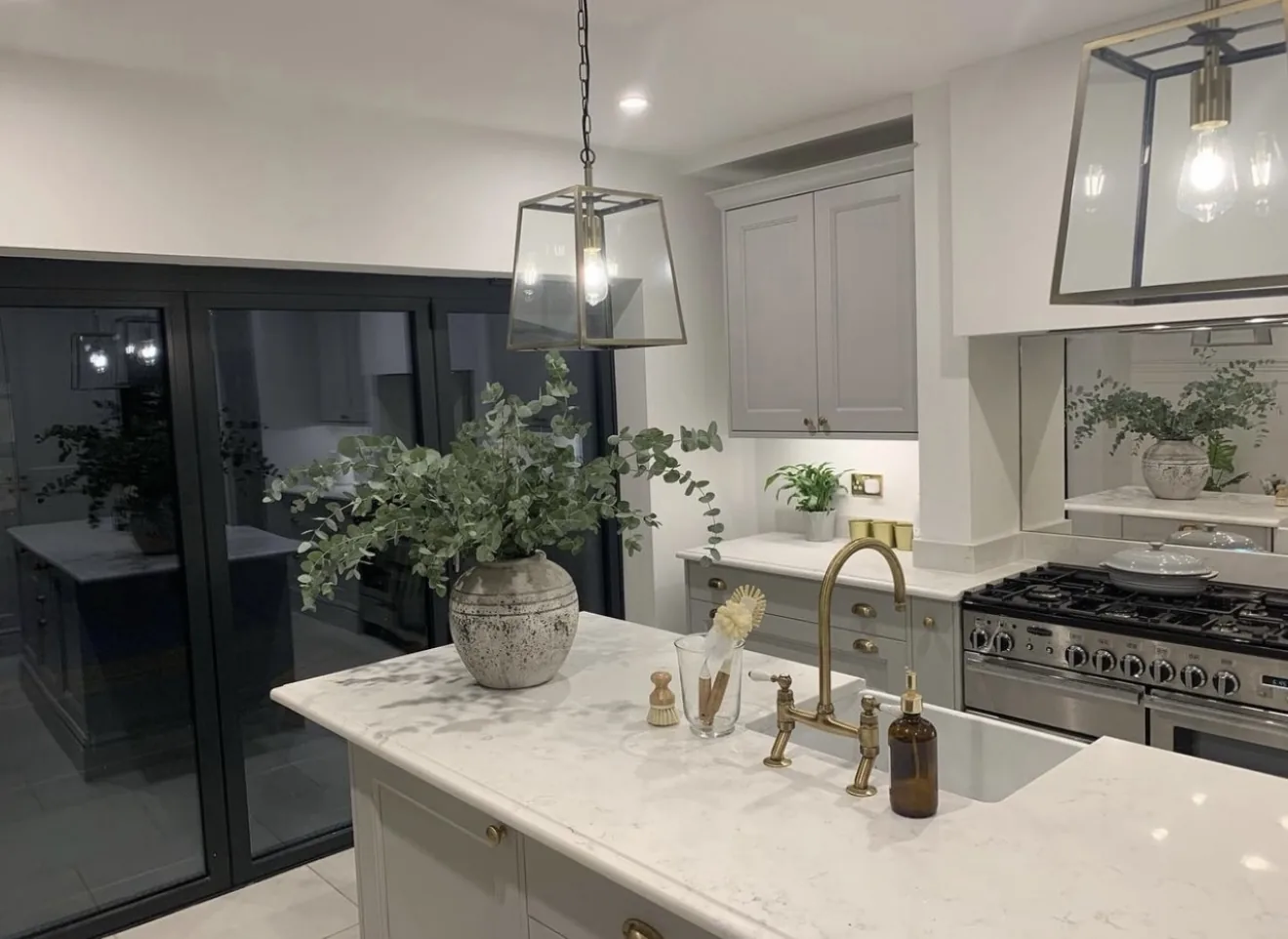
A Belfast is a large fireclay bowl sitting in its own unit with its front face exposed. The worktop neither carries it nor contains it: the stone is cut to meet it, finishing against the back and sides, or oversailing the rear edge so water runs in rather than behind.
That makes it the least forgiving to template. The bowl is a ceramic object with real dimensional variation, and its final height depends on how the unit was set, not on any drawing. So it must be installed at its final height before templating, and must not move afterwards. Lift the bowl 5mm on packers the week after the template and the stone no longer fits.
Be honest about the run, too. A Belfast bowl is wide, and in a compact galley it swallows most of a short length, leaving narrow tongues of stone either side of a large opening. That is the weakest arrangement in a kitchen: workable, but settle it at design stage.
05 / 13
The three compared on what the worktop has to do
| Compared | Undermount | Inset / drop-in | Belfast / butler |
|---|---|---|---|
| Where the bowl sits | Bonded under the stone | Rim rests on the stone | In its own unit, stone meets it |
| Cut edge visible | Yes, all the way round | No, hidden by the rim | Yes, on the edges facing the bowl |
| Polishing needed | Full polished return | None | Polished on the exposed edges |
| Fabrication cost | Highest of the three | Lowest | High, and least tolerant of error |
| Wiping crumbs in | Straight off the surface | The rim is in the way | Straight off the surface |
| What takes the weight | Carcass rails, not the stone | Its own rim | The carcass, always |
| On site to template | Yes | Yes | Yes, fully installed |
06 / 13
Why does the sink have to be on site before templating?
A template records the room as it actually is, taken once the units are fitted, fixed and level. Nothing is cut from a plan, and the same applies to the sink, tap and hob: their openings are set out from the objects themselves and the templates in their boxes. A model number is no substitute, because two sinks with the same catalogue name can differ in corner radius and flange depth.
On the bench your sink and hob are then dry-fitted into the cut stone before anything is loaded onto a van. A sink that arrives after the drawing is done has missed the one point at which a mistake is still cheap, and stone cut to the wrong opening is not adjustable on site.
07 / 13
Corners, radii and where stone actually cracks
Every internal corner of a cut-out concentrates stress, and a square one gives that stress a single point to gather at. That is where a crack starts, months later, with nobody having done anything to deserve it. So openings are machined with a radius at each internal corner, and those corners are polished rather than left sawn. It is also why a sink cut on site with an angle grinder is a bad idea.
It also governs how close an opening sits to a join. Joins go over a cabinet gable, never through a cut-out, and an opening near an edge may need extra support beneath it. If your sink and your join want the same 100mm of worktop, one of them moves, and it will not be the join.
08 / 13
Reveal: positive, flush and negative
On an undermount, the reveal is how the cut edge of the stone lines up with the inside wall of the bowl. It changes both the look and the cleaning.
- Positive: the stone stops short, leaving a band of rim visible inside the opening. Easiest to wipe, most forgiving of a bowl that is not quite square, and the most common
- Flush: the cut edge follows the inside of the bowl exactly, so stone and sink read as one line. The cleanest look and the least tolerant of error, because deviation shows along its whole length
- Negative: the stone oversails the bowl. Sharp, and it hides the rim entirely, but it leaves a lip with water running under it and you sweep crumbs over an unseen edge
In a busy kitchen we fit a positive reveal every time. Flush is worth the care on a showpiece island. Negative photographs superbly and is the one people most often regret.
09 / 13
Drainers: grooves, a separate drainer, or neither
Drainer grooves are milled into the top after the cut-out is machined, as shallow channels falling towards the bowl. That is machine time on top of the cut-out, so they are a separate priced item, cut deep enough to move water without weakening the slab.
They also need room: uninterrupted worktop to run across, and material in front to finish to. Where the sink sits close to a corner, an end or the hob there is often nowhere sensible for them, and forcing them in gives stubby channels. A rack over the bowl does the same job with no machining.
- Grooves are permanent: milled channels cannot be taken out again
- They collect limescale in hard-water areas and want pH-neutral cleaning
- Decide on them when you decide the edge profile, because the two interact
10 / 13
Support: what actually holds the sink up
A stone worktop is not a structural bracket. An undermounted bowl is bonded to the stone and also carried on rails or a cradle fixed into the base unit, so a full bowl and a stack of pans loads the carcass, not the edge of a cut-out. A heavy cast iron or fireclay bowl is usually no undermount candidate at all: it wants a unit built to take it.
Belfast bowls make that obvious, but it holds for every family: the carcass has to be sound. That is the usual thing to sort out before stone goes onto units that carried laminate, so if you are keeping your units, expect the conversation as part of a worktop replacement, not a surprise on fitting day.
11 / 13
Sealing at the sink, and who connects what
Water gets in at three places: under the front lip of an inset rim, down the joint between stone and the back of a Belfast bowl, and along the underside seal of an undermount. All three are siliconed, never grouted. Silicone stays flexible, and worktop, units and building all move slightly against each other; grout is rigid, it cracks, and a cracked seal puts water into the cabinet below.
Silicone is a consumable, so the bead discolours and eventually wants replacing. Look under the sink every few months, particularly on an undermount where the seal is invisible from above.
One thing we do not do, worth stating plainly: we seat and seal the sink and hob, and we do not connect water, waste, gas or electrics. On a replacement, a plumber disconnects the tap and waste before we arrive and reconnects at the end.
12 / 13
Which sink suits which material
All three families work with all three surfaces, so this is a question of degree. Quartz takes an undermount well and polishes to a fine cut-out edge; the usual caution about heat applies, which here means tipping boiling water into the bowl, not onto the stone. Granite is the most tolerant material round a sink, though beside the bowl is where the sealing water test belongs. Sintered stone is hard on tooling, so cut-outs and polished returns take longer to machine, which shows in labour rather than the slab.
Thickness changes how an undermount reads: on a 20mm top the polished return is a shallow band, on 30mm a deeper edge. Look at both in the colour you shortlisted from the colour library, because tone decides how much that band shows.
13 / 13
A recommendation by kitchen type
- Busy family kitchen with a run either side of the sink: deep undermount bowl, positive reveal, grooves if there is room
- Compact galley, or a short run between a corner and the hob: undermount bowl and a half, no grooves, a rack over the bowl
- Island sink as the showpiece: flush reveal, no grooves, and the tidiest fabrication on the job
- Traditional kitchen with a Belfast: keep it on a generous run, get the bowl levelled before the template, and check the carcass will carry it
- Rental, budget refit, or a sink you are keeping: inset, and put the money into the material instead