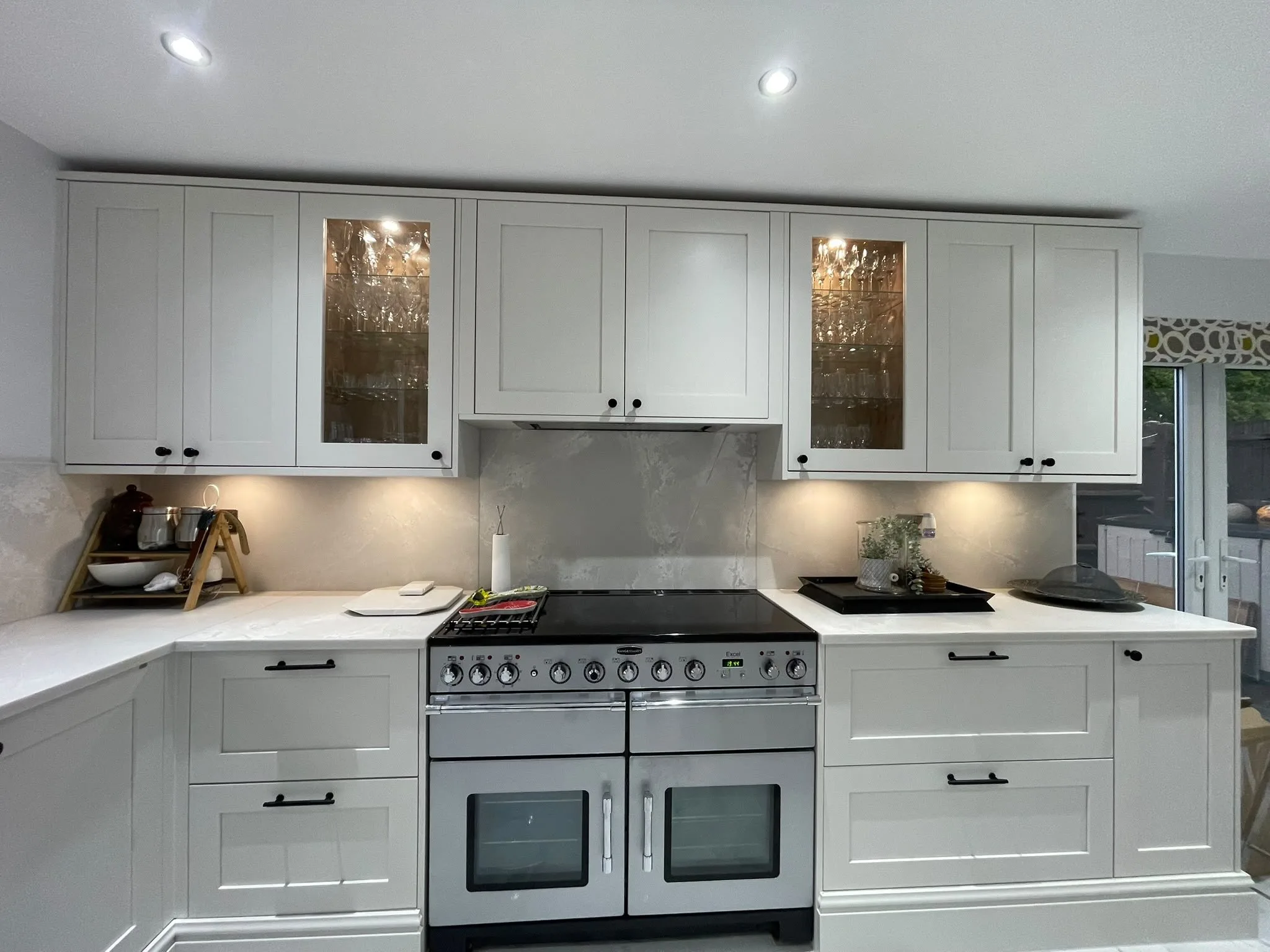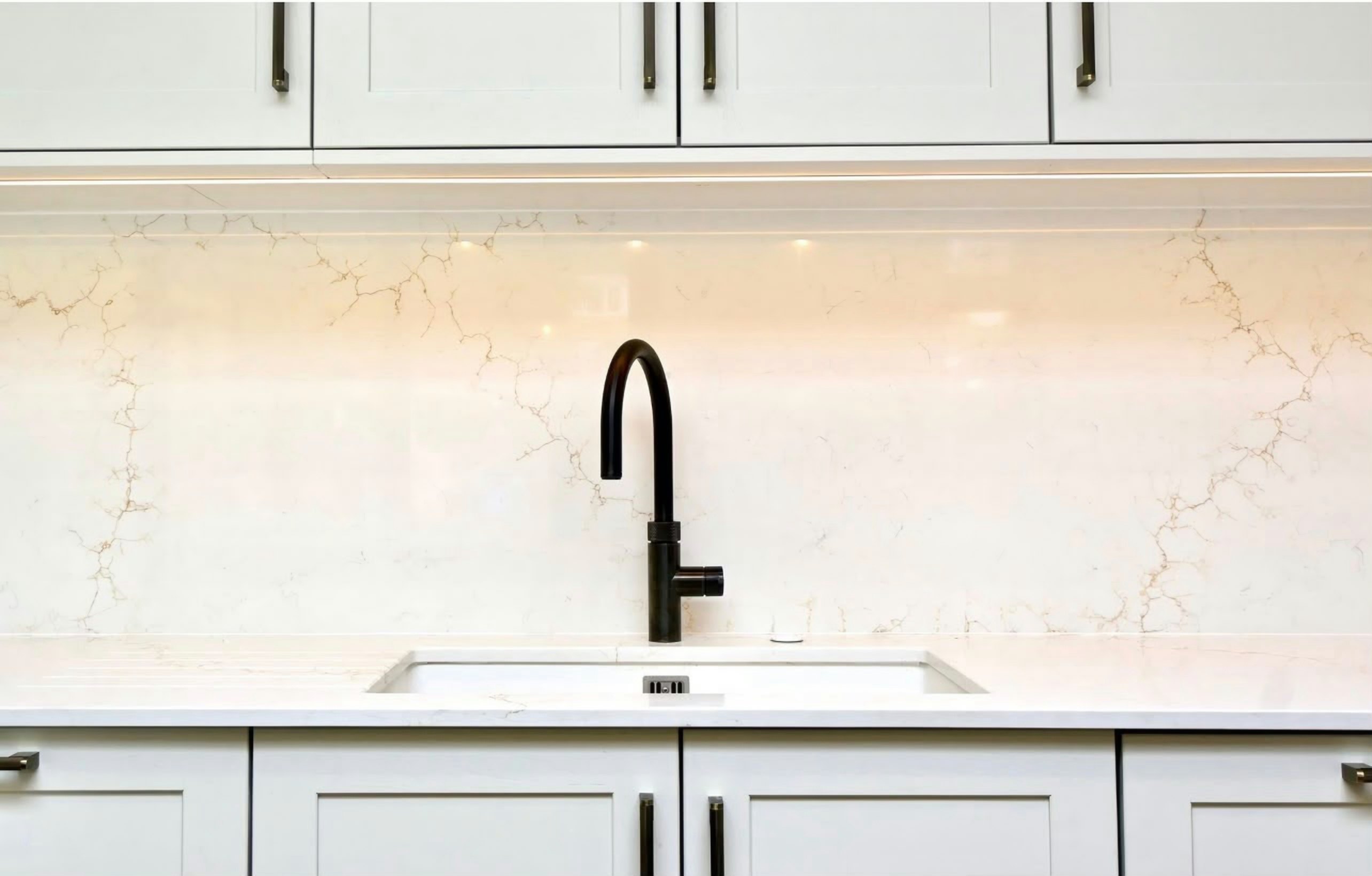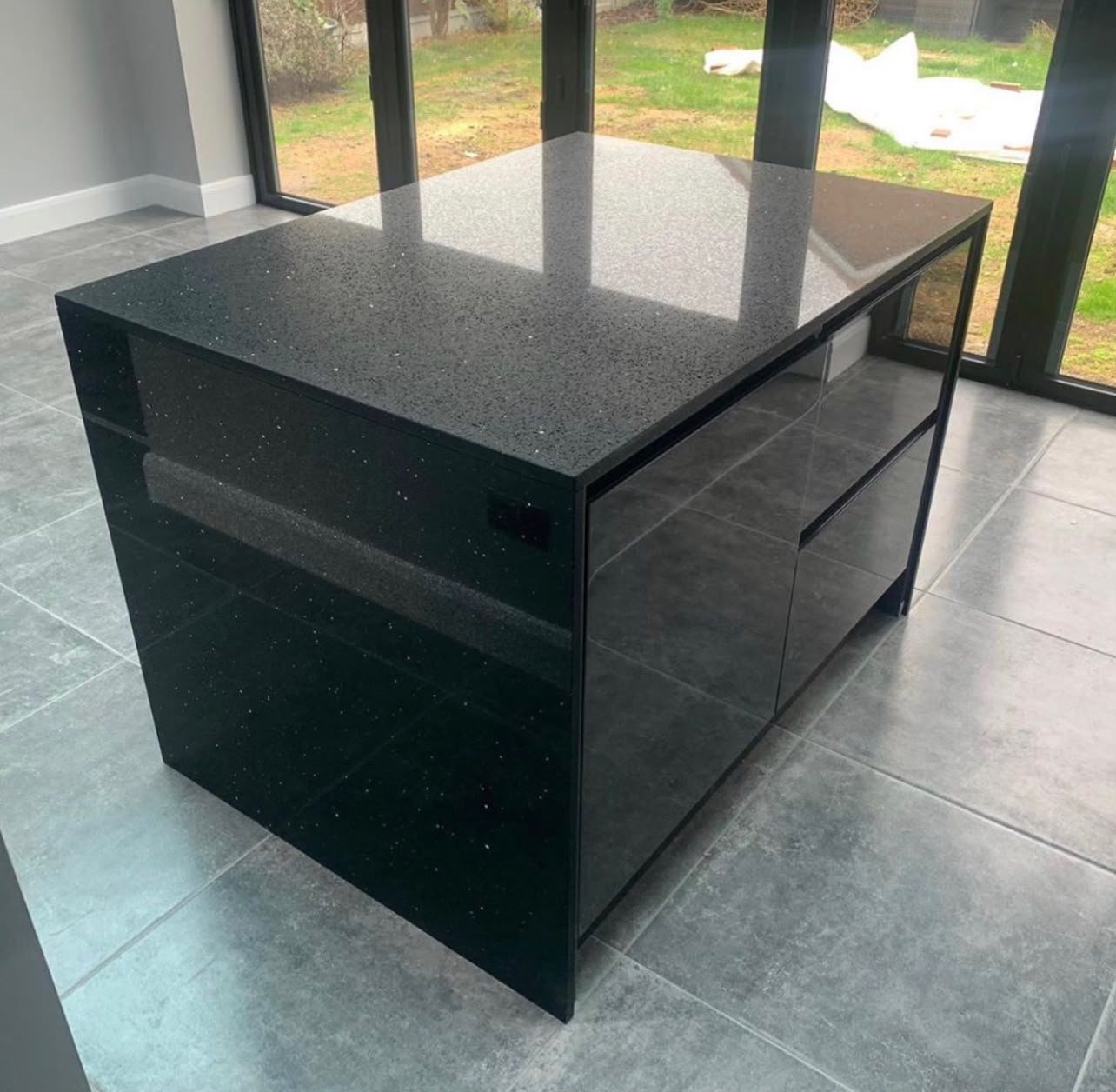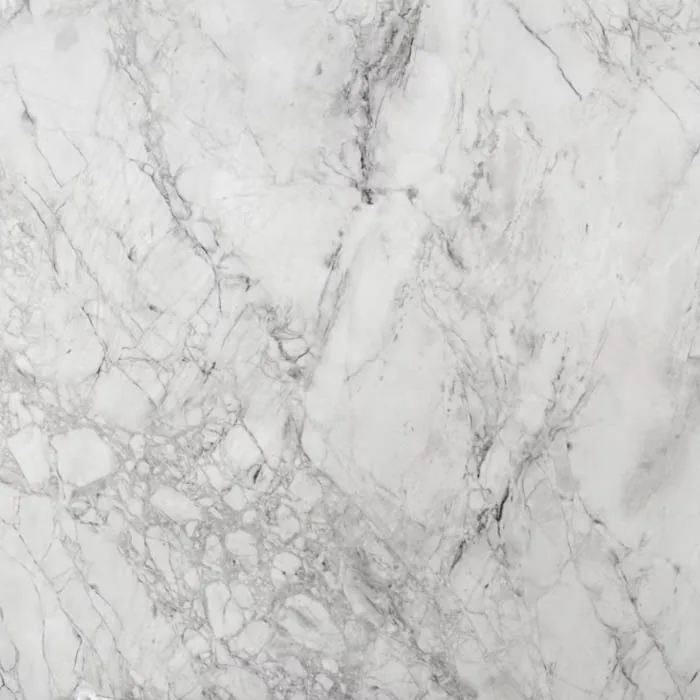
Most people meet these names in a showroom, in a sentence that treats all of them as interchangeable. They are not, and one of them is not even a material. The underlying surface differs from quartz in exactly one important way, and almost everything worth knowing about it follows from that difference. Here is what sintering is, what the names mean, and when this is and is not the right worktop for your kitchen. Worktop Worx cuts and fits both Cosentino’s Dekton and our own Karexa sintered range, so what follows is written from the workshop bench.
Key points
- Sintered stone is fused mineral with no resin in it, and that single absence explains the heat tolerance, the zero porosity and the thin formats
- Dekton is a brand of sintered surface, not the material: compare brand, colour, finish and thickness before comparing two quotes
- It never needs sealing and nothing in it can scorch; the honest weakness is impact at a thin or unsupported edge
- The premium is fabrication labour rather than slab price, which is why a small cut-out-heavy kitchen is where it makes least sense
- It is what we would specify outdoors or in direct sun, and often the answer to a difficult carry into a London flat
01 / 10
What is sintered stone?
Sintered stone is a slab of mineral particles compacted under very high pressure and fired until the particles fuse into a single dense body. Nothing binds them but the process: no resin, no cement, no adhesive anywhere in it. That absence is the whole story. It is why nothing in it can scorch, why its porosity is effectively zero, why it never needs sealing, and why it can be produced far thinner than quarried or engineered stone and still be usable. Every other property on this page follows from it.
Dekton is a brand of sintered surface rather than the name of the material, in the way Hoover is a brand of vacuum cleaner. Large-format porcelain is a close relative made a similar way. Quartz, in the next rack along, is made differently and behaves differently, and the difference is the resin.
02 / 10
Sintering, and why the missing resin matters
The starting point is a blend of mineral powders, drawn from the same raw families found in glass, porcelain and natural stone. That blend is compacted under enormous pressure, which drives the air out and brings the particles into contact, then fired until they fuse. What comes out is one dense body rather than a mixture of aggregate and glue, which is what "ultra-compact" is describing.
Compare that with engineered quartz: ground natural quartz mixed with pigment and a polymer resin, pressed and cured into slabs. The resin is what makes quartz consistent and reliably non-porous, and it is also organic, which is why a pan straight off the hob can scorch a pale quartz or thermal-shock it into a crack. Sintered stone has nothing organic in it to scorch. That is not a general claim about toughness; it is a specific consequence of how it is made, and it is why sintered slabs turn up as fire surrounds and outdoor kitchens.
Granite sits somewhere else again: quarried, nothing added, so heat is a non-issue there too, but porous to a degree that varies from stone to stone and sealed at fabrication. Sintered stone skips that maintenance entirely, because there is nothing for a sealer to soak into.
03 / 10
Is Dekton sintered stone?
Yes. Dekton is a sintered surface, and the name is a brand: Cosentino’s ultra-compact surface. That trips up more buyers than anything else here, partly because sellers who should know better use the brand name as though it were the material. Neolith, Lapitec and Laminam are other companies making sintered or ultra-compact slabs in the same broad family. They are no more identical to each other than two quartz brands are, but they are the same kind of thing, and none of them is "the" sintered stone.
The practical version: two quotes that both say "sintered" are not comparable until each names the brand, colour, finish and thickness. Polished and matt versions of one colour are not the same price, and a look-alike from another range is not the same slab.
04 / 10
Is sintered stone the same as porcelain?
Large-format porcelain is the closest relative: a clay-derived body fired at high temperature, usually with the pattern applied to the surface under a fine wear layer. Sintered slabs are pressed blends of mineral powders; some carry pattern through more of the body, others are surface-decorated much as porcelain is. In a kitchen the two behave similarly: hard, non-porous, never sealed, indifferent to heat, available very thin, and sharing the same weakness at an edge.
The distinction matters when one gets chipped. Where the pattern is applied to the surface rather than running through the body, the material underneath can be a different colour, so a chip on a dark top can show as a pale mark rather than as a dent you would struggle to find. Ask which of your shortlist is patterned through and which is decorated on the surface, and where each piece is going. On the walk-past corner of a peninsula it matters; on the run behind the kettle, much less.
05 / 10
Sintered stone vs quartz vs granite
| Compared | Sintered / Dekton | Quartz | Granite |
|---|---|---|---|
| What holds it together | Nothing: fused mineral | Polymer resin | Nothing: quarried stone |
| Hot pan straight on it | Nothing in it can scorch | No: use a trivet | Tolerant |
| Porosity | Effectively zero | Non-porous | Porous, varies by stone |
| Sealing | Never | Never | Sealed on installation, topped up |
| Scratch resistance | Excellent | Good | Very good |
| Chip risk at an edge | Needs careful detailing | Low | Low |
| Thin formats | Yes, thinner than either | Standard thicknesses | Standard thicknesses |
| Direct outdoor sun | What we would specify | Not one for outside | Durable, keep it sealed |
| Where the cost sits | Fabrication labour | Slab price | Slab price |
06 / 10
Thin formats, and the difficult carry
Because there is no resin holding it together, sintered material can be produced considerably thinner than quarried or engineered stone and remain usable, thin enough at one end of the range for wall cladding. Available thicknesses vary by colour and by finish, so they get confirmed for your chosen slab at quotation rather than assumed from a brochure.
That has two consequences and only one is about looks. The visible one is the edge: a thin slab mitred down into a deep apron reads as a solid block of stone, and that detail is what most people are actually asking for when they ask for Dekton. It is skilled work and priced accordingly, so read the edge profile guide before committing to it.
The invisible one is weight, and in London it decides more jobs than the edge does. A thin sintered piece weighs a fraction of the same piece in 30mm granite, so when the route in is a stairwell with a half-landing, a lift that will not take a long piece on its end, or a third-floor flat with a turn on the landing, the choice is often between a lighter material and an extra join you did not want. Raise access before templating, not on installation morning.
What thinness does not buy you is span. A thinner top is not a stronger one, and a breakfast bar overhang still needs steel or proper brackets whatever the slab is made of.
07 / 10
Does sintered stone chip?
A very hard material is a brittle one. Surface wear is not how sintered worktops fail: they resist scratching better than quartz or granite and are difficult to mark with normal kitchen tools. What damages them is impact at a thin or unsupported edge, which is the trade you make when you buy the hardest surface in the showroom.
It is a fabrication problem before it is an ownership problem, which is why the same material is trouble-free in one kitchen and chipped in another. What matters:
- Internal corners at sink and hob cut-outs radiused rather than cut square; a square internal corner is where a crack starts
- Cut-outs supported across their span while the piece is handled and set down
- A slight ease on the top arris rather than a knife-sharp edge, especially on a peninsula end
- Overhangs carried on steel or a proper bracket rather than on the stone alone
- Enough people on the carry: most damage happens before the slab reaches the units
Repairs are harder than on quartz, and on a surface-decorated slab a chip can show as a contrasting mark rather than disappearing into the pattern. None of that is a reason to avoid the material; it is a reason to care who fabricates and fits it. The cheapest sintered quote is rarely the one to take.
08 / 10
Sunlight, outdoors and colour stability
Colour stability is a real advantage and worth stating plainly. The pigment is mineral and fired into the body, so there is no organic component for ultraviolet light to degrade. It is the surface we would specify for an outdoor kitchen or a garden bar, and the same property is why these slabs get used on building facades.
Indoors it matters far less than the internet suggests, and we are not going to tell you otherwise. Daylight through a normal kitchen window will not change the colour of a quartz worktop, and choosing on that basis is choosing for the wrong reason. It becomes a genuine question under unfiltered sun year after year: an outdoor run, or a rooflight that puts one end of an island in direct afternoon sun. There, sintered stone is the safe specification.
One caveat on finish rather than colour: matt and textured finishes in dark tones show fingerprints and cleaning residue more readily than a polished surface, which a bright showroom hides completely. We cannot post sintered samples, so it is worth seeing a dark matt finish somewhere other than a bright showroom before committing to a whole island of it.
09 / 10
When is sintered stone the wrong choice?
The clearest case is a small, cut-out-heavy kitchen. Material cost tracks area; fabrication cost tracks cutting. Sintered stone is hard on tooling and slow to machine, so mitres, cut-outs and drainer grooves take longer in it than in quartz, and that time lands on the quote as labour.
Put those two together. A compact galley with a sink, a hob, a tap, a boiling-water tap and drainer grooves has a very high ratio of machining to square metres, so you pay a labour premium across almost the whole job and get little back, because there is barely any plain surface for the durability to work on. The same layout in quartz is cheaper to make and behaves almost identically in that kitchen. We would say so.
Other reasons to choose something else
- You have found the exact colour you want and it exists in quartz rather than in sintered; pattern is a legitimate reason to choose a material
- The design has a lot of exposed, walk-past edges and nobody in the house is careful
- You own trivets and use them, so the heat tolerance is a property you would be paying for and never calling on
- The budget is tight and the choice is between sintered stone fabricated cheaply and quartz fabricated well: take the second one every time
10 / 10
How to decide between the three
Step by step
Step 1: Start with where the surface is going
Outside, or in permanent direct sun, and the decision is already made: sintered stone. A normal indoor kitchen, and all three families will do the job, which means the choice is really about the four things below.
Step 2: Then look at the route in
If getting stone into your kitchen is awkward (stairs, a lift that will not take a long piece, a tight landing) a thinner, lighter sintered top can be what saves you a join. Say so before templating, because that is the visit where join positions get agreed.
Step 3: Then count the cut-outs
A high ratio of machining to area pushes towards quartz. Long clean runs and a large island, where most of the slab is uninterrupted surface, is where sintered earns its labour premium.
Step 4: Then be honest about heat
If pans come straight off the hob onto the worktop in your house, sintered stone or granite removes the one rule quartz has. If your household already uses trivets without being asked, that advantage is worth less to you than the brochure implies.
Step 5: Choose the colour last
Shortlist the two or three you are seriously considering. Sintered samples cannot be posted, so if you want something in your hand first, free samples cover the Worktop Worx quartz collection only. The colour library tags every surface by family, so you can see which of a shortlist is sintered and which is not. Book a design consultation if you want a view on which will actually suit the room.
If you are replacing tops in an existing kitchen, add one thing: the units have to take the weight and the old surface has to come off cleanly, both part of a worktop replacement rather than an afterthought. Send plans or photographs with rough measurements and we will tell you which of the three we would put in, including when the answer is the cheaper one.