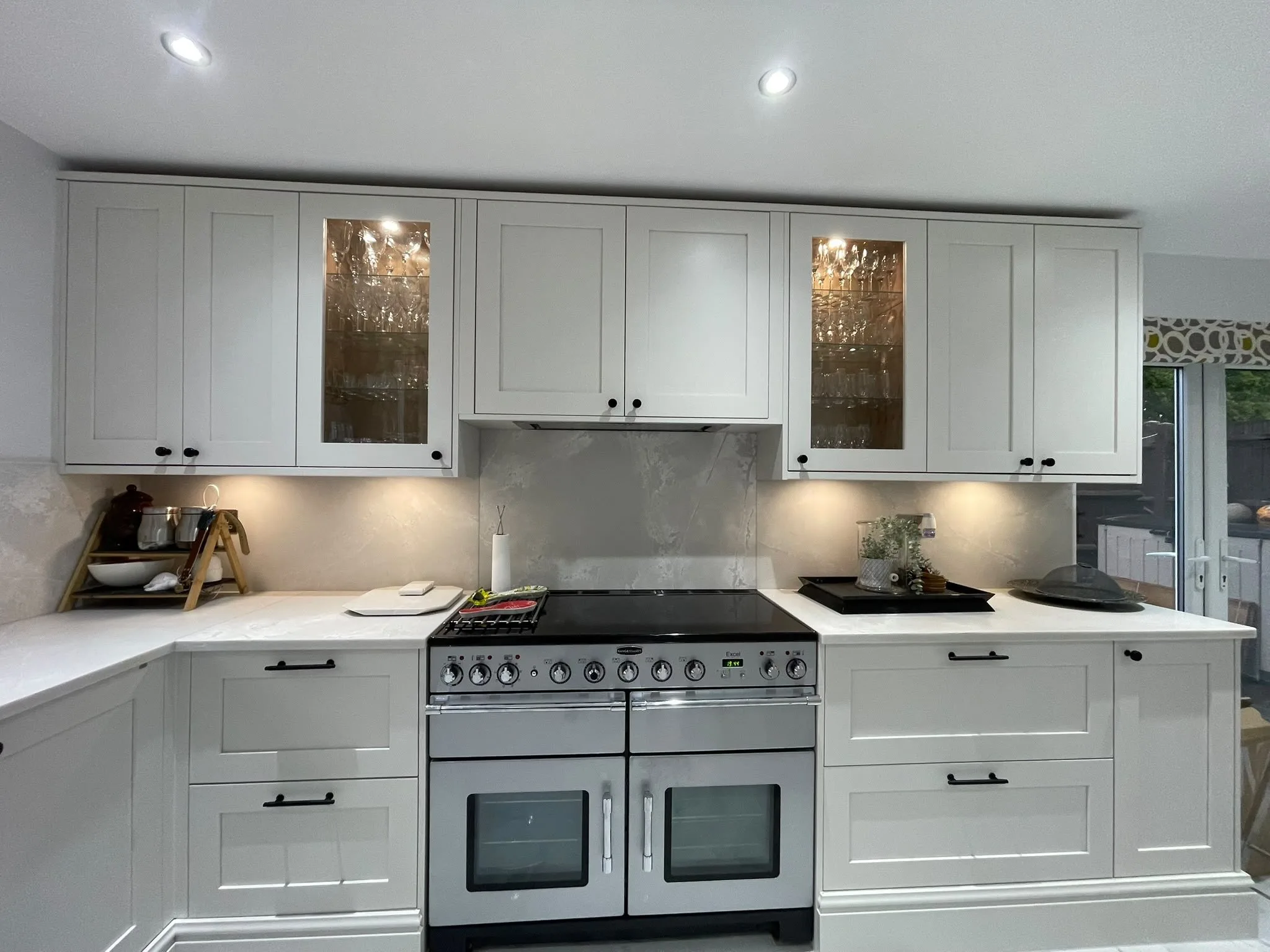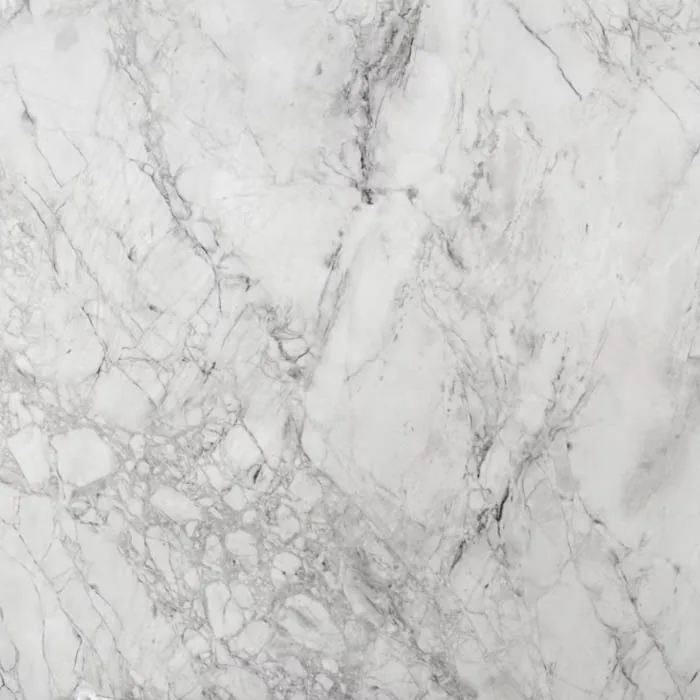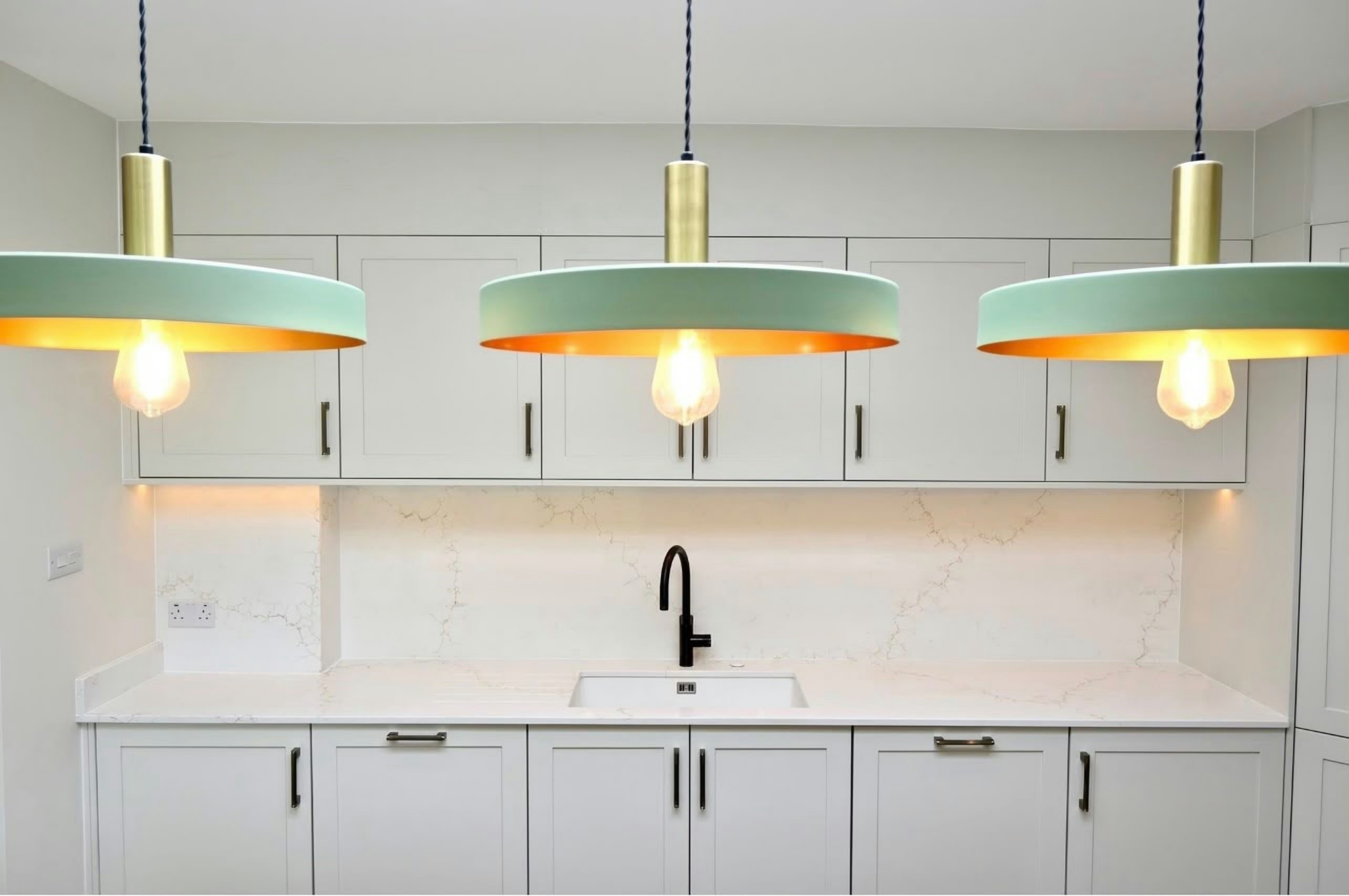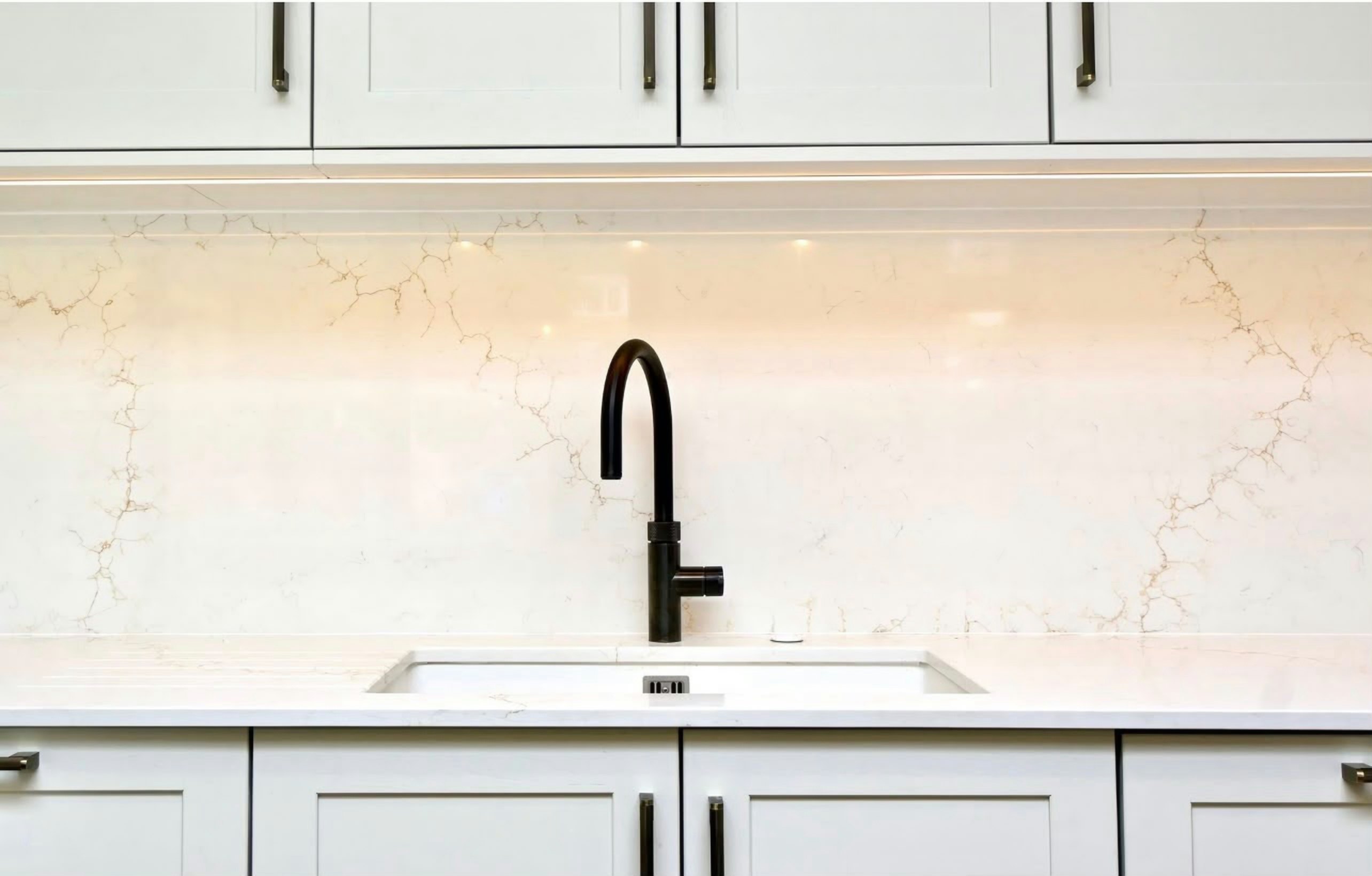
There are six kinds of worktop most people will be shown, and they are not competing for the same kitchen. Three are stone and three are not, and the useful question is less which one is best in general than which one suits the way your kitchen is used. Worktop Worx templates, fabricates and fits the three stones only. Laminate, solid wood and solid surface are on this page because you will be comparing against them, and we would rather describe them fairly than pretend they do not exist.
Key points
- The six main types are quartz, granite, sintered stone such as Dekton, laminate, solid wood and solid surface
- Quartz is the best fit for most busy family kitchens: consistent, non-porous and never sealed, with a trivet for hot pans
- Granite brings heat tolerance and one-of-a-kind character for periodic sealing; sintered stone suits heat, sun and slim mitred profiles
- Laminate, wood and solid surface each have a fair place, and we do not sell them
- Stone supply prices overlap: quartz £130 to £500/m², granite £121 to £550/m², Dekton and sintered £110 to £366/m², before fabrication and fitting
01 / 08
What are the main types of kitchen worktop?
There are six main types of kitchen worktop: quartz, granite and sintered stone such as Dekton, which are made to a template in a workshop, and laminate, solid wood and solid surface. For most busy family kitchens quartz is the best fit, granite suits heavy cooks who want natural stone, and we fit the three stones only.
- Quartz: engineered stone, ground natural quartz bound with resin and pressed into slabs
- Granite: natural stone, quarried and cut into slabs with nothing added
- Sintered stone, including Dekton: mineral powders pressed and fired into one dense body, with no resin
- Laminate: a printed decorative layer bonded to a board core
- Solid wood: timber staves glued into a board, oak being the familiar example
- Solid surface: an acrylic or resin-based sheet material, Corian being the best-known brand
The three stones are made in workshops from a template of your kitchen and delivered finished. Laminate and timber are typically cut and finished on site, and solid surface can be made either way. That difference explains most of the gap in price, in lead time and in how the joins and sink cut-outs look once they are in.
02 / 08
Quartz worktops
Quartz is the safe default for a busy kitchen. Because it is manufactured, it is consistent: the sample you hold is a fair picture of the slab you get, and a long run stays uniform across joins. It is non-porous, so it never needs sealing and spills sit on top rather than soaking in. The one rule is heat: the resin scorches, so a hot pan goes on a trivet. Our catalogue has 69 quartz colours from £130 to £500/m² supply only, and most sit between £150 to £270/m².
Choice is its strength. White quartz runs from flat bright whites to soft-veined ones, marble-effect quartz gives the look of Calacatta or Carrara without the sealing, and sparkle quartz hides crumbs and fine wear better than any plain colour.
03 / 08
Granite worktops
Granite is quarried natural stone with nothing added, which is the source of both its strengths and its habits. There is no resin, so a hot pan is not the problem it is on quartz, and it is extremely hard. Every slab is different, which is a feature if you want a worktop nobody else has and a nuisance if you want a swatch matched exactly. It is porous to a degree that varies by stone, so it is sealed at fabrication and topped up when a simple water test says it needs it. Our catalogue has 45 granites from £121 to £550/m² supply only, and most sit between £148 to £250/m².
Dark granites take a deep polish and are the densest, so they need sealing least; black granite has been a kitchen staple for that reason. Lighter, more open stones are more characterful and want a little more care near the sink.
04 / 08
Dekton and sintered stone worktops
Sintered stone is made by pressing mineral powders under very high pressure and firing them until they fuse, with no resin in the result. Nothing in it can scorch, its porosity is effectively zero, it never needs sealing, and it can be produced thinner than quarried or engineered stone, which is why a mitred edge in it looks so sharp. It is the surface we would specify outdoors or in direct sun. The trade-offs are a brittleness at thin, unsupported edges and slower, more skilled fabrication, so the premium sits in labour rather than in the slab. We carry Cosentino’s Dekton and our own Karexa range: 71 colours from £110 to £366/m² supply only, most between £250 to £300/m².
Dekton is a brand of sintered stone rather than a separate material, and large-format porcelain is a close relative. Our guide to sintered stone explains the difference and when it is the wrong choice, which is mostly in small kitchens full of cut-outs.
05 / 08
Laminate, wood and solid surface: the ones we do not fit
Laminate is the cheapest worktop by a distance and modern decors imitate stone and timber well. It is light, it is cut and fitted in the kitchen in a day, and it suits a rental, a utility room or a kitchen you plan to replace in a few years. Its weak points are heat, which can blister or scorch the surface, and water at cut edges and joins, which can swell the board underneath. A sink is usually set on top rather than undermounted, and a damaged section is replaced rather than repaired.
Solid wood is warm, quiet and repairable: scratches and marks can be sanded out and the surface re-oiled. In exchange it needs regular oiling, it moves with humidity, and standing water near a sink or dishwasher will mark it if the finish is neglected. Many people use timber for an island or a breakfast bar and stone for the working runs, which plays to both.
Solid surface is the material for seamless joins and integrated sinks moulded from the same sheet, and minor scratches can be buffed out. It is softer than stone and less tolerant of heat, so it scratches and marks more readily in a hard-working kitchen. If an invisible join or a one-piece sink is the priority, it is worth seeing.
06 / 08
Which kitchen worktop is best? The six side by side
| Compared | Quartz | Granite | Sintered / Dekton | Laminate | Solid wood | Solid surface |
|---|---|---|---|---|---|---|
| Hot pan straight on it | No: use a trivet | Tolerant | Nothing in it can scorch | No | No | No |
| Sealing or oiling | Never | Sealed, topped up | Never | Never | Regular oiling | Never |
| Scratches | Good resistance | Very good | Excellent | Marks easily | Marks, sands out | Marks, buffs out |
| Undermount sink | Yes | Yes | Yes | Usually not | Possible, needs care | Integrated option |
| Made | Workshop, to a template | Workshop, to a template | Workshop, to a template | On site | On site | Workshop or on site |
| Supply price, most colours | £150 to £270/m² | £148 to £250/m² | £250 to £300/m² | Not sold by us | Not sold by us | Not sold by us |
For a standard indoor family kitchen, quartz is the answer most of the time and the real question is which quartz. If you cook heavily and want natural stone, granite is the better fit and the sealing is a small job. If the worktop is going outside, sits under a rooflight, or you have set your heart on a very thin mitred edge, sintered stone earns its fabrication cost. If the budget is tight or the kitchen is temporary, laminate is a sensible choice and we would say so. For the head-to-head between the three stones, read quartz vs granite vs Dekton.
07 / 08
The best worktop for your kitchen, by situation
- Busy family kitchen, nobody keen on maintenance: quartz
- You cook a lot and want a surface that shrugs off a hot pan: granite or sintered stone
- You want a worktop nobody else has: granite
- Outdoor kitchen, garden bar or a run in direct sun: sintered stone
- A thin, sharp mitred edge on an island: sintered stone, or a mitred quartz
- A marble look without marble’s upkeep: marble-effect quartz
- A rental, a utility room or a kitchen you will replace soon: laminate
- A warm, softer surface for an island or bar: solid wood, with stone on the working runs
08 / 08
What the price per square metre does and does not tell you
Every figure on this page is supply only: the slab, before fabrication, cut-outs, edge work, delivery and fitting. The three stone bands overlap heavily, so there are granites cheaper than mid-range quartz and sintered colours cheaper than premium quartz. What separates two quotes for the same kitchen is usually the work rather than the stone: how the kitchen falls onto a slab, how many cut-outs there are, the edge profile and the access.
That is why we quote the job rather than the metre. Our guide to what affects worktop cost walks through every input, and every colour, with its own supply price, is listed in the colour library so you can shortlist by budget before you ask for a quote.