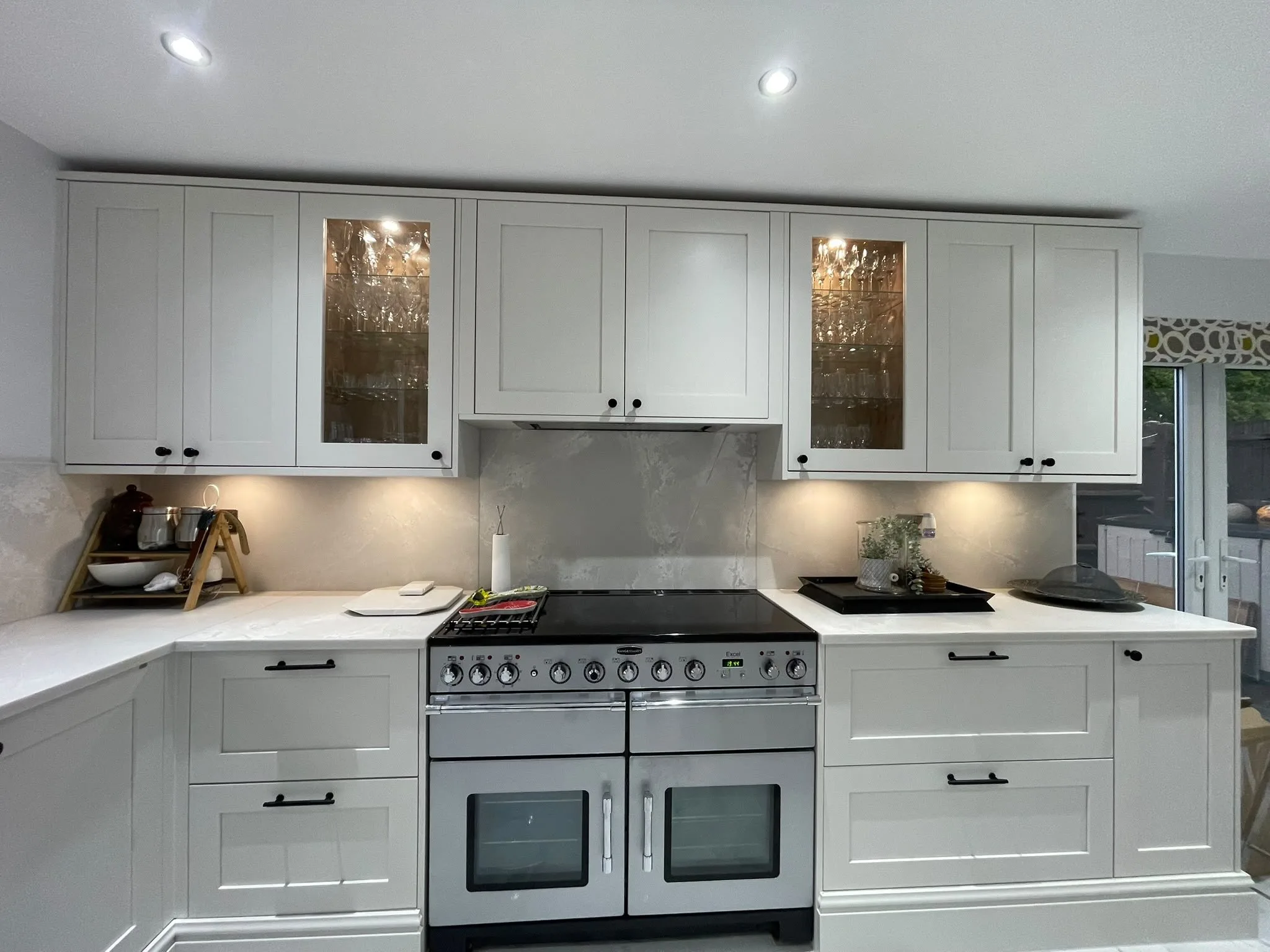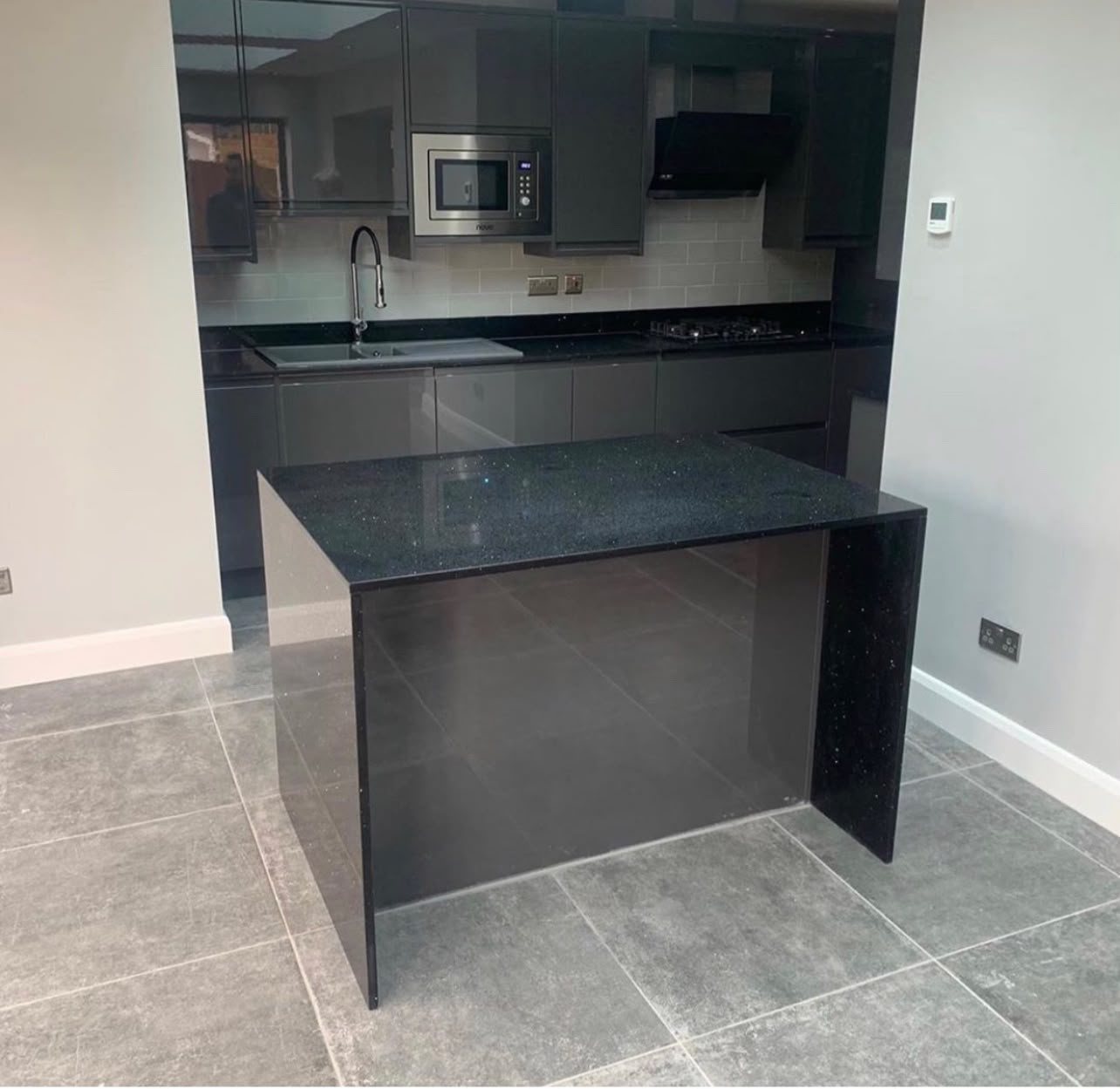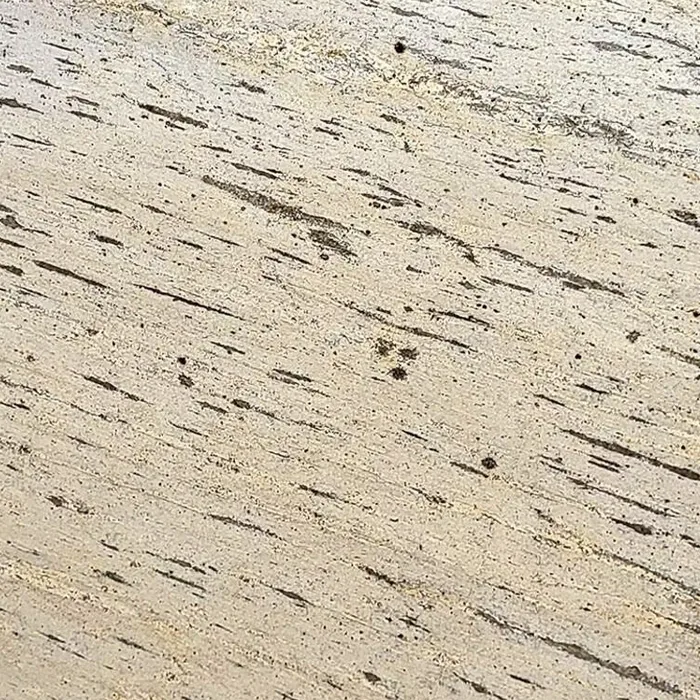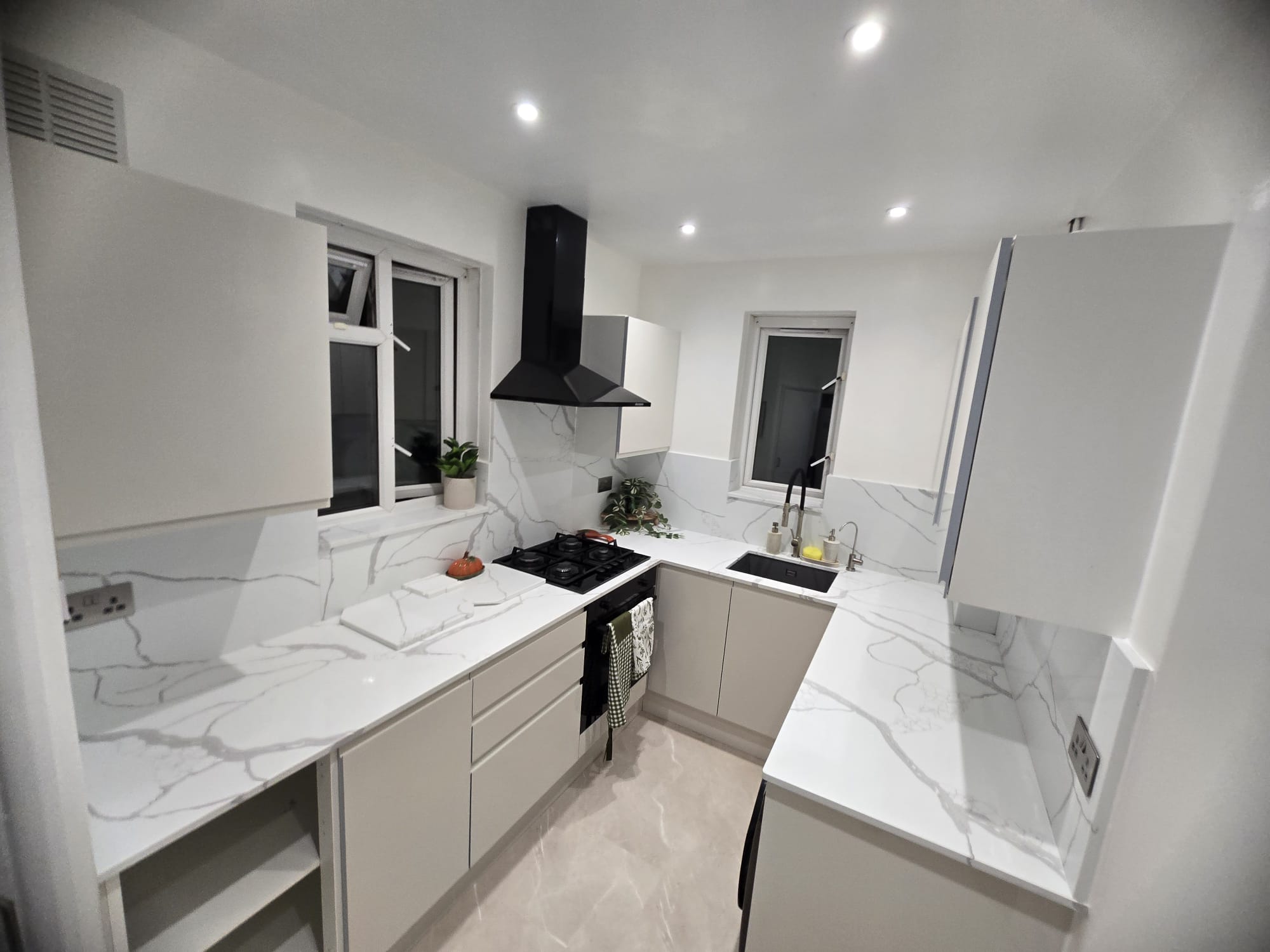
The argument between quartz and granite is usually conducted in adjectives. The useful differences are few and concrete: what happens when a hot pan lands on each, whether the surface needs sealing, how each takes a stain, and whether you want every slab to match or every slab to differ. Worktop Worx templates, fabricates and fits both, from the same workshop and with the same fitters, so there is no favourite to push here.
Key points
- Quartz suits most busy family kitchens: non-porous, never sealed, and the slab matches the sample
- Granite suits heavy cooks who want natural stone: hot pans are fine, at the cost of occasional sealing
- Use the fifteen-minute water test on granite rather than a calendar
- The prices overlap: supply only, quartz £130 to £500/m² and granite £121 to £550/m²
- Judge granite from the slab; quartz samples from our own collection are posted free
01 / 08
Which is better, quartz or granite?
For a busy indoor family kitchen, quartz. It is non-porous, it never needs sealing, the slab matches the sample and the range of designs is wider. The one rule it brings is a trivet for hot pans. Granite is the better choice if you cook heavily, like a surface that shrugs off a pan straight from the hob, and want natural stone with real character, accepting a short sealing job now and then.
Both outlast the units beneath them when they are fitted properly, and most of the difference in how people feel about a worktop five years on comes from how it was made and fitted rather than the material. Our guide with all three compared adds the sintered option, if that is on your list as well.
02 / 08
Is quartz or granite more expensive?
Neither, reliably: the bands overlap. Supply only, our quartz runs from £130 to £500/m² and our granite from £121 to £550/m². Taken as whole families, granite is the cheaper of the two: the middle granite price is £177/m² against £180/m² for quartz. By group, the cheapest group to buy from is our own quartz collection, with a middle price of £150/m², and the dearest is Sensa granite at £300/m². Those are slab prices alone, before cutting, finishing, delivery and fitting.
| Compared | Colours | From | Most colours | Middle price | Top of range |
|---|---|---|---|---|---|
| Worktop Worx quartz collection | 36 | £130/m² | £140 to £180/m² | £150/m² | £280/m² |
| Silestone quartz | 30 | £150/m² | £192 to £320/m² | £235/m² | £500/m² |
| Sensa granite | 19 | £170/m² | £200 to £350/m² | £300/m² | £550/m² |
| Other granite | 26 | £121/m² | £138 to £167/m² | £150/m² | £271/m² |
Silestone is the quartz brand made by Cosentino and Sensa is the same company’s branded granite range; the Worktop Worx collection is our own quartz. Within a band the difference is almost always pattern rather than performance, so the cheaper slab in either family will behave like the dearer one in a domestic kitchen. Where the two families do differ in cost is the work around them, which is the same for both: the openings, the edge, the number of pieces and the access, all covered in our guide to what affects worktop cost.
03 / 08
Can you put hot pans on quartz or granite?
On granite, yes. Our spec tables put it as "Excellent (hot pans are fine)": it is quarried stone with nothing in it to soften or scorch, so a pan straight off the hob is not the disaster it is on quartz. On quartz, no: "Use a trivet (the resin scorches)". The resin that makes quartz consistent and non-porous is organic, and a hot pan can scorch a pale quartz or crack it through thermal shock.
In practice this is the most important difference on the page, and it is about your household rather than the stone. If pans, oven trays and slow cookers go straight onto the worktop in your house and nobody is going to change that, granite removes the rule quartz brings. If you already reach for a trivet without thinking, quartz costs you nothing here.
04 / 08
Does granite need sealing, and does quartz?
Quartz never does: it is non-porous, sealed by its own construction, and a bottle of quartz sealer is a bottle of nothing. Granite is natural stone and "porous, varies by stone", so it is sealed when it is fitted and re-sealed from time to time. How often depends on the stone and how hard the kitchen is worked, and dark, dense granites need it less than pale, open ones.
Rather than a calendar, use the water test: a tablespoon of water near the sink and near the hob, left for fifteen minutes. If the stone beneath has darkened, it is absorbing and it is time to re-seal. Our guide to sealing a granite worktop has the full method; it is about twenty minutes for a normal kitchen. If nobody in the house will ever do that, be honest about it now and buy quartz.
05 / 08
Which stains and scratches more easily?
Staining favours quartz. Because nothing soaks into it, wine, oil and turmeric sit on the surface and wipe off. On granite a spill left long enough can soak in, and an absorbed stain has to be drawn back out with a poultice rather than scrubbed; scrubbing only polishes the area around it. A well-sealed granite resists most of this, which is the point of the water test, and our guide on removing stains from stone worktops covers both materials.
Scratching slightly favours granite, which is extremely hard; quartz resists everyday wear well but is not scratch-proof. Neither will lose to a knife, so both blunt your blades, and grey marks from a pan base are usually transferred metal on either surface rather than a scratch. Chips happen in the same places on both: front edges and around sink and hob openings.
06 / 08
Which looks more natural, quartz or granite?
Granite, because it is. Every slab is different: flecking, movement and background tone vary between slabs and a great deal between batches, and natural pitting and fine fissures are properties of quarried stone rather than faults. That makes a granite worktop one of one, and it means a small sample can only indicate tone and character, which is why we do not post granite samples. Dark stones take a deep polish, and black granite has been a kitchen staple for that reason.
Quartz looks like what it is: a designed surface, consistent across a run, in more shades than any quarry supplies. If you want the look of veined stone without its habits, marble-effect quartz is the usual answer. If you want the stone itself, the slab is the thing to judge, and the colour library tags every design by family so you can shortlist either.
07 / 08
How do quartz and granite compare, side by side?
| Compared | Quartz | Granite |
|---|---|---|
| What it is | Engineered: ground quartz, pigment and resin | Natural: quarried, nothing added |
| Hot pan straight on it | Use a trivet (the resin scorches) | Excellent (hot pans are fine) |
| Porosity | Non-porous | Porous, varies by stone |
| Sealing | Never needs sealing | Sealed on installation, topped up over time |
| Scratch resistance | Good | Very good |
| Pattern | Consistent, matches the sample | Varies slab to slab |
| Free samples | Our own collection, posted | Judged from the slab |
| Supply price, most colours | £150 to £270/m² | £148 to £250/m² |
Read the table for what it is: a list of differences, not a score. A family kitchen with careful cooks barely touches the heat row, and someone who loves a quarried slab will happily do the sealing row. For the full picture of what goes into each one, our guide to what quartz is made of covers the engineered side.
08 / 08
Should you choose quartz or granite?
Choose quartz when
- It is a busy indoor family kitchen and you want to stop thinking about the worktop
- You want a specific shade, a clean white or a marble look, done consistently
- You are matching two rooms, or a long run where consistency across joins matters
- Nobody in the house is going to be reliable about sealing anything
Choose granite when
- Pans go straight from the hob to the worktop and that is not going to change
- You want a surface nobody else has, and like that it varies
- A short sealing job whenever the water test says so does not bother you
- You have seen the slab, not only a photograph of it
If you are still undecided, start with the heat question, because it is the only one that changes how you live with the worktop every day. Then order free samples of the quartz you are considering, put them on your own units in daylight and under your own lights, and look at a granite slab rather than a chip of one. If a third option is in the frame, Dekton vs quartz and our guide to the types of kitchen worktop take it from there.