Quartz is the worktop most often described in a showroom in words that mean nothing. It is not a natural stone, it is not indestructible, and it is not the most expensive thing on the rack. What it is, is predictable, which is worth more in a family kitchen than almost any other property. Worktop Worx templates, fabricates and fits quartz alongside granite and Dekton, so this page says plainly where quartz is the right answer and where it is not.
Key points
- Quartz worktops are engineered stone: ground natural quartz, pigment and a polymer resin, pressed into slabs
- Non-porous and never needs sealing, so stains sit on the surface
- Heat is the one rule: the resin scorches, so hot pans and running appliances go on a trivet
- It is not natural stone, and it is not quartzite, which is a quarried stone
- Supply only, most of our quartz sits between £150 and £270/m², from £130/m²
01 / 09
What are quartz worktops made of?
A quartz worktop is made from ground natural quartz bound with pigment and a polymer resin, then pressed and cured into slabs. The quartz gives the hardness and the body; the resin holds it together and closes the surface; the pigment sets the shade and draws any veining. Because it is manufactured rather than quarried, the sample you hold is a fair picture of the slab you get, and a long run stays uniform from one end to the other.
It is made in batches. Two slabs of the same name from different batches can differ slightly in tone and in the scale of the veining, which is invisible across a room and noticeable where two pieces meet. That is why every piece of one kitchen, including the strips against the wall and the sill, is cut from one slab run at the same time rather than ordered months apart.
The slab is cut in a workshop to a drawing taken in your kitchen, polished, and fitted by hand. Our catalogue has 69 quartz designs, every one with its own supply price.
02 / 09
Are quartz worktops natural stone?
No. The quartz in it is a natural mineral, but the worktop is engineered: the stone is ground down and remade into a slab with resin, which is why it is often called engineered stone. Quartzite, a name that sounds almost the same, is something else entirely: a natural stone cut from a quarry, so the two are never interchangeable on a quote.
If you would rather have a stone that came out of the ground as it is, our guide on quartz vs granite sets the two side by side. Every slab of the natural one is different, which is both its appeal and its nuisance. Quartz is the choice for people who want the worktop to match the sample exactly, and neither is better in the abstract.
03 / 09
What are the pros of quartz worktops?
The headline advantage is that quartz asks almost nothing of you. It is non-porous and needs no sealer, so wine, oil, coffee and turmeric sit on the surface rather than soaking in, and there is nothing to apply and no water test to remember. That alone is the case for it in a family kitchen.
What quartz does well
- Non-porous, and never needs sealing
- Consistent from sample to slab and across a long run, because it is made rather than quarried
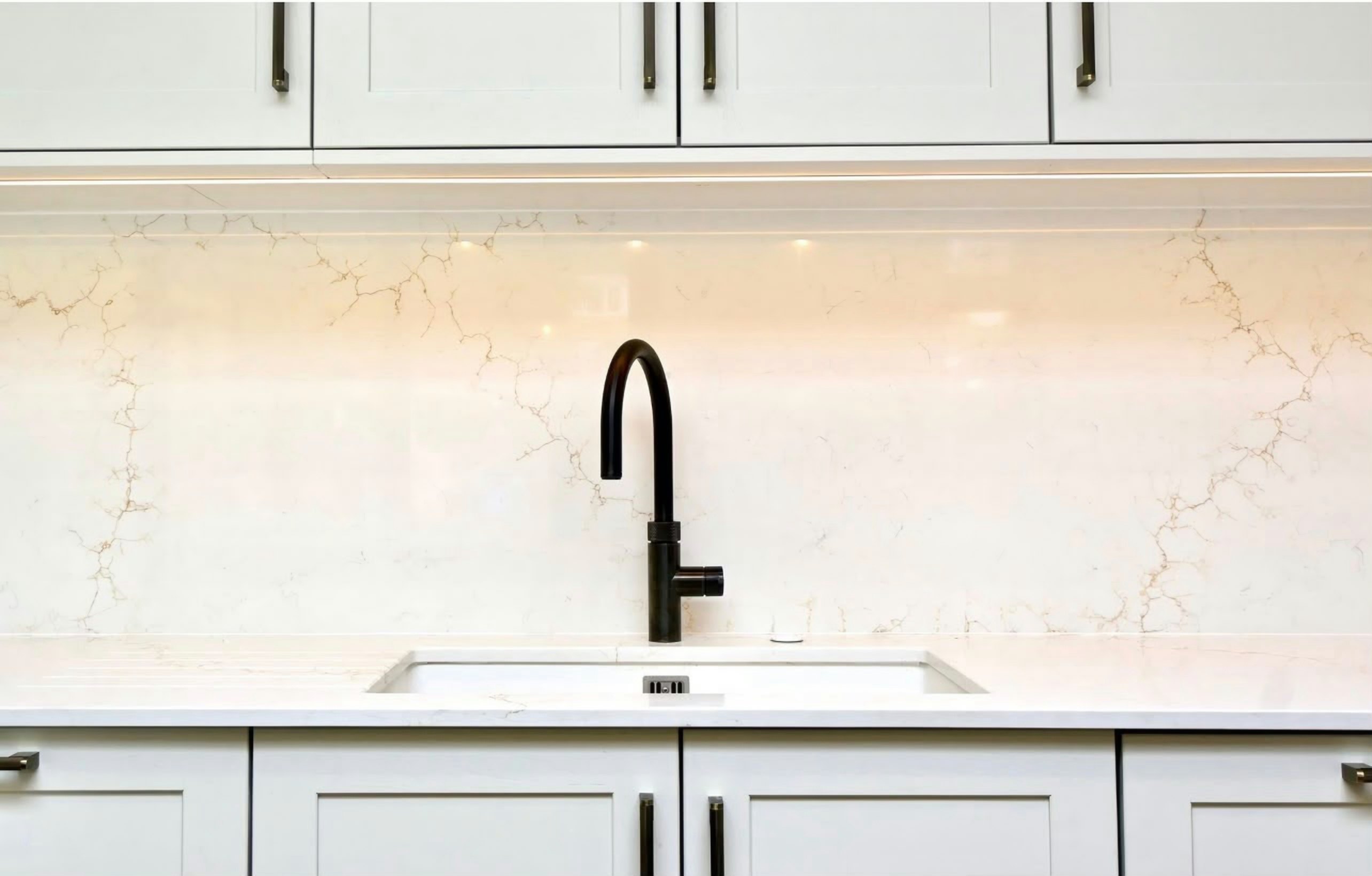
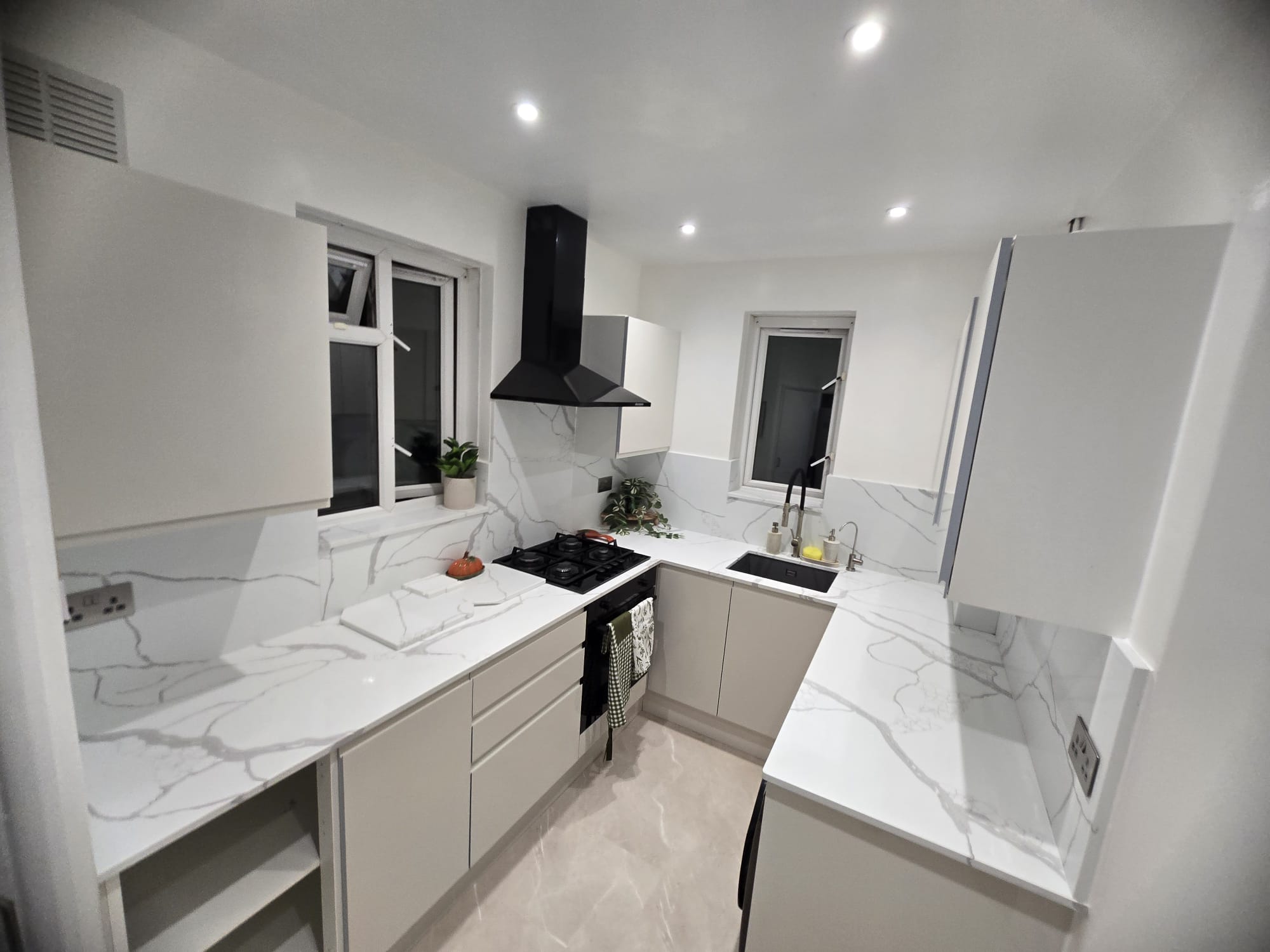
- The widest choice of colours of the three stones we fit, from flat whites to convincing marble looks
- Hard enough that everyday use will not scratch it, though it is not scratch-proof
- Takes an undermounted sink well and polishes to a fine cut-out edge
- Up to four samples of our own quartz collection are posted free, so you can judge it in your own kitchen
Choice is the other strength. White quartz runs from bright plain whites to soft-veined ones, and marble-effect quartz gives the look of Calacatta or Carrara without the upkeep of the real thing.
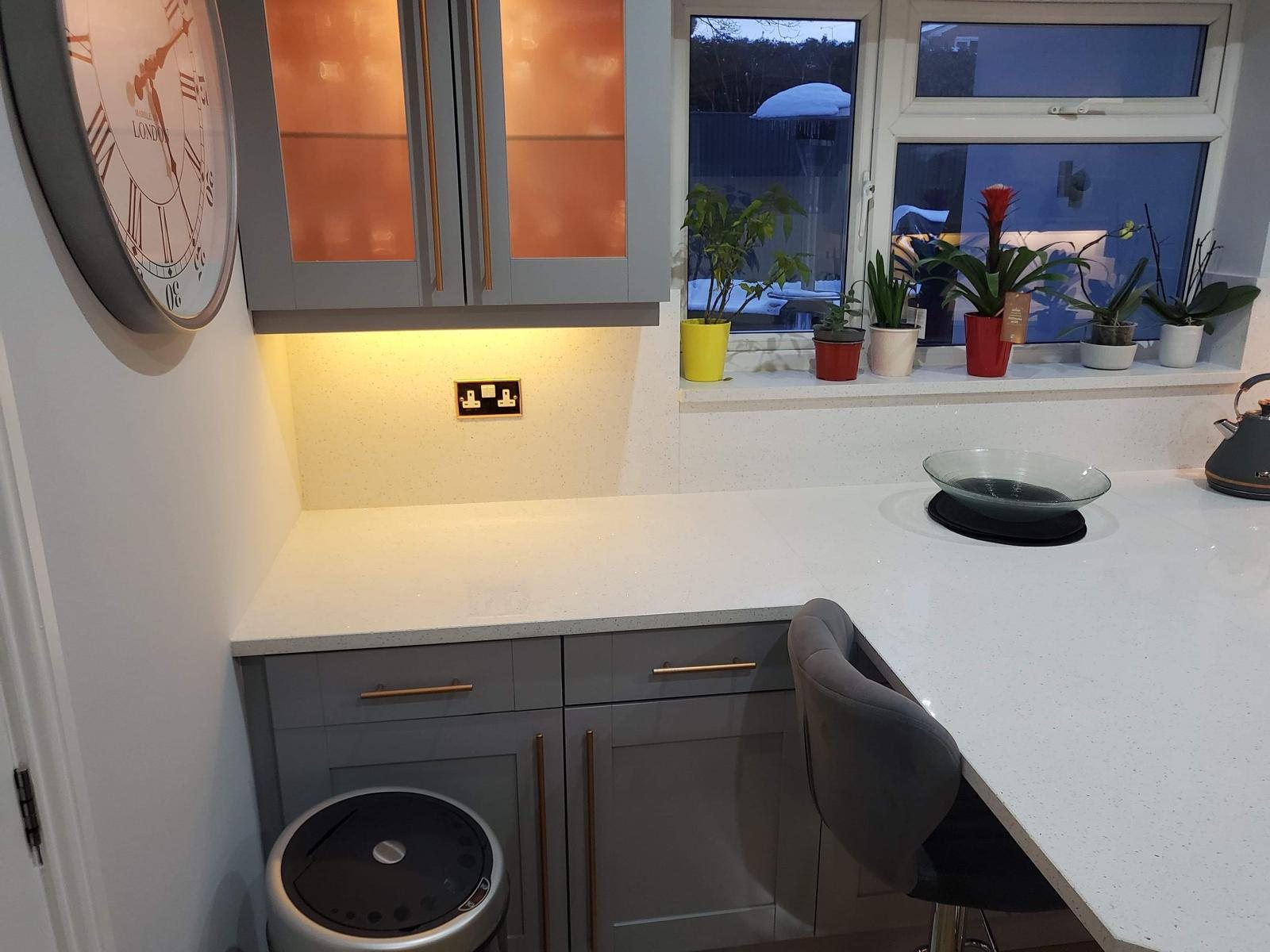
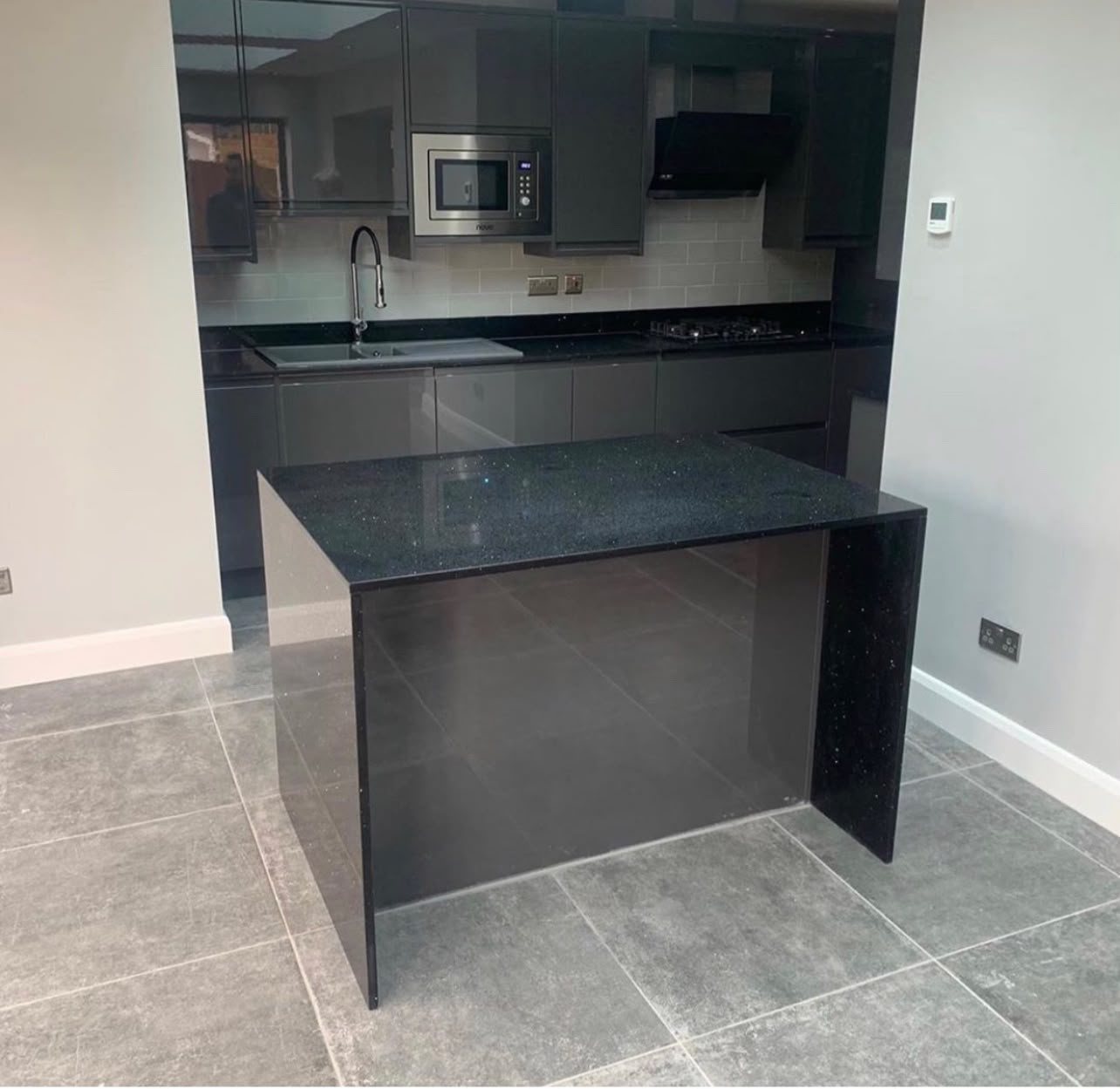
For a busy kitchen, sparkle quartz is the most forgiving finish of all: the mirror fleck hides crumbs, water marks and fine wear that would show on a plain surface.
04 / 09
What are the disadvantages of quartz worktops?
Heat is the main one, and it follows from the resin. A pan straight off the hob can scorch a pale quartz or, worse, crack it through thermal shock. Slow cookers, air fryers and anything with a heating element left running on the surface are the modern version of the same problem. A scorch is a change to the resin, so it will not clean off, and heat damage is not covered by either guarantee.
It is not one for outside. Daylight through a normal kitchen window will not change the look of a quartz worktop, and we would not tell you otherwise, but one end of a worktop under a rooflight or a south-facing glazed wall, in direct sun year after year, is a different case. There a resin-free surface is the safer choice, and our guide on Dekton vs quartz covers that comparison in full.
Joins are visible to a degree. A slab is finite, so a long run has one, typically 2 to 3mm, glued and tinted to match. On a plain quartz it can be very hard to find; on a veined one the pattern stops at the line. Where the joins go is agreed with you before anything is cut, and it matters more than people expect.
And it is not the cheapest surface you can buy. Our guide to the types of kitchen worktop sets quartz against the cheaper boards honestly, including the cases where one of them is the better buy.
05 / 09
Can you put hot pans on a quartz worktop?
No. The short form on our own spec tables is "Use a trivet (the resin scorches)", and it is the one rule quartz has. Put pans, oven trays and anything with a heating element in its base on a trivet or a board, every time, including slow cookers and air fryers left running. A trivet costs a few pounds and removes the question entirely.
Boiling water deserves the same respect: tip it into the bowl, not across the stone. None of this is a reason to avoid quartz if your household already reaches for a board without thinking about it. It is a reason to be honest with yourself if it does not.
If hot pans go straight onto the worktop in your house
- Granite: excellent (hot pans are fine), because there is no resin in it
- Sintered stone and Dekton: excellent (nothing in it can scorch)
- Quartz: keep it, and keep a trivet beside the hob
06 / 09
Do quartz worktops scratch or stain?
Everyday use will not scratch quartz, but it is not scratch-proof, and it will always win against a knife: you will blunt the blade first. Use a board for the knife’s sake and for the edge of the sink opening, where chips start. Grey lines left by a pan base usually look like scratches and are not; they are metal transferred from the pan, and they wipe off. Our guide on whether you can cut on a stone worktop explains how to tell the two apart.
Spills sit on the surface rather than in it, because nothing soaks into quartz. Warm water, a little washing-up liquid and a soft cloth does almost everything; a pH-neutral cleaner deals with the rest. The full routine, and the products that attack the resin, are in our guide on how to clean quartz worktops.
Chips happen at front edges and around the sink and hob openings. Most can be filled with a tinted resin and polished back so they are hard to find, which is a repair for someone with the materials rather than a job for a general filler from a hardware shop.
07 / 09
How much do quartz worktops cost per m² and per metre?
Supply only, our quartz runs from £130 to £500 per square metre, and most designs sit between £150 and £270/m². The cheapest way into quartz is our own collection, from £130/m², with Silestone starting at £150/m²; Silestone also runs higher, with most of its designs between £192 and £320/m² against £140 to £180/m² for ours. Those figures are the slab alone, before it is cut, finished, delivered and fitted.
| Compared | Colours | From | Most colours | Top of range | Per linear metre |
|---|---|---|---|---|---|
| Worktop Worx collection | 36 | £130/m² | £140 to £180/m² | £280/m² | £78 to £108/m |
| Silestone | 30 | £150/m² | £192 to £320/m² | £500/m² | £90 to £192/m |
| All quartz we sell | 69 | £130/m² | £150 to £270/m² | £500/m² | £78 to £162/m |
The per-metre column is supply only, per linear metre at the standard 600mm depth, from the cheapest design to the top of the usual band: the square metre price multiplied by 0.6. Standard base units are 600mm deep, as our guide to worktop depth and the other standard sizes explains, though a finished top often runs a little deeper at the front, and a centre unit is usually deeper still.
Neither figure is the price of a fitted kitchen, and no honest per-metre installed price exists, because two kitchens of the same area can differ by more than the stone costs. How the kitchen falls onto a slab, the number of openings, the shape of the front edge and the access all move the total, and our guide to what affects worktop cost goes through each of them.
08 / 09
Is branded quartz better than unbranded?
Of our 69 quartz designs, 30 are Silestone, the quartz brand made by Cosentino, 36 are our own Worktop Worx collection, and 3 are other quartz. In a domestic kitchen the difference within a price band is almost always pattern rather than performance: a mid-range white and a premium one behave the same, and you are paying for the veining. We will tell you when that is the case, because it is the fastest way to take money off a quote without regretting it later.
What a name does give you is a specific, nameable product: two quotes that both say "quartz" are not comparable until each names the brand, colour, finish and thickness. The free samples we post cover our own collection only. Silestone and the other quartz are best judged from the slab.
09 / 09
Are quartz worktops the best choice for a kitchen?
For a normal indoor family kitchen, quartz is the answer most of the time, and the real argument is about which quartz rather than which material. It loses to granite if you want natural stone and cook with pans straight off the hob, and to sintered stone in direct sun or where a very thin mitred edge is the point.
The closer calls each have their own page. Quartz vs granite goes through heat, sealing and natural character; Dekton vs quartz goes through heat, chipping at the edge and the cost of fabricating each; and the overview of worktop types puts all six common materials on one page, with prices for the three we fit.