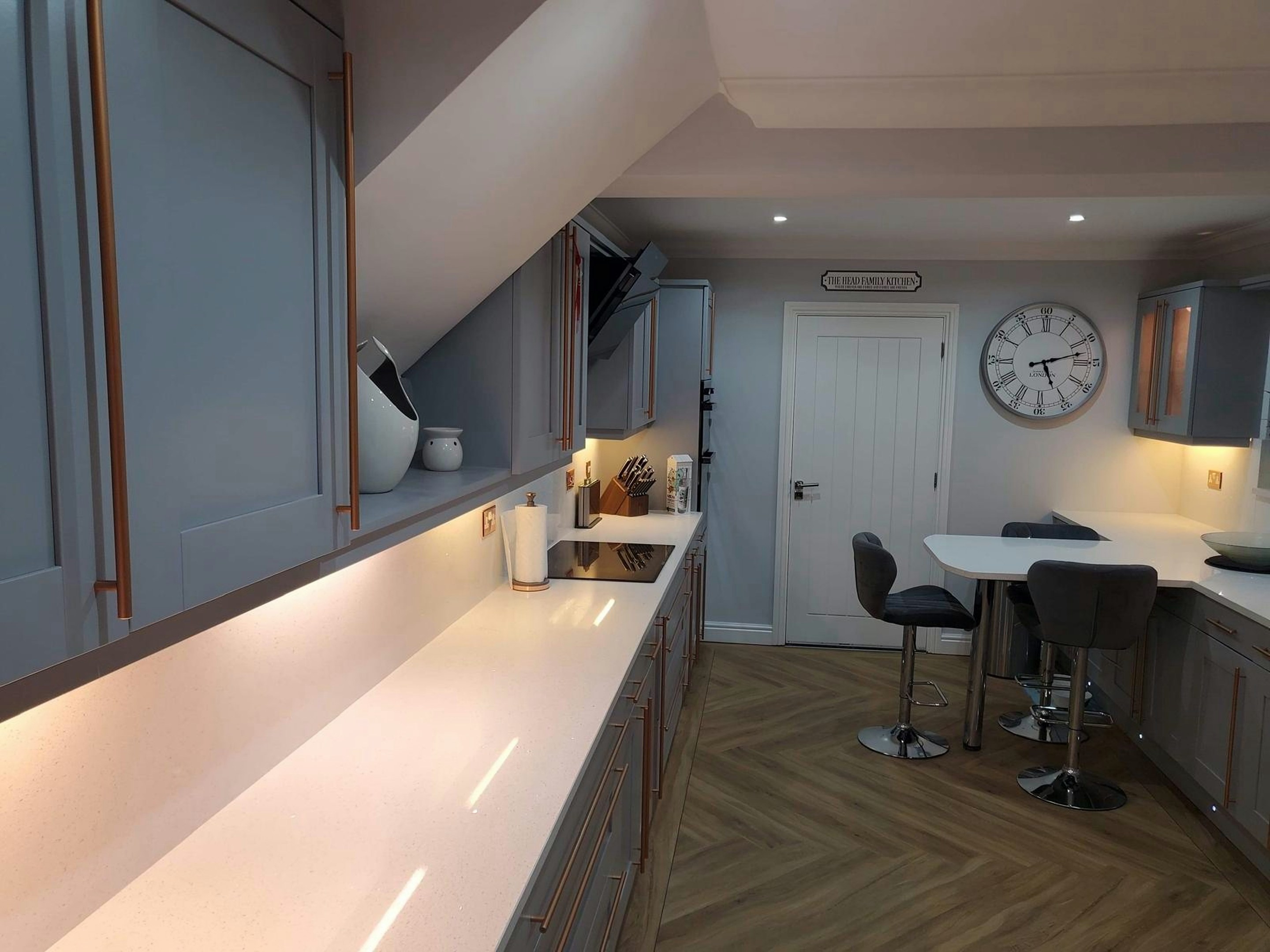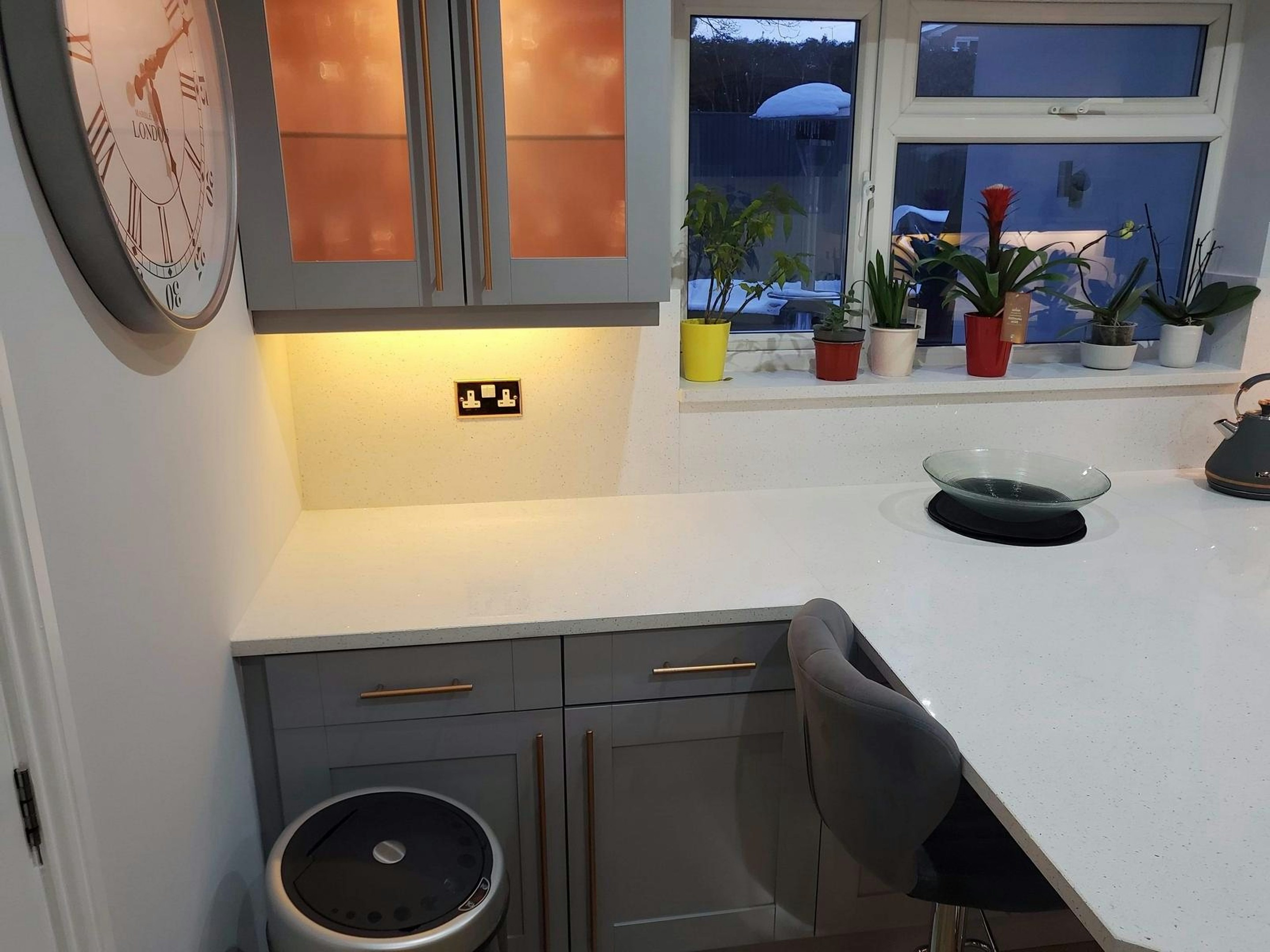
Somebody put a pan down. Not for long, a minute, maybe two, while they found a trivet or answered the door. And now there is a mark: a ring or a patch that is slightly the wrong colour, often a little yellow or grey, sometimes with a faint bloom around the edge, and it does not come off. The first thing worth knowing is that you are not looking at a stain. Nothing has soaked in, because there is nowhere for it to soak. What has happened is a chemical change in the material itself, and understanding which part of the material changed tells you everything about whether you can do anything about it.
01 / 06
What quartz actually is, and what heat does to it
The short answer
- Quartz surfacing is ground stone held together by a polymer resin. Under heat, it is the resin that fails, not the stone.
- That is why no cleaner works. There is nothing on top of the surface to remove, the surface itself has changed.
- Abrasive creams and scouring pads make it visibly worse, because they matt the polish around the mark as well.
- A true resin burn is permanent. The realistic options are live with it, attempt a specialist repair that may still show, or replace the piece.
- Every manufacturer we have read excludes heat damage. Nobody is paying for this but you.
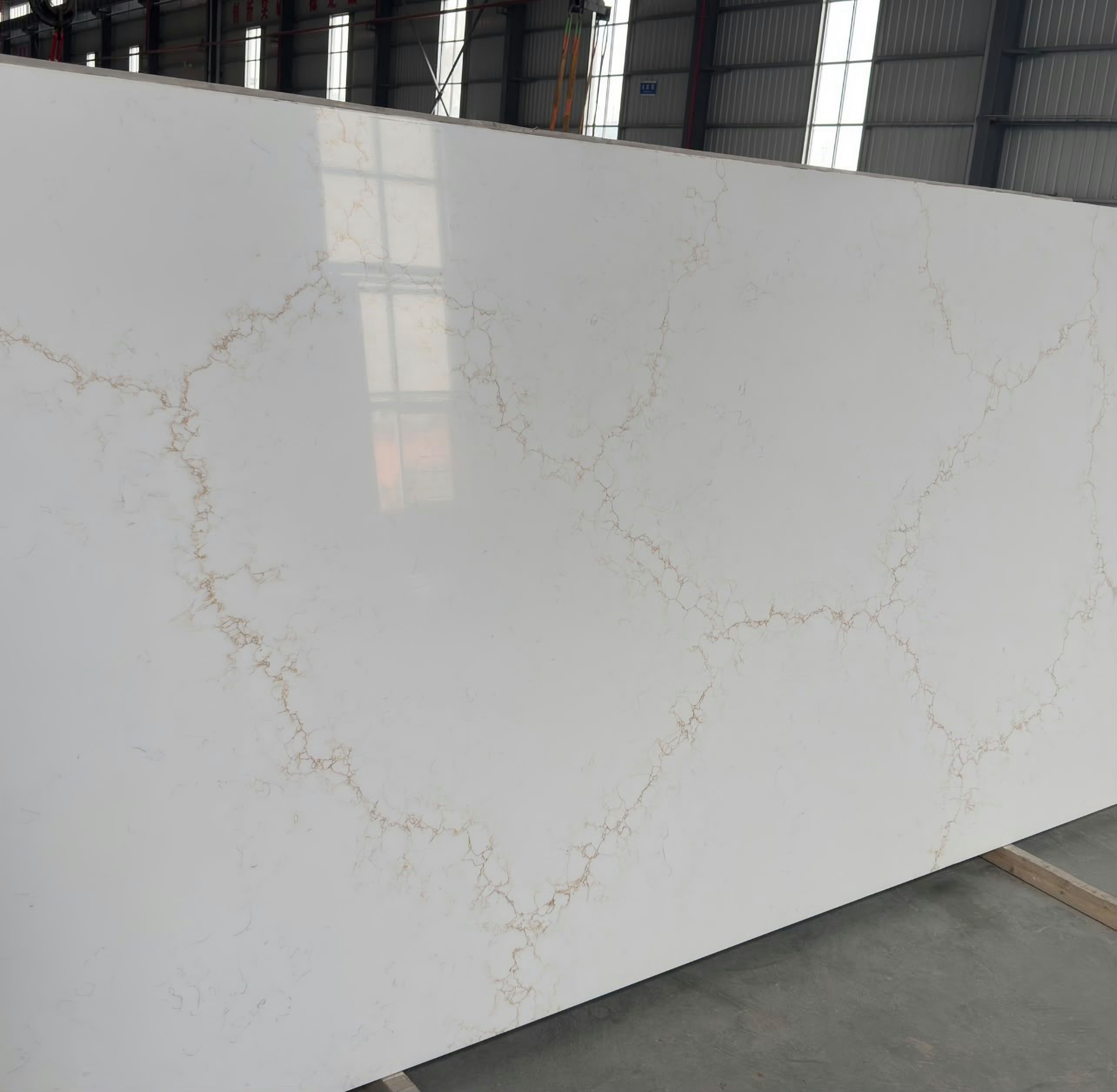
A quartz worktop is not a slab of quartz. It is quartz that has been crushed, graded, mixed with pigment and a polymer resin binder, pressed under vacuum and cured. The mineral gives it hardness and its appearance; the resin is what holds the whole thing together and what gives the surface its gloss and its non-porosity. Two materials, doing two jobs, with very different tolerances.
Quartz the mineral does not care about a hot pan. The resin does. Polymers degrade with heat in a way that is not reversible: they discolour, they lose their gloss, they can craze, and at the extreme they scorch. Which is why a heat mark on quartz appears in the surface rather than on it, and why it usually looks exactly the way a slightly burnt plastic looks, because that is what it is.
What happens under the pan
- Pan set downheat transfers
- Binder heatsfaster than stone
- Polymer changescolour and gloss
- Coolschange locks in
- Mark remainsin the surface
There is a second, less common outcome. Concentrated heat on one spot puts the material under thermal stress, and a run of stone that is already under strain (bridging a void, or spanning between cabinets that are not level) can crack rather than merely scorch. If you have a mark and a line, you may be dealing with something that has cracked at the cut-out rather than only a burn.
02 / 06
Why scrubbing cannot work, and why it usually makes things worse
Search this problem and you will find a wall of pages recommending baking soda, cream cleaners, abrasive powders and scouring pads. That advice is not merely useless for a resin burn. It is actively harmful, and it is worth being precise about why.
A cleaner removes something that is sitting on a surface. A resin burn is not sitting on the surface, the surface is the damage. Rubbing it therefore does nothing to the mark. What it does do is abrade the polished, undamaged material immediately around the mark, because polished quartz is a fine finish and household abrasives are perfectly capable of dulling it. The result is a discoloured patch surrounded by a larger matt halo where somebody has been scrubbing. Now you have two problems, one of which you made, and the second one is bigger than the first.
Strong chemicals are the same story with a different mechanism. Oven cleaner, drain cleaner, paint stripper and bleach left standing will attack the binder in their own right. A reader trying to lift a burn with an aggressive product is putting a chemical attack on a surface that has already had a thermal one.
03 / 06
Burn, film or stain: telling them apart
Three different marks get called the same thing, and they need entirely different responses. The test takes a minute and needs nothing but water, a cloth and a light source held low.
| Compared | When wet | Gloss | Reversible? |
|---|---|---|---|
| Product film or residue | Disappears completely, then returns as it dries | Unchanged underneath | Yes. It is on the surface, not in it |
| Metal marking | Little change, but it moves under a cloth | Unchanged | Yes, with a stone-safe cleaner and a soft pad |
| Resin burn | Looks the same wet or dry, and often shows more strongly when wet | Dulled, crazed or glassy within the mark | No |
One more possibility is worth ruling out near a sink or a kettle: a white bloom that is gritty under a fingernail and sits proud of the surface is hard-water scale rather than anything to do with heat, and it comes off with patience. If your problem is that a whole area has gone hazy rather than that one ring has changed colour, you are probably in a different article. A surface that is dull rather than discoloured is either film or abrasion, and the test that separates those two is not the same as this one.
04 / 06
The options, in order of how much they cost
There are four, and it is worth being honest that the first one is what most people choose and is often the right call.
- Live with it. A single mark beside a hob, in a kitchen that gets used, is not a structural problem. It will bother you for about six months and then you will stop seeing it. If it is in a corner or behind a kettle, put something there.
- Have a specialist stone restorer look at it. Localised machine re-polishing can lift a very shallow gloss change, and a colour-matched resin repair can improve a small burn. Neither reliably makes a scorch invisible, and both are skilled work, ask to see photographs of the same material before and after, not a portfolio of granite.
- Replace the piece. This is the only remedy that genuinely removes the mark. It is a new template, a new piece cut from a slab, and a fitting day, and if the burn is in a long run with a join it may mean replacing more than the damaged section so the colour matches.
- Rework the layout around it. If the mark is where a hob or a chopping station wants to be anyway, a purpose-cut inset (a granite or steel trivet plate let into the surface) is occasionally a better answer than a new run. It is not invisible either, but it is deliberate, which reads completely differently.
On cost: supply-only material across the materials we work with runs from £110 to £550 per square metre before fabrication and fitting, so the arithmetic on replacing a run for one mark is usually unattractive. That is the reason to try a repair even when nobody can promise it will be invisible.
Supply-only material, per square metre
- Quartz, granite and Dekton£110–£550
05 / 06
What the warranty says, and it says it plainly
Nobody is paying for this except you, and the manufacturers are unusually direct about it. The published Caesarstone UK residential warranty excludes heat twice over. Exclusion 6 covers improper use and abuse, which "includes, but is not limited to, damage from: mishandling of the Product; flames or excessive heat". Exclusion 20 goes further and names the exact scenario:
“Thermal shock can occur when a hot pan, dish or other receptacle or object is left on the countertop for more than a brief period. Trivets or hot pads should always be used. These issues are not considered Product defects and are subject to proper care and maintenance by the owner.”
Caesarstone UK Residential Limited Lifetime Warranty, exclusion 20
Other manufacturers word it differently and exclude the same thing. There is no route through a material warranty for heat damage, and there is no route through a workmanship guarantee either, because nothing was fitted wrongly. Understanding who pays when a worktop fails is mostly about recognising which of those two documents, if either, your failure falls under, and heat falls under neither.
One qualification, because it occasionally matters. If the mark appeared during the installation itself (a fitter’s heat gun, a hot tool set down on the finished surface) that is not owner damage at all. It is damage caused by the work, and the company that did the work owns it. Photograph the run at handover, before anyone leaves, for exactly this reason.
06 / 06
Questions people actually ask
01Is quartz not supposed to be heat resistant?
It is heat resistant, which is a different claim from heat proof, and the resistance belongs mostly to the mineral rather than the binder. Quartz will take a warm plate, a mug of tea and a dish out of a low oven without complaint. What it does not take well is a pan straight off a gas ring, a slow cooker running for hours in the same spot, or an air fryer venting hot air onto the surface behind it.
02Would granite or Dekton have survived it?
Generally yes, and this is one of the few honest points in favour of both. Granite is a natural stone with no polymer binder, and sintered materials such as Dekton are fired rather than resin-bound, so neither has the component that scorches. Both can still crack under severe thermal shock, and both will happily mark from a scorched pan base, but neither burns in the way quartz does. If you are a cook who cannot be relied upon to reach for a trivet, that is a real material argument.
03Can a heat mark be polished out?
A very shallow loss of gloss with no colour change sometimes responds to machine polishing by a stone restorer. A discoloured burn does not, because the polishing removes material until it reaches undamaged resin, and by then you have a visible dish in the surface. Be sceptical of anyone who promises otherwise without seeing it.
04The mark keeps looking worse. Is it spreading?
The burn is not spreading. What usually changes is the area around it, either because somebody is cleaning it harder than the rest of the worktop or because a matt patch created by abrasive cleaning is growing. If it genuinely looks bigger each month, stop treating it and look at what is being used on it.
05Should I use a worktop saver everywhere now?
A trivet at the hob and beside the oven does almost all of the work. Two positions account for most heat damage: the landing spot next to the hob and the landing spot next to the oven door. Put something permanent in both, and stop thinking about the rest of the kitchen.
What to take away
- Quartz surfacing is ground stone in a polymer binder. Under heat it is the binder that changes, which is why a burn is in the surface rather than on it.
- No cleaner reaches it. Abrasive creams and pads dull the sound polish around the mark and make the damage look bigger than it is.
- A true resin burn is permanent. Living with it, a specialist repair that may still show, or replacing the piece are the only real options.
- Every manufacturer we have read excludes heat, and Caesarstone names hot pans specifically. There is no warranty route here.
- If the mark appeared during installation rather than in use, it is not owner damage. Photograph the finished run at handover.
Sources
Every figure quoted above is traceable to one of these. Where a source is a price survey rather than our own quoting, it is named as such in the text.
- [1]Caesarstone UK Residential Limited Lifetime Warranty (2022-08 revision), Caesarstone UK, retrieved 25 August 2026
- [2]Quartz worktop: how do you keep yours looking lovely?, Mumsnet, retrieved 25 August 2026
- [3]Worktop damaged by a hot pan, homeowner discussion, Mumsnet, retrieved 25 August 2026
- [4]Consumer Rights Act 2015, section 49: service to be performed with reasonable care and skill, legislation.gov.uk, retrieved 25 August 2026