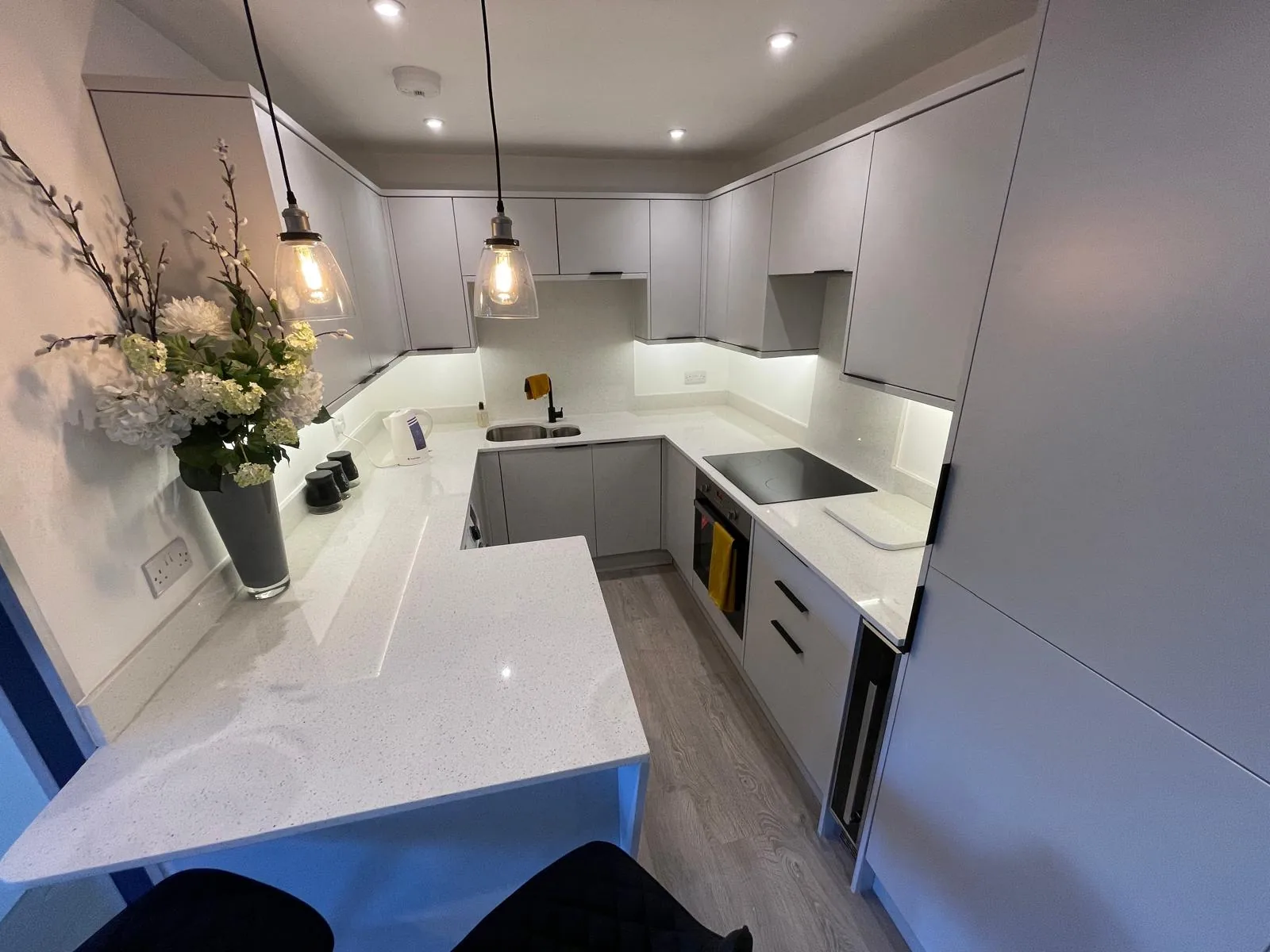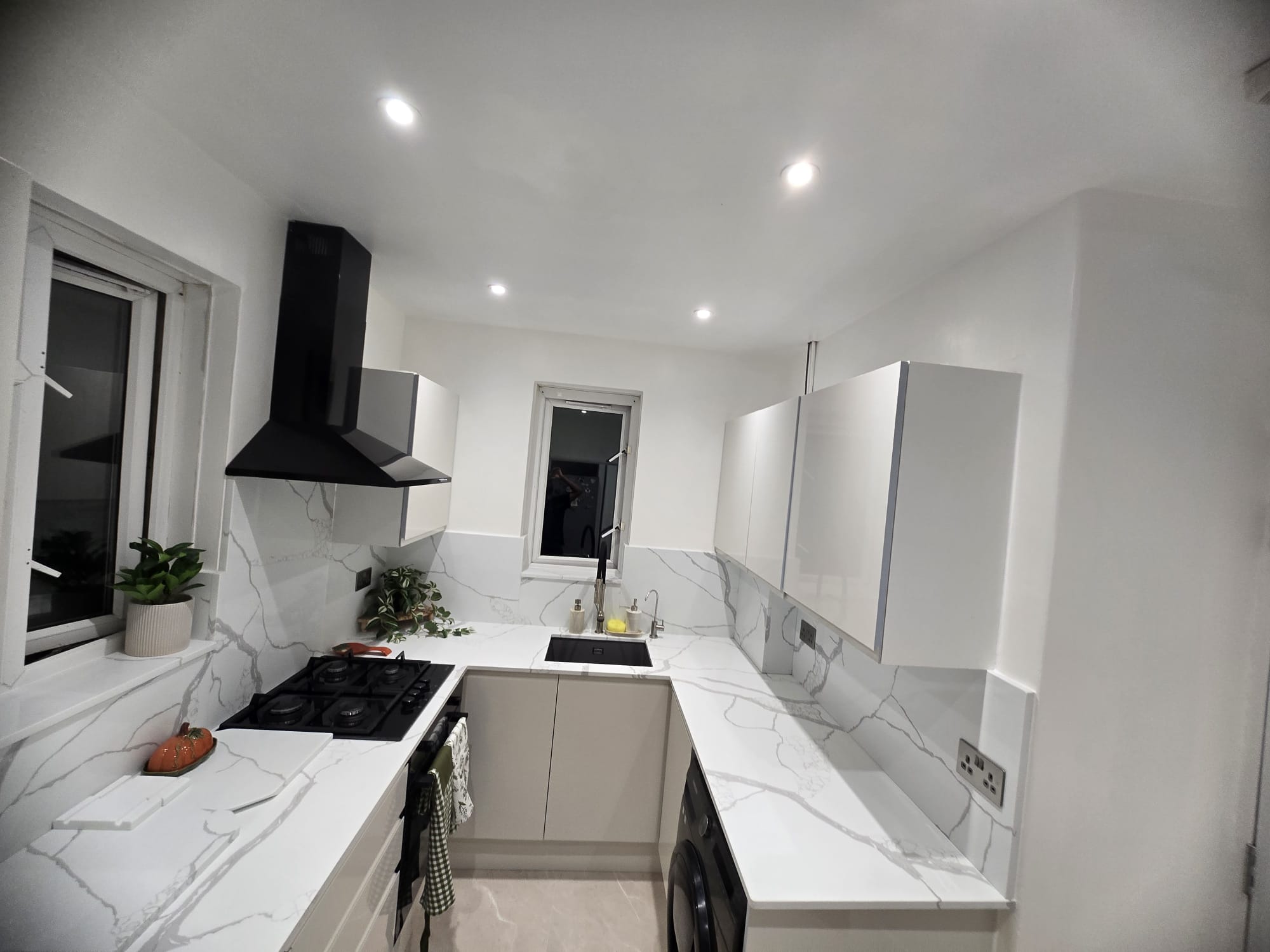
Stone worktops do not crack at random. They crack where the section is narrowest and the load is most concentrated, and in a normal kitchen that means the corners of the sink aperture and the corners of the hob aperture. That is not bad luck and it is not a defect in your particular slab. It is geometry, and it is predictable enough that a competent fabricator designs against it before the slab is cut. Which is why the first useful thing to do with a crack at a cut-out is not to phone anyone. It is to look at where the crack starts and where it goes, because that tells you what happened, and what happened decides who pays.
01 / 05
Read the crack before you read the warranty
The short answer
- A crack that begins at a cut-out corner and runs outward is a stress failure. It points at support and fabrication.
- A crack that begins at a point on the surface or the edge, with a bruise or a chip at the origin, is an impact failure. That one is yours.
- The material warranty almost certainly will not help. Failures caused by the fabricator or fitter are excluded outright.
- An edge-to-edge crack through a cut-out is a replacement piece, not a repair. Anyone who says otherwise is selling you a line you will see forever.
Get your eye down to worktop level with a torch held almost flat against the surface. Raking light shows a crack far better than overhead light does, and it will also show you whether the two sides of the crack sit in the same plane. Then trace the crack to its ends. One end is the origin, and it is nearly always the end nearest a corner, a hole or an edge.
A stress crack has a clean, continuous line, usually leaving a cut-out corner at something close to forty-five degrees, and it widens away from the corner rather than towards it. There is no bruising, no chipping and no crushed material at the origin, because nothing hit it. An impact crack looks different: it starts at a visible point of damage, often with a small chip or a shallow crater, and it radiates. If somebody dropped a Le Creuset lid on the worktop, you can usually see exactly where.
Thermal cracking is the third pattern and the least common of the three on a cut-out. It shows up close to a heat source (the hob aperture, a dishwasher vent, occasionally a boiling-water tap), and tends to be short and locally chaotic rather than one long clean line. It is also the pattern most likely to be a heat mark rather than a crack, so check whether you are looking at a fracture at all before deciding you have one.
02 / 05
Why a cut-out is where it breaks
Take a 3.6-metre run of 20mm quartz with a 550mm sink aperture in it. Across the sink, the stone is no longer a continuous slab: it is two narrow bridges, one in front of the sink and one behind, joined at four corners. In a kitchen with an inset hob and a sink in the same run, the same stone may be reduced to a strip 80mm wide in places. Every load that the full run could carry easily is now being carried by those strips, and it is being funnelled into the four corners where they meet the aperture.
That funnelling is what engineers call a stress riser. A sharp internal corner concentrates stress at a point; a radiused one spreads it around a curve. It is the same reason aircraft windows are rounded. In stone fabrication the practical consequences are specific and checkable: cut-out corners should be radiused rather than left square, the cut should be made wet on a machine rather than dry with an angle grinder, and the run should be supported so that the aperture is not being asked to bridge a void.
Then there is what happens under the stone. A sink aperture usually sits above a cabinet with no top rail, because the sink has to drop through. A hob aperture frequently sits above a drawer stack, and drawer stacks are where somebody has been known to cut out a rail to get a deep pan drawer in. One homeowner on DIYnot described exactly that in 2022, removing a 900mm drawer rail to accommodate a hob, and then asking how to support 30mm quartz across the resulting span. Asking is the right instinct. Not asking is how you get a crack eighteen months later.
Where the load goes at a sink aperture
- Full sectionload spread
- Aperture cuttwo bridges left
- Cornersstress concentrates
- Support gapbridging a void
- Crackstarts at a corner

03 / 05
The sentence that decides the argument
People reach for the warranty at this point, and it is worth reading rather than assuming. The Caesarstone UK residential warranty is published as a four-page PDF that anyone can download, and exclusion 18 says this:
“Any failures due to fabricators’/installers’ work. Fabricators, including Caesarstone Certified Fabricators, are professionals who operate their business completely independently of Caesarstone. Caesarstone is not responsible for any act or omission of fabricators/installers. Therefore, any failures resulting from fabrication and/or installation are the sole responsibility of the fabricator and/or installer of the Product. If you have complaints of this kind, you should contact the fabricator/installer who you engaged to perform the work.”
Caesarstone UK Residential Limited Lifetime Warranty, exclusion 18
Read that carefully, because it inverts the usual assumption. For a crack at a cut-out, the material warranty is not merely unhelpful. It is designed to point you somewhere else. And the exclusions on either side of it close the door further. Exclusion 22 excludes "Any failures due to inadequate support for the installation". Exclusion 24 excludes "Chips or cracks that are a result of not following the minimum requirements for edge details". Exclusion 23 excludes "Any chips or cracks that are a result of ‘dry’ cutting or polishing". Exclusion 26 excludes "Cracking due to uneven cabinets or flooring, structural settling or movements, improper installation".
Every one of those describes a mechanism that could produce your crack, and every one of them is out of scope for the manufacturer. That is not Caesarstone being awkward; it is the normal structure of the trade, and other manufacturers exclude the same things in their own wording. The practical meaning is simple. Your counterparty is the company that cut and fitted the stone, not the company that made it. Understanding who pays when a worktop fails is most of the work here.
| Mechanism | What you would see | Sits with |
|---|---|---|
| Square, unradiused cut-out corner | Crack leaving a sharp corner at an angle, no impact damage | Fabricator |
| Aperture bridging an unsupported span | Crack at a corner, plus a visible void under the cut-out | Fitter |
| Dry cutting on site | A cut edge with chipping and burn marks along it | Fabricator or fitter |
| Cabinets out of level at template | Crack with no impact origin, often twelve months or more later | Fitter |
| Impact | A chip or bruise at the origin, radiating cracks | Owner |
| Thermal shock | Short local cracking beside a heat source, often with discolouration | Owner |
| Internal slab tension | Almost always cracks during cutting, in the workshop | Manufacturer |
04 / 05
Can it be repaired? The honest answer
This is where a lot of pages go vague, so here is the position plainly. It depends on where the crack ends, not on how long it is.
- A crack that starts at a cut-out corner and stops within the body of the stone can often be stabilised: the crack is opened slightly, flooded with a colour-matched resin, cured and re-polished. On a busy-patterned quartz or a granite this can be genuinely hard to find afterwards. On a plain white it will be findable in the right light forever.
- A crack that runs from the aperture to the front edge, or from the aperture to the back edge, has separated the piece. The tension across the section has already been released, the two halves are no longer acting as one, and filling the line does nothing structural. It will move, it will collect grime along its length, and it will look like exactly what it is.
- A crack across the front bridge of a sink aperture (the narrow strip between the sink and the front edge) is effectively always a replacement. That strip is what stops the sink pulling the front of the worktop into the cabinet.
If it is a replacement piece, the work does not stop at the stone. The sink comes out, the tap comes off, the old piece is broken out and carried away, the run is re-templated because a room that has been lived in is never quite the room that was measured, and a new piece is fabricated and fitted. From template to fitting is 5 to 10 working days in our workshop, and the day either side of that is plumbing and making good.
Fabrication time for a replacement piece
- Template to fitting3 days–7 days
05 / 05
What to do about it now
Photograph the origin, not the crack
Everyone photographs the long dramatic line. What settles the argument is a close, raking-light shot of the ten centimetres at each end. Include something for scale.
Open the cupboard and photograph what is under the cut-out
You are looking for whether the aperture is bridging a void, whether any rail has been removed, and whether there is packing or battening under the stone. Take the picture even if you do not know what you are looking at. If the sink itself has come away from the underside while you are down there, that is a separate failure with a separate remedy, and it needs dealing with first.
Check whether the run rocks
Press down firmly at several points along the front edge, one hand at a time. Any movement, any click, any tap of stone against cabinet, and you have a support problem as well as a crack.
Write to the fitter, describing the crack rather than the blame
Where it starts, where it ends, when you first saw it, and whether anything was dropped. If nothing was dropped, say so in that first email, because it will be the first thing put to you.
Ask for the mechanism in writing
Not "is it covered" but "what caused it". A stated cause can be checked against the photographs you already have. If the answer arrives before anyone has looked underneath, it is not a diagnosis.
01It cracked within a week of fitting. Does that make it easier?
Usually yes, because nothing has had time to happen to it. A failure that early is far more likely to be fabrication or handling than anything you have done, and it lands squarely on the company that fitted it. Report it the day you see it.
02Does 30mm stone crack less than 20mm at cut-outs?
A thicker section is stiffer, so it tolerates a given span better. It does not make a square corner safe, and it does not replace support. Thickness is one variable among several, and choosing 30mm is not a substitute for radiused corners and something solid under the aperture.
03The fitter says the crack is a natural fissure in the stone.
On granite that is occasionally true and worth checking, because a fissure does not change the plane of the surface and a fingernail glides over it. On quartz and on sintered material it is not an available explanation. They are manufactured, and a line running out of a machined corner is a fracture.
04Can I just live with it?
For a short stabilised crack in the field of the stone, yes, and plenty of people do. For a crack through a sink aperture, be careful. Once the section is separated, the weight of a full sink is being carried differently from the way it was designed to be, and cracks through apertures tend to grow rather than settle.
05What if the crack appeared much later, with nothing dropped on it?
Then the cut-out may not be the story at all. A crack that appeared twelve months or more after fitting, with no impact, is usually a movement failure traceable to what was under the stone on template day, and it is worth reading that case separately.
What to take away
- The origin of the crack is the diagnosis. A clean line leaving a cut-out corner is a stress failure; a chip or bruise with cracks radiating from it is an impact failure.
- Cut-outs concentrate load at their corners. Radiused corners, wet cutting and support under the aperture are the three things that prevent it, and all three are decided before the slab is cut.
- Caesarstone exclusion 18 makes failures resulting from fabrication or installation the sole responsibility of the fabricator or installer. The material warranty is not your route here.
- A crack contained within the body of the stone can often be stabilised and filled. A crack running edge to edge through an aperture is a replacement piece.
- Photograph the ends of the crack and the underside of the cut-out before anyone visits. That evidence disappears the moment somebody starts work.
Sources
Every figure quoted above is traceable to one of these. Where a source is a price survey rather than our own quoting, it is named as such in the text.
- [1]Caesarstone UK Residential Limited Lifetime Warranty (2022-08 revision), Caesarstone UK, retrieved 25 August 2026
- [2]Quartz worktop support, supporting 30mm quartz where a drawer rail was removed for a hob, DIYnot, retrieved 25 August 2026
- [3]20mm quartz worktop unsupported, homeowner asking about an unsupported span, DIYnot, retrieved 25 August 2026
- [4]Consumer Rights Act 2015, section 49: service to be performed with reasonable care and skill, legislation.gov.uk, retrieved 25 August 2026
- [5]Problem with building work, decorating or home improvements, Citizens Advice, retrieved 25 August 2026