An L-shaped kitchen comes to about £2,095 fitted at MyJobQuote’s published UK rates, and the stone in it costs £310 to £1,551 on our own supply-only band, depending on which quartz you choose. The difference is the work: templating, cut-outs, grooves, removal and a skip. Every page that ranks for this question does the same thing. It gives you a rate (so much per metre, so much per square metre), and then leaves you to work out how many metres your kitchen contains, which is the one part you cannot do, because you do not yet know. This page does the arithmetic instead. It starts from the material band, converts between the two units the trade quotes in, adds the extras that are genuinely separate line items, and says plainly which parts of the number nobody can know until somebody has stood in your kitchen with a template.
01 / 07
The short answer
The short answer
- Stone is sold supply-only in a wide band. Ours runs £110 to £550 per square metre, and where you land inside it is mostly colour and pattern, not quality.
- A typical London kitchen is between two and four and a half square metres of worktop. That is a smaller number than most people guess.
- Fabrication and fitting are charged on top of material, and the extras (cut-outs, upstands, edge work, removal, disposal) are itemised separately by nearly everyone.
- The quoted rate is not the price. The area, the number of cut-outs and the disposal are what turn one into the other.
Start with the material, because it is the number people ask for first and the only one this business publishes flatly. Supply-only stone runs from £110 to £550 per square metre. That is a five-fold spread and it is real: a plain mid-grey engineered quartz and a heavily veined book-matched slab are the same product category and nothing like the same price. Nothing about the cheaper end of that band is defective. It is a colour decision with a price attached.
Supply-only material, per square metre
- Quartz, our supply-only band£110–£550
- Quartz, MyJobQuote£220–£900
- Granite, MyJobQuote£270–£450
Those bands overlap without agreeing, and that is not a contradiction. It is the unit problem. Some of the trade quotes per square metre of finished surface and some quotes per linear metre and per square metre in the same document without saying which applies where. Until you have converted both quotes to the same unit you are not comparing anything.
02 / 07
How many square metres your kitchen actually is
Worktop depth is almost always 600mm, because that is what a standard base unit plus a door front comes to. So a three-metre run of worktop is 3.0 × 0.6 = 1.8 square metres, and a whole galley kitchen with runs down both walls is rarely more than three and a half. People who have been told "about £400 a square metre" and are bracing for a five-figure number are usually carrying a badly wrong area in their heads.
| Layout | Dimensions | Area | Cut-outs |
|---|---|---|---|
| Single run | 3.6m along one wall | 2.16 m² | Sink and hob |
| Galley | 3.6m and 2.4m facing runs | 3.60 m² | Sink and hob |
| L-shape | 3.2m leg, 2.1m return | 2.82 m² | Sink and hob |
| U-shape | 3.0m back, two 2.2m returns | 3.72 m² | Sink and hob |
| L-shape with island | as above plus 1.8m × 0.9m | 4.44 m² | Sink, hob, sometimes both |
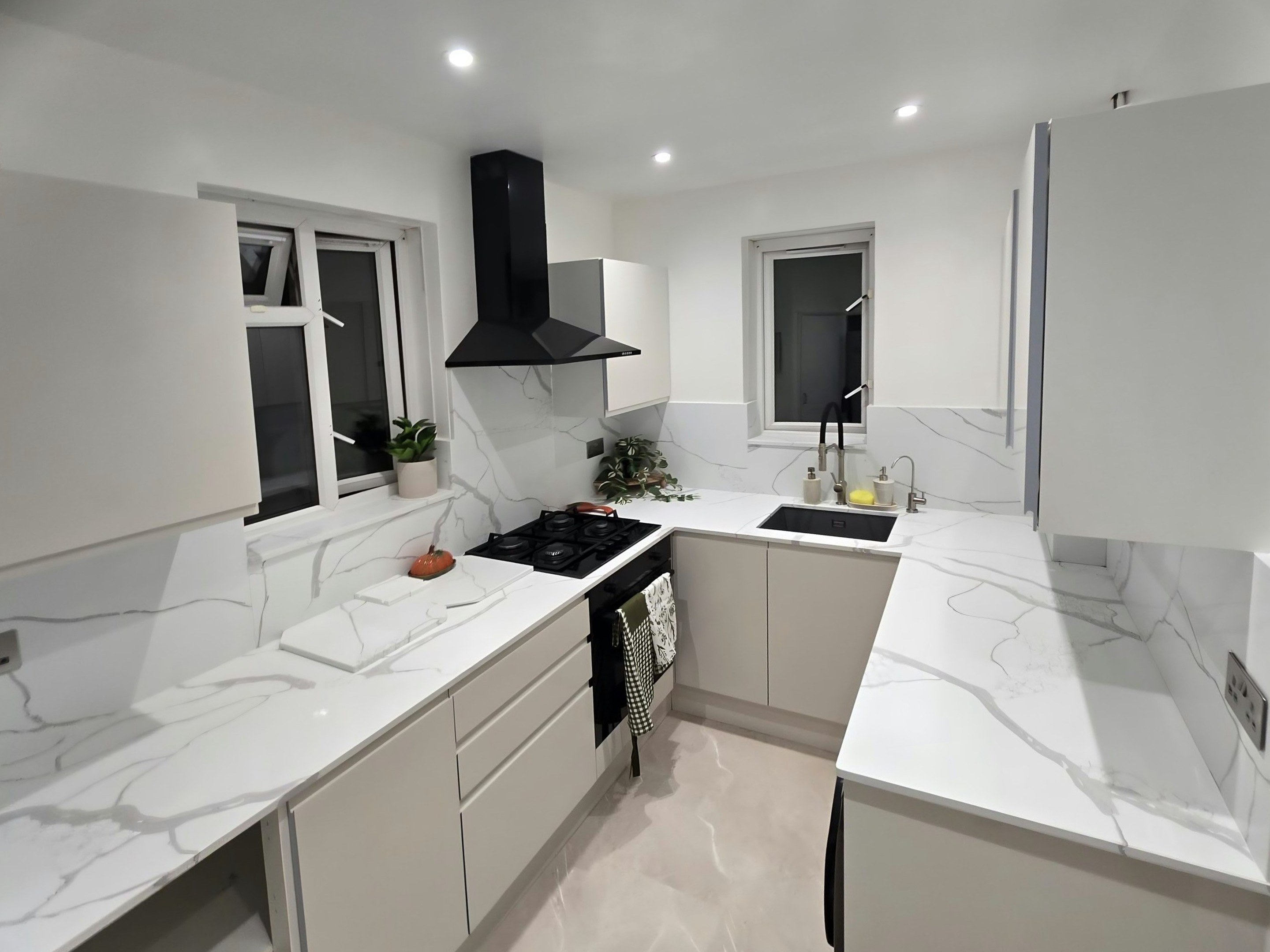
Multiply any of those by a rate and you have the material. The L-shape at 2.82 m² is £310 of stone at the bottom of the band and £1,551 at the top. The island kitchen at 4.44 m² is £488 to £2,442. If you want each of the five costed all the way through, with the extras added and the totals reconciled, that is the whole job of the article on cost by kitchen layout.
03 / 07
What sits on top of the material
Material is somewhere between a third and two-thirds of a fitted price, and the rest is work: templating, cutting, machining the cut-outs, profiling and polishing the edges, delivering, and fitting. Almost every firm in the country itemises at least some of that separately, which is why two quotes for the same kitchen can differ by hundreds of pounds without either being wrong.
The figures below are MyJobQuote’s published UK rates, read from its quartz cost page as updated on 18 February 2026 and its replacement page as updated on 12 May 2026. They are an independent aggregator rather than a fabricator, which makes them the fairest public yardstick available. Held against a base of 5.3 linear metres at the £250 per metre supply-and-fit average that same page publishes, an ordinary L-shaped kitchen looks like this.
A £2,095 L-shape, by line item
- Supply and fit£1,325
- Two cut-outs£380
- Drainer grooves£150
- Old top removed£150
- Skip£90
Thirty-seven per cent of that total is not the worktop. It is holes, grooves, demolition and a skip, and every one of those items is optional in the sense that a quote can be written without them and still look like a quote. That is the mechanism behind almost every complaint about a price going up after acceptance, and it is the subject of the piece on what a quote leaves out.
04 / 07
Where London changes the number
Not as much as people expect on the material, and more than people expect on everything else. Stone costs what stone costs; a slab does not know which borough it is going to. What London does is make the work around the stone harder and the disposal more expensive.
- Access. A three-metre piece of stone is carried in on edge by two or three people and cannot be set down halfway. A second-floor flat with a turn in the stair is a different job from a ground-floor terrace, and it is priced as one.
- Parking. A controlled bay, a suspension, or a congestion and emissions charge on the day are real costs and they are usually passed on. Ask whether they are inside the number or outside it.
- Disposal. MyJobQuote puts skip hire between £90 and £440 nationally, and the top of that range is a London number. Removing an old worktop it prices separately again, at £100 to £200.
- Timing. Where a lift is shared or a stairwell is communal, the fitting window may be fixed by a building management rule rather than by the fitters, which can add a visit.
None of that is a surcharge for the postcode. It is the actual cost of doing the actual work in a building that was not designed for it, and a firm that has not asked about your access has not priced your job. It has priced an average one.
05 / 07
The three questions that move the number most
Once the area and the extras are settled, three decisions are left, and each has its own article because each has a real answer rather than a preference.
Should you buy supply only and fit it yourself?
Genuinely worth costing if you have the access, the labour and the nerve. What you take on is a slab you cannot drop, a levelling job you cannot fudge, a seam bond you get one attempt at, and full liability for breakage. Some jobs suit it. Most do not, and the honest version of that argument is worth reading before you decide.
Is the cheapest quote cheap for a reason?
Sometimes yes and sometimes no, and the reason is rarely the one people assume. Fabricating engineered stone safely costs money: water suppression, extraction, respiratory protection and health surveillance are legal duties with equipment and time attached. A quote that is suspiciously cheap against every other quote is worth understanding rather than simply refusing.
Would an overlay or an offcut do the job instead?
For a utility room, a downstairs cloakroom or a small island, an offcut can be genuinely cheaper, though not proportionally cheaper, for reasons that are worth understanding. And for a kitchen whose units will not carry stone, an overlay is a legitimate answer. We do not fit them, which is exactly why our comparison of them is worth reading.
06 / 07
When the money is actually due
Payment terms in this trade vary more than prices do. Published terms across the industry include deposits of ten, thirty and fifty per cent, with balances variously due two days before installation, on the morning of it, or before the fitters leave. Ours are set out stage by stage on the written quote, so you know them before you agree to anything.
The order money and work happen in
- Enquiryestimate from plans
- Templatemeasured, fixed price
- Fabrication5–10 working days
- Fithalf a day, usually
The distinction that matters is between an estimate and a quotation. Anything given before a template is an estimate worked from your plans, and it is genuinely subject to what the templater finds, walls out of true, a run longer than the drawing, a sink that turned out to be undermounted. Anything given after a template should be a fixed figure, and if it is not, ask which part of it is still moving and why.
07 / 07
Questions people actually ask
01Why will nobody give me a price over the phone?
Some will, and it is an estimate. The reason it cannot be a quotation is that price follows area, cut-outs and access, and none of those are knowable from a description. One fabricator has published its reasoning plainly: templating, manufacture and installation are a significant part of the quotation, and sometimes the labour exceeds the material cost. A number given without those inputs is a guess with a decimal point.
02Is quartz cheaper than granite?
Not reliably. MyJobQuote’s published bands put granite at £270 to £450 per square metre and quartz at £220 to £900, so the ranges overlap heavily and the colour you pick matters far more than the material category does. Choose on how it behaves and how it looks, then price the specific slab.
03Does a thicker worktop cost more?
Yes, and less than people expect. MyJobQuote’s polished quartz tables show standard 20mm at £205 to £260 per linear metre and standard 30mm at £220 to £280, roughly seven per cent, not fifty. Thickness is an appearance and detailing decision with a modest price attached.
04Should I be suspicious of a quote that is much lower than the rest?
Be curious rather than suspicious. Ask what material, in what thickness, with which extras included, at which VAT status, and whether the firm fabricates in its own workshop or subcontracts. Most low quotes resolve into one of those answers. Where they do not, the compliance costs of fabricating engineered stone are the next place to look.
05How accurate is an estimate from my kitchen plans?
Close, if the plans are dimensioned and current. What moves it is the things the drawing does not show: whether the walls are square, whether the units are level, where the joins have to fall, and how the slab gets into the room. Send the plan, get the estimate, and treat the templated figure as the real one.
What to take away
- Work out your square metres before you compare anything. At 600mm deep, most London kitchens are between 2 and 4.5 m², which is less than people assume.
- Supply-only material runs £110 to £550 per square metre here. Where you land is mostly about colour and pattern, not quality.
- On an ordinary L-shape priced at published UK rates, well over a third of the total is cut-outs, grooves, removal and disposal rather than worktop.
- London costs land on access, parking and disposal rather than on the stone itself. A firm that has not asked about your stairs has not priced your job.
- An estimate before template is genuinely provisional. A price after template should be fixed, and you are entitled to ask which parts are not.
Sources
Every figure quoted above is traceable to one of these. Where a source is a price survey rather than our own quoting, it is named as such in the text.
- [1]Quartz worktop cost guide (updated 18 February 2026), MyJobQuote, retrieved 25 August 2026
- [2]Kitchen worktop replacement cost guide (updated 12 May 2026), MyJobQuote, retrieved 25 August 2026
- [3]Can you give a price per square metre?, Affordable Granite, retrieved 25 August 2026
- [4]HSE says no dry cutting of engineered stone ahead of inspection crackdown, Health and Safety Executive, retrieved 25 August 2026
- [5]Installing stone worktops: controlling silica dust on site, Health and Safety Executive, retrieved 25 August 2026