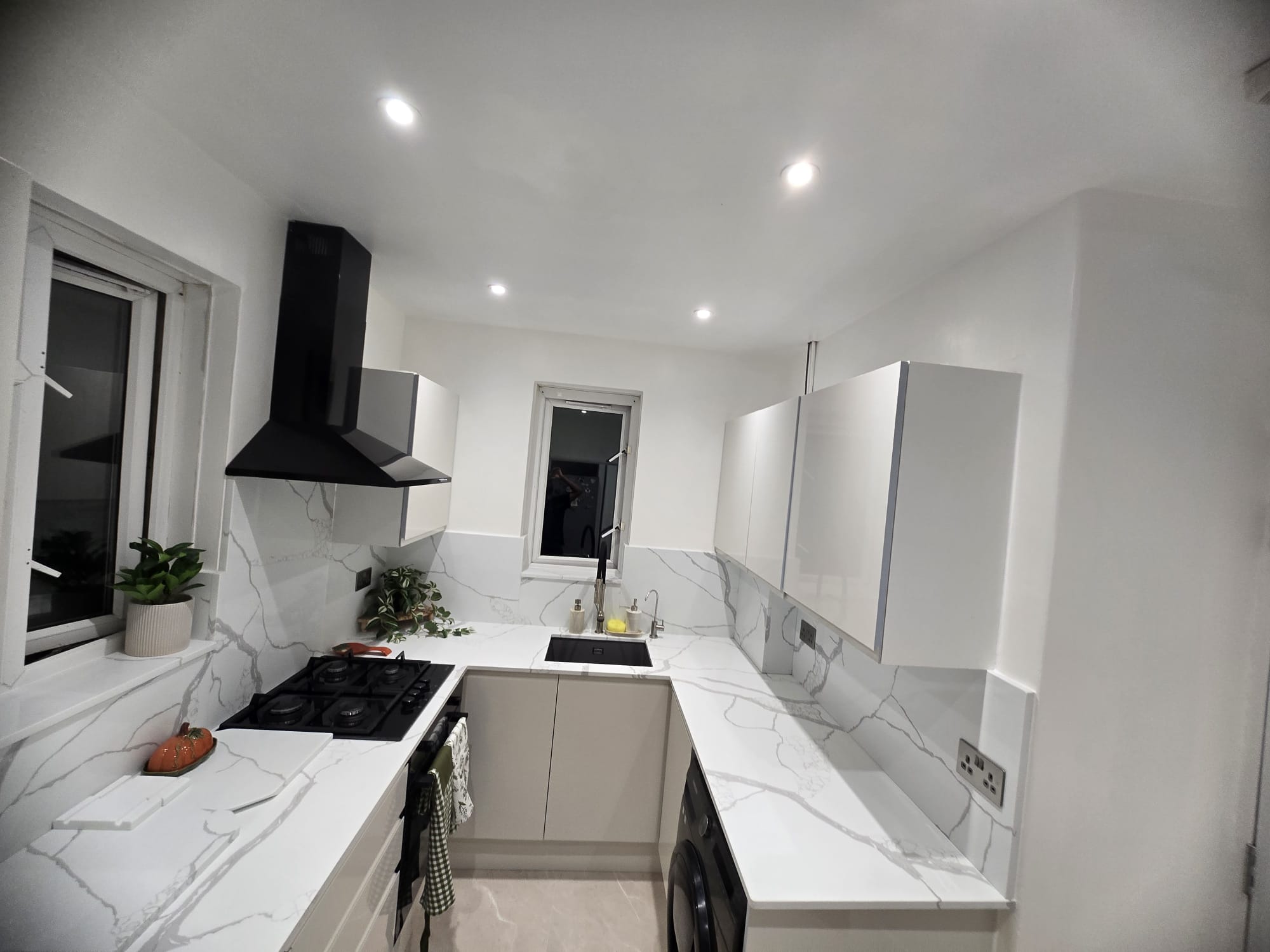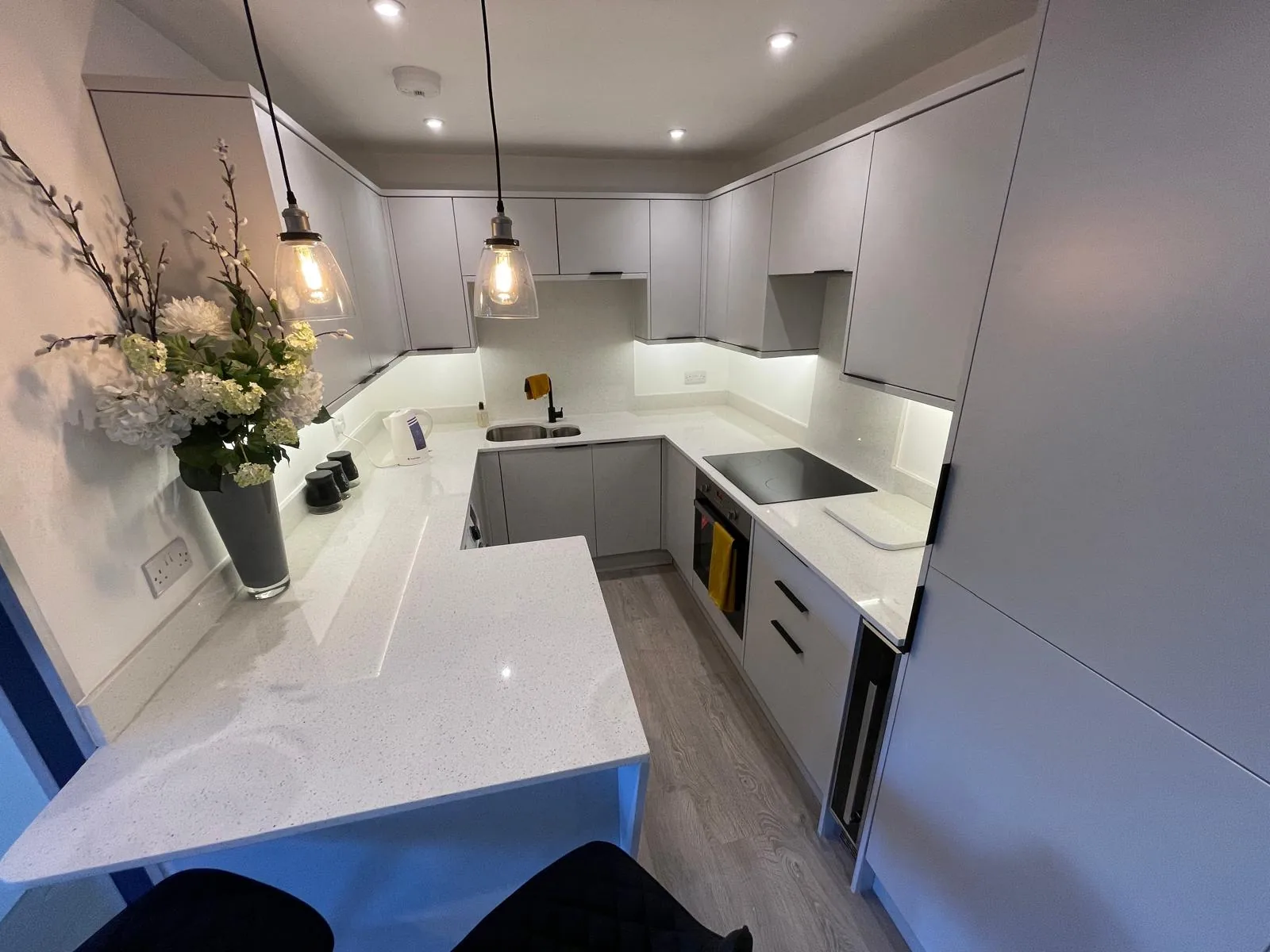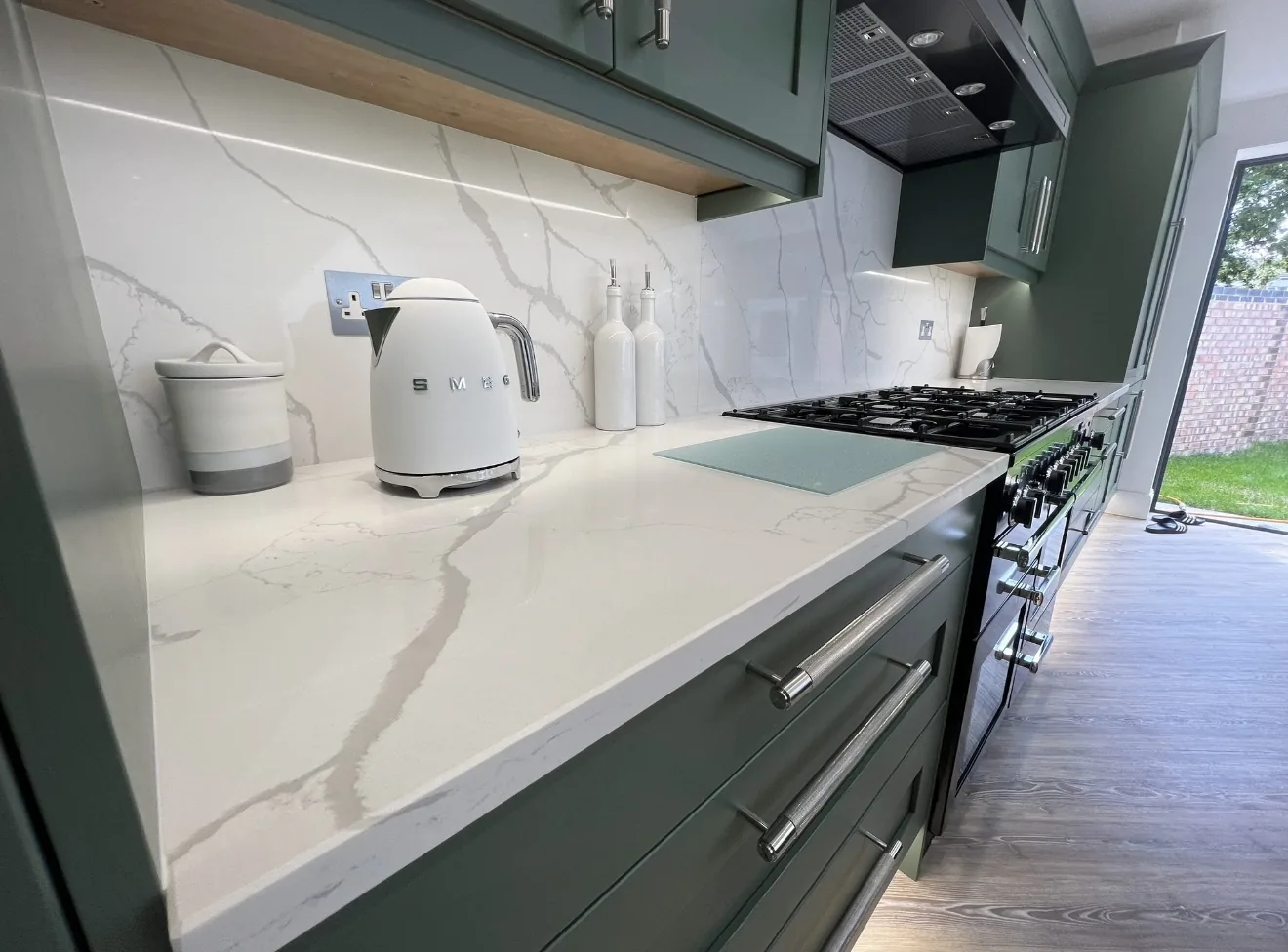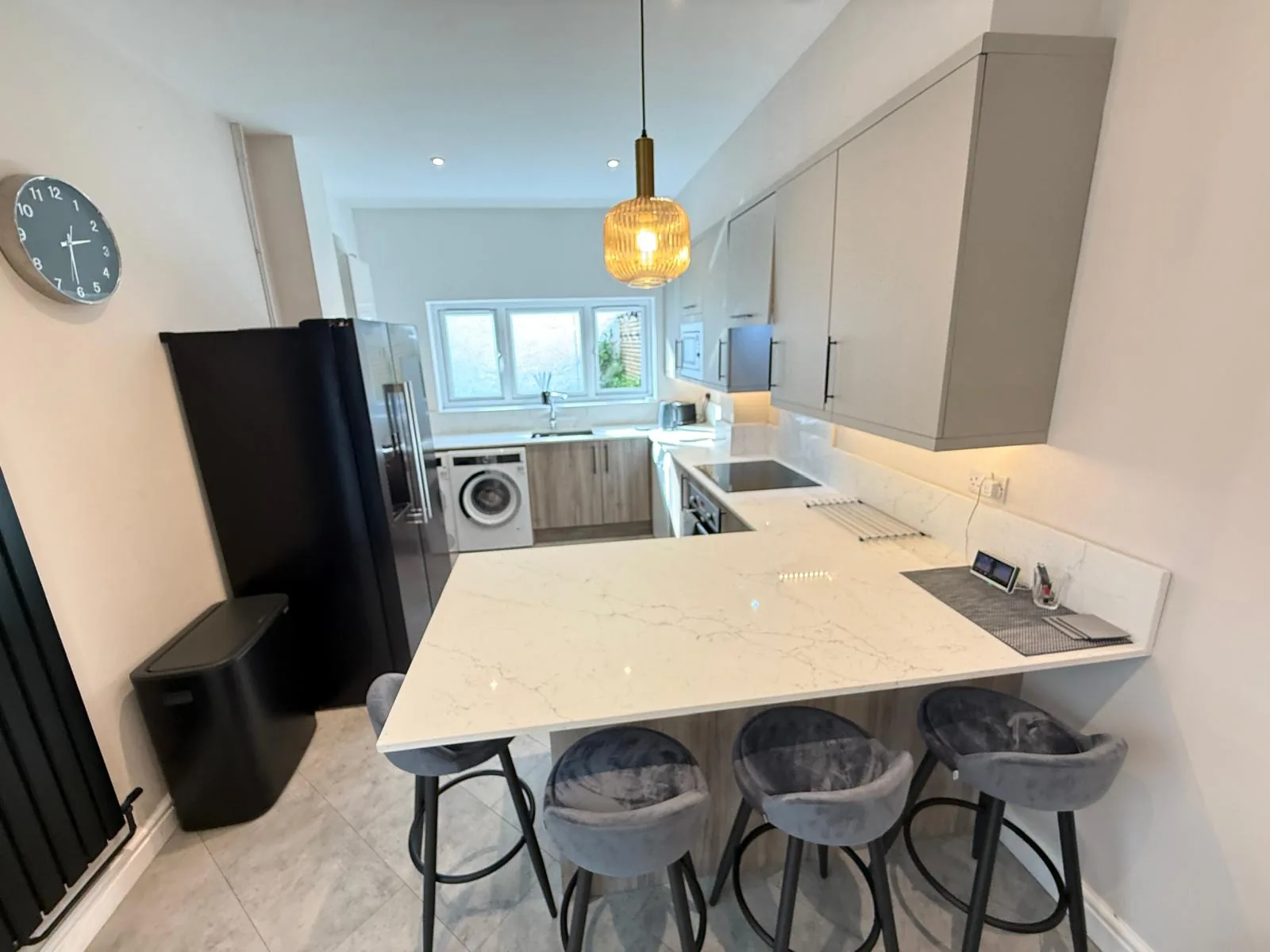
The quartz alone runs from £238, for a 3.6m single run at the bottom of our supply-only band, to £2,442 for an L-shape with an island at the top of it. Taken all the way to a fitted total with cut-outs, removal, a skip and delivery, a 6m galley comes to £2,310 at MyJobQuote’s published rates. The rest of this page shows every step of that arithmetic. This page is not about why worktops cost what they cost. The drivers (material, thickness, finish, edge, how the veining has to run) are a separate subject and the guide on what affects worktop cost answers it properly. This page does the other half, the half nobody does: it takes five named layouts with stated dimensions, converts them to square metres, and prices them all the way to a total using rates you can go and check. If you know roughly which shape your kitchen is, you will leave with a number. For the wider picture (where London costs actually land, and what a stone worktop really costs once the work around it is added) start at the cluster hub and come back here for the arithmetic.
01 / 06
The measurement everyone gets wrong
A worktop is 600mm deep. That is not a rule of physics, it is what a standard 570mm base unit plus a door front and a small overhang comes to, and it is what almost every kitchen in the country uses. Which means area is trivial: metres of run, multiplied by 0.6.
The part that goes wrong is corners. If your L-shape has a 3.2m wall and a 2.1m wall, the temptation is to add them, 5.3 metres, and multiply. But the 600mm square where the two runs meet belongs to both walls and can only be cut once. Counted properly, the return leg contributes 2.1 − 0.6 = 1.5 metres of new worktop, not 2.1. That single correction is worth about 0.36 m² per corner, and on a U-shape with two corners it is worth roughly £240 of stone in the middle of our band.
It matters commercially too, because a quote priced per linear metre usually measures wall lengths and therefore does count the corner twice, while a quote priced per square metre counts it once. Neither is dishonest. They are simply not the same number, which is the whole reason converting between units is a skill worth having.
02 / 06
Five layouts, measured
Here are the five shapes that cover the great majority of London kitchens, each with its dimensions stated so you can check the arithmetic against your own room rather than trusting it.
Single run, 3.6m, 600mm deep
One wall, hob and sink in the same run. 3.6 × 0.6 = 2.16 m². The layout of a converted flat or a small terrace. Two cut-outs, 3.6m of upstand, one long front edge and two short ends to polish.
Galley, 3.6m and 2.4m facing runs, 600mm deep
(3.6 + 2.4) × 0.6 = 3.60 m². No corners, so no double-counting problem, but two separate pieces and therefore two deliveries into the room. 6.0m of upstand. Sink in the long run, hob in the short one.
L-shape, 3.2m leg and 2.1m return, 600mm deep
(3.2 × 0.6) + (1.5 × 0.6) = 1.92 + 0.90 = 2.82 m². One corner, counted once. 4.7m of upstand. A join at or near the corner unless the slab is long enough and the access good enough to bring one L-shaped piece in, which in a flat it usually is not.
U-shape, 3.0m back run, two 2.2m returns, 600mm deep
(3.0 × 0.6) + 2 × (1.6 × 0.6) = 1.80 + 1.92 = 3.72 m². Two corners, two joins, 6.2m of upstand. More linear metres than a galley for barely more area, which is exactly where per-metre and per-square-metre quotes diverge most sharply.
L-shape with island, as above plus 1.8m × 0.9m
2.82 + 1.62 = 4.44 m². The island is a single piece with four polished edges, no upstand, and frequently its own cut-out. It is also the piece most likely to force a second slab, which is a cost step rather than a cost slope.
Worktop area by layout, at 600mm deep
03 / 06
The stone, at three points in the band
Our supply-only band is £110 to £550 per square metre. Below, each layout is costed at the bottom of that band, at its midpoint of £330, and at the top. This is material only, the slab, cut to your sizes, before anybody fits it. If you want that figure on its own, the case for buying supply only is a genuine one and worth costing separately.
| Layout | Area | At £110/m² | At £330/m² | At £550/m² |
|---|---|---|---|---|
| Single run 3.6m | 2.16 m² | £238 | £713 | £1,188 |
| L-shape | 2.82 m² | £310 | £931 | £1,551 |
| Galley | 3.60 m² | £396 | £1,188 | £1,980 |
| U-shape | 3.72 m² | £409 | £1,228 | £2,046 |
| L-shape + island | 4.44 m² | £488 | £1,465 | £2,442 |
Material cost, bottom to top of the band
- Single run£238–£1,188
- L-shape£310–£1,551
- Galley£396–£1,980
- U-shape£409–£2,046
- L + island£488–£2,442
Read that chart before you read anything else on the page. A U-shape at the bottom of the band is cheaper stone than a single run at the top. Which shape your kitchen is barely matters next to which slab you point at, and every conversation that starts "how much for a U-shaped kitchen" is asking the second-most-important question first.
04 / 06
Adding the work: two routes to the same total
Material is not a price. Templating, cutting, machining, polishing, delivering and fitting are the rest of it, and there are two honest ways to get from one to the other. Both are shown here because neither alone is trustworthy.
The first route is a published all-in rate. MyJobQuote gives an average installed cost of £250 per metre and works a five-metre kitchen at about £1,250. Applied to wall lengths, that produces the figures in the middle column below. It is an average, so it flattens material choice completely, but it is independent, it is dated 18 February 2026, and it is a real published number rather than an estimate of one.
| Layout | Wall length | Material at £330/m² | Installed at £250/lin m |
|---|---|---|---|
| Single run 3.6m | 3.6m | £713 | £900 |
| L-shape | 5.3m | £931 | £1,325 |
| Galley | 6.0m | £1,188 | £1,500 |
| U-shape | 7.4m | £1,228 | £1,850 |
| L-shape + island | 7.1m | £1,465 | £1,775 |
Look at the U-shape row. Measured by area it is barely larger than a galley; measured by wall length it is 1.4 metres longer, and at £250 per metre that is £350 of difference generated purely by how the job was measured. That is not a rounding error and it is not anybody cheating. It is two units answering two different questions, which is why a quote given per linear metre has to be converted before it can be compared to one given per square metre.
05 / 06
The galley, all the way to a total
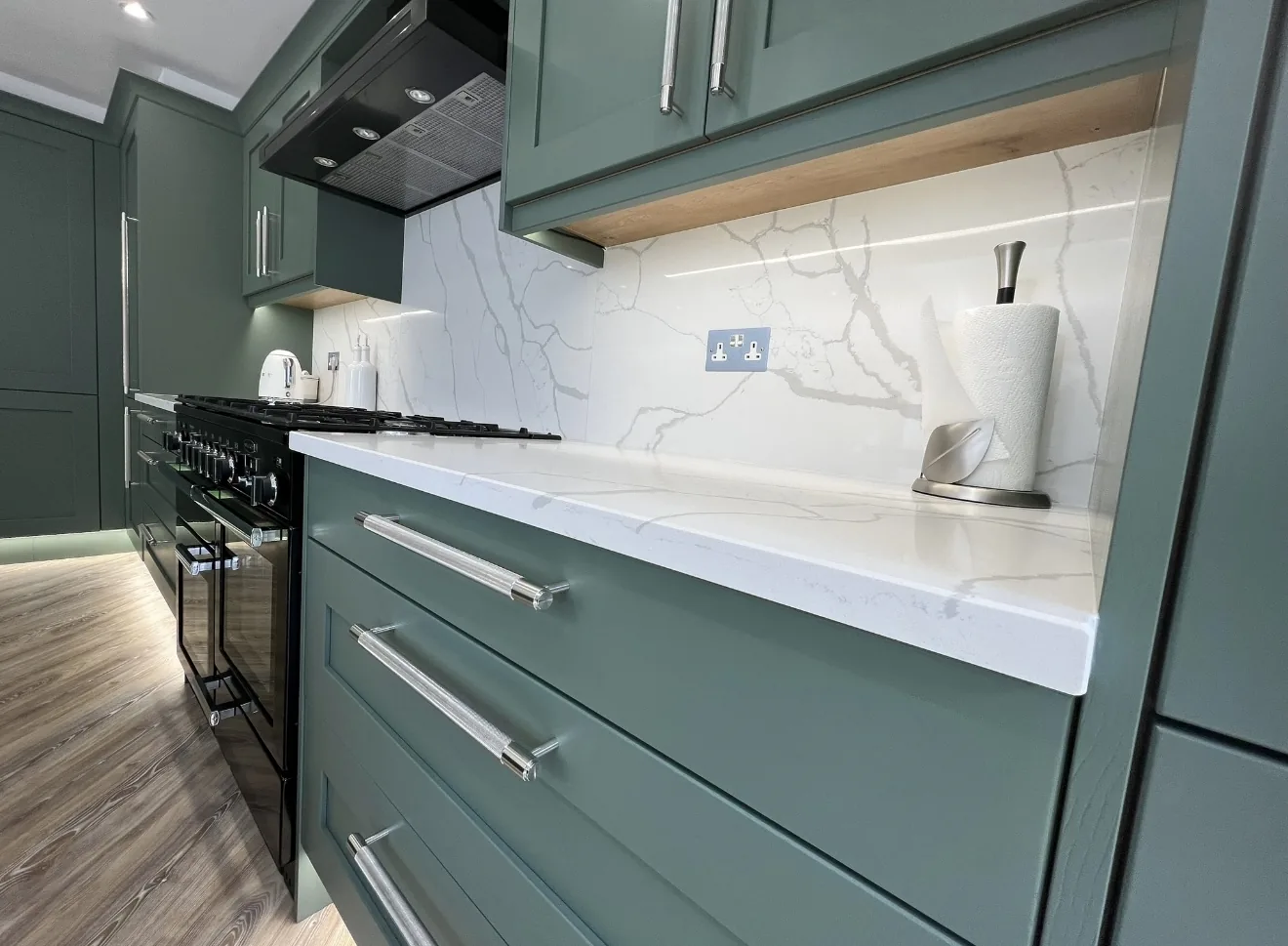
One layout, taken to the end, with every line shown. The 3.6m and 2.4m galley: 3.60 m² of worktop, 6.0 metres of wall, one sink cut-out, one hob cut-out, a set of drainer grooves, 100mm upstands throughout, an old laminate top coming out and going in a skip.
| Line | Rate | Amount |
|---|---|---|
| Supply and fit, 6.0 linear metres | £250 per metre | £1,500 |
| Sink cut-out | £175–£190 | £190 |
| Hob cut-out | £175–£190 | £190 |
| Drainer grooves | £140–£160 | £160 |
| Removal of old worktop | £100–£200 | £150 |
| Skip hire | £90–£440 | £90 |
| Delivery | £20–£40 | £30 |
| Total | £2,310 |
Thirty-five per cent of that total is not worktop. It is two holes, a set of grooves, a demolition, a skip and a van. Every one of those is a line a quote can be written without, which is why two quotes for this identical kitchen can arrive at £1,500 and £2,310 with nobody lying. The extras a quote itemises separately are where the difference lives, and they are worth going through line by line before you sign anything.
06 / 06
Where these numbers stop being reliable
This page is arithmetic, and arithmetic is only as good as its inputs. Four things will move your real figure away from the table above, and it is better to know them now than to discover them at template.
- Slab count. Material is bought by the slab, not by the square metre, so a job that needs 4.5 m² and can only be cut from two slabs pays for two slabs. That is a step in the cost curve, not a slope, and it is the single largest source of surprise on island kitchens. Whether the leftover comes back to you as an offcut is a separate question with a commercial answer.
- Access. A three-metre piece carried up two flights and round a turn is priced differently from the same piece wheeled through a ground-floor door, and no rate card captures that.
- Squareness. Older London walls are rarely true. A run that has to be scribed to a bowed wall takes longer to template and longer to fit, and a corner that is 3 degrees off square changes how the join is cut.
- What the number includes. Two quotes at the same figure are not the same offer if one is ex-VAT and the other is not, or if one includes removal and the other does not.
01My kitchen is between two of your layouts. What do I do?
Measure your runs along the wall, subtract 0.6m from every leg that meets another leg at a corner, multiply what is left by 0.6, and add any island as its own rectangle at its own depth. That is the whole method, and it is the same one the tables above use.
02Why is an island so much more expensive than the same area of run?
Three reasons, all structural. It is deeper, so it eats a different part of the slab. It has four polished edges rather than one. And it is the piece most likely to tip a job onto a second slab. None of that is a premium for the word "island". It is more stone, more edge work and sometimes twice the material purchase.
03Do upstands count in the square metres?
They are usually priced separately, by the metre or by the length, not folded into the worktop area. Check which, because a 6.0m galley has 6.0 metres of upstand and that is a line item of real size on any quote.
04Is a 20mm worktop meaningfully cheaper than a 30mm one?
Less than most people expect. On MyJobQuote’s polished quartz tables, standard 20mm runs £205 to £260 per linear metre and standard 30mm runs £220 to £280, a few per cent, not a tier. Decide thickness on how you want the edge to read, not to save money.
What to take away
- Area is metres of run times 0.6, with every corner counted once. Most London kitchens land between 2.16 and 4.44 square metres.
- Within one layout, the spread between the bottom and the top of the material band is far wider than the spread between layouts. Colour decides the price; shape barely does.
- A U-shape has more wall length than a galley for almost the same area, so it costs more per linear metre and about the same per square metre. Convert before you compare.
- On a worked galley at published UK rates, roughly a third of the total is cut-outs, grooves, removal, skip and delivery rather than worktop.
- Material is bought by the slab. A job that spills onto a second slab steps up in price rather than sloping up, and islands are the usual cause.
Sources
Every figure quoted above is traceable to one of these. Where a source is a price survey rather than our own quoting, it is named as such in the text.
- [1]Quartz worktop cost guide (updated 18 February 2026), MyJobQuote, retrieved 25 August 2026
- [2]Kitchen worktop replacement cost guide (updated 12 May 2026), MyJobQuote, retrieved 25 August 2026
- [3]Can you give a price per square metre?, Affordable Granite, retrieved 25 August 2026
- [4]Supply-only granite worktop prices and fabrication charges, Affordable Granite, retrieved 25 August 2026
- [5]Installing stone worktops: controlling silica dust on site, Health and Safety Executive, retrieved 25 August 2026