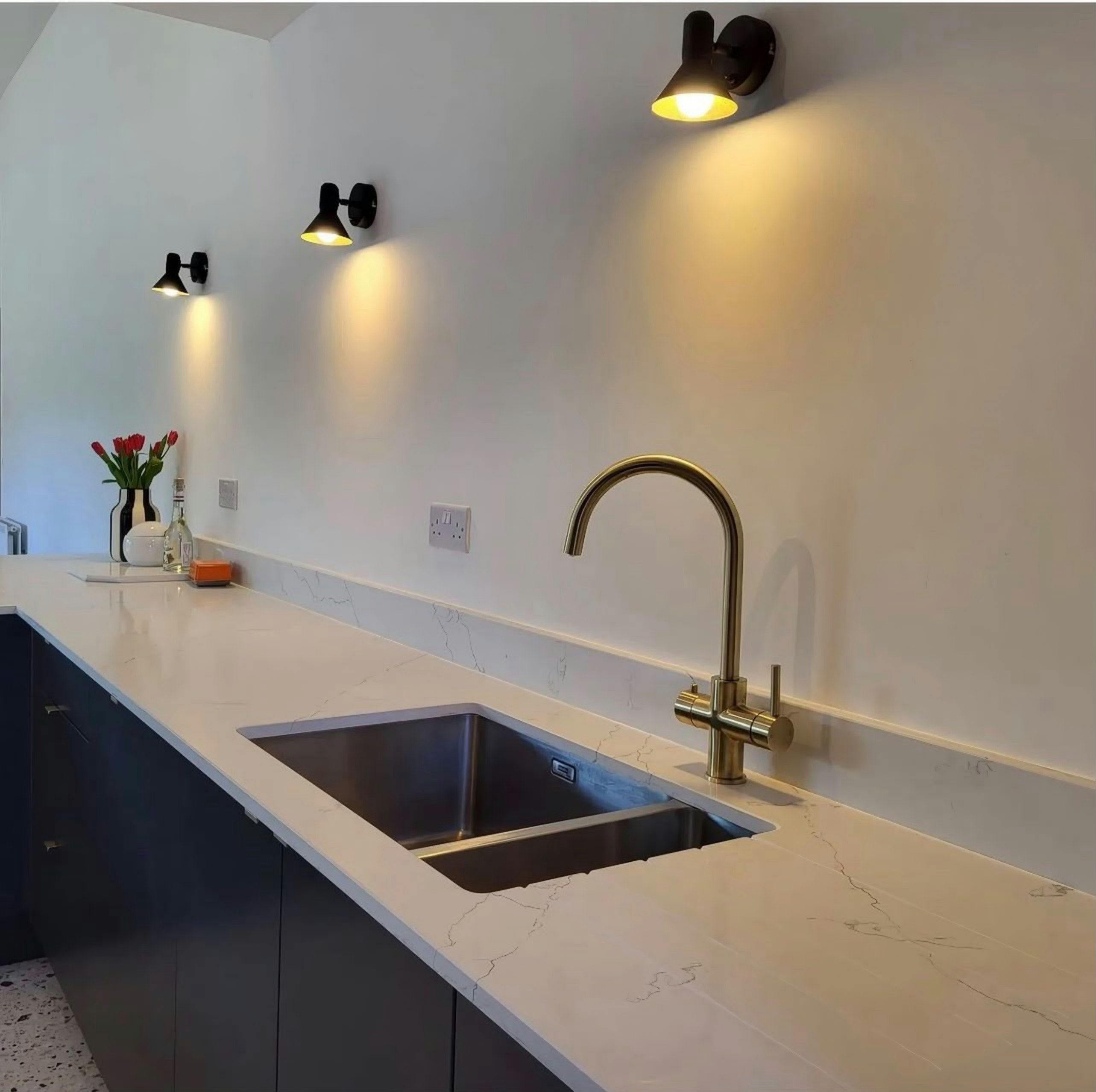
The question arrives in one of two forms. Homeowners ask whether a quartz worktop is dangerous to have in the house. The trade press asks whether engineered stone is about to be banned. The answers are no and not in Great Britain, and the reason both answers are straightforward is the same: this is a hazard created by cutting, grinding and polishing a slab, and it falls on the people doing the cutting. It is our risk, not yours, which is exactly why a fabricator is the right party to explain it calmly rather than a solicitor advertising for claims.
01 / 05
The answer, before the detail
The short answer
- Respirable crystalline silica is generated when stone is cut, ground and polished. A finished, installed worktop is not a source of it.
- In May 2026 the Health and Safety Executive published its first COSHH guidance sheet written specifically for engineered stone, and stated that dry cutting is unacceptable and water suppression is how the legal duty is met.
- HSE inspectors are conducting more than 1,000 visits to fabricators across Great Britain over twelve months, with enforcement against those failing to meet the standard.
Silicosis is an irreversible lung disease caused by breathing in fine silica dust. HSE describes it plainly: the dust is fine enough to reach deep inside the lungs, it can cause irreversible lung damage, chronic obstructive pulmonary disease and lung cancer, and damage may be done before any symptoms appear. Its own deputy director put it in one sentence in the May press release: "Silicosis is incurable, but it is entirely preventable."
None of that is a statement about a worktop in a kitchen. It is a statement about a workshop with a cutting bench in it. The distinction is not a convenient one we have invented. It is the structure of the regulation itself, which sits under the Control of Substances Hazardous to Health Regulations 2002 and applies to employers controlling workers’ exposure. There is no consumer-facing duty in it, because there is no consumer-facing exposure.
02 / 05
What the regulator actually published, in May 2026
On 11 May 2026 HSE announced a package of measures, and the specifics are worth having accurately rather than through a headline.
- New guidance "making clear that dry cutting of engineered stone is unacceptable and that water suppression techniques, already used by many industry leaders, are how businesses should meet the legal requirement."
- A nationwide inspection programme: "Over the next 12 months, HSE inspectors will conduct more than 1,000 visits to fabricators across Great Britain, with enforcement action taken against those failing to meet the required standards."
- The evidence behind it: HSE’s research "found that dry fabrication typically results in exposure to respirable crystalline silica (RCS) five to ten times higher than wet methods using equivalent tools."
- A finding about materials: it "also found that lower-content silica engineered stone is available at the same quality, removing any reason for businesses not to switch to less dangerous products."
- And the scale of the underlying problem: engineered stone "can contain up to 95% crystalline silica", and recent cases suggest exposure to its dust can cause silicosis in a matter of months or years rather than the decades associated with natural stone.
The first-ever COSHH guidance sheet for the sector, ST3A, sets out what employers must do in five plain requirements: switch to engineered stone with a low silica content; use on-tool water suppression; control the mist that water suppression generates, because that mist contains crystalline silica too; provide appropriate respiratory protective equipment; and carry out regular health surveillance. HSE states that these are legal requirements rather than good practice.
Read past the summary and ST3A gets specific in ways that are useful for judging any workshop. It calls for powered air purifying respirators with an assigned protection factor of at least 20 during processing, cleaning and machinery maintenance. It requires tight-fitting RPE wearers to be clean shaven and face fit tested. It says work clothing goes to a contract laundry and is not laundered at home. It requires at least Class M vacuum equipment, and it puts three words in bold: "No dry brushing."
03 / 05
Our own position, stated so it can be checked
It is easy to write an article about somebody else’s duty. Here is ours, in the same terms the guidance uses, because a company answering this question ought to answer it about itself.
We cut wet, and we do not cut dry
Every cutting, grinding and polishing operation on a slab is done with water. That is the single control HSE identifies as the difference between typical exposure and exposure five to ten times higher, and there is no job small enough to be an exception to it, including a tap hole, a socket cut-out or an edge trimmed on site.
On-tool water suppression, and mist control with it
Water is fed at the tool rather than sprayed at the work afterwards. The second half of that is the part people forget: the mist generated by wet suppression contains crystalline silica, and controlling it is a separate requirement in the guidance rather than an automatic consequence of using water.
Respiratory protective equipment, maintained and fit tested
RPE is provided for processing, cleaning and machinery maintenance. The guidance is specific about what makes it work (the right protection factor, filters changed to the manufacturer’s schedule, and face fit testing for anything tight fitting), and it is those details rather than the presence of a mask that decide whether it protects anyone.
Health surveillance for the people exposed
Because the damage happens before symptoms appear. HSE is explicit that workers can suffer permanent and irreversible lung damage before experiencing any symptoms, and that by the time symptoms appear it may be too late. Surveillance is the only mechanism that finds it while it still matters.

04 / 05
Low-silica material: what the numbers are and who published them
HSE’s first requirement is to work with stone containing the lowest crystalline silica content, and its research concluded that lower-content material of equivalent quality is available. That makes what manufacturers publish about their own products directly relevant to a buying decision for the first time.
Cosentino publishes figures for Silestone. It describes the range as a mineral low-silica surface, states that its Hybriq+ technology reduces crystalline silica content, and publishes a per-colour label giving the maximum percentage present. In its own statement on the subject it puts it numerically: "Silestone Q10 and Q40 products now contain a maximum 10% and 40% crystalline silica content respectively." It also states that since 2023 all Silestone colours are manufactured with low crystalline silica content, and that its technology obtained independent certification in 2023 from SGS Australia for containing less than 40% crystalline silica across the entire colour portfolio.
Published maximum crystalline silica figures
Beyond low-silica engineered stone there is a second category: sintered materials formulated without crystalline silica at all, marketed on exactly that basis. We are not going to publish a figure for any of them, for a simple reason. We could not open the manufacturer’s own technical file at the time of writing, and this is not a subject on which to repeat a number found somewhere else. If a silica-free product is being offered to you, ask for the maker’s own published statement and read it. That is the same test we apply to every figure on this page.
How the material and the regulation moved
- 2017silica-reduction research begins
- 2020first low-silica collections
- 2023whole portfolio, independently certified
- May 2026ST3A guidance published
- 2026/271,000+ inspections
05 / 05
What it means for the worktop you already have, and the one you are buying
This applies to every stone we cut, which is a short list, the full account of what we fit and what we refuse to fit is published separately, and every material on it is machined in the same wet workshop. For an installed worktop: nothing. It is a finished, solid, sealed surface, and there is no mechanism by which it generates respirable dust while it sits there. Cosentino says as much about its own product. That it has been certified as safe and not generating any type of risk for the final consumer, and that fabrication is fully safe as long as the fabricator follows appropriate safety measures. The whole of the risk sits in that second clause, and that second clause is about us.
There is one genuine exception and it is worth stating clearly, because it is the only place a householder can put themselves in the way of this. If you ever take a grinder, a drill or a diamond blade to a stone worktop yourself (cutting in a new tap hole, enlarging a cut-out, trimming an upstand) do not do it dry, and do not do it in an enclosed kitchen. That is the same operation the guidance is written about, done without any of the controls it requires. It is a job to hand back to a fabricator.
- Ask any fabricator you are considering how they cut. "Wet, with on-tool water suppression" is the answer the guidance describes; anything that sounds like extraction alone is a different and weaker control.
- Ask whether they control the mist as well as the dust, because the guidance treats those as two problems.
- Ask whether the material you are being quoted has a published silica figure, and who published it. This is a new question, and it is a fair one now that the regulator has told the industry to prefer lower-content material.
- Ask what happens on site, not just in the workshop. Site work is where the temptation to make one quick dry cut lives.
- If a price is far below every other quote, ask what is in it. Cutting safely is a real cost, and so is templating, edge work and waste.
01Is engineered stone going to be banned in the UK?
HSE considered the question and set out its conclusion in the May 2026 announcement: after a two-year process of research and industry engagement, it concluded that the most effective and proportionate action is to make sure proper controls are in place and actively enforced. That is a decision to regulate the process rather than prohibit the product, and it is the position that is being enforced through the inspection programme now.
02Should I choose a low-silica material for my own safety?
Not for your own safety, because your exposure from a fitted worktop is not the issue. There is a decent argument for choosing it anyway on other grounds: it lowers the exposure of the people who cut it, HSE has told the industry that equivalent-quality lower-content material exists, and a manufacturer that publishes a figure is a manufacturer being checkable. That is a reasonable thing to want from a purchase.
03Does this affect natural stone, granite and sintered surfaces too?
The guidance sheet is written for engineered stone specifically, and HSE draws a contrast with natural stone, where silica-related disease typically takes decades to develop rather than months or years. But respirable crystalline silica is produced when cutting natural stone as well, and the controls in the guidance are good practice across a stone workshop rather than a special case for one material.
04My worktop was fitted years ago. Should I be worried?
No. Whatever dust existed was created at the point of cutting and polishing, before the piece arrived. A worktop that has been in your kitchen for a decade is a solid surface, and there is no reason to treat it as anything else. The care instructions that apply to it are about cleaning, not about safety.
05How does this change the choice between materials?
Less than you would expect. It adds one question to the list rather than replacing the list. Whether the surface takes a hot pan (which is what separates Dekton or Silestone in the maker’s own care documents) whether it is going somewhere sunny, what the warranty covers and what you want to look at all still decide the kitchen. What is genuinely new is that "what does the maker publish about silica content, and how does your fabricator cut" is now a fair question to put to a supplier, alongside the ones about a brand name on the slab.
What to take away
- This is an occupational hazard created by cutting, grinding and polishing. A finished worktop in a kitchen is not a source of respirable crystalline silica.
- HSE published its first engineered-stone-specific COSHH guidance in May 2026, stated that dry cutting is unacceptable, and is carrying out more than 1,000 inspections of fabricators over twelve months.
- The five legal requirements are low-silica material, on-tool water suppression, mist control, appropriate RPE and regular health surveillance. Its research found dry fabrication gives exposure five to ten times higher than wet methods.
- Cosentino publishes maximum crystalline silica figures for its own Silestone ranges (a maximum of 40% for Q40 and 10% for Q10), and per-colour labelling. Any silica figure worth relying on comes from the maker of that product.
- The one thing a householder should never do is take a grinder or diamond blade to a stone worktop dry, in a closed kitchen. That is the exact operation all of this guidance exists to control.
Sources
Every figure quoted above is traceable to one of these. Where a source is a price survey rather than our own quoting, it is named as such in the text.
- [1]HSE says no dry cutting of engineered stone ahead of inspection crackdown, 11 May 2026, Health and Safety Executive, retrieved 25 August 2026
- [2]COSHH essentials for stone workers: ST3A, cutting and polishing engineered stone using powered hand-held rotary tools, Health and Safety Executive, retrieved 25 August 2026
- [3]Working with engineered stone: control silica risk, Health and Safety Executive, retrieved 25 August 2026
- [4]Dry cutting of engineered stone to be avoided, Work Right, GOV.UK, retrieved 25 August 2026
- [5]Hybriq technology, the first low-silica surface, with published per-colour maxima, Cosentino, retrieved 25 August 2026
- [6]Cosentino statement on Silestone crystalline silica content, 17 February 2023, Cosentino, retrieved 25 August 2026