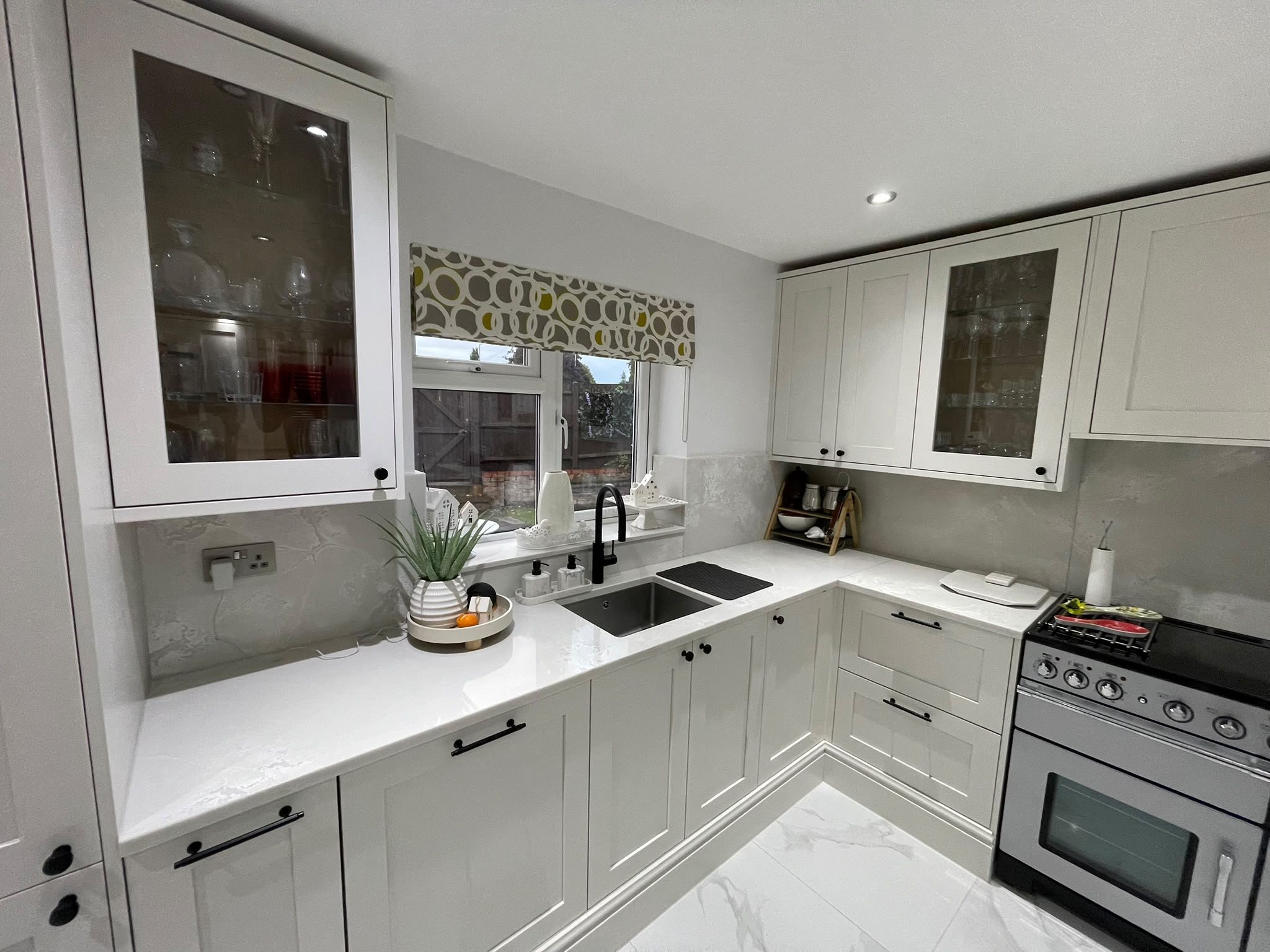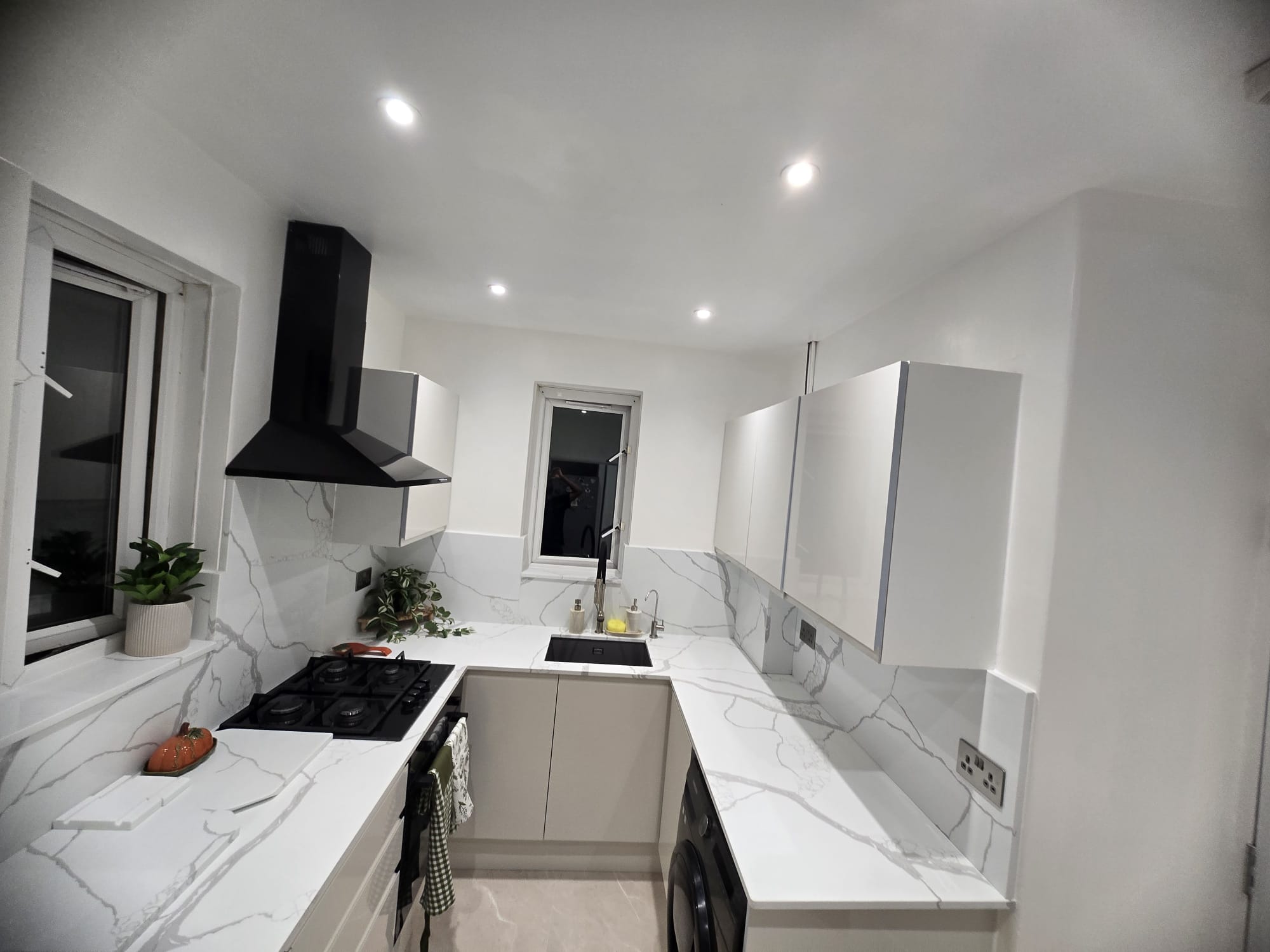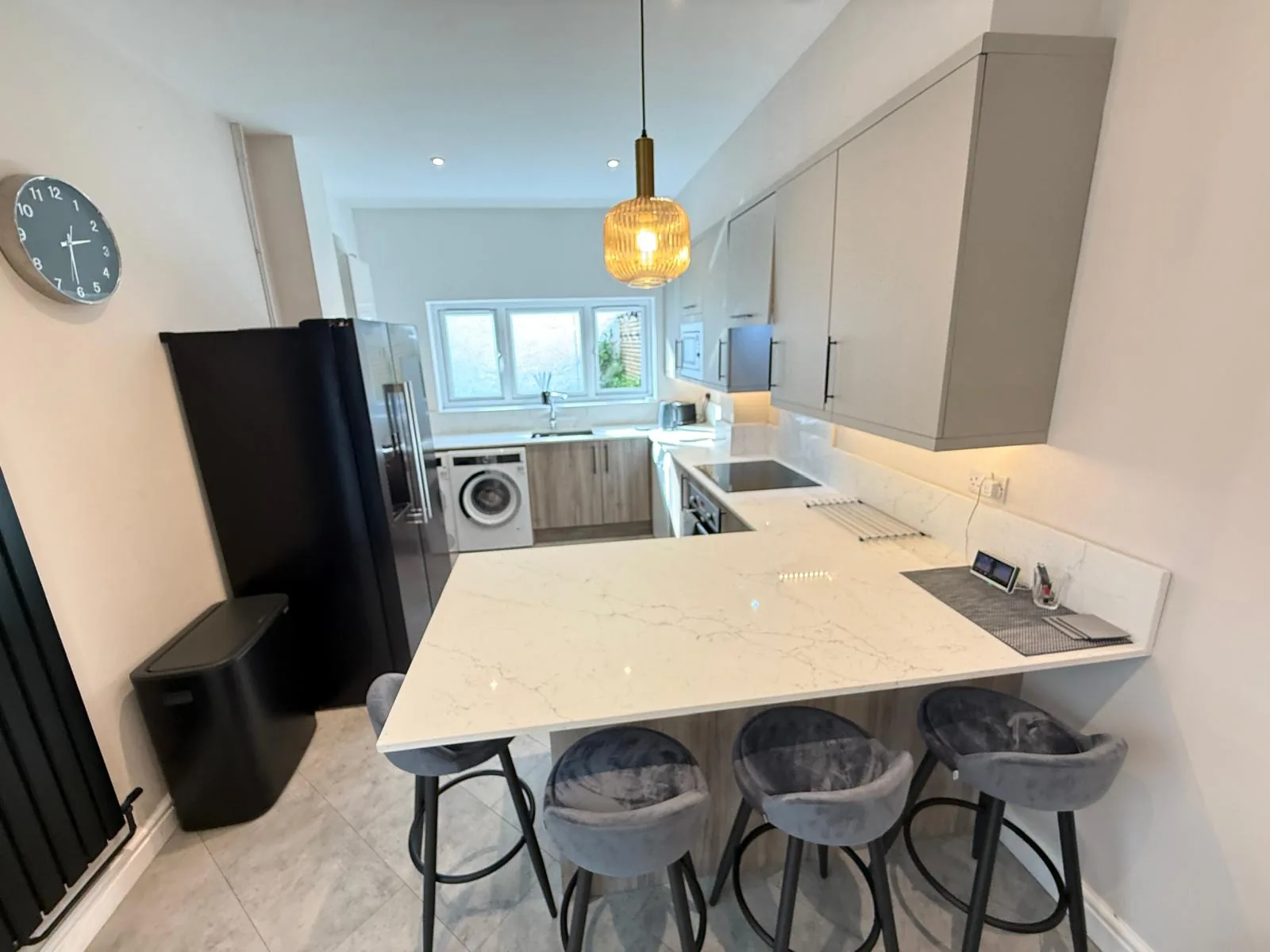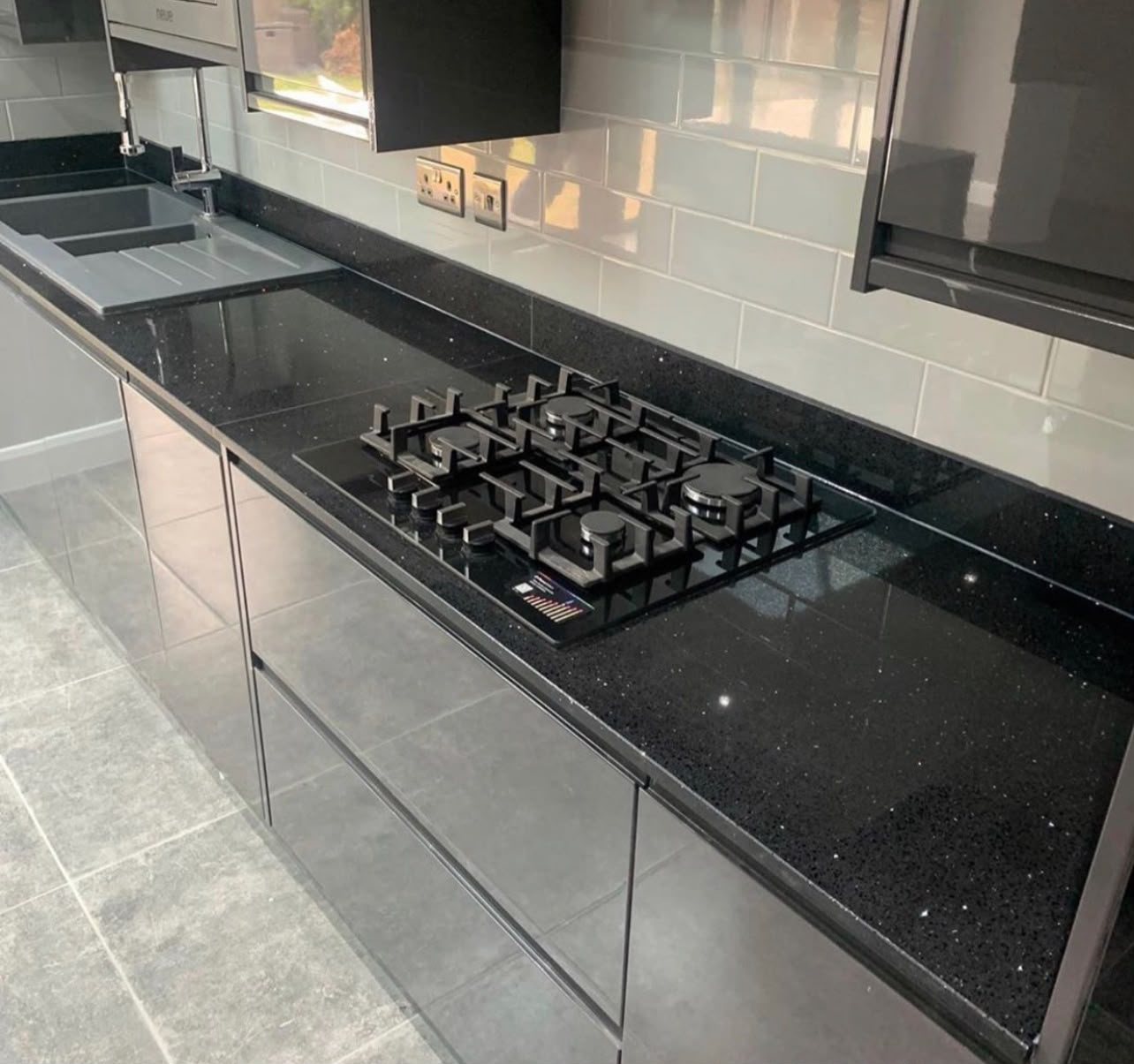
A disclosure before the first number, because it changes how you should read every number after it: we fit quartz, granite and Dekton, and we do not fit laminate. We cannot sell you a laminate worktop, cannot fit one, and make nothing if you buy one. Every other page comparing these two materials was written by someone in the same position, and every one of them concluded in favour of stone. This one names four situations where laminate is the correct purchase and shows the working that gets there.
01 / 06
The question is not which is better. It is how long you will own it
The short answer
- Compare cost per year of ownership, not headline price. The same two quotes produce opposite answers at a three-year horizon and a fifteen-year one.
- At the bottom of the range the material gap is far smaller than people expect. The gap that actually decides it is fabrication and fitting, which laminate can avoid entirely and stone cannot.
- This page publishes no lifespan figure for either material, because we could not verify one. The figures circulating on this subject are unsourced.
The standard version of this comparison lines up durability, heat resistance, stain resistance and appearance, awards points, and declares stone the winner. It is not wrong about any individual point. It is answering a question nobody asked. Almost nobody choosing a worktop is trying to identify the objectively superior material; they are trying to work out whether the difference in the two quotes in front of them is worth paying, in their house, on their timescale.
That converts into a single sum. Take the two installed quotes, subtract one from the other, and divide the difference by the number of years you realistically expect to own that kitchen. What comes out is the annual cost of the upgrade, and it is the only figure in this comparison that can be compared to anything else you spend money on.
What this page does not do is describe the switch itself. Going from a laminate kitchen to a stone one changes the weight on your carcasses, the way the worktop is measured and made, where the joins fall and what happens to your sink, and there is a separate guide that covers all of it properly. Decide whether to switch here; find out what changes there.
Laminate is one of seven materials we will not quote for. If you want the same treatment applied to the other six, our map of what we fit and what we refuse to fit takes each of them in turn and names the situation where it beats stone.
02 / 06
The arithmetic, with every assumption on the table
A worked example, using a kitchen small enough that both options are genuinely live: a galley with a 3.6 metre run and a 1.4 metre return, 600mm deep. Five linear metres, three square metres of surface, one sink cut-out, one hob cut-out.
- Laminate material. One named product at one named retailer on 25 August 2026: a 600 x 38 x 3000mm laminate worktop at £110. Five linear metres needs two lengths, so £220 buys 3.6 square metres to cover 3.0 square metres of run. That is roughly £61 per square metre of surface, with the offcut wasted.
- Stone material. Our own supply-only band runs from £110 to £550 per square metre, material only. At the entry of that band the same three square metres is £330. At the top of it, £1,650.
- The material difference at the bottom of the band is therefore about £110 across the whole kitchen. Over a ten-year horizon that is £11 a year, which is not a decision.
- The difference that matters is everything the material figure excludes. Laminate is cut and scribed in your room, and a competent person can fit it themselves in a day. Stone is templated, machined off site and delivered finished, and it cannot be fitted by the householder.
- So the honest instruction is: get both quotes as installed totals, not as per-square-metre rates, and run the subtraction on those. Anyone who tells you the answer before seeing your two quotes is guessing.
Material only, per square metre of finished surface
- Laminate, one named product£61–£61
- Quartz, granite or Dekton, supply only£110–£550
Two things fall out of that chart that the usual comparison never mentions. The first is that the cheapest stone in our catalogue is under twice the price of a mid-range laminate per square metre, which is a much narrower gap than the phrase "budget option versus premium option" implies. The second is that the stone band is five times wide. Most of the difference between two stone quotes is the colour you picked and whether there is a brand name on the slab, not the fact that it is stone.
The horizon you should be dividing by
- Under 3 yearsselling, or renting out
- 3 to 5 yearsa move is planned
- 5 to 10 yearsthe usual case
- 10 years plusthe forever house
03 / 06
Four cases where laminate is the correct purchase
These are not consolation prizes. In each of them a stone worktop is a worse use of the money, and we would say so at the quote stage rather than take the job.
A rental or a buy-to-let
The surface will be used by people who did not choose it and will not own it, and it will be replaced on a letting cycle rather than a household one. The upgrade cannot be recovered in rent in any way you can demonstrate, and damage in a tenanted property is a deposit conversation rather than a warranty one. Buy the material that is cheap to replace by the metre.
A sale inside about five years
Divide the difference by four or five and it becomes an annual figure most people would not pay. The counter-argument is that it helps the sale, and it might, but nobody has published a UK number for that which survives being checked, the percentages in circulation trace back to press releases rather than to transaction data. If you are specifying for a buyer rather than for yourself, specify tidy and neutral, not expensive.
A kitchen already on the list to come out
This is the one people talk themselves out of. If the units are tired, the layout is wrong, or the extension is coming in four years, a stone worktop is being fitted to a kitchen that will not survive it. Stone is templated to the room it is in and does not transfer to a new layout. Spend the money on the surface now and the kitchen later, in that order.
You intend to fit it yourself
This is the largest saving available in the whole comparison and it exists only on one side of it. A laminate worktop is a board you can cut, scribe and bolt in a day with a router and a jig. A stone worktop is a rigid machined panel carried in on edge by a team, and there is no version of the job you can do yourself. If your labour is free and your weekend is available, that is a real number and it belongs in the sum.
04 / 06
What the laminate manufacturer asks of you, in its own words
A stone fabricator listing laminate’s weaknesses is not evidence. A laminate manufacturer’s own installation and maintenance document is, and it is public. Bushboard publishes one for its worksurfaces, and it is more candid than anything a competitor could safely say.
- Heat: "you should never place cooking utensils directly from the oven or hob onto the worksurface", with protective mats always to be used.
- Knives: "Never cut directly onto any worksurface: a chopping board should always be used to protect the surface from cut marks."
- Water: the surfaces are sealed against water penetration, but the document advises wiping up spillages immediately, especially around the front edge and any joints.
- Joints: "Joints are most vulnerable to moisture ingress", and it is the installer’s responsibility to ensure every cut edge is properly sealed against moisture.
- Sinks: the worksurfaces are described as ideal for inset sinks, and explicitly not suitable for forming drainer surrounds for Belfast or butler-style sinks.
And then the part that a stone fitter is not supposed to quote: those worksurfaces carry a lifetime guarantee from the manufacturer, subject to fair wear and tear and to being installed and used in accordance with the manufacturer’s instructions. That is a stronger written commitment than a great many people assume laminate comes with, and it is worth knowing before you decide the cheap option is the disposable one.
Set against that, the quartz side of the comparison has its own published instruction, and it is not "do whatever you like" either. Cosentino’s Silestone care guidance says the material is heat resistant but that sudden temperature change can affect it as it would other stone materials, and that trivets are highly recommended. The gap between the two instructions is real, but it is narrower than the marketing on either side suggests.
05 / 06
What the model cannot see, and the number we refuse to give you
Cost per year is a good instrument and a blunt one. Four things sit outside it and should be decided separately rather than folded into the arithmetic.
- Joins. Laminate joins in a corner with a mason’s mitre or a butt strip, and both are reversible. Stone joins are bonded seams in a rigid panel and are permanent, which makes where they fall a specification decision rather than a fitting detail.
- Failure mode. When laminate goes, it usually goes at a joint or an edge, from water, and it goes gradually and visibly. When stone goes, it is usually a crack from movement or a cut-out, and it is sudden. Gradual damage gives you time to budget; sudden damage does not.
- Replaceability by the metre. A damaged three-metre laminate run is a three-metre laminate run. A damaged stone run is a new template, a new slab and a new fabrication, because a worktop is cut from a slab rather than bought by the piece.
- Who is standing in your kitchen. A laminate worktop can arrive on a van and be fitted by one person. Stone arrives with a team, a protected route and a lift plan, which is a bigger intervention in a lived-in house.
One last thing that belongs in the honest version of this comparison and never appears in it. If you are buying stone, ask the fabricator how a fabricator cuts it before you ask what they charge, because the price of a stone worktop is partly the price of doing the cutting safely, and the cheapest quotes in this trade are sometimes cheap for that reason.
06 / 06
Questions people ask at exactly this point
01Is compact laminate different from ordinary laminate?
Yes, and it is a genuinely different product rather than a grade of the same one. Ordinary postformed laminate is a decorative face on a chipboard core; compact laminate is a solid pressed sheet, usually much thinner, with no chipboard in it. That changes how it behaves at a cut edge and around water. If you are being quoted for both, treat them as two separate options and ask which one the price refers to.
02Does a stone worktop help sell the house?
Possibly, and we will not put a number on it. Any figure we published would be a percentage we copied from somewhere, and the ones in circulation do not survive a check. What is defensible is that a buyer at a viewing touches the worktop, and that a surface which reads as tired invites a mental deduction for a new kitchen rather than for a new worktop.
03Can I have laminate now and stone later?
Yes, and it is a reasonable plan if the units are sound and you are staying. The thing to understand is that it is two jobs, not one deferred job: the laminate comes off and is scrapped, and the stone is templated to the room as it then exists. It is not an upgrade path in any technical sense. It is a cheap surface for a few years followed by a full worktop replacement.
04Why is your cheapest stone almost the same price per square metre as laminate?
Because our band is supply only. It is the slab and nothing else. No template visit, no cutting, no cut-outs, no polished edges, no fitting. A laminate price at a shed is a finished board you can carry out. The two figures look comparable and are not, which is exactly why the sum has to be run on installed totals.
05What about solid wood instead of either?
It is a real third option and it behaves like neither of these two. Wood is the only one of the three that can be sanded back and re-finished by the owner, and the only one that will go black around a sink if it is neglected. The specification that usually works is timber on the island or the bar run and stone on the wet and hot runs, which is a hybrid rather than a compromise.
06What would you actually tell a friend?
That the horizon decides it. Under five years, or in a property you let, buy laminate and do not think about it again. Over ten years in a house you are staying in, the annual cost of the upgrade is usually smaller than one takeaway a month, and at that point the question stops being financial and becomes a question about what you want to look at.
What to take away
- Run the subtraction on two installed totals and divide by the years you will own the kitchen. Per-square-metre rates are not comparable between the two materials because one includes fitting and the other does not.
- Buy laminate in a rental, ahead of a sale inside about five years, in a kitchen already due for replacement, or wherever you intend to fit it yourself. In all four the upgrade is a worse use of the money.
- The laminate manufacturer’s own document is more useful than any comparison page: never cut on it, never put a pan straight from the hob on it, seal every cut edge, and a lifetime guarantee on the worksurfaces.
- Most of the spread in a stone quote is the colour, not the material class. Our own supply-only band runs from £110 to £550 per square metre for material alone.
- Nobody, including us, can tell you how long either material lasts. Every figure we found for that was unsourced, and we would rather leave the gap visible than fill it.
Sources
Every figure quoted above is traceable to one of these. Where a source is a price survey rather than our own quoting, it is named as such in the text.
- [1]Bushboard worksurfaces, installation and maintenance instructions, including guarantee terms, Bushboard, a Wilsonart company, retrieved 25 August 2026
- [2]Wickes Laminate Blocked Oak Effect Worktop, 600 x 38 x 3000mm, published price, Wickes, retrieved 25 August 2026
- [3]Silestone maintenance, heat resistance and care guidance, Cosentino, retrieved 25 August 2026
- [4]Anyone got a decent laminate worktop? Worth getting over wood?, UK homeowners comparing the two, Mumsnet, retrieved 25 August 2026
- [5]Quartz worktops: branded vs unbranded, UK buyers weighing the premium, MoneySavingExpert, retrieved 25 August 2026