
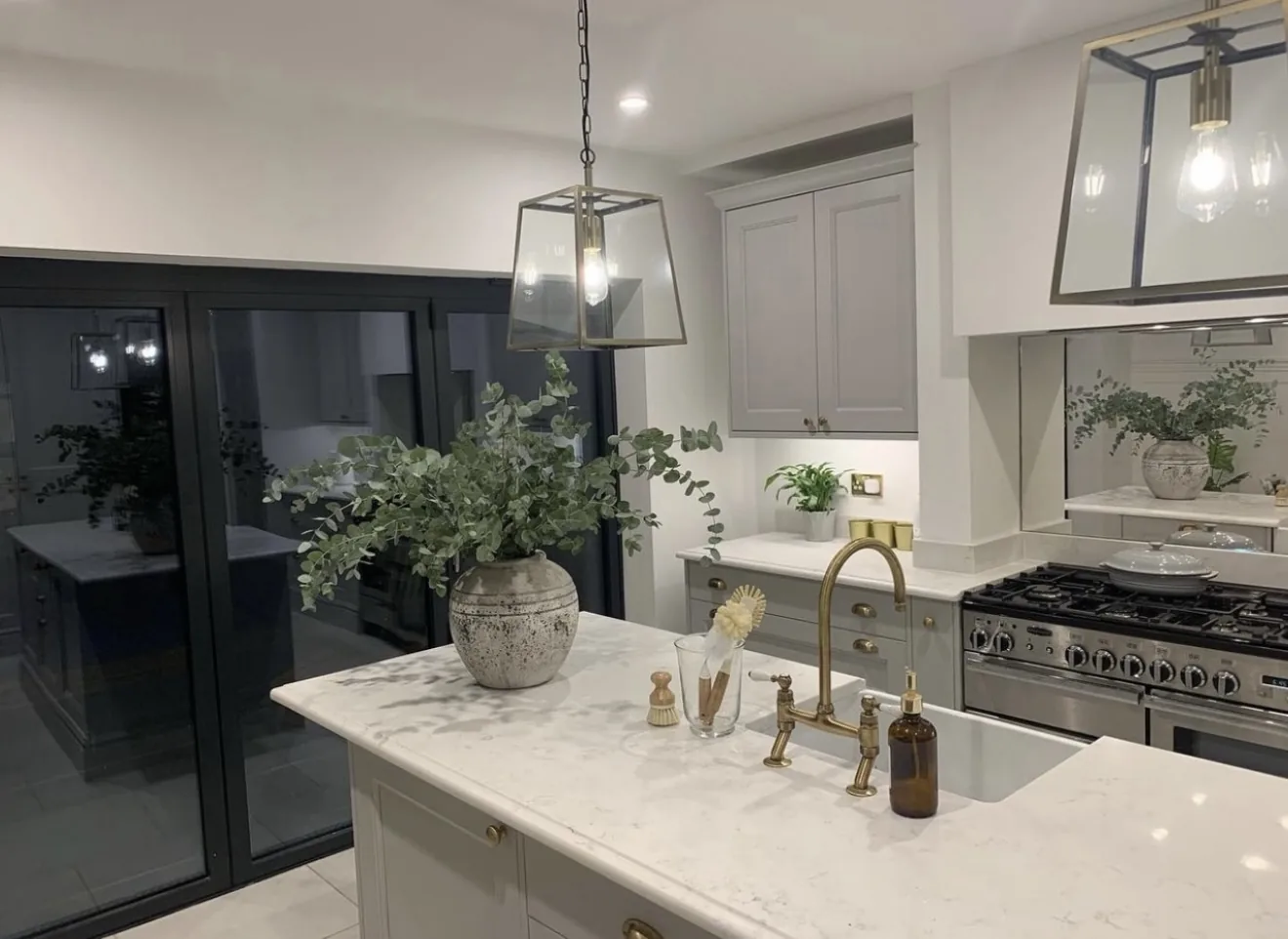
Barnet · HA8
Worktops in Edgware
The surface itself: which stone, what it costs by the square metre, and what the room does to that number.
- 5.0from 26 Google reviews
- 25-year material · 5-year workmanship
- Fitted 5-10 working days from template
Edgware kitchens
The kitchens we meet in Edgware
A survey is where stone worktop supply and fitting in Edgware stops being a guess, because until someone has stood in the kitchen nobody knows what it is going to ask for. Large interwar semis and detached houses with deep plots, where full-width rear extensions with an island and a separate utility are the standard specification, and kosher kitchen requirements are common enough that duplicated sinks and hobs should be assumed rather than asked about late. Town centre flats are the opposite: fixed compact galleys with no scope to change. You do not have to work out which of those you have. We will look at it with you when we come to Edgware.
Suspended floors at the front meet a solid slab in the extension somewhere in the middle, and the units sit across the change. Veining is the part people pick from a photograph and then meet at full size, running across a slab at a scale no postcard has ever managed to convey. The cheapest stone and the dearest one share a fitting day.
Solid brick with a render coat is firm to work against and out of plumb, so the scribe at worktop height is different from the one at plinth level. Original tiling and painted timber sit more comfortably beside a warm stone than a cool grey, and cool grey is the choice most often regretted in a room of this period. Cool artificial light turns a warm stone grey.
The archetypes on this patch are 1930s semi, 1930s detached, purpose-built 1960s flat and town centre redevelopment blocks. The floor datum is the thing that changes most between them.
True everywhere
Worktops, in short
- Supply is £110 to £550 per square metre across the 181 surfaces we fit.
- Granite comes out of the ground porous, which is why it gets sealed.
- Dekton and sintered stone hold their colour under heat and direct sunlight.
- That figure is the slab. Fabrication, edges, cut-outs and fitting are quoted separately.
- Borough
- Barnet
- Postcodes
- HA8
- Covered on
- our north London run
- Fitted
- 5–10 working days from template
The place
Why Edgware is its own job
Every kitchen we template in Edgware gets looked at for access and for what the walls are going to do to the run. Wide 1930s roads with driveways and clear side access on most houses, though a lot of side alleys have been filled by side extensions. Around the station and the shopping centre, loading is restricted and multi-storey height barriers rule out taller vans. Two sinks and two hobs in one run leaves very little solid material between cut-outs, so the piece needs rodding or a repositioned joint to survive transport. We sort it out with a template, then the quote says what sorting it out costs.
The work
What worktops involves
The material carries a twenty five year guarantee and the fitting workmanship five years, and both are handed over in writing with the paperwork for the slab. Fitting follows the template by five to ten working days, and the pieces arrive finished, with joins bonded in a resin mixed to the colour of the slab. You end up with a surface chosen for how it behaves in your room rather than for how it looked on a screen, which is a different decision and usually a better one.
Finish is not decoration. Polished, honed, leathered and brushed faces differ in how they absorb light, how they hold a mark and how often they want wiping. Thermal shock is a genuine risk at a narrow bridge of stone, where a frozen dish set down beside a hot pan across the same span is how a hairline begins. Garden light comes in from the side here, which is the condition that lets a stone with movement in it actually be seen. Sampled at home, templated in the room, machined once.
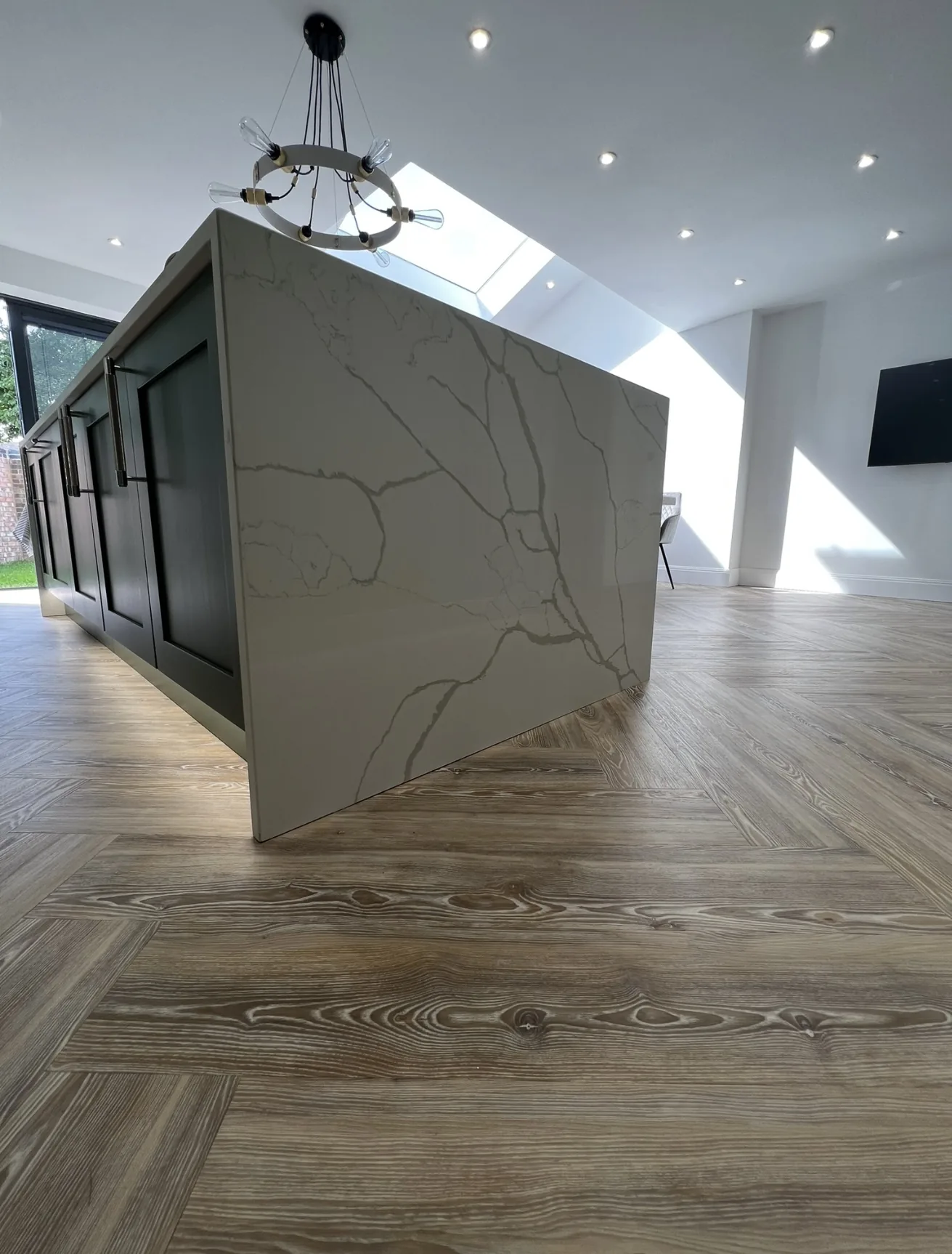
The money
What it costs in Edgware
Two rooms of identical floor area can differ by more than double on the stone alone, and the reason is almost never the size of either of them. Two facing runs mean two sets of edges and two scribes in a small span, which is why a compact galley rarely prices as cheaply as its area suggests. Multiplying your worktop area by something between £110 and £550 gives you a material bill rather than a job cost, and the two are far enough apart to be worth keeping separate. Finished edges are counted by the metre, not by the surface.
Get it priced
1930s and inter-war semis
Edgware in the housing figures
In this corner of the borough, the inter-war semi is the dominant house type. Short square kitchens carry few seams, which is what makes them good value whatever else the building does. Depth of shade matters more in a poorly lit kitchen than any figure in the stone.
1930s and inter-war semis
What Edgware asks for
Infrequent work for this area, though we do it whenever it is asked for. Worktop installation and worktop fabrication are the commoner calls. Nothing about the method or the standard varies with frequency.
1930s and inter-war semis
The shape of the run
The catch with a galley is that both runs are seen end-on from the doorway, so any difference in overhang between the two reads immediately. A seating overhang is charged as stone and as support together, and in a brittle sintered surface the support matters more than the thickness of the slab does. A pale honed face earns its keep in a room short of daylight.
Access
Getting stone into an Edgware kitchen
Wide 1930s roads with driveways and clear side access on most houses, though a lot of side alleys have been filled by side extensions. Around the station and the shopping centre, loading is restricted and multi-storey height barriers rule out taller vans.
Tell us what the approach looks like when you book the template and it gets built into the day rather than discovered on it. Where the route is genuinely tight, it changes how the pieces are cut, which is a fabrication decision rather than a delivery one.
5–10 working days
From template to fitted, working days from template. The same on this patch as every other.
north London patch
Edgware is covered on our north London run, along with the rest of Barnet.
We come to you
Templated in your kitchen, cut in our workshop, fitted by our own installers.
Access told straight
If the route forces an extra join, you hear that at quote stage, not on the day.
Questions
Questions we get asked in Edgware
If yours is not here, ring and ask. You get a straight answer rather than a call-back from a salesperson.
Is Edgware on your patch?
Yes. Edgware is on the patch, and the postcodes we work here are HA8. It is worked on our north London run, along with the rest of Barnet. The distance from the standing to the actual kitchen door is the number that counts, since plenty of drives finish at a side gate and a garden path. Whatever the standing allows, the stone leaves that van finished, because every edge, cut-out and internal radius is machined at the works and none of it is open to reconsideration at the kerb. The face is uncovered once, and that once is at handover. There is nothing to drive to and nothing to pick up, because both visits are to the property itself.
What do the kitchens in Edgware do to worktops?
The kitchen sits on the far side of the hall from the front door, so even with easy access outside there is still a turn to make inside. These kitchens are usually knocked through to the dining room, so the surface is read from two sides at once and the figure has to carry across the pieces rather than restart at every join. True walls and standard carcasses give the best yield there is. The face of a breast is rarely flat, and a top returning onto it picks up that bow across the last few hundred millimetres of its length. Every notch and every scribe is machined into the piece before it leaves the works, and a hard sintered surface is the least forgiving of a tight internal corner, so one is always cut with a generous radius. Porous or sealed is a decision about the next ten years.
Do you have trouble getting long pieces into Edgware kitchens?
Garden routes carry their own hazards: a drain cover, a step up to a patio, wet decking, or a lawn that will not take a loaded trolley. That caps the longest piece, and a run split into two lengths nests differently on the slab, which moves the yield and moves the figure with it. A remnant worth keeping rides back on the van rather than to a skip. Deep gravel takes the wheels of a loaded trolley and holds them, so either boards go down or the pieces are carried. A granite kitchen ends its day with a sealer, and a sealer wants a dry face and a quiet hour afterwards, so that hour is written into the day rather than borrowed from it. Stone arrives finished, because a kerb is not a polishing shop.
Do you get much worktops work in Edgware?
Honestly, no, though it would be easy to claim otherwise. What the research on this patch actually lists is worktop installation and worktop fabrication. That says something about the housing round here, not about the work. Quote, cut and fit are the same here as on any other part of the patch. An open-plan extension puts the worktop in the middle of the living space, so it is looked at from the sofa as well as worked on. Where several kitchens are ordered together the sensible move is to take them all off one batch, because two slabs of the same name bought six months apart will not sit happily in the same building. Fitting follows template by five to ten working days. Extension budgets are usually well spent by the time the worktop is ordered, which is where the choice between quartz and a thinner sintered stone actually gets made. Volume work tends to live at the entry end of the range, and the entry end is genuine stone rather than a compromise, since the lowest supply figure we quote is a sintered surface and not a thin laminate pretending to be one. Four samples by post settle more than four showroom visits.
What decides the price of a worktop in Edgware?
Galley runs are usually short enough to come out of a single slab, so the material band you choose does more to the total than the room shape does. A shape like that nests kindly on a slab, so more of what gets bought ends up on the units and the rate per square metre behaves much as the brochure says it will. The shape sets the cut list and the cut list sets the stone bill. Expect £110 to £550 per square metre for material supply only, with templating, fabrication and fitting on their own lines.
What do I need to sort out first?
Old breasts carry a bulge low down where the original opening was closed up, and the units stand off it before the stone is measured at all. A hob dropped into the middle of a length puts sustained warmth at the lip of a cut-out, and an engineered surface will yellow there across ten years where a natural one takes it without comment. A short upstand shows a fragment of pattern, never a run of it. Confirm the depth of the units, the total run lengths and whether an island or peninsula is going in, and tell us the colour temperature of the lighting. Someone who expects to still be there in ten years asks different questions: how a honed finish marks, what a sealer does and does not do, and whether a chip by the sink can be repaired in place. That changes which questions are worth asking about the stone, because somebody staying put wants to know how a honed face marks in five years and somebody selling wants to know how it photographs next spring. Hard use by people who did not choose it points at sintered stone.
What happens if my units are not level?
Packing takes up small variation. It is not there to hide something that belongs in the units. An island is where this usually shows, standing free with no wall to level against. If the carcasses are corrected, the template is taken again, since a drawing off units that then moved is worthless. Two alcove pieces will not swap over however similar they look, so they are marked left and right at the bench and stay that way to the van. A run that sits under strong sun for hours every afternoon suits a surface built to be stable in daylight, because a resin-bound stone is made for indoor use and sustained sunlight is the one thing it was never designed around. Reach across an unsupported span is a thickness question.
Does a stone worktop need sealing?
A seal is not waterproofing. It only buys time to wipe a spill up. No maintenance visit is built into the job. Soap, water, and on the porous stones a seal. Where a top takes wine, oil and lemon most days, the non-porous materials ask least of the household. These were built with a separate dining room, and most have had the wall between it and the kitchen taken out with a steel put in above. Side light from the garden is what lets a stone with movement in it actually be seen, which is why a busier granite or a veined quartz earns its keep here and a flat single colour rarely does. A kitchen with no window of its own needs tone rather than colour.
Can I have stone up the wall in an Edgware kitchen?
A full-height piece shows a wall that is out more than an upstand does, over the extra height. Both are templated after the worktop is down and settled, because they are cut to the wall itself. Tiling and stone can meet, but where they meet is decided before the template rather than after. A side return glazed over gives the room a second aspect and a second floor level, because the old external threshold is still under the finish. A knocked-through room means the surface is read from the dining side as well as the working side, so the figure has to run continuously and the pieces are taken from adjoining slab. A galley nests efficiently and frees money for better stone.
What if the stairs turn too tightly for the stone?
Hoisting through a window is occasionally the answer, and it is a decision made at the template, not improvised on the fitting day. The carry route is measured before anything is cut, so a piece that will not make the turn is split at the drawing stage rather than discovered on the day. Doorways, the newel post and the handrail usually take the room away, rather than the stairs themselves. A side gate hung to open outward against a fence post is narrower in use than it measures, and lifting the gate off its hinges is usually the quickest win on the route. Where a seam becomes unavoidable the choice of stone starts to matter, because a fine even speckle closes a joint almost invisibly and a broad vein simply will not. Thinner stone carries easily and asks for continuous support.
Reviews
5.0 from 26 Google reviews
Every one of these is on our Google profile under the reviewer’s own name. Nothing here is written by us, and the link goes straight to the source.
Great work, super helpful team. I'd definitely recommend!
Andreea Tanase
Google review
Great experience from this company, I am happy with the materials, fitting and the team.
Rrahim Brati
Google review
Absolutely delighted with our new worktop from Worktop WorX. The Capri White finish looks incredible, clean, modern, and really brightens up the whole kitchen while pairing beautifully with the darker cabinetry. The quality of the worktop is outstanding, with a flawless finish and seamless installation that really shows the attention to detail. It’s not only stylish but also feels incredibly durable and practical for everyday use. Cam handled everything from start to finish and made the whole process smooth and stress-free. Professional, reliable, and clearly takes pride in the work. Highly recommend Worktop WorX. We couldn’t be happier with the result!
Dawid Myszor
Google review · Capri White
Related
More around Edgware
Other work we do in Edgware
Next step
Worktops in Edgware, priced properly
Plans, a sketch or photographs with rough run lengths is enough to start. You get an itemised written quote and the template dates we can offer on this patch.
25-year material warranty and a 5-year workmanship guarantee, both stated on your quote.