The housing stock
What we are usually working with in Harlington
Original solid floors are quarry tile or flagstone bedded on ash, and they have moved with the ground rather than with the building. Pieces come in the order they go down, because there is rarely anywhere to stand the second one while the first is bedded. The first hour is protection and packing, not stone.
M4 Junction 4 and the Bath Road feed the area. 1930s semis with rear extensions, and a strong local preference for a second kitchen or heavy-duty utility so the main kitchen is spared. Long back-wall runs with tall unit banks at one end. Second kitchens take real punishment here, so a low-porosity surface with a pencil or bullnose edge lasts, and a sharp arris is what comes back as a chip.
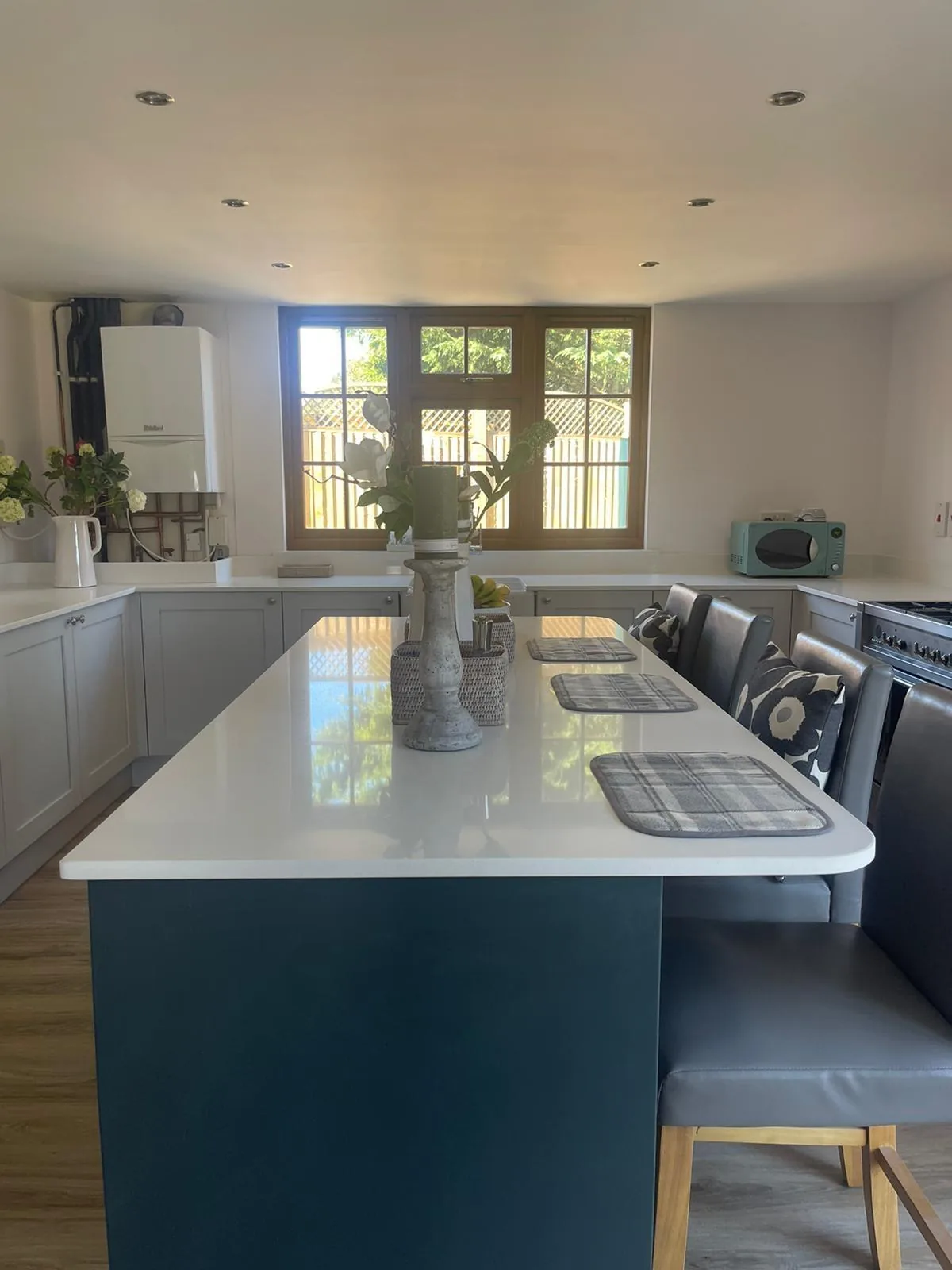
A period cottage has low ceilings, thick rubble-filled walls and a floor that has never been level, and the worktop is the thing that has to look straight. The old island top is frequently sitting on units that were never fixed down, which is fine for laminate and not for stone. Same units, straighter line, better surface.
What we are usually templating in is Historic village core, 1930s semi, postwar estate house and recent infill. They were built to different tolerances, and the stone has to absorb that.
Access. The High Street through the old village is narrow, but the surrounding estates have drives. M4 Junction 4 and the Bath Road feed the area.
There is nothing to visit in Harlington. Samples are posted free, the template is taken in your kitchen and the stone is fitted there too.