
Bromley · BR6
Worktops in Pratts Bottom
The surface itself: which stone, what it costs by the square metre, and what the room does to that number.
- 5.0from 26 Google reviews
- 25-year material · 5-year workmanship
- Fitted 5-10 working days from template
Pratts Bottom kitchens
The kitchens we meet in Pratts Bottom
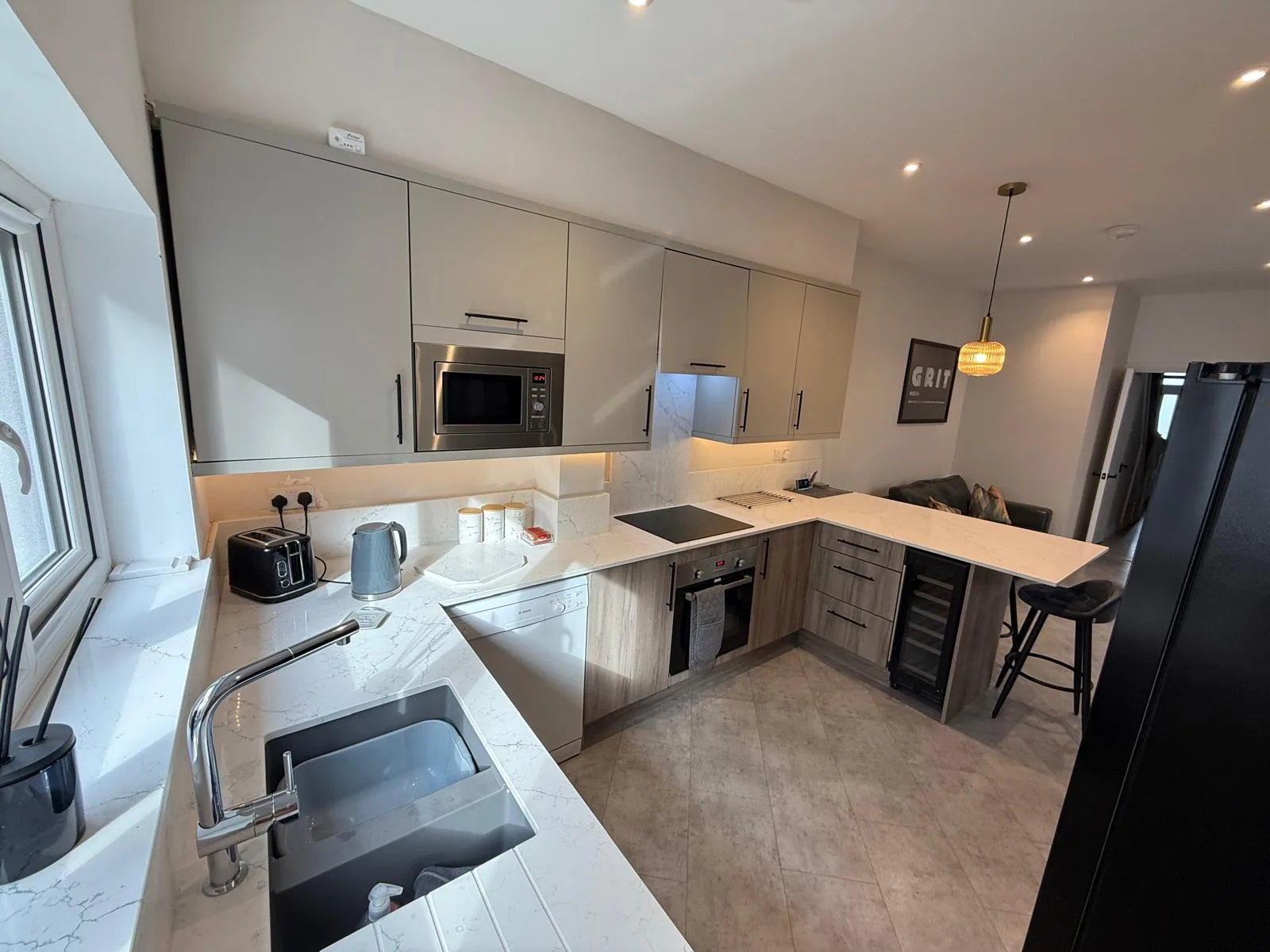
We turn down very few worktop jobs in Pratts Bottom, but we do insist on seeing the kitchen first, and the reason for that is in the rooms themselves. Small hamlet stock with kitchens that are usually part of a rear extension or an old outbuilding brought into the house, so ceiling heights change mid-run and there is often a step down into the kitchen. Oil or LPG range cookers are more common here than in the suburbs. Bring us the problem rather than the diagnosis. Working out what you have got is the first thing we do.
Lime plaster on nine inch brick has been patched with gypsum wherever a radiator or a socket has moved, and the two finish at different depths. Weight arrives as a figure per square metre and turns into a question about the floor, which is worth asking in any building where a timber span carries the kitchen. The surface outlasts the doors beneath it, usually twice over.
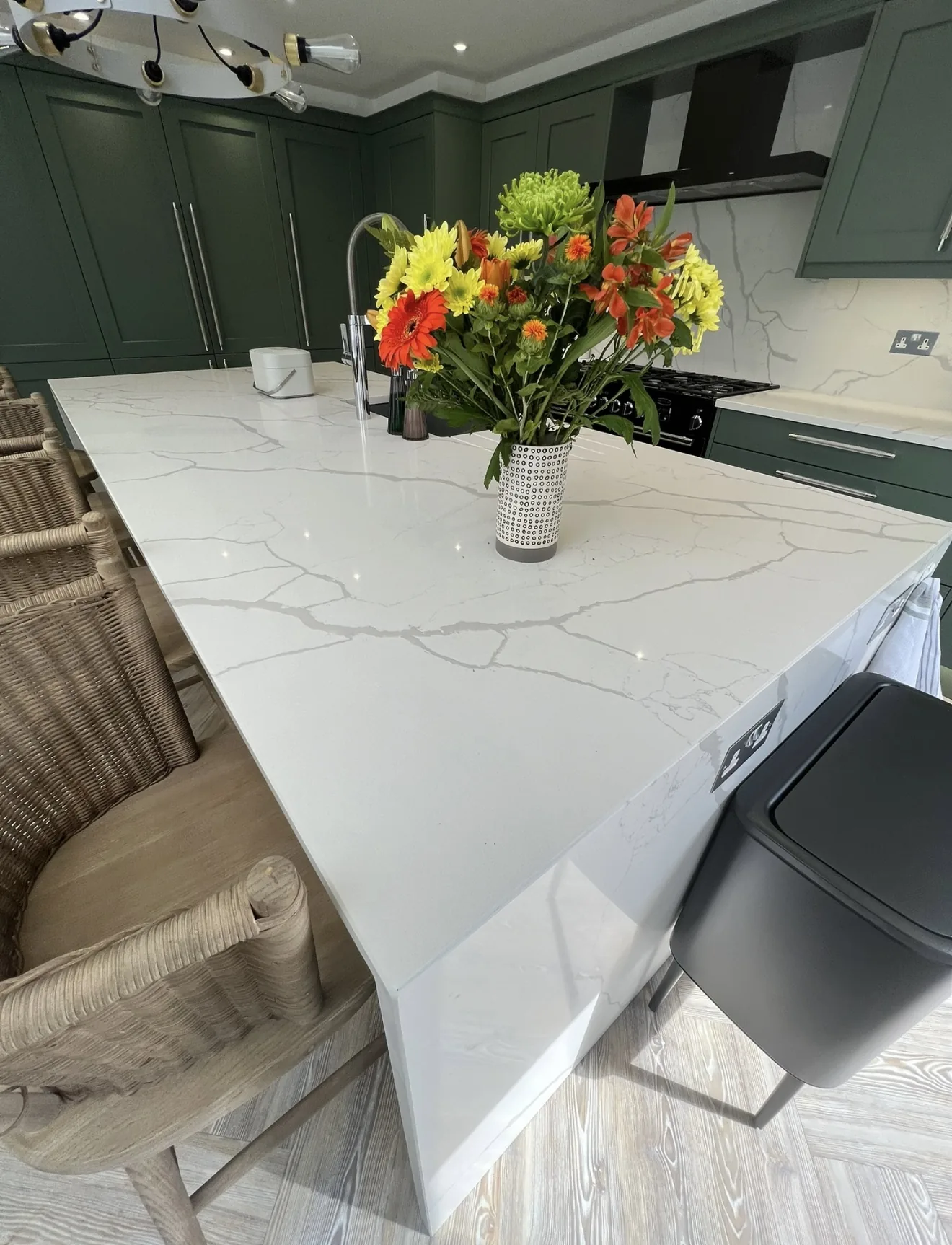
Ceiling beams cross the room at a height that decides where a piece can be stood on edge and where it cannot. There is usually an island, and the island takes the liveliest part of the stone while the perimeter is allowed to stay quiet, which is a decision made at the slab rather than on paper. Side light flatters movement and wastes a flat colour.
The kinds of building we work in here are semi-rural detached, 1930s cottage, converted outbuilding and post-war bungalow. Each carries its own carry problem before it carries a worktop.
True everywhere
Worktops, in short
- Supply is £110 to £550 per square metre across the 181 surfaces we fit.
- Quartz is engineered, so its pattern repeats and a long kitchen matches itself end to end.
- Granite comes out of the ground porous, which is why it gets sealed.
- Dekton and sintered stone hold their colour under heat and direct sunlight.
- Borough
- Bromley
- Postcodes
- BR6
- Covered on
- our south east London run
- Fitted
- 5–10 working days from template
The place
Why Pratts Bottom is its own job
We would rather tell you what a fit in Pratts Bottom is going to involve now than discover it with a slab in the hallway. Off the A21 down single-track lanes with passing places and blind bends, and driveways that turn sharply off the lane, so a long wheelbase van has to reverse in. Where there is a step down into an old outbuilding kitchen the cabinet plinths get packed, so we set datum from the units and not the floor. Once the template is signed off the price is fixed. It does not move because the job turned out fiddly.
The work
What worktops involves
Up to four quartz samples are posted out free so a colour can be lived with under your own lighting before a slab is reserved in your name. A natural stone is sealed before the kitchen is handed back, and you are told plainly which products will dull the finish and which will not touch it. You get an itemised figure that shows what the slab cost, what the edges cost and what the openings cost, so the layout can be adjusted before anything is cut.
Across the 181 surfaces fitted, supply is £110 to £550 per square metre: quartz £130 to £500, granite £121 to £550, Dekton £110 to £366. Where a run needs a join, the pieces are cut from adjoining slab and bonded with a colour matched resin so the line reads as a shadow rather than as a repair. A kitchen this size runs to two slabs, and the second slab changes the question from what it costs to which one you want. Three materials, three temperaments, and a shortlist that writes itself.
The money
What it costs in Pratts Bottom
Edge work is charged along the length of every exposed face, which is why an island with four finished sides prices differently from a run with one. In a galley the runs are short and the cut-outs are close together, so the fixed operations carry more of the total than the stone does. Supply-only material is £110 to £550 per square metre. The more useful question is not which end of that you are at, but how many operations the cut list carries. The slab, then the machining, then the fitting, each on its own line.
Get it priced
period detached houses and villas
Pratts Bottom in the housing figures
In this corner of the borough, there are very few flats. Every survey starts from a blank sheet. A route that forces short lengths rearranges the nesting, and nesting is where the gap between two quotations usually hides. Rough treatment calls for whichever material has the thickest skin.
period detached houses and villas
The carry, and what it rules out
Drives with a dropped kerb and a tight turn-in take a long van at an angle, and that angle decides which side the tail lift can work from. Where something genuinely has to be eased on site it is done wet and under extraction, since dry cutting quartz burns the resin in it and leaves a mark that will not polish out. Pieces are unloaded in laying order so the figure runs true.
period detached houses and villas
What Pratts Bottom asks for
This is not the commonest thing we do here. Worktop installation and worktop fabrication come up more. It is a fact about the local building stock, not about the standard or the price of the work.
Access
Getting stone into a Pratts Bottom kitchen
Off the A21 down single-track lanes with passing places and blind bends, and driveways that turn sharply off the lane, so a long wheelbase van has to reverse in.
Tell us what the approach looks like when you book the template and it gets built into the day rather than discovered on it. Where the route is genuinely tight, it changes how the pieces are cut, which is a fabrication decision rather than a delivery one.
5–10 working days
From template to fitted, working days from template. The same on this patch as every other.
south east London patch
Pratts Bottom is covered on our south east London run, along with the rest of Bromley.
We come to you
Templated in your kitchen, cut in our workshop, fitted by our own installers.
Access told straight
If the route forces an extra join, you hear that at quote stage, not on the day.
Questions
Questions we get asked in Pratts Bottom
If yours is not here, ring and ask. You get a straight answer rather than a call-back from a salesperson.
Are you set up to work in Pratts Bottom, or is it a subcontractor?
Yes. Pratts Bottom is on the patch, and the postcodes we work here are BR6. It is worked on our south east London run, along with the rest of Bromley. Where the drive is too short for the van the back end overhangs the footway, and a footway is a route people are using rather than spare space. Whatever the standing allows, the stone leaves that van finished, because every edge, cut-out and internal radius is machined at the works and none of it is open to reconsideration at the kerb. A reserved slab is a slab nobody else is allowed to buy. We template in your kitchen and fit in your kitchen, so there is nothing to visit and nothing to collect.
What is different about worktops in Pratts Bottom?
The floor is often flags or brick laid straight on the ground, so it is solid, uneven and not going to be levelled by chasing into it. A kitchen of this size runs to two slabs almost every time, and once a second slab is in the quotation the question shifts from rate per square metre to which slab you actually want to live with. One full slab and no second is the sweet spot on price. A junction between an original floor and a later extension slab is almost never at the same level, so units carrying a run across it need packing first. Every notch and every scribe is machined into the piece before it leaves the works, and a hard sintered surface is the least forgiving of a tight internal corner, so one is always cut with a generous radius. Short lengths are where a full slab starts to pay for itself.
Is access a problem in Pratts Bottom?
Where the van stands level with the front of the house a piece gets handled twice instead of five times, and stone breaks on handling rather than on the road. That caps the longest piece, and a run split into two lengths nests differently on the slab, which moves the yield and moves the figure with it. A forced seam is a material decision before it is a fitting one. Having the van on the drive means the load can be staged, so the heavy pieces come off last and go straight in instead of standing outside. A granite kitchen ends its day with a sealer, and a sealer wants a dry face and a quiet hour afterwards, so that hour is written into the day rather than borrowed from it. Cutting is done wet and extracted, never dry on a pavement.
Is Pratts Bottom really a worktops area?
Not really, and there is no sense dressing it up. What the research on this patch actually lists is worktop installation and worktop fabrication. That is a statement about the local housing rather than about the work. It gets quoted, cut and fitted exactly as it would anywhere else on the patch. Rear and side-return extensions are where the islands appear, and an island is the piece that decides whether one slab does the kitchen or two. Volume work tends to live at the entry end of the range, and the entry end is genuine stone rather than a compromise, since the lowest supply figure we quote is a sintered surface and not a thin laminate pretending to be one. A focal surface deserves to be seen at full size. A new extension slab is not automatically level, and that wants checking before templating rather than after the stone is cut. Adding an island is what moves most of these projects from one slab to two, and that jump is the single largest step in any worktop quotation. Specify before the room is finished, not afterwards.
What makes one Pratts Bottom kitchen dearer than the next?
Walls at both ends mean two scribes on every piece, and a run that has to drop between two fixed points has no tolerance left to give away. A shape like that nests kindly on a slab, so more of what gets bought ends up on the units and the rate per square metre behaves much as the brochure says it will. Long unbroken lengths are what make a plain stone look dear. Material is £110-£550 per square metre supply only, and templating, fabrication and fitting are quoted on their own lines.
What holds a template up more often than anything else?
Legs bottoming out on hard concrete or an uneven screed mean the tops of the carcasses are not one plane, and that is picked up at template rather than on fitting day. A hob dropped into the middle of a length puts sustained warmth at the lip of a cut-out, and an engineered surface will yellow there across ten years where a natural one takes it without comment. The narrowest return in the kitchen is its weakest stone. Send the island dimensions and the perimeter run lengths, say whether a waterfall end is wanted, and tell us which slab you would like reserved. A quartz sample left on the counter for a week under the actual kitchen lights settles more arguments than any showroom, and an owner is the only person in a position to do that. That changes which questions are worth asking about the stone, because somebody staying put wants to know how a honed face marks in five years and somebody selling wants to know how it photographs next spring. A let kitchen is specified for indifference, and rightly so.
What is not included in the quoted figure?
Cut-outs, edge profile and join count are itemised, so taking one out removes a line rather than starting an argument. What is quoted is what the drawing says, and the figure does not move unless the drawing does. Every run, cut-out, edge, join and groove set is a line, which is what makes it comparable with anyone else’s. Level has to hold across the whole room rather than along one wall, or a floor that falls end to end shows as a step where two pieces meet. A run that sits under strong sun for hours every afternoon suits a surface built to be stable in daylight, because a resin-bound stone is made for indoor use and sustained sunlight is the one thing it was never designed around. Porous or sealed is a decision about the next ten years.
Is taking the old top off part of the job?
Disposal means it goes in the van, not into the garden to wait for a collection. The template can be taken with the old top still down, which is why one visit covers both. On a replacement the old top comes off in the morning and the new stone is down and sealed the same day. A dropped kerb wide enough for a car is not always wide enough for a long-wheelbase van, and the width of the crossing decides the rest. Sintered surfaces are the hardest of the three to machine and the messiest to cut wet, which is precisely why none of that happens on a public pavement. Remnants become chopping boards, hearths and window boards.
Will I have to look after it? What does a Pratts Bottom worktop need?
Quartz and sintered stone never need sealing: quartz is non-porous and sintered stone has effectively zero porosity. Sealing is the one maintenance job that genuinely differs by material, and it is worth knowing which you are buying before the slab is chosen. Marble is the one people underestimate. It is porous, like granite, and wants sealing. These have been added to over two centuries, so the kitchen is made of two or three walls of different ages and different thicknesses. Kitchens of this size nearly always run to two slabs, and once a second slab is in the quotation the question changes from price per square metre to which slab you actually want. Warm stone beside painted timber, cool grey rarely.
Will you fit a worktop I have bought myself?
Supply through us runs £110 to £550 per square metre for the slab alone, which is the line you would be removing. The quote is itemised, so a job where you already hold the slab is the same job with the material line taken off it. Stone cut to somebody else’s drawing cannot usefully be re-cut to yours. The junction between the original room and the extension is the point to watch, because the two floors rarely sit at the same height. Quartz is the sensible default where a kitchen changes hands often, because there is nothing to seal, nothing to re-seal and nothing an incoming household has to be told about the surface. Repeat work rewards a single decision taken carefully.
Reviews
5.0 from 26 Google reviews
Every one of these is on our Google profile under the reviewer’s own name. Nothing here is written by us, and the link goes straight to the source.
Great service. Super quick and easy communication. I love my new worktop 🥹🥹
Sara Arghir
Google review
Professional, polite and friendly service. Very pleased with finished product.
costas andrews
Google review
I used Karem’s services 5 years ago for purchasing and fitting the quartz worktop in my then brand new kitchen. The price was reasonable and the service reliable and spot on, no delays in fitting, misunderstanding or excuses. I recommended him to a friend, who also used his services and they were happy too! If I need to order new kitchen work top again, I would definitely use him again. Thanks Karem!
shoshencence
Google review · quartz
Related
More around Pratts Bottom
Other work we do in Pratts Bottom
Next step
Worktops in Pratts Bottom, priced properly
Plans, a sketch or photographs with rough run lengths is enough to start. You get an itemised written quote and the template dates we can offer on this patch.
25-year material warranty and a 5-year workmanship guarantee, both stated on your quote.