
Tower Hamlets · E1
Worktops in Stepney
The surface itself: which stone, what it costs by the square metre, and what the room does to that number.
- 5.0from 26 Google reviews
- 25-year material · 5-year workmanship
- Fitted 5-10 working days from template
Stepney kitchens
The kitchens we meet in Stepney
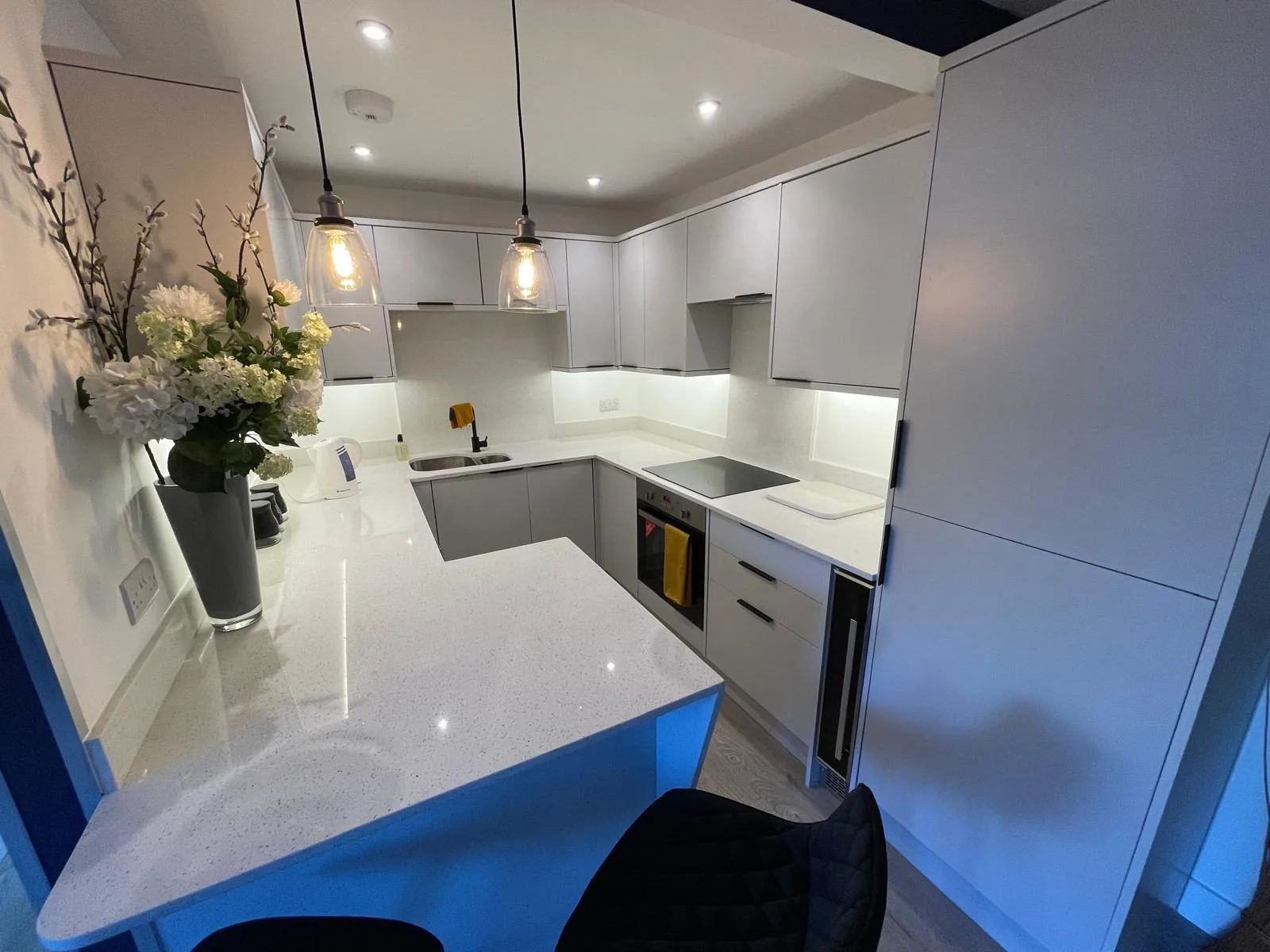
A good quote for stone worktop supply and fitting in Stepney reads like a description of your kitchen rather than a price list, and that is deliberate. Estate flats have kitchens designed as separate rooms, typically 2.2m to 2.8m in an L with the boiler cupboard eating one corner and no room for a peninsula. Where houses have been reconfigured the kitchen moves to the rear with a modest island of around 1.8m. Either way, the next step is the same one: get someone out to look, and get the measurements written down.
Small, roughly square kitchens with a back door and a window in the middle of the run: short lengths, few joins, and a lot to work around. Quartz, granite and sintered stone each let you down in a different way, and choosing well is mostly a matter of knowing which of those three failures this room will provoke. Thickness changes the look and the figure in the same breath.
A boiler in a cupboard on the kitchen wall is normal in this stock, and its position is fixed by its flue. A window in the middle of the run gives the working surface good light, so a mid-tone will not be swallowed the way it would be in a darker room. A kitchen with no window of its own needs tone rather than colour.
What turns up on the job sheets is large post-war estate, 1970s low-rise deck-access housing, surviving Victorian terrace and recent estate-renewal block. The age of the shell tells us more than the age of the kitchen does.
True everywhere
Worktops, in short
- Supply is £110 to £550 per square metre across the 181 surfaces we fit.
- Quartz runs £130 to £500 per square metre, granite £121 to £550 and Dekton £110 to £366.
- Templating is done in the room itself, once the units are fixed and level.
- Fitting happens five to ten working days after the template is taken.
- Borough
- Tower Hamlets
- Postcodes
- E1
- Covered on
- our east London run
- Fitted
- 5–10 working days from template
The place
Why Stepney is its own job
Having worked in Stepney regularly, we already know what to check before a template is booked and a slab is ordered. Vehicle access is through estate roads with speed tables, resident-only bays and bollarded pedestrian links, so a route survey saves a long carry. Low-rise deck housing means walking the slab along a raised walkway with a step up at the door threshold. Original estate kitchens are frequently out of square where partitions were built off timber studs, so scribes matter more here than anywhere else in the borough. It gets measured, drawn, agreed and priced, in that order, and you sign the drawing off before the workshop puts a blade near the slab.
The work
What worktops involves
Worktop supply and fitting covers the stone itself, machined to your room: the surface, the polished edges, the openings for sink, hob and tap, and the fitting of the finished pieces. A natural stone is sealed before the kitchen is handed back, and you are told plainly which products will dull the finish and which will not touch it. You keep the offcut if you want it, which is where the chopping board, the shelf and the spare piece for a future repair come from.
The order of decisions matters: body, then gauge, then finish, then edge, then the apertures, because each one narrows what the next is allowed to be. Veining is a batch property, not a catalogue property, and two slabs bearing one name can differ more than two names taken from the same quarry. A window set into the middle of the run puts daylight where the chopping happens, so a mid-tone will not go flat. Machined to the millimetre and guaranteed by the decade, not the year.
The money
What it costs in Stepney
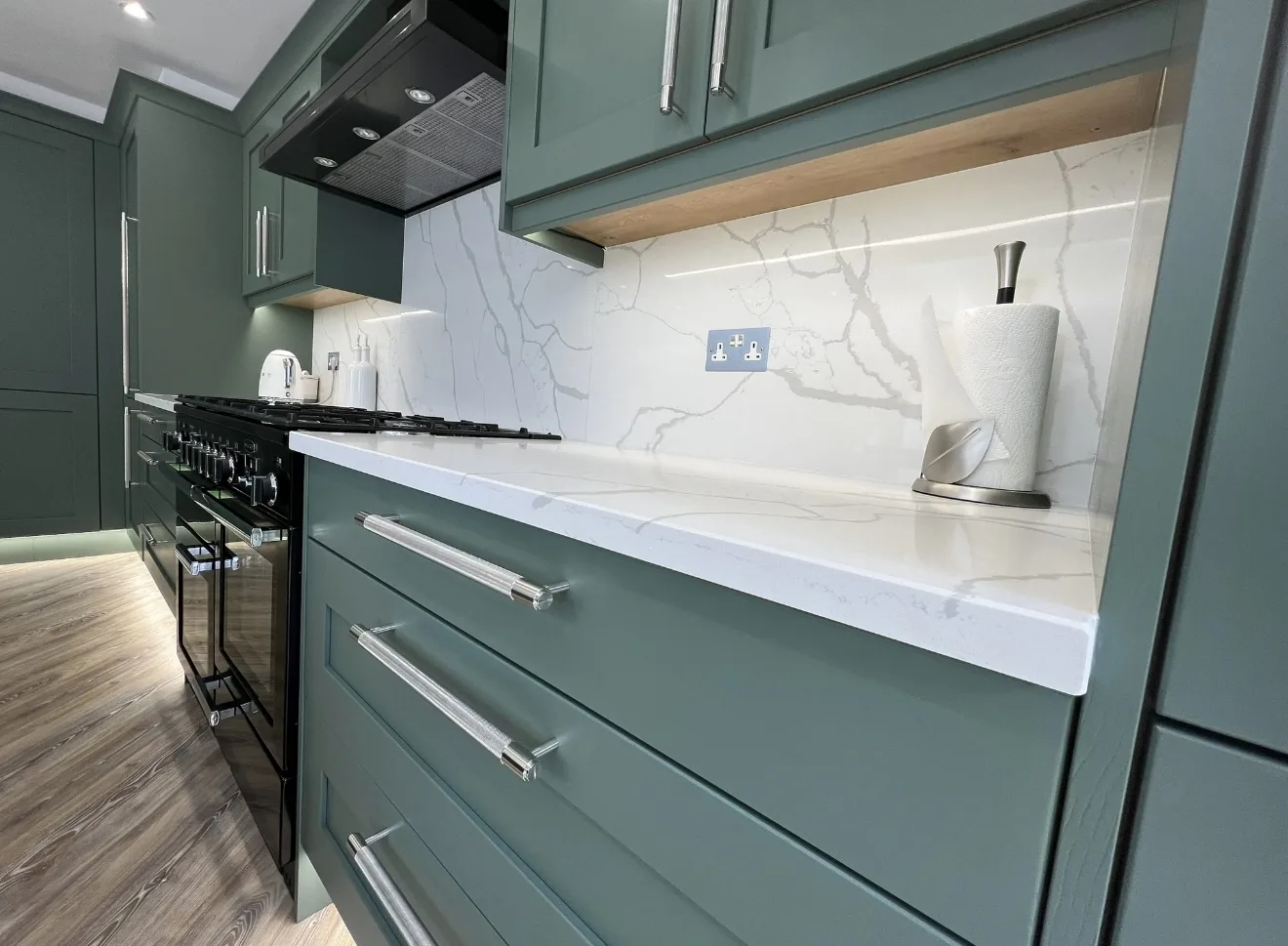
Two rooms of identical floor area can differ by more than double on the stone alone, and the reason is almost never the size of either of them. The corner is either a join or a single cut piece, and which one it is changes both the price and how the run reads. Thickness, finish and colour move a slab within the £110 to £550 supply band before anyone touches it, so that figure is settled by what you pick rather than by the room. Priced off the cut list, never off the floor plan.
Get it priced
ex-local-authority flats and estates
Stepney in the housing figures
Taken across Stepney and the roads either side of it, owner-occupation is well below the London average. Where the next occupier inherits the decision, a disc filed with the paperwork is what lets a future repair be matched to the right dye lot. Serious daily cooking narrows the sensible choices to a handful of materials.
ex-local-authority flats and estates
The carry, and what it rules out
A resident bay and a shared-use bay can sit on the same street under different rules, and it is usually the shared one a visitor permit or a ticket touches. Resin filled fissures in a natural slab are inspected in daylight at the works and never under a street lamp, since that is the only honest way to see them. Wet stone reads darker, which is why colour is judged indoors.
ex-local-authority flats and estates
What Stepney asks for
We are not going to claim this is the local speciality when the stock says otherwise. Worktop replacement and worktop installation is what these streets actually ask for. The work itself is done exactly the same way.
Access
Getting stone into a Stepney kitchen
Vehicle access is through estate roads with speed tables, resident-only bays and bollarded pedestrian links, so a route survey saves a long carry. Low-rise deck housing means walking the slab along a raised walkway with a step up at the door threshold.
Tell us what the approach looks like when you book the template and it gets built into the day rather than discovered on it. Where the route is genuinely tight, it changes how the pieces are cut, which is a fabrication decision rather than a delivery one.
5–10 working days
From template to fitted, working days from template. The same on this patch as every other.
east London patch
Stepney is covered on our east London run, along with the rest of Tower Hamlets.
We come to you
Templated in your kitchen, cut in our workshop, fitted by our own installers.
Access told straight
If the route forces an extra join, you hear that at quote stage, not on the day.
Questions
Questions we get asked in Stepney
If yours is not here, ring and ask. You get a straight answer rather than a call-back from a salesperson.
Do you actually work in Stepney, or just list it?
Yes. Stepney is on the patch, and the postcodes we work here are E1. It is worked on our east London run, along with the rest of Tower Hamlets. A shared-use bay allows a paid stay up to a set maximum, and that maximum is routinely shorter than the working day the job needs. Whatever the standing allows, the stone leaves that van finished, because every edge, cut-out and internal radius is machined at the works and none of it is open to reconsideration at the kerb. Nothing is ever colour matched outdoors under a grey sky. The template happens in your kitchen and so does the fit, so there is nothing to visit and nothing to collect.
Why would worktops in Stepney be any different from anywhere else?
Ceiling heights dropped after the war, so there is less wall between the worktop and the wall units than in anything older. These kitchens are small and roughly square, so the run is short, the join count is low and the material band accounts for almost all of the figure rather than the bench time. A galley nests efficiently and frees money for better stone. Plaster thickness varies over the height of a wall, so the line at worktop height is not the line at skirting level, and the units decide which one matters. Every notch and every scribe is machined into the piece before it leaves the works, and a hard sintered surface is the least forgiving of a tight internal corner, so one is always cut with a generous radius. A short upstand shows a fragment of pattern, never a run of it.
What is the carry like in Stepney?
Where the turn inside is tight the piece gets turned on the path and brought in already on edge, which needs room in front of the door as well as behind it. That caps the longest piece, and a run split into two lengths nests differently on the slab, which moves the yield and moves the figure with it. A remnant worth keeping rides back on the van rather than to a skip. Camera enforcement gives nobody the chance to explain, where an officer on foot at least sees a tail lift down and stone coming off it. A granite kitchen ends its day with a sealer, and a sealer wants a dry face and a quiet hour afterwards, so that hour is written into the day rather than borrowed from it. The film stays on the face until the last trade leaves.
Would you call Stepney a worktops area?
Not especially, and pretending otherwise would be simple enough. What the research on this patch actually lists is worktop replacement and worktop installation. It is a fact about the local housing rather than about the work. The job is quoted, cut and fitted the same way wherever on the patch it lands. Extension budgets are usually well spent by the time the worktop is ordered, which is where the choice between quartz and a thinner sintered stone actually gets made. Where several kitchens are ordered together the sensible move is to take them all off one batch, because two slabs of the same name bought six months apart will not sit happily in the same building. Where the cooking is serious, heat tolerance leads the list. Rear and side-return extensions are where the islands appear, and an island is the piece that decides whether one slab does the kitchen or two. Volume work tends to live at the entry end of the range, and the entry end is genuine stone rather than a compromise, since the lowest supply figure we quote is a sintered surface and not a thin laminate pretending to be one. Order the stone against the room, never against the drawing.
Where does the money go on a Stepney worktop?
Corner sinks and corner hobs sit exactly where the joint wants to be, so on an L the cut-out positions get settled before the join positions do. A shape like that nests kindly on a slab, so more of what gets bought ends up on the units and the rate per square metre behaves much as the brochure says it will. One slab or two is the biggest single jump in any quotation. Supply-only material is £110 to £550 per square metre, and templating, fabrication and fitting are quoted separately rather than rolled in.
What needs to be ready before you come to Stepney?
Two walls each a degree out give an internal corner two degrees out, and the whole of that error lands in the mitre. A hob dropped into the middle of a length puts sustained warmth at the lip of a cut-out, and an engineered surface will yellow there across ten years where a natural one takes it without comment. Reach across an unsupported span is a thickness question. Measure the run between the walls, note the cill height above the units, and tell us the thickness of the top that is coming off. Method statements, insurance certificates and named operatives are wanted before a crew is cleared to attend, all of which is routine when it is asked for a week out. That changes which questions are worth asking about the stone, because somebody staying put wants to know how a honed face marks in five years and somebody selling wants to know how it photographs next spring. Staying put and selling on ask different questions of a stone.
Can the price change after templating?
The quote is written from the template drawing. Before that it works from what you have described. The design and quotation visit is free and carries no obligation, so a figure exists before any commitment. What is quoted is what the drawing says, and the figure does not move unless the drawing does. A scribe has a working limit, and past twenty millimetres or so the back edge starts eating depth the run cannot spare. A run that sits under strong sun for hours every afternoon suits a surface built to be stable in daylight, because a resin-bound stone is made for indoor use and sustained sunlight is the one thing it was never designed around. Speckle hides the resin line a mitre leaves behind.
What happens if a piece will not go up the stairs?
A join added to get stone into the room is a different thing from a join added because the slab ran out, and the quote says which is which. A piece travels on edge, never flat, because on edge is how stone of that length carries its own weight. Doorways, the newel post and the handrail usually take the room away, rather than the stairs themselves. Everything comes through the front door and down the hall, so the tightest point on the route is usually the newel post at the foot of the stairs. Where a seam becomes unavoidable the choice of stone starts to matter, because a fine even speckle closes a joint almost invisibly and a broad vein simply will not. Thinner stone carries easily and asks for continuous support.
Can a Stepney worktop be done in one piece?
A finished join is typically two to three millimetres, colour-matched and sanded flush. A join cannot cross a cut-out, so a sink mid-run takes away the position you would have used. A join is glued and clamped flush on the day, so it is fixed rather than something to be undone. One leg of an L is nearly always the working run and the other little more than a landing space, but both are templated, cut and edged to the same standard. An island is the piece that decides whether one slab covers the kitchen or two, and a second slab arrives as a step in the figure rather than a gentle slope. A mitre asks the pattern to turn a corner and be believed.
Are hob and sink cut-outs priced separately on a Stepney quote?
Where the hob lands is set out against the units and the wall behind, not off the kitchen plan. A piece with a bowl and a hob cut into it is the fragile one, and it is handled accordingly. A tap under a window board still needs room for its handle to lift, which is checked at the template. Two runs meeting at an internal corner is the most common shape we fit, and the corner is where the decisions are. A waterfall end is the most expensive detail per visible square metre in the trade, because the leg is a whole extra piece and the figure has to run down it uninterrupted. The waterfall leg is a whole extra piece of stone.
Reviews
5.0 from 26 Google reviews
Every one of these is on our Google profile under the reviewer’s own name. Nothing here is written by us, and the link goes straight to the source.
Great service. Super quick and easy communication. I love my new worktop 🥹🥹
Sara Arghir
Google review
Professional, polite and friendly service. Very pleased with finished product.
costas andrews
Google review
I used Karem’s services 5 years ago for purchasing and fitting the quartz worktop in my then brand new kitchen. The price was reasonable and the service reliable and spot on, no delays in fitting, misunderstanding or excuses. I recommended him to a friend, who also used his services and they were happy too! If I need to order new kitchen work top again, I would definitely use him again. Thanks Karem!
shoshencence
Google review · quartz
Related
More around Stepney
Other work we do in Stepney
Next step
Worktops in Stepney, priced properly
Plans, a sketch or photographs with rough run lengths is enough to start. You get an itemised written quote and the template dates we can offer on this patch.
25-year material warranty and a 5-year workmanship guarantee, both stated on your quote.