
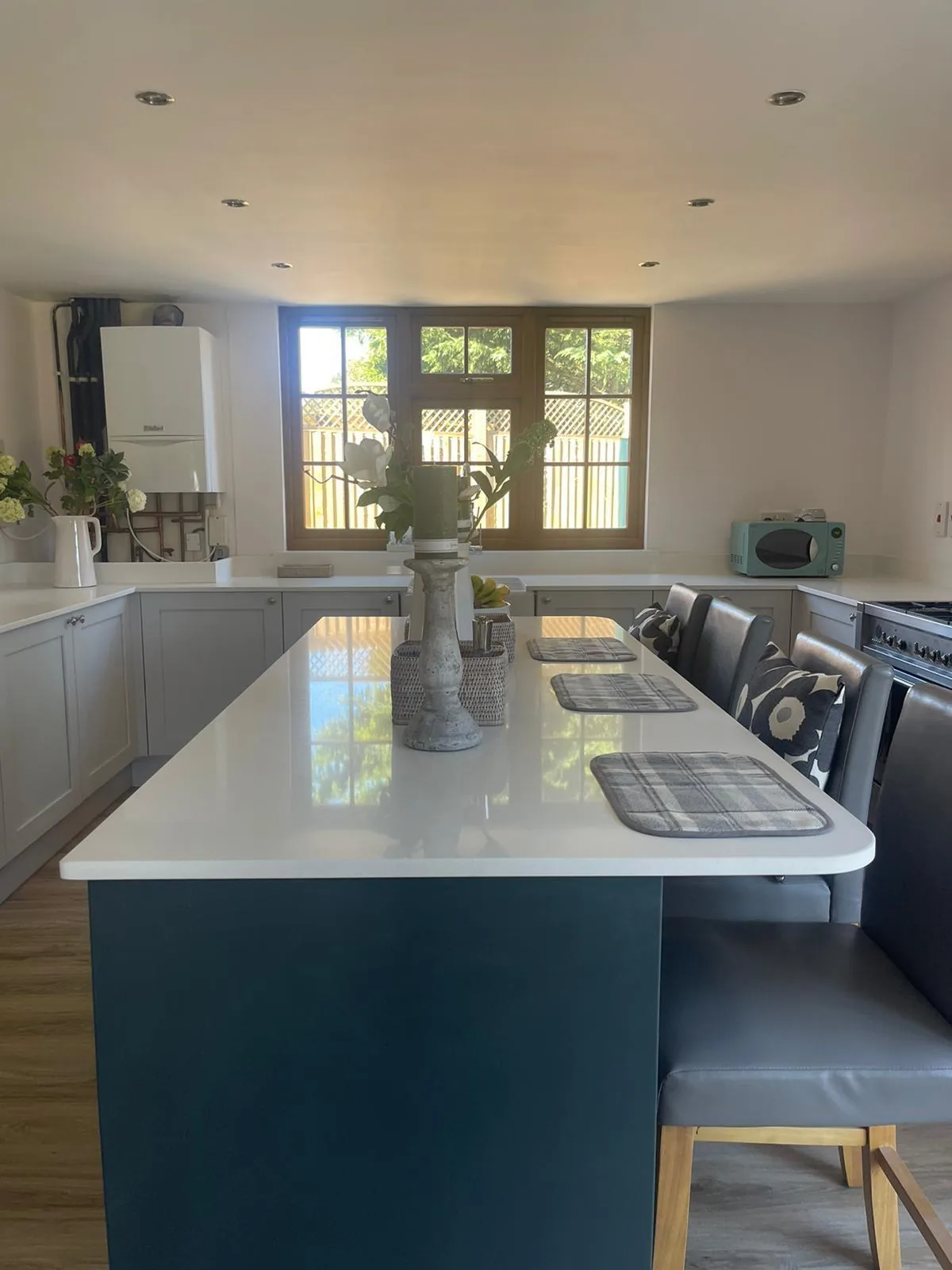
Lewisham · SE14
Worktops in Telegraph Hill
The surface itself: which stone, what it costs by the square metre, and what the room does to that number.
- 5.0from 26 Google reviews
- 25-year material · 5-year workmanship
- Fitted 5-10 working days from template
Telegraph Hill kitchens
The kitchens we meet in Telegraph Hill
If stone worktop supply and fitting in Telegraph Hill is on your list this year, the useful starting point is not the colour but the shape of the room. Tall Victorian villas on a steep hill, most converted into flats. Garden-level flats have kitchens in the old lower ground with low ceilings and a lightwell, and the upper flats have kitchens in the return with a window at one end and no straight run beyond 3m. None of that has to be decided before you get a price. It is what the survey is for.
Sliding or folding doors take the whole garden wall, so a long stretch of the room has glass where a wall would otherwise carry the units. Water settles more than taste does: how much a body absorbs, and how quickly, decides whether sealing becomes part of your year. Stone is bought whole and paid for whole, offcut and all.
These kitchens are big rooms with long perimeter runs and an island, so level has to hold across the whole floor rather than along one wall. A kitchen of this size runs to two slabs almost every time, and once a second slab is in the quotation the question shifts from rate per square metre to which slab you actually want to live with. A low seam count is what makes a small kitchen good value.
On this patch the buildings are 1870s-1890s Victorian villa, Victorian terrace and conservation-area flat conversion. They were built to different tolerances, and the stone has to absorb that.
True everywhere
Worktops, in short
- Supply is £110 to £550 per square metre across the 181 surfaces we fit.
- Four free quartz samples are posted out, because photographs of stone lie.
- The material is guaranteed 25 years and the workmanship 5.
- Quartz runs £130 to £500 per square metre, granite £121 to £550 and Dekton £110 to £366.
- Borough
- Lewisham
- Postcodes
- SE14
- Covered on
- our south east London run
- Fitted
- 5–10 working days from template
The place
Why Telegraph Hill is its own job
The part of a Telegraph Hill job that goes wrong is almost never the stone, it is what nobody looked at first. Some of the steepest streets in the borough, with houses set high above the pavement behind long flights of steps and railings; conservation-area frontages mean no dropped kerbs and permit-only parking. A dozen steps up from the pavement then a stair inside is the normal profile here, anything over 2.5m needs three people or a joint. The itemised quote is deliberately boring reading, because a boring quote is one with no surprises left in it.
The work
What worktops involves
Quartz, granite and sintered surfaces such as Dekton are all supplied, and the choice between them is made on heat, sunlight, porosity and the light in the room rather than on price alone. The pieces are cut and polished at the works with radiused internal corners at every opening, so nothing is machined into a finished surface inside your house. You end up with a surface chosen for how it behaves in your room rather than for how it looked on a screen, which is a different decision and usually a better one.
That figure per square metre buys the slab and nothing else. Machining, edge work, openings and fitting are separate lines, which is why a rate is never a bill. Granite runs £121 to £550 across 45 of them, and the spread inside that band is about rarity of the colour far more than about performance. The island takes the best of the stone and the perimeter takes the quieter part of the same batch. Sampled at home, templated in the room, machined once.
The money
What it costs in Telegraph Hill
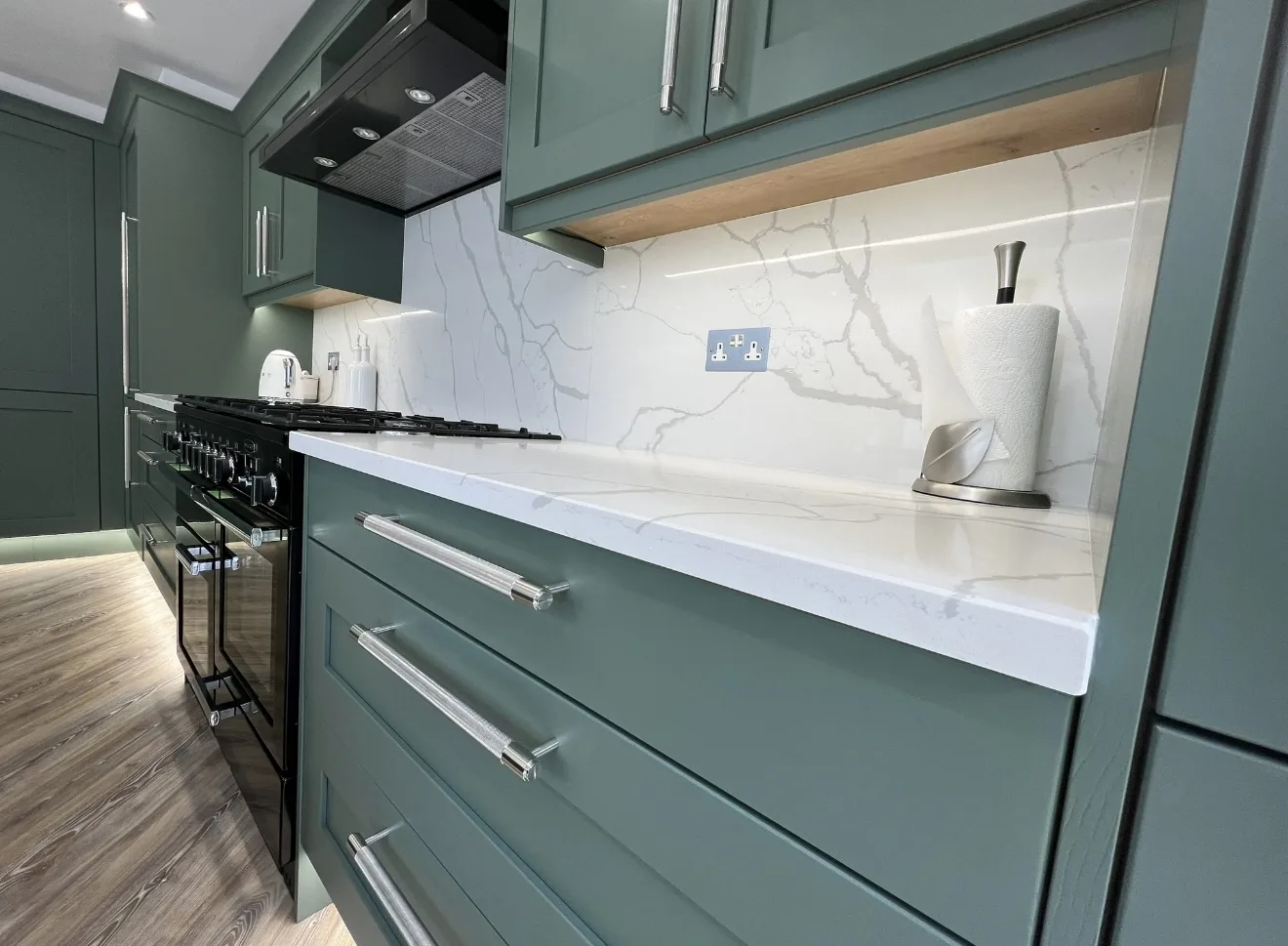
The rate per square metre buys stone and nothing else, so the machining, the openings, the polished edges and the fitting are set out beside it rather than folded into it. In a galley the runs are short and the cut-outs are close together, so the fixed operations carry more of the total than the stone does. Across the catalogue the supply-only rate is £110 to £550 per square metre, before any of the work that turns a slab into a worktop. You see what the offcut costs before you agree to the layout.
Get it priced
period detached houses and villas
Telegraph Hill in the housing figures
On the Telegraph Hill streets we cover, the twenties and thirties barely register, so the standard semi galley is not the shape we are fitting. Rooms in that housing are narrow and poorly lit at the working end, which is what makes a pale soft face worth more than a bold colour. Opening a second slab is a jump, and extra length is only a gentle climb.
period detached houses and villas
The carry, and what it rules out
Having the van on the drive means the load can be staged, so the heavy pieces come off last and go straight in instead of standing outside. Where something genuinely has to be eased on site it is done wet and under extraction, since dry cutting quartz burns the resin in it and leaves a mark that will not polish out. Colour matched resin is mixed to the slab, not to a chart.
period detached houses and villas
What Telegraph Hill asks for
The research on this patch does not put this among the three commonest jobs. Worktop fabrication and worktop replacement do. That changes how often we are here, not how the work is done.
Access
Getting stone into a Telegraph Hill kitchen
Some of the steepest streets in the borough, with houses set high above the pavement behind long flights of steps and railings; conservation-area frontages mean no dropped kerbs and permit-only parking.
Tell us what the approach looks like when you book the template and it gets built into the day rather than discovered on it. Where the route is genuinely tight, it changes how the pieces are cut, which is a fabrication decision rather than a delivery one.
5–10 working days
From template to fitted, working days from template. The same on this patch as every other.
south east London patch
Telegraph Hill is covered on our south east London run, along with the rest of Lewisham.
We come to you
Templated in your kitchen, cut in our workshop, fitted by our own installers.
Access told straight
If the route forces an extra join, you hear that at quote stage, not on the day.
Questions
Questions we get asked in Telegraph Hill
If yours is not here, ring and ask. You get a straight answer rather than a call-back from a salesperson.
Is Telegraph Hill on your patch?
Yes. Telegraph Hill is on the patch, and the postcodes we work here are SE14. It is worked on our south east London run, along with the rest of Lewisham. A dropped kerb wide enough for a car is not always wide enough for a long-wheelbase van, and the width of the crossing decides the rest. Whatever the standing allows, the stone leaves that van finished, because every edge, cut-out and internal radius is machined at the works and none of it is open to reconsideration at the kerb. Thirty millimetre stone unloads slowly and thin stone does not. The template happens in your kitchen and so does the fit, so there is nothing to visit and nothing to collect.
What is different about worktops in Telegraph Hill?
Original walls are thick, lime-plastered and rarely straight, which makes dry-laying and scribing the bulk of the fitting day. There is usually an island, and the island takes the liveliest part of the stone while the perimeter is allowed to stay quiet, which is a decision made at the slab rather than on paper. Long narrow rooms want a pale face at the working end. A floor that falls across the depth of a run rather than along it tips the carcasses front to back, and packing the front feet changes the overhang while it fixes the level. Every notch and every scribe is machined into the piece before it leaves the works, and a hard sintered surface is the least forgiving of a tight internal corner, so one is always cut with a generous radius. Speckle hides the resin line a mitre leaves behind.
Is access a problem in Telegraph Hill?
Carrying down a flight is not the easier direction, because the weight runs ahead of the crew and whoever is at the bottom has no way of stopping a slip. That caps the longest piece, and a run split into two lengths nests differently on the slab, which moves the yield and moves the figure with it. The seam is planned on the layout, not discovered in the room. Where a car has to come off the drive first, it is worth knowing whose car it is and whether the keys are in the house on the morning. A granite kitchen ends its day with a sealer, and a sealer wants a dry face and a quiet hour afterwards, so that hour is written into the day rather than borrowed from it. The packaging and the spent cartridges leave with the crew.
Is Telegraph Hill really a worktops area?
Not really, and claiming otherwise would cost nothing and mean nothing. What the research on this patch actually lists is worktop fabrication and worktop replacement. It reflects the local housing rather than any difference in the work. It is quoted, cut and fitted here the same way it is anywhere else on the patch. A kitchen carved out of a larger room sits under whatever the original plan left behind, so the run frequently ends at a blocked doorway or a boxed-in service. Where several kitchens are ordered together the sensible move is to take them all off one batch, because two slabs of the same name bought six months apart will not sit happily in the same building. Several kitchens at once should come off a single batch. Conversions put kitchens where the services could be made to reach rather than where they belong, so runs are short and interrupted. Volume work tends to live at the entry end of the range, and the entry end is genuine stone rather than a compromise, since the lowest supply figure we quote is a sintered surface and not a thin laminate pretending to be one. The entry end of the range is real stone, not a compromise.
What makes one Telegraph Hill kitchen dearer than the next?
The walkway between the two runs is fixed by the units either side, so any overhang added to one worktop comes straight off the space somebody has to stand in. A shape like that nests kindly on a slab, so more of what gets bought ends up on the units and the rate per square metre behaves much as the brochure says it will. The waterfall leg is a whole extra piece of stone. Supply only, material is £110 to £550 per square metre, with templating, fabrication and fitting quoted on their own lines.
What holds a template up more often than anything else?
Once the carcasses are levelled the gap under the plinth varies along the run, and that varying gap is the honest record of what the floor is doing. A hob dropped into the middle of a length puts sustained warmth at the lip of a cut-out, and an engineered surface will yellow there across ten years where a natural one takes it without comment. Every notch is machined on the bench and none on site. Send the island dimensions and the perimeter run lengths, say whether a waterfall end is wanted, and tell us which slab you would like reserved. Someone who expects to still be there in ten years asks different questions: how a honed finish marks, what a sealer does and does not do, and whether a chip by the sink can be repaired in place. That changes which questions are worth asking about the stone, because somebody staying put wants to know how a honed face marks in five years and somebody selling wants to know how it photographs next spring. Repairability is a fair question to ask before choosing.
What happens when the route into a Telegraph Hill kitchen is tighter than the worktop?
A join added to get stone into the room is a different thing from a join added because the slab ran out, and the quote says which is which. Every piece goes in by hand and stone does not bend, so the tightest turn on the route sets the longest piece. A short run of external steps before the communal door means a piece is lifted twice before the staircase proper has even started. Where a seam becomes unavoidable the choice of stone starts to matter, because a fine even speckle closes a joint almost invisibly and a broad vein simply will not. The pieces either side of a break come off adjoining slab.
Do you cut drainer grooves on Telegraph Hill kitchens?
A groove set needs a clear stretch of worktop beside the bowl, so it competes with the run for length instead of being free surface. Machining is permanent. If a later kitchen moves the sink, the grooves stay where they were cut. Where there is no room for a separate drainer, grooves are usually what gets specified instead. A lantern or a rooflight over the room throws raking light across every horizontal surface, which shows a lipped join from the far side of the kitchen. Which stone belongs on top of all that is a separate question from the building itself, and it is the one with a figure attached, because supply alone runs from £110 to £550 per square metre before a single cut has been made. Quartz, granite and sintered stone answer three different rooms.
Are hob and sink cut-outs priced separately on a Telegraph Hill quote?
Two bowls means two cut-outs and a bridge of stone between them, which decides where the sink can go. A boiling tap needs a hole of its own and a cupboard below for the tank, so the units change too. A tap under a window board still needs room for its handle to lift, which is checked at the template. Both runs are in view at the same time, so the two pieces are taken off the same area of slab and the veining is set to run the same way on each side. An island is the piece that decides whether one slab covers the kitchen or two, and a second slab arrives as a step in the figure rather than a gentle slope. Finished ends cost by the metre, however short the run is.
Is one material less trouble than another for a Telegraph Hill kitchen?
Sealing is the one maintenance job that genuinely differs by material, and it is worth knowing which you are buying before the slab is chosen. Marble is the one people underestimate. It is porous, like granite, and wants sealing. The bead where the sink and hob meet the stone is siliconed rather than sealed, and wants watching. A range sitting in a chimney recess is common, and the flanking pieces are cut with the manufacturer clearance built into the template. Kitchens of this size nearly always run to two slabs, and once a second slab is in the quotation the question changes from price per square metre to which slab you actually want. Short pieces are the argument for buying a slab outright.
Reviews
5.0 from 26 Google reviews
Every one of these is on our Google profile under the reviewer’s own name. Nothing here is written by us, and the link goes straight to the source.
Excellent service and top quality workmanship. The worktop looks absolutely amazing and the attention to detail is impressive. The team was professional, punctual, and very easy to work with. Highly recommended for anyone looking for a premium kitchen worktop! 👌
Costin Roman
Google review
Excellent service from start to finish. The team at Worktop Worx were professional, friendly, and really paid attention to detail. They listened to what I wanted, gave helpful advice, and delivered a high-quality finish. The worktop looks amazing and has completely transformed the space. Everything was completed on time and left clean and tidy. Highly recommended 5/5
Kam 98
Google review
We recently had our kitchen worktops supplied and fitted by Worktop WorX using Laurent Gold sintered stone, and we couldn’t be happier with the result. The finish, quality, and attention to detail were outstanding from start to finish. Karem was incredibly helpful throughout the whole process professional, knowledgeable, and always available to answer any questions. The new worktops have completely transformed our kitchen and look amazing. Highly recommend Worktop WorX to anyone looking for high quality kitchen worktops, bespoke workmanship, and excellent customer service.
Gabriel Tivadar
Google review · Laurent Gold sintered stone
Related
More around Telegraph Hill
Other work we do in Telegraph Hill
Next step
Worktops in Telegraph Hill, priced properly
Plans, a sketch or photographs with rough run lengths is enough to start. You get an itemised written quote and the template dates we can offer on this patch.
25-year material warranty and a 5-year workmanship guarantee, both stated on your quote.