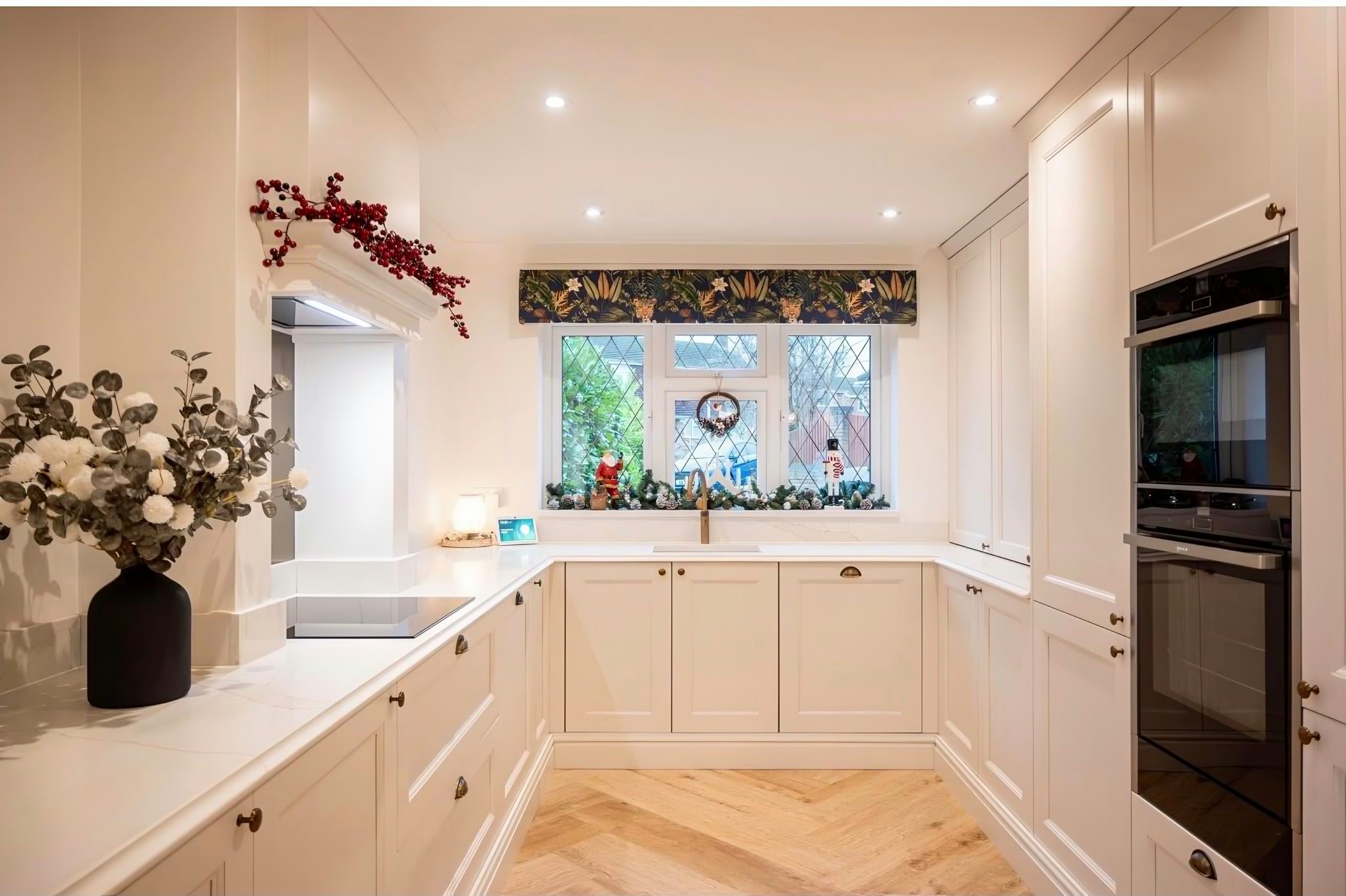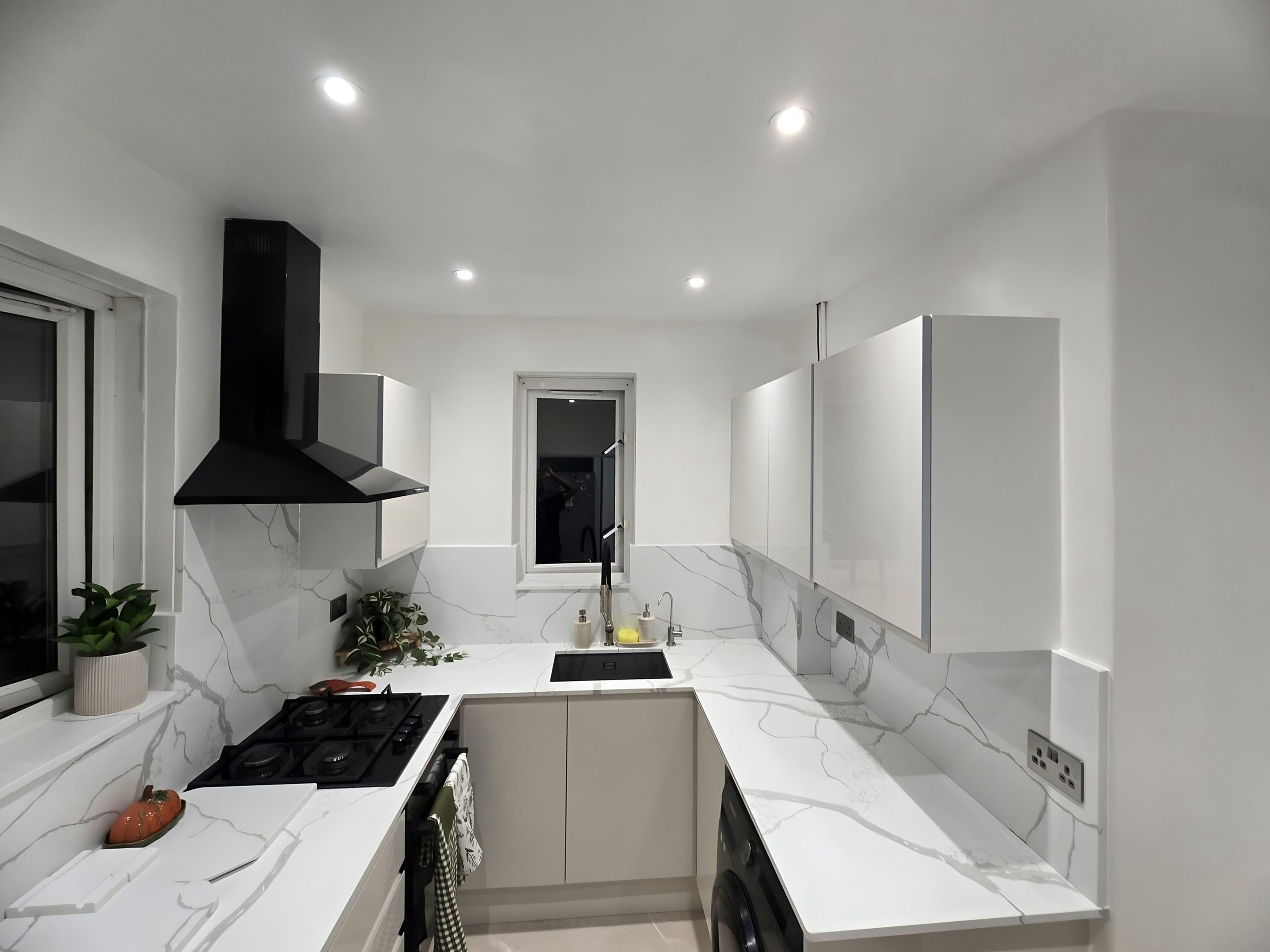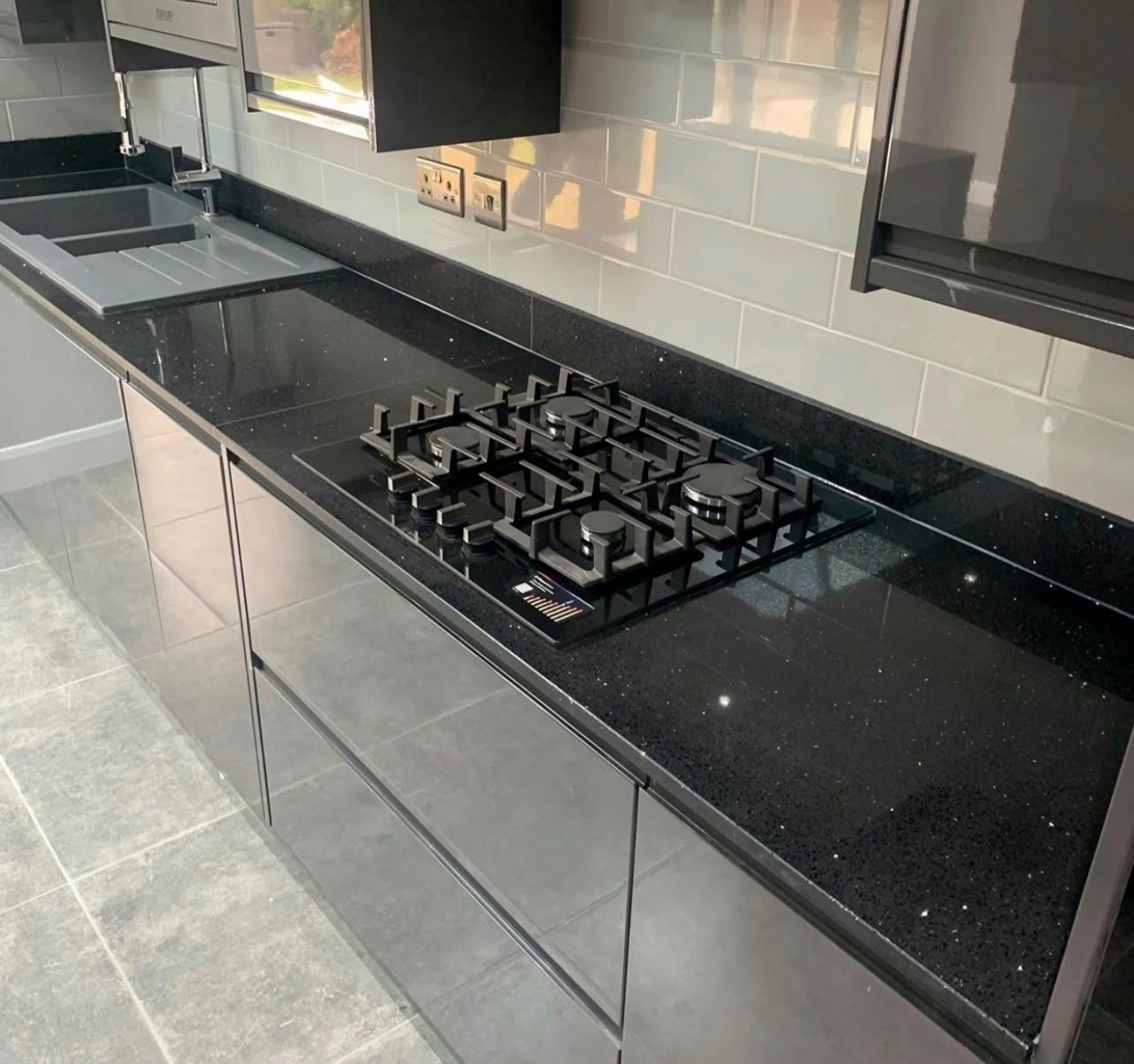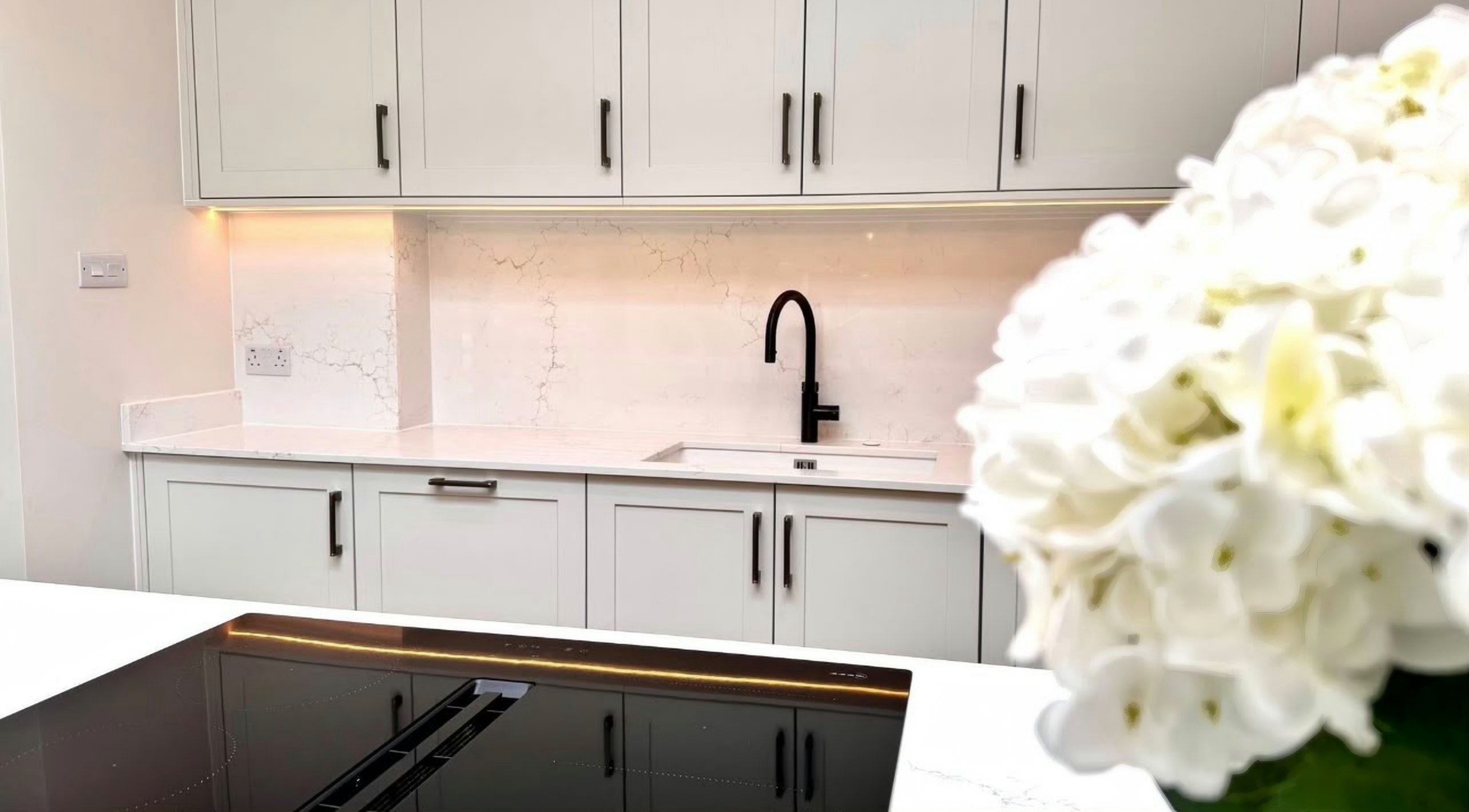
People who replace a worktop early almost never say the material was wrong. They say it looks tired, or it fights the cabinets, or it went a funny colour, or they are sick of wiping it. Those are four different failures and none of them is a property of the slab. They are all consequences of a specification decision made in a lit showroom or off a phone screen, against a kitchen that did not exist yet. This page is the map of those decisions: what each one actually determines, which order to take them in, and where each is answered in full.
01 / 08
How do you choose a worktop that still looks right in year five?
The short answer
- Colour pairing against your cabinets, not colour in isolation. This is where most early replacements start.
- Undertone (warm or cool) which is invisible on a hand sample and obvious across a 3m run.
- The light in your actual room, which is not the light in any showroom.
- Surface finish, which should be chosen after colour and after you know your water hardness.
- What any of it is worth on resale, which is a smaller and stranger question than the internet suggests.
None of these is the question people arrive with. People arrive asking quartz or granite, or 20mm or 30mm, and those are real decisions with real consequences. They are simply not the ones that determine whether the room still looks right in five years. A well-chosen mid-grey quartz and a well-chosen mid-grey granite age almost identically. A cool white quartz next to warm sage cabinets ages badly whichever material it is made of.
The second thing worth saying at the top: the worktop is rarely the thing people regret most. When Which? surveyed 415 people in September 2025 about what they regretted in their kitchens, the top answers were flooring, storage, layout and sockets. Not enough worktop space came sixth, and lighting seventh. Worktop space had topped the earlier wave of the same survey. Nowhere in either list does the surface material appear. Read that as permission to spend your worry budget somewhere useful.
02 / 08
Your cabinets are already chosen, and they are the constraint
By the time a worktop is templated, the doors have usually been bought or ordered. That is the normal order of a kitchen project and there is nothing wrong with it, but it means the worktop is not a free choice. It is a response. And the doors people are buying are no longer neutral. In the Houzz UK Kitchen Trends Study published in January 2026, which surveyed more than 400 UK homeowners about a recent or planned kitchen, blue was the single most popular cabinet colour at 18 per cent and green was second at 17 per cent. Grey, the colour that dominated the previous decade, was 12 per cent. Off-white and wood finishes were 9 per cent each.
UK cabinet colour choice, Houzz UK Kitchen Trends Study 2026
- Blue18%
- Green17%
- Grey12%
- Off-white9%
- Wood9%
That shift matters more than it sounds. A grey kitchen forgave almost any worktop, because grey has no strong undertone to fight with. A saturated colour does not forgive. It has a bias (towards yellow, towards blue, towards grey), and the worktop either sits with that bias or argues with it for the next decade. The two most common versions of that argument are a green kitchen, where sage, olive and forest each want a different surface, and a navy kitchen, where the wrong white reads yellow-brown the moment the lights come on.
If your cabinets are still undecided, you have more freedom than you think and you should use it in the other direction: pick the worktop you will still like in ten years and paint to it. Paint is a weekend. Stone is a template, a fabrication slot and a fitting day.
03 / 08
Undertone is what goes wrong, not colour
Every white is a white until you put two of them side by side. Then one is plainly warm and the other is plainly cold, and the difference that was invisible on a 100mm sample is a visible seam of disagreement along four metres of wall. Undertone is the single most reliable predictor of whether a pairing will still look deliberate in year five, and it is the thing least likely to be mentioned to you in a showroom.
- Cool undertones lean blue, grey or violet. They read crisp against blue, black and cold greys, and they read dirty against cream, sage and any warm wood.
- Warm undertones lean yellow, cream or pink. They read soft against greens, woods and off-whites, and they read grubby against a bright cool white.
- Neutral is mostly a marketing word. Hold a supposedly neutral sample against a sheet of printer paper in daylight and it will pick a side within a second.
- Paint moves and stone does not. Emulsion and lacquered doors yellow slightly with age and with cooking; engineered quartz pigment does not. A pairing that starts at zero difference does not stay there.
That last point is the mechanism behind most two-year regret. Nobody chose a dirty-looking worktop. They chose a stark white worktop against a soft warm cabinet colour, the cabinet warmed a fraction, the worktop did not move at all, and the gap between them opened up until one of the two started to look wrong. The one that looks wrong is always the paint, and the one that gets replaced is always the stone.
04 / 08
The room decides what the slab looks like
A slab has no fixed appearance. It has a response to a light source, and the light source in your kitchen is not the one the sample was chosen under. Showrooms are lit to sell stone: bright, high, and neutral to slightly warm. A north-facing kitchen is lit by reflected sky, which is blue at every hour of every day, and it flattens a cool grey into something dead. A basement or side-return kitchen may be running on artificial light most of the year, in which case the colour temperature of your downlights is a specification decision you did not know you were making.
“The worktops will bounce the light around.”
Allison Lynch, senior designer at Roundhouse, on pairing dark cabinets with lighter worktops in north-facing rooms, quoted by Livingetc
That is the whole argument for going lighter in a dark room, and it is a better argument than "light colours make rooms look bigger", which is decorating-magazine shorthand. The worktop is a large, horizontal, roughly waist-height plane facing straight up at your ceiling and your lights. It is the most efficient reflector in the room. In a room short of light, that is a job you can give it. In a room with a rooflight over the island, it is a job you probably want to take away from it, which is why dark low-sheen islands work under glass and look sullen against a wall.
05 / 08
Finish comes after colour, never before
The finish question (matt, polished or textured) is usually asked first, and it is the one question in this list that cannot be answered on its own. Matt and polished do not have fixed properties. They have properties in combination with a colour and with the water coming out of your tap. Matt on a black surface behaves nothing like matt on a warm white, and either of them behaves differently in a hard-water postcode, which in London and the Home Counties is effectively all of them.
So the order is: colour first, then check your water, then finish. Reversing it is how people end up with a beautiful matt black island that shows a pale ring every time a glass is put down on it. There is no dishonest answer to give here because there is no universally better finish, and any page that tells you one is better is either selling it or has not fitted enough of both.
06 / 08
What it is worth, and the number that does not exist
Sooner or later someone asks whether a stone worktop will add value to the house. Six of the pages that answer that question will give you a percentage for the worktop specifically. None of them can tell you where the percentage came from, because there is no survey anywhere that isolates a worktop from the kitchen it sits in. What does exist is a figure for the whole kitchen, with a stated method.
Which? put the uplift from a non-structural kitchen renovation at 5 to 10 per cent of property value and a structural one at around 10 to 15 per cent, with a consensus range of 5 to 15 per cent, drawing on its Trusted Traders network, builders and chartered surveyors together with a September 2025 survey of 200 readers. It also advises not spending more than 10 to 15 per cent of your home’s value on a kitchen, which is a more useful sentence than any of the uplift numbers. Whether a worktop on its own can add value is a question with a genuinely honest answer, and the honest answer is not a percentage.
07 / 08
The order to take these in
Specification, in the order that stops you doubling back
- Cabinet colourusually already fixed
- Undertonewarm or cool, decided
- Room lightaspect and fittings
- Colour and patternshortlist of three
- Finishafter water hardness
- Edge and thicknesslast, and cheapest to change
Edge profile and thickness sit at the end deliberately. They are the two decisions people spend most of their time on and they are the two that change the look of the room least. A 20mm square edge and a 30mm pencil round in the same colour are a difference you will stop noticing within a month. A cool white against warm sage is a difference you will notice every morning for a decade.
One practical note about samples, since the whole of this page depends on them. We post samples of our own quartz collection only; granite and sintered stone are chosen from the slab. If you are choosing a granite or a Dekton, budget for seeing a full slab rather than a chip, and if the pattern has any real movement in it, a chip was never going to tell you the truth anyway.
08 / 08
Questions people actually ask
01Should the worktop match the floor?
It should not clash, which is a much lower bar than matching and a much more achievable one. The floor is almost always already down by the time we template, so the practical question is how to choose a surface against a floor you cannot change. Two surfaces with the same undertone and different tones read as deliberate. Two surfaces with opposite undertones read as a mistake regardless of how well the tones sit together.
02Is white quartz a bad idea in a family kitchen?
No, but it is a different maintenance profile rather than a harder one. Pale surfaces hide crumbs, dust and limescale and show pigment, tea, turmeric, tomato. Dark surfaces do the exact reverse. Nothing hides both, so the honest question is which sort of mess you would rather look at.
03How much does the choice of colour change the price?
Less than the choice of material and much less than the shape of the kitchen. Supply-only stone sits in a band from around £110 to £550 per square metre, and where a colour lands in that band is about the slab, not about whether it is light or dark. Cut-outs, joins, upstands and overhangs move a quote far more than a colour does.
04Do I need to see a full slab, or is a sample enough?
For a plain or finely speckled surface a sample is enough. For anything with real veining it is not, and a hand sample of a large-vein stone is close to misleading. It cannot show you where the vein goes across three metres, or what happens to it at the hob cut-out. Ask for a photograph of the actual slab with the cut layout drawn on it before fabrication starts.
05What actually dates a worktop?
Contrast level and pattern scale, far more than colour. A very high-contrast, large-scale pattern is a strong statement and strong statements are the ones that read as belonging to a particular year. Mid-tone surfaces with fine movement have never been in fashion and therefore cannot go out of it. That is not a recommendation to be timid; it is a description of what happens.
What to take away
- Pairing, not material, is what people replace worktops early over. The slab is rarely the thing that was wrong.
- Undertone beats colour. Warm and cool are invisible on a sample and unmissable across a four-metre run, and paint drifts warmer over time while stone does not move at all.
- Test the sample in your own room at three different times of day, including after dark with your own lights. Anything that disagrees in one of the three will disagree forever.
- Take the decisions in order: cabinets, undertone, light, colour, finish, then edge and thickness. Edge and thickness change the room least and are usually worried about most.
- There is no defensible resale figure for a worktop on its own. There is one for a whole kitchen, from Which?, and it is worth reading before you spend.
Sources
Every figure quoted above is traceable to one of these. Where a source is a price survey rather than our own quoting, it is named as such in the text.
- [1]2026 UK Houzz Kitchen Trends Study, Houzz UK, retrieved 25 August 2026
- [2]7 things people regret most about their kitchens, Which?, retrieved 25 August 2026
- [3]Does a kitchen renovation add value to your home?, Which?, retrieved 25 August 2026
- [4]The best colours for north-facing kitchens, according to designers, Livingetc, retrieved 25 August 2026
- [5]Water hardness, Thames Water, retrieved 25 August 2026