
Barnet · N11
Worktops in Brunswick Park
The surface itself: which stone, what it costs by the square metre, and what the room does to that number.
- 5.0from 26 Google reviews
- 25-year material · 5-year workmanship
- Fitted 5-10 working days from template
Brunswick Park kitchens
The kitchens we meet in Brunswick Park
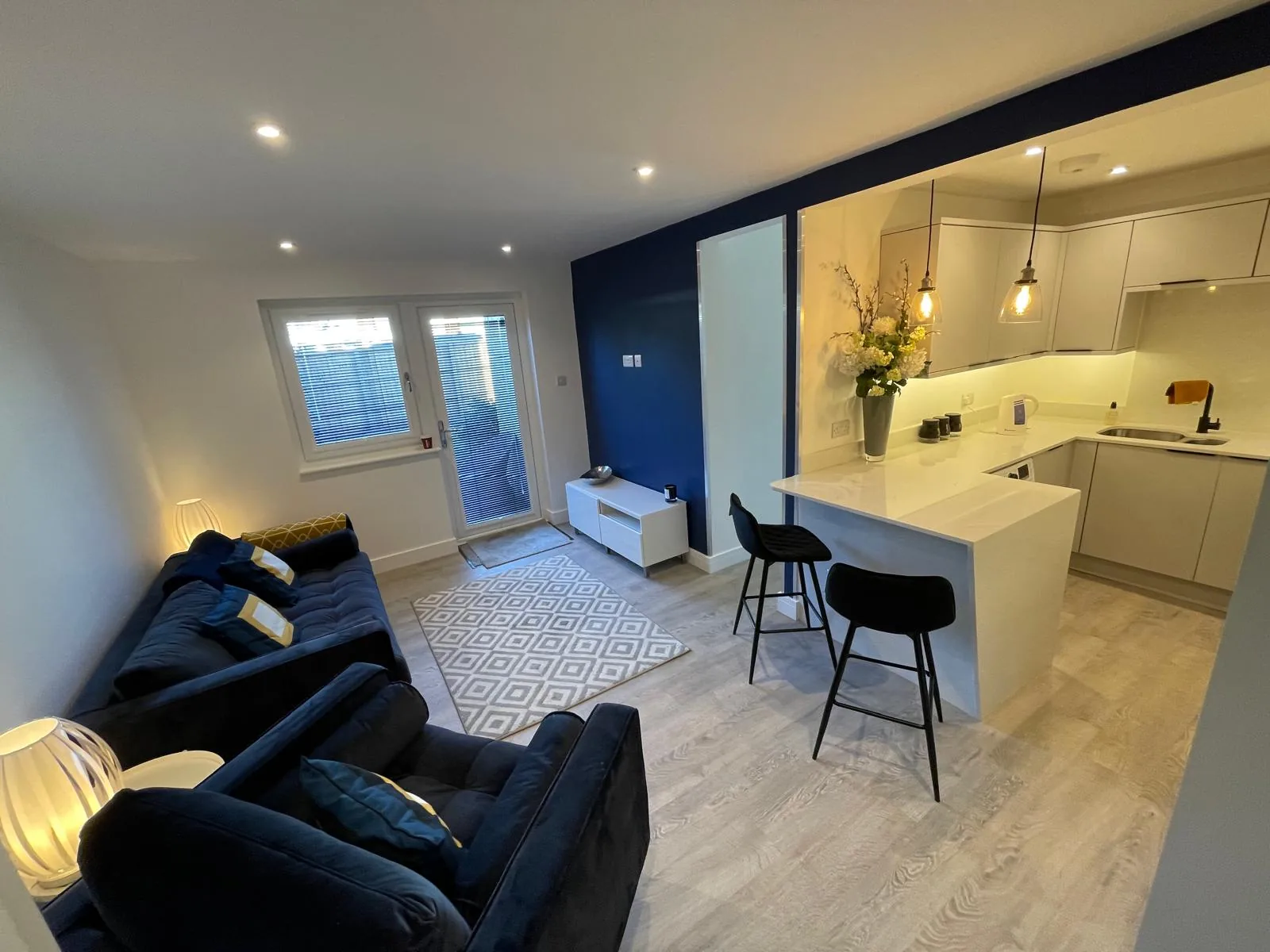
If stone worktop supply and fitting in Brunswick Park is on your list this year, the useful starting point is not the colour but the shape of the room. Quiet interwar and post-war family housing on closes and cul-de-sacs, with kitchens that are usually the original size and a modest rear or side addition at most. Typical job is a straight L of 3m plus 1.8m keeping the existing units, with new upstands and a window board in the same material. We measure the kitchen you have, not the kitchen the plans said you would have. Those two part company often.
The kitchen door opens inwards into the middle of a run, so the usable length of that wall stops well short of the corner. Veining is the part people pick from a photograph and then meet at full size, running across a slab at a scale no postcard has ever managed to convey. A slab has a direction, and the room decides which way it runs.
The chimney breast served a back boiler and is usually still standing, so there is a shallow recess on one side of the room. A knocked-through room means the surface is read from the dining side as well as the working side, so the figure has to run continuously and the pieces are taken from adjoining slab. Long narrow rooms want a pale face at the working end.
The stock behind these kitchens runs to 1930s semi, post-war cul-de-sac housing and 1960s low-rise flat. Which of those you have decides most of what follows.
True everywhere
Worktops, in short
- Supply is £110 to £550 per square metre across the 181 surfaces we fit.
- Granite comes out of the ground porous, which is why it gets sealed.
- Dekton and sintered stone hold their colour under heat and direct sunlight.
- That figure is the slab. Fabrication, edges, cut-outs and fitting are quoted separately.
- Borough
- Barnet
- Postcodes
- N11
- Covered on
- our north London run
- Fitted
- 5–10 working days from template
The place
Why Brunswick Park is its own job
The part of a Brunswick Park job that goes wrong is almost never the stone, it is what nobody looked at first. Cul-de-sac layouts with parking bays and drives, easy kerbside working, but turning a long-wheelbase van in some of the closes is tighter than it looks on a map. Where the customer keeps the units, the old tiled splashback usually comes off with the top and the plaster behind it needs making good before an upstand will sit tight. That is a survey question, not a fitting-day question, and we treat it as one.
The work
What worktops involves
Quartz, granite and sintered surfaces such as Dekton are all supplied, and the choice between them is made on heat, sunlight, porosity and the light in the room rather than on price alone. A natural stone is sealed before the kitchen is handed back, and you are told plainly which products will dull the finish and which will not touch it. You end up knowing what your surface will and will not tolerate: the hot pan, the sunlight through the window and the spray under the sink.
Granite is quarried, which makes every slab its own object. It will take a pan straight off the flame, and being porous it asks for sealing now and then. Sintered slabs are brittle where they are unsupported, so an overhang or a wide aperture is drawn with the support underneath it rather than after the fact. A run of this length usually fits one slab, and staying inside one slab is the cheapest decision available on any kitchen. Three materials, three temperaments, and a shortlist that writes itself.
The money
What it costs in Brunswick Park
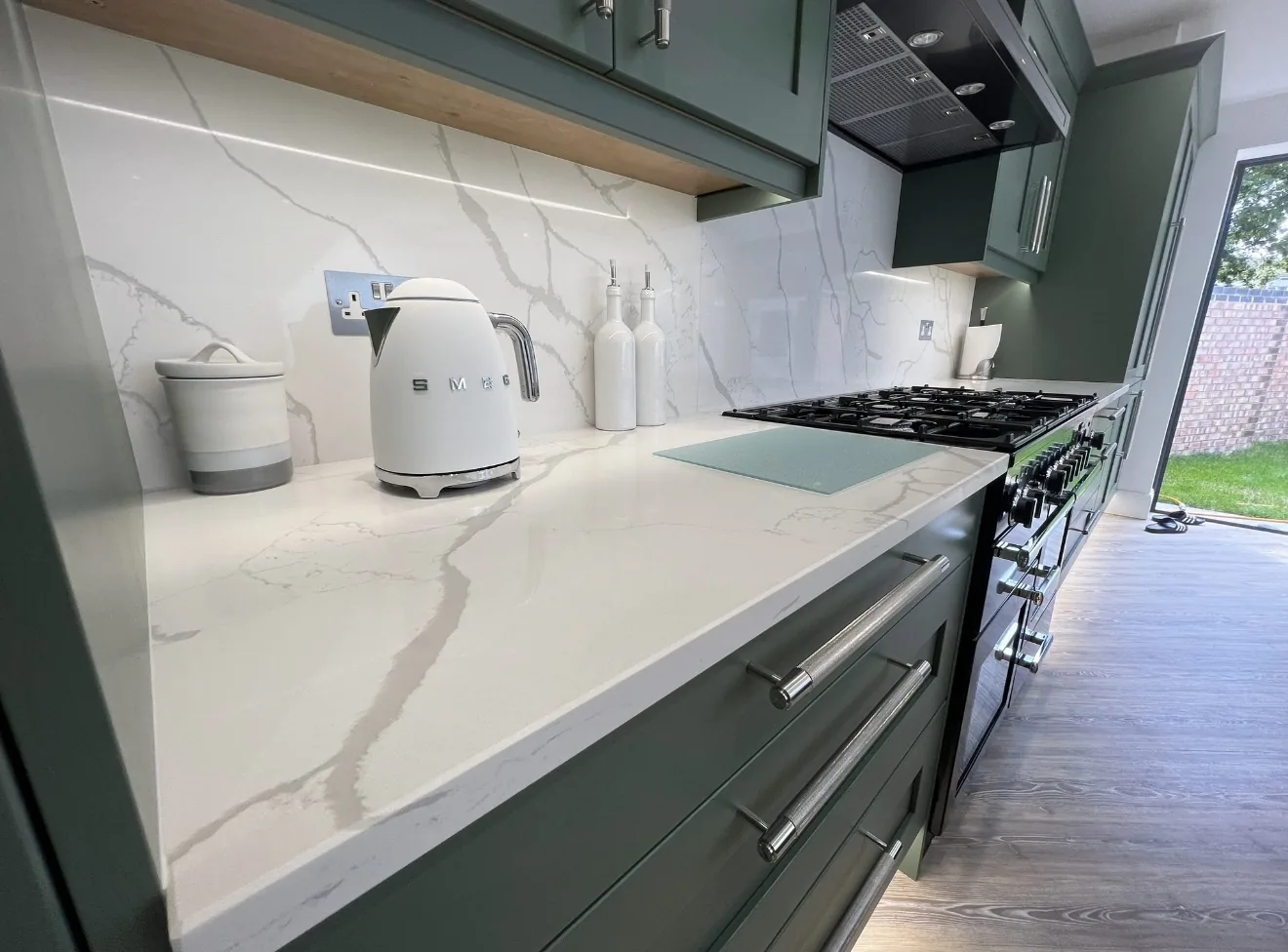
The remainder of a slab is part of the price whether it is fitted or left behind, and that is the honest reason short awkward lengths cost what they do. One continuous L takes more slab than its metreage implies, because the waste sits inside the angle. Multiplying your worktop area by something between £110 and £550 gives you a material bill rather than a job cost, and the two are far enough apart to be worth keeping separate. The slab, then the machining, then the fitting, each on its own line.
Get it priced
1930s and inter-war semis
Brunswick Park in the housing figures
Locally the housing predates the recent building boom almost entirely, and the units in it usually do too. Extensions finished in spring fill the yards, so a reservation placed early holds a consignment that would otherwise be gone by templating. The remainder of a slab is the quiet line on every quotation.
1930s and inter-war semis
What Brunswick Park asks for
The research on this patch does not put this among the three commonest jobs. Worktop replacement and worktop splashbacks & upstands do. That changes how often we are here, not how the work is done.
1930s and inter-war semis
The shape of the run
The return piece is the awkward one on a slab: short, full depth, and rarely nesting neatly against the long lengths, so yield rather than area is what moves the material figure. A drainer grooved beside the sink takes stone out of the weakest part of the piece, so the grooves stop short of the aperture instead of running into it. Where the run beats the slab, the stone decides how the seam reads.
Access
Getting stone into a Brunswick Park kitchen
Cul-de-sac layouts with parking bays and drives, easy kerbside working, but turning a long-wheelbase van in some of the closes is tighter than it looks on a map.
Tell us what the approach looks like when you book the template and it gets built into the day rather than discovered on it. Where the route is genuinely tight, it changes how the pieces are cut, which is a fabrication decision rather than a delivery one.
5–10 working days
From template to fitted, working days from template. The same on this patch as every other.
north London patch
Brunswick Park is covered on our north London run, along with the rest of Barnet.
We come to you
Templated in your kitchen, cut in our workshop, fitted by our own installers.
Access told straight
If the route forces an extra join, you hear that at quote stage, not on the day.
Questions
Questions we get asked in Brunswick Park
If yours is not here, ring and ask. You get a straight answer rather than a call-back from a salesperson.
Is Brunswick Park far enough out to be a problem for you?
Yes. Brunswick Park is on the patch, and the postcodes we work here are N11. It is worked on our north London run, along with the rest of Barnet. Where the van cannot turn on the plot it has to arrive already facing the right way, so the approach along the street is part of the plan. Whatever the standing allows, the stone leaves that van finished, because every edge, cut-out and internal radius is machined at the works and none of it is open to reconsideration at the kerb. What stands on the van is finished stone, not raw slab. The work comes to you. We template in your kitchen and fit in your kitchen, with nothing to visit or collect.
Does the housing in Brunswick Park change how worktops works?
An inter-war terrace is wider than a Victorian one and shallower than a semi, so the kitchen is a compact square room rather than a galley. These kitchens are usually knocked through to the dining room, so the surface is read from two sides at once and the figure has to carry across the pieces rather than restart at every join. Short pieces are the argument for buying a slab outright. Window boards and cills stand proud of the plaster, so the back edge of the top has to be plotted to where the units actually sit rather than to the wall. A hob dropped into the middle of a length puts sustained warmth at the lip of a cut-out, and an engineered surface will yellow there across ten years where a natural one takes it without comment. Brittle stone and narrow returns are a poor pairing.
How does the stone actually reach a kitchen in Brunswick Park?
A short hard approach with no steps means a full-length piece can be walked in flat by two people rather than turned up on edge. That caps the longest piece, and a run split into two lengths nests differently on the slab, which moves the yield and moves the figure with it. A hard route shortens the list to lighter, thinner surfaces. A drive behind an electric gate depends on somebody being in to open it and on the gate staying open while the load comes off. A granite kitchen ends its day with a sealer, and a sealer wants a dry face and a quiet hour afterwards, so that hour is written into the day rather than borrowed from it. Nothing about the shortlist is decided on the day itself.
Is Brunswick Park really a worktops area?
Not particularly, and it would be easy to pretend otherwise. What the research on this patch actually lists is worktop replacement and worktop splashbacks & upstands. That is a point about the buildings round here, not about the job. The quoting, the cutting and the fitting are identical here to anywhere else we work. Extension budgets are usually well spent by the time the worktop is ordered, which is where the choice between quartz and a thinner sintered stone actually gets made. Volume work tends to live at the entry end of the range, and the entry end is genuine stone rather than a compromise, since the lowest supply figure we quote is a sintered surface and not a thin laminate pretending to be one. Where tenants change often, a surface with nothing to seal wins. Rear and side-return extensions are where the islands appear, and an island is the piece that decides whether one slab does the kitchen or two. Adding an island is what moves most of these projects from one slab to two, and that jump is the single largest step in any worktop quotation. Heavy daily cooking is an argument for natural stone.
What am I actually paying for, line by line?
An L can be mitred at the corner for a continuous look or butt-jointed over the gable, and the two are different money and different risk. A shape like that nests kindly on a slab, so more of what gets bought ends up on the units and the rate per square metre behaves much as the brochure says it will. An overhang is stone and steel priced together, never stone alone. The supply-only figure for material runs £110 to £550 per square metre, and templating, fabrication and fitting are lines of their own.
Is there anything I have to finish before the template in Brunswick Park?
Where a run finishes into a reveal, the depth of that reveal is taken at worktop height and nowhere else. A run that sits under strong sun for hours every afternoon suits a surface built to be stable in daylight, because a resin-bound stone is made for indoor use and sustained sunlight is the one thing it was never designed around. What the room obstructs, the layout pays for in slab. Confirm the depth of the units, the total run lengths and whether an island or peninsula is going in, and tell us the colour temperature of the lighting. Owner-occupied kitchens are usually being done once, which is why the edge profile, the vein direction and where a join falls are worth the conversation. That changes which questions are worth asking about the stone, because somebody staying put wants to know how a honed face marks in five years and somebody selling wants to know how it photographs next spring. Matching anything later means writing down the batch reference now.
Do you take on fitting-only work in Brunswick Park?
Delivery to the workshop has to be arranged and dated, since nothing is nested until it is there. Sinks, taps and hobs are yours to buy in any case, and they only have to be in the room for the template. Stone cut to somebody else’s drawing cannot usefully be re-cut to yours. A new extension slab is not automatically level, and that wants checking before templating rather than after the stone is cut. Quartz is the sensible default where a kitchen changes hands often, because there is nothing to seal, nothing to re-seal and nothing an incoming household has to be told about the surface. A small kitchen still buys the remainder of the slab.
How much upkeep is a stone worktop?
A seal is not waterproofing. It only buys time to wipe a spill up. Where a top takes wine, oil and lemon most days, the non-porous materials ask least of the household. No maintenance visit is built into the job. Soap, water, and on the porous stones a seal. There is usually a shared rear alley, and whether the gate onto it is unlocked decides whether long pieces come in from the back. These rooms take good side light from the garden, which flatters a stone with movement in it and is largely wasted on a flat single colour. A tall room carries a thick edge; a low one does not.
Is removal and disposal included on a Brunswick Park job?
Take the old tops off yourself if you would rather, and the quote simply carries one line fewer. The carcasses stay put. Only the surface changes. Tiling bonded to the wall behind usually comes away with the old top, so that wall is agreed beforehand. Some drives are wide enough for the van and too short for the tail lift, because the tail lift needs its own clear metre behind the vehicle. Sintered surfaces are the hardest of the three to machine and the messiest to cut wet, which is precisely why none of that happens on a public pavement. A figured slab takes longer to match than a plain one.
Can you machine drainer grooves into the stone?
The grooves sit inside the depth of the top with stone left either side, so a shallow run limits them. A groove set needs a clear stretch of worktop beside the bowl, so it competes with the run for length instead of being free surface. The bowl position has to be settled before templating, since the grooves are set out from it. Two runs and a return into a rear extension is the pattern, and the return is the piece that never nests neatly on a slab. Which stone belongs on top of all that is a separate question from the building itself, and it is the one with a figure attached, because supply alone runs from £110 to £550 per square metre before a single cut has been made. Porous or not porous is the fork in the road on day one.
Reviews
5.0 from 26 Google reviews
Every one of these is on our Google profile under the reviewer’s own name. Nothing here is written by us, and the link goes straight to the source.
Lovely team, business and quality motivated, prompt delivery with installation. Affordable prices. Wide range of worktops available. High recommendation
Loreta Skalisiene
Google review
Great service. Super quick and easy communication. I love my new worktop 🥹🥹
Sara Arghir
Google review
Professional, polite and friendly service. Very pleased with finished product.
costas andrews
Google review
Related
More around Brunswick Park
Other work we do in Brunswick Park
Next step
Worktops in Brunswick Park, priced properly
Plans, a sketch or photographs with rough run lengths is enough to start. You get an itemised written quote and the template dates we can offer on this patch.
25-year material warranty and a 5-year workmanship guarantee, both stated on your quote.