
Islington · EC1Y EC2A
Worktops in Bunhill
The surface itself: which stone, what it costs by the square metre, and what the room does to that number.
- 5.0from 26 Google reviews
- 25-year material · 5-year workmanship
- Fitted 5-10 working days from template
Bunhill kitchens
The kitchens we meet in Bunhill
Customers looking at stone worktop supply and fitting in Bunhill usually want to know two things first: what it will cost and what has to come out to make room for it. Predominantly flats in tall blocks with compact galley kitchens of 2.4-2.8m against a fixed services wall. The newer developments have open-plan kitchen-living rooms, but the floorplates favour a peninsula return over a freestanding island. We measure the kitchen you have, not the kitchen the plans said you would have. Those two part company often.
Open plan means long uninterrupted runs and an island in the middle of the room with every edge on show. Quartz, granite and sintered stone each let you down in a different way, and choosing well is mostly a matter of knowing which of those three failures this room will provoke. Yield is the word behind most quotations people did not expect.
Original brickwork is uneven by ten millimetres or more across a bay, so the back edge is scribed to the actual face rather than to a line. The light in these buildings is bright and cool, and a warm cream that feels generous in a small room can turn sallow under it. Even light lets a mid-tone hold its own.
What the job sheets keep listing is post-war estate block, modern tower, warehouse conversion and Victorian block. That mix is why two jobs on the same road can run completely differently.
True everywhere
Worktops, in short
- Supply is £110 to £550 per square metre across the 181 surfaces we fit.
- Templating is done in the room itself, once the units are fixed and level.
- Fitting happens five to ten working days after the template is taken.
- Quartz is engineered, so its pattern repeats and a long kitchen matches itself end to end.
- Borough
- Islington
- Postcodes
- EC1Y, EC2A
- Covered on
- our north London run
- Fitted
- 5–10 working days from template
The place
Why Bunhill is its own job
We have carried enough stone into kitchens in Bunhill to know what to allow for before the day arrives. Congestion Charge zone with red routes on City Road and Old Street, plus a low-traffic scheme covering the residential streets behind. Tower access runs through a booked service lift and an agreed delivery window with the managing agent. Managing agents here run tight access rules, so confirm lift dimensions and protection requirements in writing at template stage rather than turning up with a full van. That is a survey question, not a fitting-day question, and we treat it as one.
The work
What worktops involves
The material carries a twenty five year guarantee and the fitting workmanship five years, and both are handed over in writing with the paperwork for the slab. A natural stone is sealed before the kitchen is handed back, and you are told plainly which products will dull the finish and which will not touch it. You end up knowing what your surface will and will not tolerate: the hot pan, the sunlight through the window and the spray under the sink.
That figure per square metre buys the slab and nothing else. Machining, edge work, openings and fitting are separate lines, which is why a rate is never a bill. Colour under the kitchen lights is the thing samples exist to settle, and a warm bulb will pull a cool grey brown while a cool one drains a cream stone of everything generous in it. A surface in a room this size is seen from across the floor, so it registers as a tone long before anybody reads the pattern in it. Heat, water and sunlight sort the shortlist quickly.
The money
What it costs in Bunhill
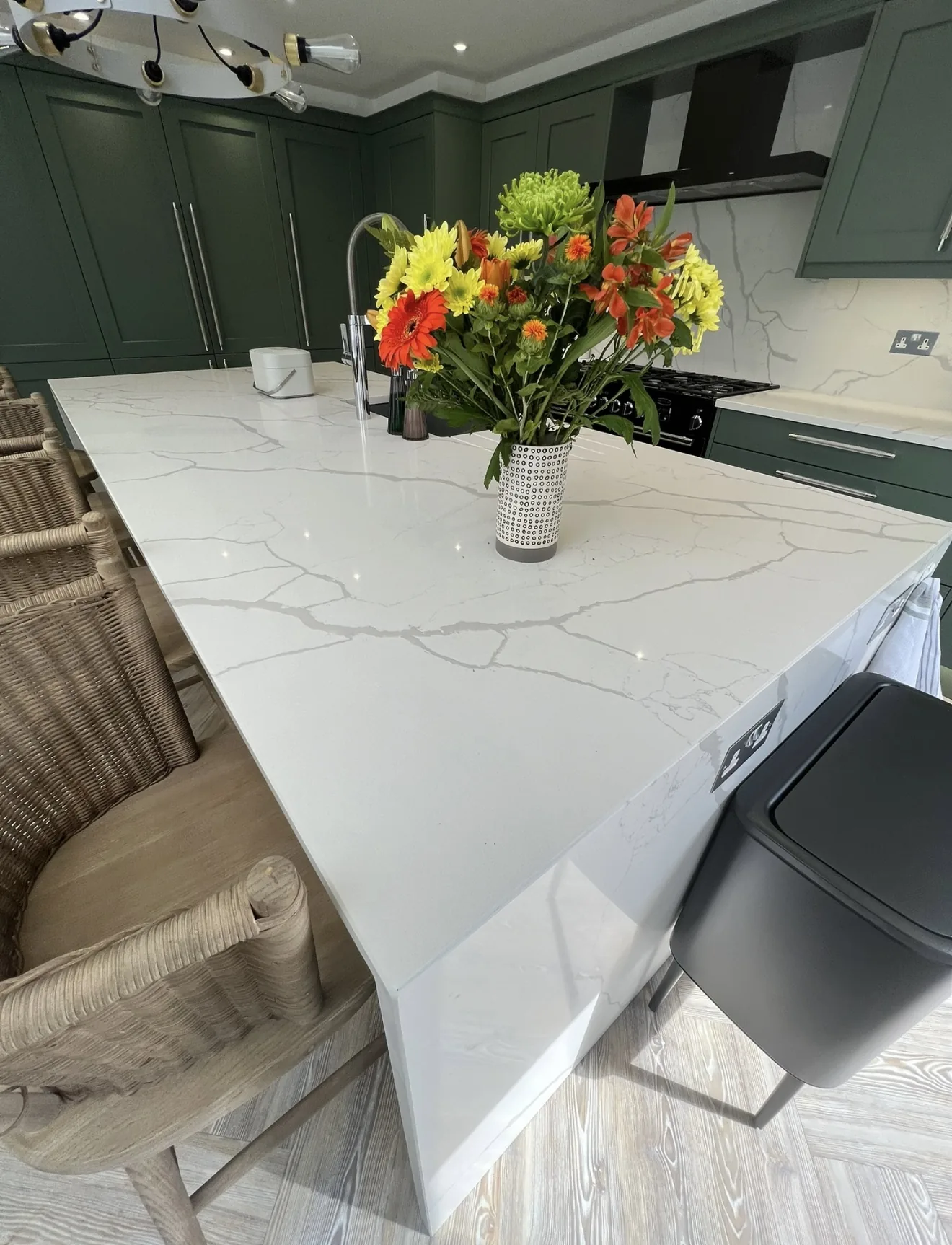
Material band is the single largest lever on the total, and moving up a band on a small kitchen costs less than most people assume because there is little area to multiply. An island is a yield question before it is a design one: it either comes out of the same slab as the perimeter or it needs a second. The catalogue starts at £110 per square metre at the plainest end and reaches £550 at the top, supply only, with the same fabrication work sitting behind either choice. The slab, then the machining, then the fitting, each on its own line.
Get it priced
ex-local-authority flats and estates
What Bunhill asks for
The stock here does not generate much of this. What it generates is worktop replacement, worktop installation and worktop splashbacks & upstands. The job itself is surveyed, quoted and fitted exactly as it would be anywhere else we work.
ex-local-authority flats and estates
Bunhill in the housing figures
Around here the great majority of homes sit in blocks rather than on their own plot. Where pieces must be small the remainder grows, and the unused part of a slab is paid for at the same rate as the used part. Movement needs a long unbroken length to be worth paying for.
ex-local-authority flats and estates
The carry, and what it rules out
Loading exemptions on red routes are narrow, time-limited and heavily camera-enforced, so we plan around them rather than relying on them. Resin for the joints is mixed to the stone on the day, and matching a heavily figured slab takes longer at the bench than matching a plain one ever does. A reserved slab is a slab nobody else is allowed to buy.
Access
Getting stone into a Bunhill kitchen
Congestion Charge zone with red routes on City Road and Old Street, plus a low-traffic scheme covering the residential streets behind. Tower access runs through a booked service lift and an agreed delivery window with the managing agent.
Tell us what the approach looks like when you book the template and it gets built into the day rather than discovered on it. Where the route is genuinely tight, it changes how the pieces are cut, which is a fabrication decision rather than a delivery one.
5–10 working days
From template to fitted, working days from template. The same on this patch as every other.
north London patch
Bunhill is covered on our north London run, along with the rest of Islington.
We come to you
Templated in your kitchen, cut in our workshop, fitted by our own installers.
Access told straight
If the route forces an extra join, you hear that at quote stage, not on the day.
Questions
Questions we get asked in Bunhill
If yours is not here, ring and ask. You get a straight answer rather than a call-back from a salesperson.
Do you actually work in Bunhill, or just list it?
Yes. Bunhill is on the patch, and the postcodes we work here are EC1Y, EC2A. It is worked on our north London run, along with the rest of Islington. The realistic answer on a main road is an early slot, a spotter on the van and pieces staged in one movement rather than several trips. Whatever the standing allows, the stone leaves that van finished, because every edge, cut-out and internal radius is machined at the works and none of it is open to reconsideration at the kerb. Cutting is done wet and extracted, never dry on a pavement. Everything that involves you happens in your kitchen, so there is nothing to visit and nothing to collect.
Is there anything about Bunhill buildings that catches worktops out?
Steel columns and downstands land where the frame put them, which is frequently in the middle of what would otherwise be a clean run. A surface in a volume this size is read from across the floor, so it registers as a tone long before anybody is close enough to read a pattern in it. Save on the colour before you save on the thickness. Where a column lands in the run the template plots its actual outline so the stone is cut to fit around it rather than stopped short and filled. Every notch and every scribe is machined into the piece before it leaves the works, and a hard sintered surface is the least forgiving of a tight internal corner, so one is always cut with a generous radius. Water standing daily is what makes porosity matter.
What do you check about the route into a Bunhill property?
Pieces get staged in the ground floor lobby and sent up singly, which needs somewhere to stand them where nobody will walk into them. That caps the longest piece, and a run split into two lengths nests differently on the slab, which moves the yield and moves the figure with it. A forced seam is a material decision before it is a fitting one. A single red line has hours and a double red line does not, and the difference decides whether an early start is a plan or a penalty. A granite kitchen ends its day with a sealer, and a sealer wants a dry face and a quiet hour afterwards, so that hour is written into the day rather than borrowed from it. Remnants become chopping boards, hearths and window boards.
Is Bunhill really a worktops area?
Not really, and there is no sense dressing it up. What the research on this patch actually lists is worktop replacement, worktop installation and worktop splashbacks & upstands. That is a statement about the local housing rather than about the work. It gets quoted, cut and fitted exactly as it would anywhere else on the patch. Rear and side-return extensions are where the islands appear, and an island is the piece that decides whether one slab does the kitchen or two. Where several kitchens are ordered together the sensible move is to take them all off one batch, because two slabs of the same name bought six months apart will not sit happily in the same building. Where tenants change often, a surface with nothing to seal wins. A new extension slab is not automatically level, and that wants checking before templating rather than after the stone is cut. Volume work tends to live at the entry end of the range, and the entry end is genuine stone rather than a compromise, since the lowest supply figure we quote is a sintered surface and not a thin laminate pretending to be one. Heavy daily cooking is an argument for natural stone.
Why do two Bunhill kitchens the same size price differently?
Sockets set into the end panel keep the top clear, but they sit below the stone and are cut into the panel by the fitter rather than machined into the worktop. A shape like that nests kindly on a slab, so more of what gets bought ends up on the units and the rate per square metre behaves much as the brochure says it will. A bold vein and a busy shape are an expensive pair. Stone is £110 to £550 per square metre supply only, and the templating, the fabrication and the fitting each carry their own line.
What has to be finished before you can template?
Exposed structure means the back edge is not a straight line at all, and a scribe of fifteen or twenty millimetres across a run is normal. A hob dropped into the middle of a length puts sustained warmth at the lip of a cut-out, and an engineered surface will yellow there across ten years where a natural one takes it without comment. Brittle stone and narrow returns are a poor pairing. Send the island size and the perimeter lengths, tell us the ceiling and window arrangement, and say whether the pod services come up through the floor. The person choosing the surface is not the person who will cook on it, which argues for a finish that absorbs ordinary wear rather than one that rewards careful housekeeping. That changes which questions are worth asking about the stone, because somebody staying put wants to know how a honed face marks in five years and somebody selling wants to know how it photographs next spring. A let kitchen is specified for indifference, and rightly so.
Is a drainer groove worth it in a small Bunhill kitchen?
Machining is permanent. If a later kitchen moves the sink, the grooves stay where they were cut. A groove set needs a clear stretch of worktop beside the bowl, so it competes with the run for length instead of being free surface. The grooves sit inside the depth of the top with stone left either side, so a shallow run limits them. These read as easy from the outside and rarely are, since the flat entrance is often tighter than the goods lift. Which stone belongs on top of all that is a separate question from the building itself, and it is the one with a figure attached, because supply alone runs from £110 to £550 per square metre before a single cut has been made. The surface outlasts the doors beneath it, usually twice over.
Do you take the old worktop away?
Disposal means it goes in the van, not into the garden to wait for a collection. Take the old tops off yourself if you would rather, and the quote simply carries one line fewer. On a replacement the old top comes off in the morning and the new stone is down and sealed the same day. Where a marked loading box sits on the red route the stop is legal but timed, so the unload runs as one movement with every hand on it. Sintered surfaces are the hardest of the three to machine and the messiest to cut wet, which is precisely why none of that happens on a public pavement. Colour matched resin is mixed to the slab, not to a chart.
What if the stone gets chipped on the way into a Bunhill kitchen?
A piece is never laid flat across a gap while it is moved, because that is how stone cracks unaided. A remade piece is cut from the same slab run wherever the slab allows, because a replacement from another batch will not match across a join. Floors and units are protected before anything comes through the door. The step and the gap at the car threshold catch a trolley wheel, so the piece comes off the trolley and goes in by hand. Where a seam becomes unavoidable the choice of stone starts to matter, because a fine even speckle closes a joint almost invisibly and a broad vein simply will not. Quiet stone closes a joint; dramatic stone announces it.
What happens when the route into a Bunhill kitchen is tighter than the worktop?
The lift, if there is one, is measured on the diagonal, because that is the dimension a long piece actually uses. Where there is a lift, whether it can be booked out and padded matters as much as its size. Splitting a run costs a join, and that is the price of getting stone into the room at all. Where a basement car park is the only way up from the parking level the carry starts below ground, and two lifts in one building rarely share the same internal dimensions. Brittleness travels badly, and a porcelain or sintered length is far less tolerant of being flexed on a turn than an engineered slab of identical size. Thin sintered stone weighs about half what thick granite does.
Reviews
5.0 from 26 Google reviews
Every one of these is on our Google profile under the reviewer’s own name. Nothing here is written by us, and the link goes straight to the source.
I recently had my kitchen worktop and splashback done by Karem from Worktop WorX and i am very pleased with the result. From the initial consultation and measurements to the final installation, the whole process was smooth and professional. The attention for details and the quality made the difference and everything was finished to a high standard. I definitely recommend Worktop WorX to anyone looking for reliable and high quality kitchen work
Alexandru Balint
Google review
Really impressed with the quality and finish of these worktops. Great range of materials, precise fabrication, and smooth communication throughout. The whole process was easy and the final result looks fantastic. Highly recommend!
Nastasia Drago
Google review
We installed new kitchen and got the worktop and splash back from them. Their professional work and commitment was wonderful. Quality of work compared to price was way too good. Thank you guys.
MD Matinur Rahman
Google review
Related
More around Bunhill
Other work we do in Bunhill
Next step
Worktops in Bunhill, priced properly
Plans, a sketch or photographs with rough run lengths is enough to start. You get an itemised written quote and the template dates we can offer on this patch.
25-year material warranty and a 5-year workmanship guarantee, both stated on your quote.