
Islington · EC1V
Worktops in St Luke's
The surface itself: which stone, what it costs by the square metre, and what the room does to that number.
- 5.0from 26 Google reviews
- 25-year material · 5-year workmanship
- Fitted 5-10 working days from template
St Luke's kitchens
The kitchens we meet in St Luke's
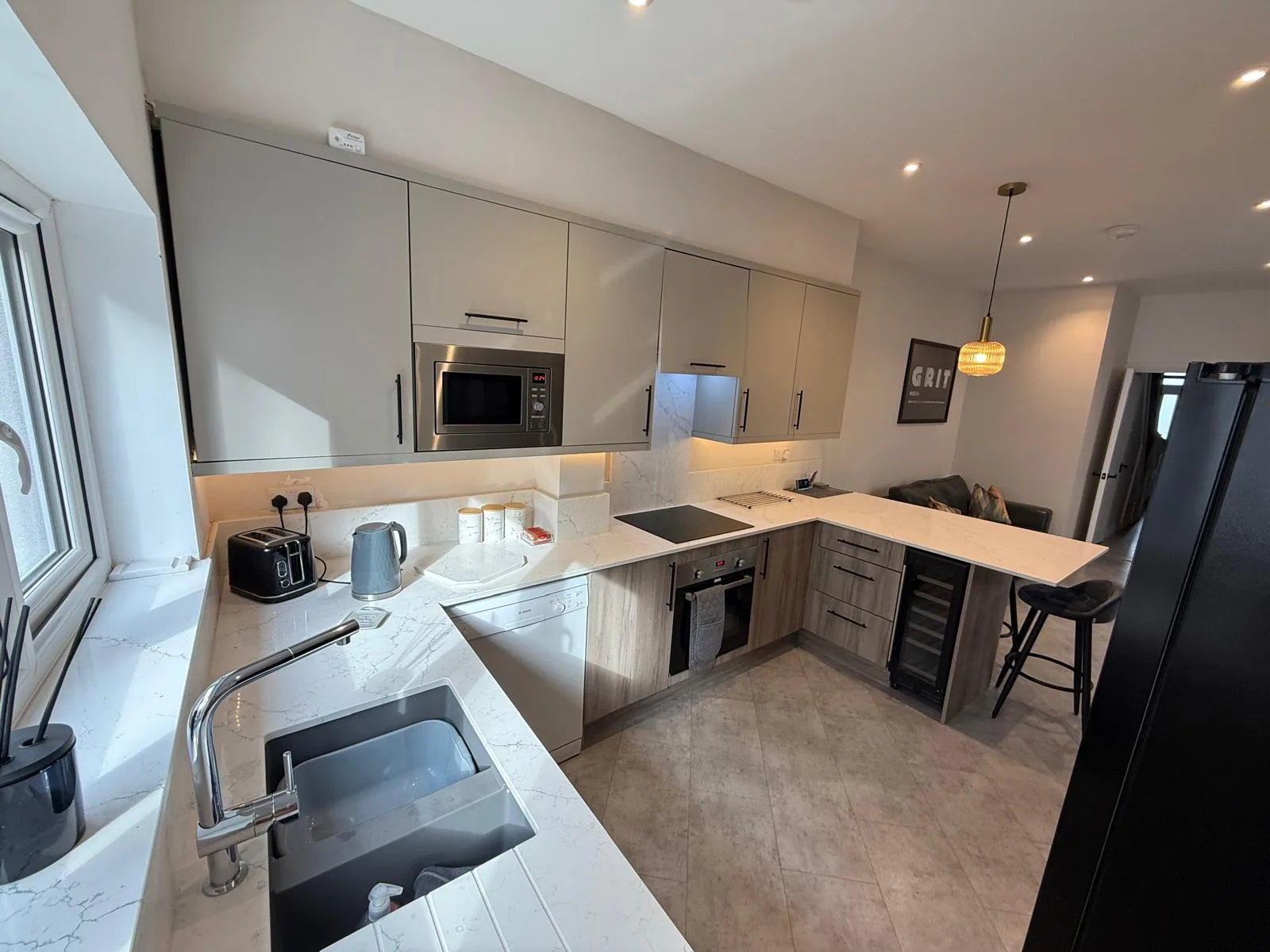
We turn down very few worktop jobs in St Luke's, but we do insist on seeing the kitchen first, and the reason for that is in the rooms themselves. A lot of interwar and Victorian model-dwelling flats with small fixed kitchens of about 2.4m and a single window, sitting alongside newer towers with open-plan runs. The older blocks have solid walls, boxed stacks and no scope to extend in any direction. Send through a photograph or two and the rough run length. We will tell you what you are probably dealing with.
These kitchens were service rooms once, so they are long, narrow and further from the entrance than the floor plan suggests. Batches move through a yard continuously, so a slab reserved this month and a slab bought next spring can carry one name and still not be the same stone. Priced by the square metre, lived with by the square inch.
Floors are concrete with a screed and a thin finish, so there is no give anywhere and packing the carcasses is the only way to get a plane. Getting a long piece in is the limiting factor, so a plain or finely speckled surface earns its place by taking a seam without announcing it. The island earns the liveliest part of the stone.
The kinds of building we work in here are 1930s municipal block, Victorian model-dwelling block, warehouse conversion and modern tower. That mix is why two jobs on the same road can run completely differently.
True everywhere
Worktops, in short
- Supply is £110 to £550 per square metre across the 181 surfaces we fit.
- Four free quartz samples are posted out, because photographs of stone lie.
- The material is guaranteed 25 years and the workmanship 5.
- Quartz runs £130 to £500 per square metre, granite £121 to £550 and Dekton £110 to £366.
- Borough
- Islington
- Postcodes
- EC1V
- Covered on
- our north London run
- Fitted
- 5–10 working days from template
The place
Why St Luke's is its own job
We would rather tell you what a fit in St Luke's is going to involve now than discover it with a slab in the hallway. Old Street and City Road are red routes, and the estates have courtyards with bollards and narrow arched entries built for handcarts rather than vans. The older blocks are walk-ups with stone stairs and iron balustrades that do not forgive a swung slab. Stone stairs and iron rails mean corner protection on every turn, since a chipped edge on the way up is the most common loss on these blocks. We would rather lose the job at the quote than lose your morning on the day of the fit.
The work
What worktops involves
Up to four quartz samples are posted out free so a colour can be lived with under your own lighting before a slab is reserved in your name. The pieces are cut and polished at the works with radiused internal corners at every opening, so nothing is machined into a finished surface inside your house. You keep the offcut if you want it, which is where the chopping board, the shelf and the spare piece for a future repair come from.
Thickness, finish and edge are three separate decisions that most households take as one, and each of the three moves the quotation on its own. The offcut from the sink opening is worth keeping as a chopping board or a shelf, and it is the only piece of the kitchen that is genuinely free. Where the way in limits the length, an even quiet stone accepts a join without the eye ever settling on it. Chosen under your own bulbs, not under ours.
The money
What it costs in St Luke's
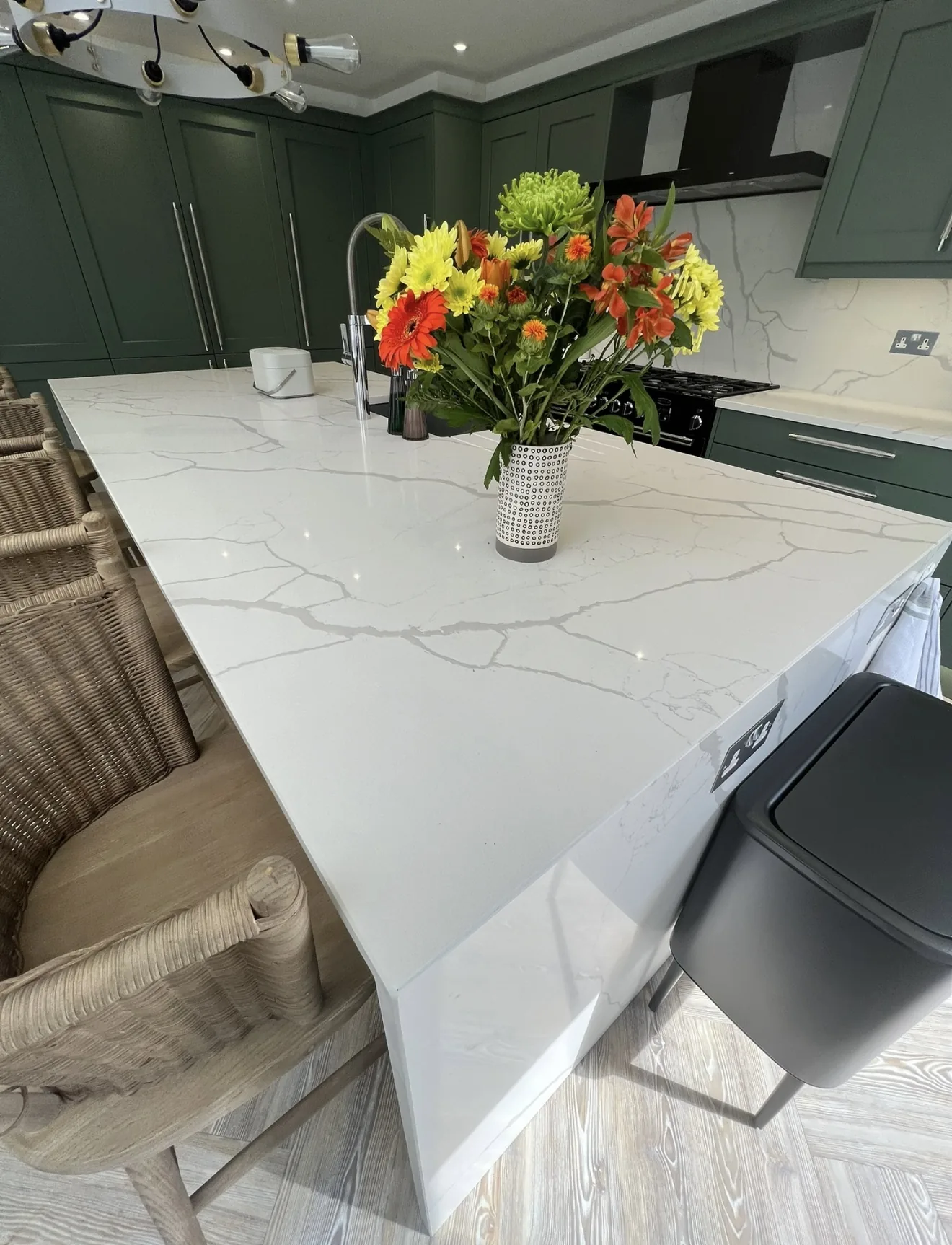
Material band is the single largest lever on the total, and moving up a band on a small kitchen costs less than most people assume because there is little area to multiply. Two facing runs mean two sets of edges and two scribes in a small span, which is why a compact galley rarely prices as cheaply as its area suggests. Multiplying your worktop area by something between £110 and £550 gives you a material bill rather than a job cost, and the two are far enough apart to be worth keeping separate. A band of stone moves the total more than a metre of run does.
Get it priced
1930s and inter-war semis
What St Luke's asks for
This is not the commonest thing we do here. Worktop replacement, worktop splashbacks & upstands and worktop installation come up more. It is a fact about the local building stock, not about the standard or the price of the work.
1930s and inter-war semis
St Luke's in the housing figures
In St Luke's, converted and purpose-built flats make up most of the stock. A long haul from the pavement favours a calibrated panel over a thick natural block, because scuffing at the arris rises with every extra handling. Depth of shade matters more in a poorly lit kitchen than any figure in the stone.
1930s and inter-war semis
The carry, and what it rules out
Where a marked loading box sits on the red route the stop is legal but timed, so the unload runs as one movement with every hand on it. Whatever the standing allows, the gloss level that leaves the works is the gloss level you keep, since no pavement anywhere has ever re-polished a face. Dust from a sintered slab belongs at the works, not on a street.
Access
Getting stone into a St Luke's kitchen
Old Street and City Road are red routes, and the estates have courtyards with bollards and narrow arched entries built for handcarts rather than vans. The older blocks are walk-ups with stone stairs and iron balustrades that do not forgive a swung slab.
Tell us what the approach looks like when you book the template and it gets built into the day rather than discovered on it. Where the route is genuinely tight, it changes how the pieces are cut, which is a fabrication decision rather than a delivery one.
5–10 working days
From template to fitted, working days from template. The same on this patch as every other.
north London patch
St Luke's is covered on our north London run, along with the rest of Islington.
We come to you
Templated in your kitchen, cut in our workshop, fitted by our own installers.
Access told straight
If the route forces an extra join, you hear that at quote stage, not on the day.
Questions
Questions we get asked in St Luke's
If yours is not here, ring and ask. You get a straight answer rather than a call-back from a salesperson.
Do your own fitters come out to St Luke's?
Yes. St Luke's is on the patch, and the postcodes we work here are EC1V. It is worked on our north London run, along with the rest of Islington. A bus lane along the frontage brings its own hours with it, and stopping in one is enforced the same way the red route is. Whatever the standing allows, the stone leaves that van finished, because every edge, cut-out and internal radius is machined at the works and none of it is open to reconsideration at the kerb. The offcut is yours if you want it and ours if you do not. Everything that involves you happens in your kitchen, so there is nothing to visit and nothing to collect.
Is there anything about St Luke's buildings that catches worktops out?
Steel windows sit in narrow reveals with a slim cill, which leaves almost no depth for an upstand to return into. The kitchen in one of these flats is often internal or single-aspect, and in a room that never gets direct light a pale face with a soft finish is worth more than any amount of colour. Movement needs length, and length is what these rooms have. A stack boxed diagonally across a corner leaves a triangle of dead space, and the top is cut to that triangle rather than to a square return. Every notch and every scribe is machined into the piece before it leaves the works, and a hard sintered surface is the least forgiving of a tight internal corner, so one is always cut with a generous radius. The wall decides the scribe and the scribe decides the depth.
What do you check about the route into a St Luke's property?
Suction lifters earn their keep on a straight flight and become a liability on a winder, where a handle standing out from the face is one more thing to catch on a wall. That caps the longest piece, and a run split into two lengths nests differently on the slab, which moves the yield and moves the figure with it. Short pieces nest tighter, and tighter nesting is less stone bought. The van is not staying on a main road for the day, so once the stone is off it goes and parks properly somewhere else. A granite kitchen ends its day with a sealer, and a sealer wants a dry face and a quiet hour afterwards, so that hour is written into the day rather than borrowed from it. A sealer needs a dry face and a quiet hour after it.
Is St Luke's really a worktops area?
Not really, and there is no sense dressing it up. What the research on this patch actually lists is worktop replacement, worktop splashbacks & upstands and worktop installation. That is a statement about the local housing rather than about the work. It gets quoted, cut and fitted exactly as it would anywhere else on the patch. An open-plan extension puts the worktop in the middle of the living space, so it is looked at from the sofa as well as worked on. Where several kitchens are ordered together the sensible move is to take them all off one batch, because two slabs of the same name bought six months apart will not sit happily in the same building. Where the cooking is serious, heat tolerance leads the list. Extension budgets are usually well spent by the time the worktop is ordered, which is where the choice between quartz and a thinner sintered stone actually gets made. Volume work tends to live at the entry end of the range, and the entry end is genuine stone rather than a compromise, since the lowest supply figure we quote is a sintered surface and not a thin laminate pretending to be one. Order the stone against the room, never against the drawing.
Why do two St Luke's kitchens the same size price differently?
A full-depth tall unit projects past the worktop line, and the run has to be scribed against its side panel instead of carrying on past it. A shape like that nests kindly on a slab, so more of what gets bought ends up on the units and the rate per square metre behaves much as the brochure says it will. One slab or two is the biggest single jump in any quotation. Stone is £110 to £550 per square metre supply only, and the templating, the fabrication and the fitting each carry their own line.
What has to be finished before you can template?
Where the boxing stands proud of the finished wall the upstand behind it has to be broken into separate lengths, because one piece cannot pass it. A hob dropped into the middle of a length puts sustained warmth at the lip of a cut-out, and an engineered surface will yellow there across ten years where a natural one takes it without comment. Sealing suits stone that drinks; nothing else needs it. Tell us the longest piece that will reach the flat, the run lengths, and whether the kitchen has any daylight at all or is lit entirely from the ceiling. Some doors in a building need a consent letter and some need nothing at all, so the first question is which arrangement applies here rather than which one is usual. That changes which questions are worth asking about the stone, because somebody staying put wants to know how a honed face marks in five years and somebody selling wants to know how it photographs next spring. Buy once where the room will not be touched again for years.
What is the order of events on a St Luke's kitchen?
The template produces a drawing, and the workshop cuts to that drawing once you agree it. No payment is due before the template. Between the template and the fit the slab is nested, cut, mitred and dry-assembled on the bench, which is work you never see and is most of the wait. The communal stair is stone with a cast iron balustrade, and the winders leave very little room to turn a long piece. Which stone belongs on top of all that is a separate question from the building itself, and it is the one with a figure attached, because supply alone runs from £110 to £550 per square metre before a single cut has been made. A finish is a decision about cleaning as much as about looks.
What maintenance does a worktop need in a St Luke's kitchen?
Marble is the one people underestimate. It is porous, like granite, and wants sealing. Where a top takes wine, oil and lemon most days, the non-porous materials ask least of the household. Day to day all three want soap and water; abrasive creams and scouring pads are what dull a polished surface. Inter-war purpose-built blocks have curved external walls and steel windows, so a run along an outside wall is following a genuine curve rather than a bow. The joinery around it is deep and period, so a substantial thickness with a simple profile sits beside it far better than a slim modern edge does. At four metres a stone is a tone rather than a pattern.
What if a worktop will not physically fit through the building?
A join added to get stone into the room is a different thing from a join added because the slab ran out, and the quote says which is which. Hoisting through a window is occasionally the answer, and it is a decision made at the template, not improvised on the fitting day. Timber nosings chip under a slipped edge, so the treads are covered along the whole flight rather than only at the landings. Where a seam becomes unavoidable the choice of stone starts to matter, because a fine even speckle closes a joint almost invisibly and a broad vein simply will not. The seam is planned on the layout, not discovered in the room.
What is the difference between an upstand and a splashback?
What decides between them is usually the wall: what it is built of, how flat it is, and where the sockets ended up. An upstand is a slim strip that follows the worktop up the wall; a full-height splashback runs from the worktop to the underside of the wall units. These blocks were built with a lift from new, which will usually take a worktop and almost never takes a full-length island piece. These kitchens are often internal or single-aspect, and in a room short of daylight a pale face with a soft finish is worth more than any amount of colour. Four visible edges make the profile part of the design.
Reviews
5.0 from 26 Google reviews
Every one of these is on our Google profile under the reviewer’s own name. Nothing here is written by us, and the link goes straight to the source.
Karem did a fantastic job at installing my antique bronze mirror for my coffee/drinks unit. He was really professional and his communication throughout was clear.
Kals
Google review
We have a new kitchen. Our builder recommended Worktop Worx for our worktop. Now we have an amazing worktop very good price too. Really recommend. They were really good to us. 10/10
j thomas
Google review
We recently had the Arctic Starburst worktop installed by Worktop WorX and it looks amazing. The subtle sparkle really catches the light and gives the kitchen a clean, modern feel. The Arctic Starburst surface feels high quality, durable, and is easy to keep clean. The finish and installation from Worktop WorX were spot on. Really happy with the result and would definitely recommend both Arctic Starburst and Worktop WorX to anyone upgrading their kitchen.
Han Lee
Google review · Arctic Starburst
Related
More around St Luke's
Other work we do in St Luke's
Next step
Worktops in St Luke's, priced properly
Plans, a sketch or photographs with rough run lengths is enough to start. You get an itemised written quote and the template dates we can offer on this patch.
25-year material warranty and a 5-year workmanship guarantee, both stated on your quote.