
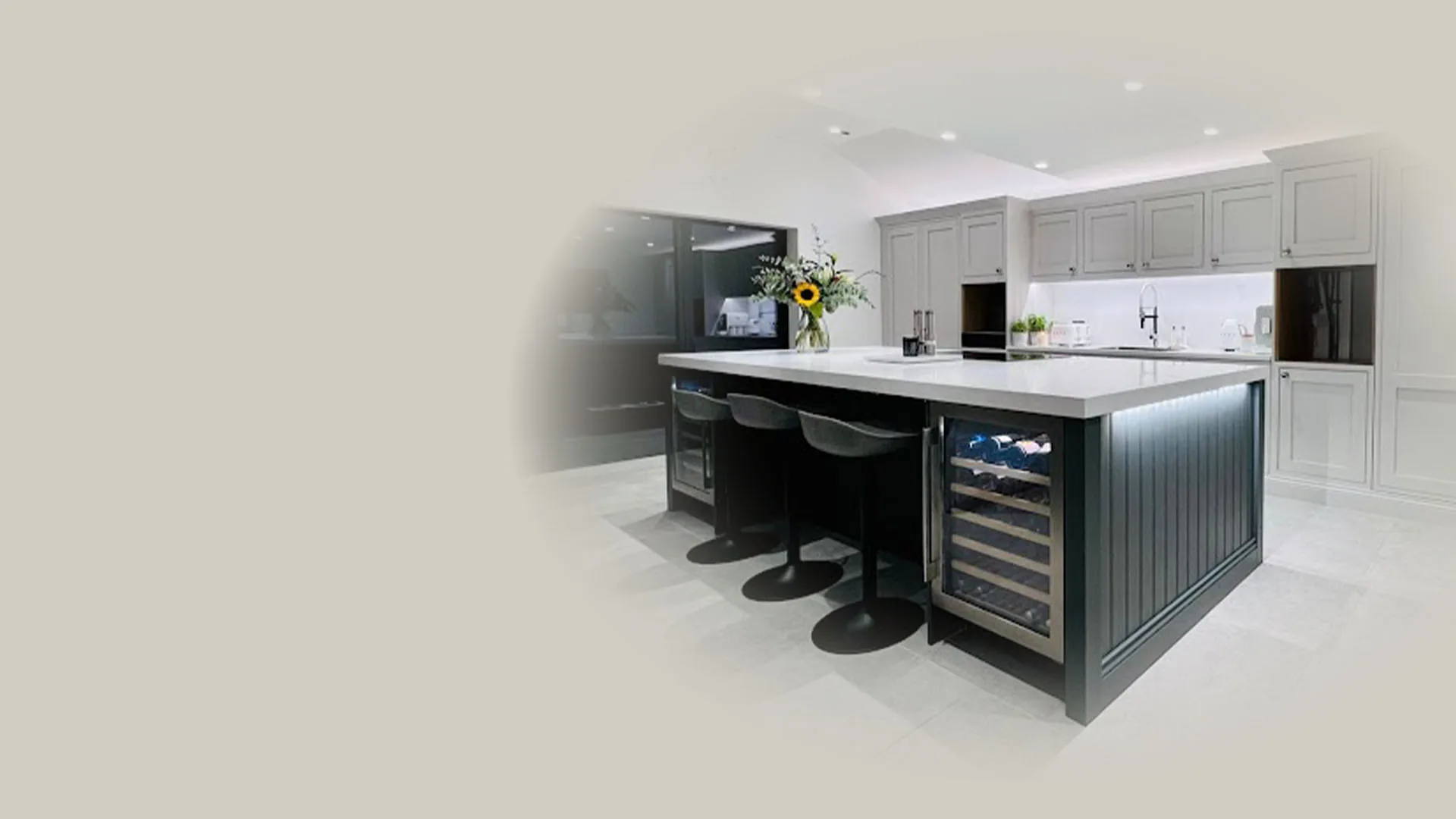
Islington · EC1
Worktops in Clerkenwell
The surface itself: which stone, what it costs by the square metre, and what the room does to that number.
- 5.0from 26 Google reviews
- 25-year material · 5-year workmanship
- Fitted 5-10 working days from template
Clerkenwell kitchens
The kitchens we meet in Clerkenwell
Over the years the worktop jobs we have done in Clerkenwell have followed a few recognisable patterns, and knowing which one you are in saves a great deal of argument later. Loft conversions of print, watchmaking and light-industrial buildings, where the kitchen is a run and an island in one large open space with exposed brick, steel and timber floors. Runs of 4m plus a 2.5-3m island are common and clients often want a single stone carried across island, worktops and splashback. If you are not sure which of those describes your kitchen, that is normal, and it is exactly what the template visit settles.
These read as easy from the outside and rarely are, since the flat entrance is often tighter than the goods lift. Hardness and toughness are separate properties, and the surface that laughs off a knife is often the one least willing to survive an unsupported corner. The surface outlasts the doors beneath it, usually twice over.
The goods lift is generous and the flat entrance often is not, so the tightest point on the route is inside the flat rather than in the building. The surface is usually an island pod standing in the middle of the floor, so all four edges are on show and the profile becomes part of the look rather than a detail. Save on the colour before you save on the thickness.
What we are measuring in, mostly, is former industrial warehouse conversion, Georgian terrace, Victorian model-dwelling block and modern apartment. Each carries its own carry problem before it carries a worktop.
True everywhere
Worktops, in short
- Supply is £110 to £550 per square metre across the 181 surfaces we fit.
- Dekton and sintered stone hold their colour under heat and direct sunlight.
- That figure is the slab. Fabrication, edges, cut-outs and fitting are quoted separately.
- Four free quartz samples are posted out, because photographs of stone lie.
- Borough
- Islington
- Postcodes
- EC1
- Covered on
- our north London run
- Fitted
- 5–10 working days from template
The place
Why Clerkenwell is its own job
In Clerkenwell, the things that make a fit straightforward or awkward are known before we cut, not discovered while we carry. Inside the Congestion Charge zone with narrow one-way streets, loading bans through the busiest hours and traffic filters on several residential blocks. Many converted buildings retain a goods lift, which is the difference between a one-piece island and a jointed one. The floors in these conversions are old timber over long spans and are rarely flat, so level and pack the island carcass properly before setting stone or a 3m top will telegraph every dip. Fitters who templated the room turn up to fit it, which is why the awkward bits are already accounted for.
The work
What worktops involves
Up to four quartz samples are posted out free so a colour can be lived with under your own lighting before a slab is reserved in your name. The room is templated once the units are fixed and level, because the stone is machined to the room as built rather than to the kitchen drawing. You keep the offcut if you want it, which is where the chopping board, the shelf and the spare piece for a future repair come from.
Quartz is crushed stone bound in resin, so it arrives consistent and predictable, and that same resin is why it objects to a hot pan and to standing sunlight. Sealing a natural surface takes an hour and wants repeating roughly once a year, using a penetrating sealer rather than anything that leaves a film on top. An island standing free shows all four edges, which makes the profile a design decision rather than a technical one. Heat, water and sunlight sort the shortlist quickly.
The money
What it costs in Clerkenwell
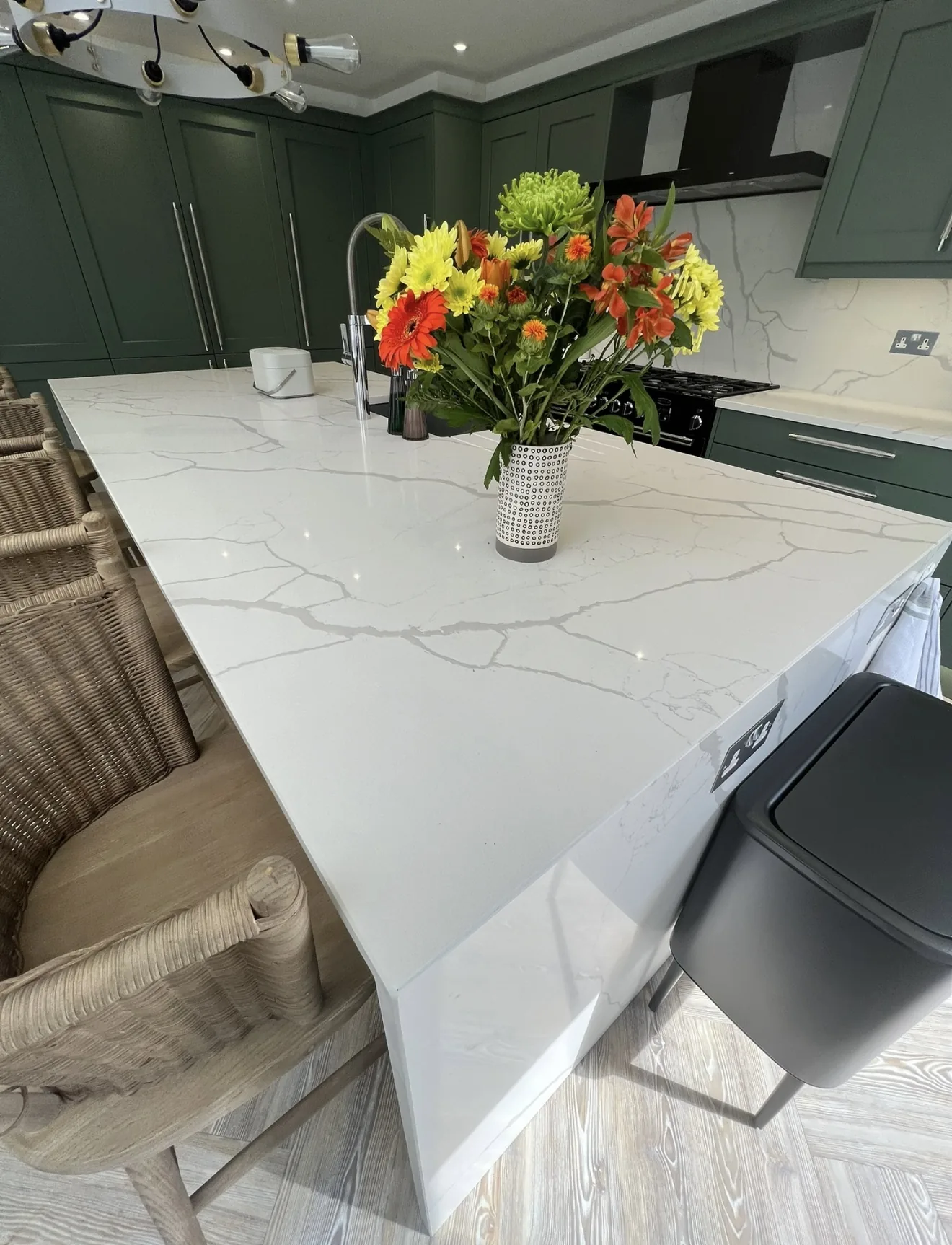
Two rooms of identical floor area can differ by more than double on the stone alone, and the reason is almost never the size of either of them. The island is normally the largest single piece in the kitchen, which makes it the piece that sets the carry and sometimes the price. Across the catalogue the supply-only rate is £110 to £550 per square metre, before any of the work that turns a slab into a worktop. A band of stone moves the total more than a metre of run does.
Get it priced
warehouse and wharf conversions
Clerkenwell in the housing figures
On the Clerkenwell streets we cover, the great majority of homes sit in blocks rather than on their own plot. Older fabric means a narrow approach, and a narrow approach puts a seam in the run, so a repeating pattern is worth more here than a sweeping one. Serious daily cooking narrows the sensible choices to a handful of materials.
warehouse and wharf conversions
What Clerkenwell asks for
This is not the commonest thing we do here. Worktop fabrication and worktop installation come up more. It is a fact about the local building stock, not about the standard or the price of the work.
warehouse and wharf conversions
The building, and what it does to the job
Where two pieces meet over a fall in the floor the join has to be flush to the hand as well as true to the level, because the eye reads the join and forgives the room. Anything that leaves a length unsupported argues for thirty millimetres rather than twenty, because the thinner slab wants continuous bearing along its whole back edge and the thicker one will bridge a short gap. What the room obstructs, the layout pays for in slab.
Access
Getting stone into a Clerkenwell kitchen
Inside the Congestion Charge zone with narrow one-way streets, loading bans through the busiest hours and traffic filters on several residential blocks. Many converted buildings retain a goods lift, which is the difference between a one-piece island and a jointed one.
Tell us what the approach looks like when you book the template and it gets built into the day rather than discovered on it. Where the route is genuinely tight, it changes how the pieces are cut, which is a fabrication decision rather than a delivery one.
5–10 working days
From template to fitted, working days from template. The same on this patch as every other.
north London patch
Clerkenwell is covered on our north London run, along with the rest of Islington.
We come to you
Templated in your kitchen, cut in our workshop, fitted by our own installers.
Access told straight
If the route forces an extra join, you hear that at quote stage, not on the day.
Questions
Questions we get asked in Clerkenwell
If yours is not here, ring and ask. You get a straight answer rather than a call-back from a salesperson.
Do you cover Clerkenwell?
Yes. Clerkenwell is on the patch, and the postcodes we work here are EC1. It is worked on our north London run, along with the rest of Islington. The realistic answer on a main road is an early slot, a spotter on the van and pieces staged in one movement rather than several trips. Whatever the standing allows, the stone leaves that van finished, because every edge, cut-out and internal radius is machined at the works and none of it is open to reconsideration at the kerb. Colour matched resin is mixed to the slab, not to a chart. We template in your kitchen and fit in your kitchen, so there is nothing to visit and nothing to collect.
Why would worktops in Clerkenwell be any different from anywhere else?
Poured screed over steel decking can fall away across a long run, so level is checked across the whole room before anything is packed. A surface in a volume this size is read from across the floor, so it registers as a tone long before anybody is close enough to read a pattern in it. Two slabs change the question from price to preference. Floors settle, and once base units are packed and levelled properly the stone sits true while everything else in the room admits it is not. Every notch and every scribe is machined into the piece before it leaves the works, and a hard sintered surface is the least forgiving of a tight internal corner, so one is always cut with a generous radius. A cut-out beside a notch leaves very little stone in between.
What is the carry like in Clerkenwell?
Handrails, mirrors and a sloping ceiling panel all eat into the usable diagonal, and none of them appear on a lift specification sheet. That caps the longest piece, and a run split into two lengths nests differently on the slab, which moves the yield and moves the figure with it. Thin sintered stone weighs about half what thick granite does. A single red line has hours and a double red line does not, and the difference decides whether an early start is a plan or a penalty. A granite kitchen ends its day with a sealer, and a sealer wants a dry face and a quiet hour afterwards, so that hour is written into the day rather than borrowed from it. Thirty millimetre stone unloads slowly and thin stone does not.
Is worktops what Clerkenwell is known for?
Not really, and there is no sense dressing it up. What the research on this patch actually lists is worktop fabrication and worktop installation. That is a statement about the local housing rather than about the work. It gets quoted, cut and fitted exactly as it would anywhere else on the patch. Extension budgets are usually well spent by the time the worktop is ordered, which is where the choice between quartz and a thinner sintered stone actually gets made. Where several kitchens are ordered together the sensible move is to take them all off one batch, because two slabs of the same name bought six months apart will not sit happily in the same building. A small kitchen still buys the remainder of the slab. Rear and side-return extensions are where the islands appear, and an island is the piece that decides whether one slab does the kitchen or two. Volume work tends to live at the entry end of the range, and the entry end is genuine stone rather than a compromise, since the lowest supply figure we quote is a sintered surface and not a thin laminate pretending to be one. Colour names outlive their batches by several years.
Where does the money go on a Clerkenwell worktop?
A waterfall leg is a separate piece bonded to the top on a mitre, so the floor it stands on has to be level enough for that mitre to close along its full height. A shape like that nests kindly on a slab, so more of what gets bought ends up on the units and the rate per square metre behaves much as the brochure says it will. The island is usually the piece that opens the second slab. Stone is £110 to £550 per square metre supply only, and the templating, the fabrication and the fitting each carry their own line.
What needs to be ready before you come to Clerkenwell?
A junction between an original floor and a later extension slab is almost never at the same level, so units carrying a run across it need packing first. A hob dropped into the middle of a length puts sustained warmth at the lip of a cut-out, and an engineered surface will yellow there across ten years where a natural one takes it without comment. Heat at the lip of an opening is the slow kind of damage. Send the island size and the perimeter lengths, tell us the ceiling and window arrangement, and say whether the pod services come up through the floor. Quartz is the sensible default in a rental: nothing to seal, nothing to maintain, and nothing an incoming tenant needs briefing on. That changes which questions are worth asking about the stone, because somebody staying put wants to know how a honed face marks in five years and somebody selling wants to know how it photographs next spring. Neutral mid-tones survive a change of owner better than statements.
What happens when the route into a Clerkenwell kitchen is tighter than the worktop?
Where there is a lift, whether it can be booked out and padded matters as much as its size. A join added to get stone into the room is a different thing from a join added because the slab ran out, and the quote says which is which. If a piece cannot be got in at all, we say so at the template rather than on the day. A lift out of service for the day turns a straightforward install into a stair carry, so the slot gets confirmed with whoever manages the building rather than against a calendar. Where a seam becomes unavoidable the choice of stone starts to matter, because a fine even speckle closes a joint almost invisibly and a broad vein simply will not. Flexing a porcelain length round a turn is how one breaks.
Do you do undermounted sinks in Clerkenwell?
A tap under a window board still needs room for its handle to lift, which is checked at the template. The tap hole is drilled in the workshop too, and its position depends on how far the tap has to swing. Each cut-out is priced on its own line, so a range, a bowl and a half, a boiling tap and a drainer are four items rather than one. It is the heaviest single piece in the kitchen, so the number of hands needed on the day and the route in are worked out from that piece rather than from the runs. An island is the piece that decides whether one slab covers the kitchen or two, and a second slab arrives as a step in the figure rather than a gentle slope. Depth beyond the standard is a slab question, not a trim question.
Is the quote a fixed price or an estimate?
The quote is written from the template drawing. Before that it works from what you have described. What is quoted is what the drawing says, and the figure does not move unless the drawing does. What moves the figure after templating is a change you make: a different edge, an extra cut-out, a bigger sink chosen late. Legs bottoming out on hard concrete or an uneven screed mean the tops of the carcasses are not one plane, and that is picked up at template rather than on fitting day. A run that sits under strong sun for hours every afternoon suits a surface built to be stable in daylight, because a resin-bound stone is made for indoor use and sustained sunlight is the one thing it was never designed around. The obstruction is templated as found and cut as templated.
Can I have grooves instead of a separate drainer in Clerkenwell?
Machining is permanent. If a later kitchen moves the sink, the grooves stay where they were cut. The grooves sit inside the depth of the top with stone left either side, so a shallow run limits them. On a porous stone the grooved area is sealed with the rest, and it gets wet more than anything else. Services coming up through a floor slab mean the island cannot move to suit the stone, so the stone is cut to suit the island. Which stone belongs on top of all that is a separate question from the building itself, and it is the one with a figure attached, because supply alone runs from £110 to £550 per square metre before a single cut has been made. What sings in a bright room can go dead in a dark one.
Reviews
5.0 from 26 Google reviews
Every one of these is on our Google profile under the reviewer’s own name. Nothing here is written by us, and the link goes straight to the source.
I used Karem’s services 5 years ago for purchasing and fitting the quartz worktop in my then brand new kitchen. The price was reasonable and the service reliable and spot on, no delays in fitting, misunderstanding or excuses. I recommended him to a friend, who also used his services and they were happy too! If I need to order new kitchen work top again, I would definitely use him again. Thanks Karem!
shoshencence
Google review · quartz
Karem did an excellent job on my kitchen. He was professional, reliable, and paid great attention to detail. The finish looks amazing and has completely transformed my kitchen. Thank you! Would highly recommend his work!
Catalina Radu
Google review
Excellent work and highly recommend. Very professional and did an outstanding job with my worktop. Karem responded very quickly and swiftly, top guy!
Faisal K
Google review
Related
More around Clerkenwell
Other work we do in Clerkenwell
Next step
Worktops in Clerkenwell, priced properly
Plans, a sketch or photographs with rough run lengths is enough to start. You get an itemised written quote and the template dates we can offer on this patch.
25-year material warranty and a 5-year workmanship guarantee, both stated on your quote.