
Ealing · UB6
Worktops in Greenford Green
The surface itself: which stone, what it costs by the square metre, and what the room does to that number.
- 5.0from 26 Google reviews
- 25-year material · 5-year workmanship
- Fitted 5-10 working days from template
Greenford Green kitchens
The kitchens we meet in Greenford Green
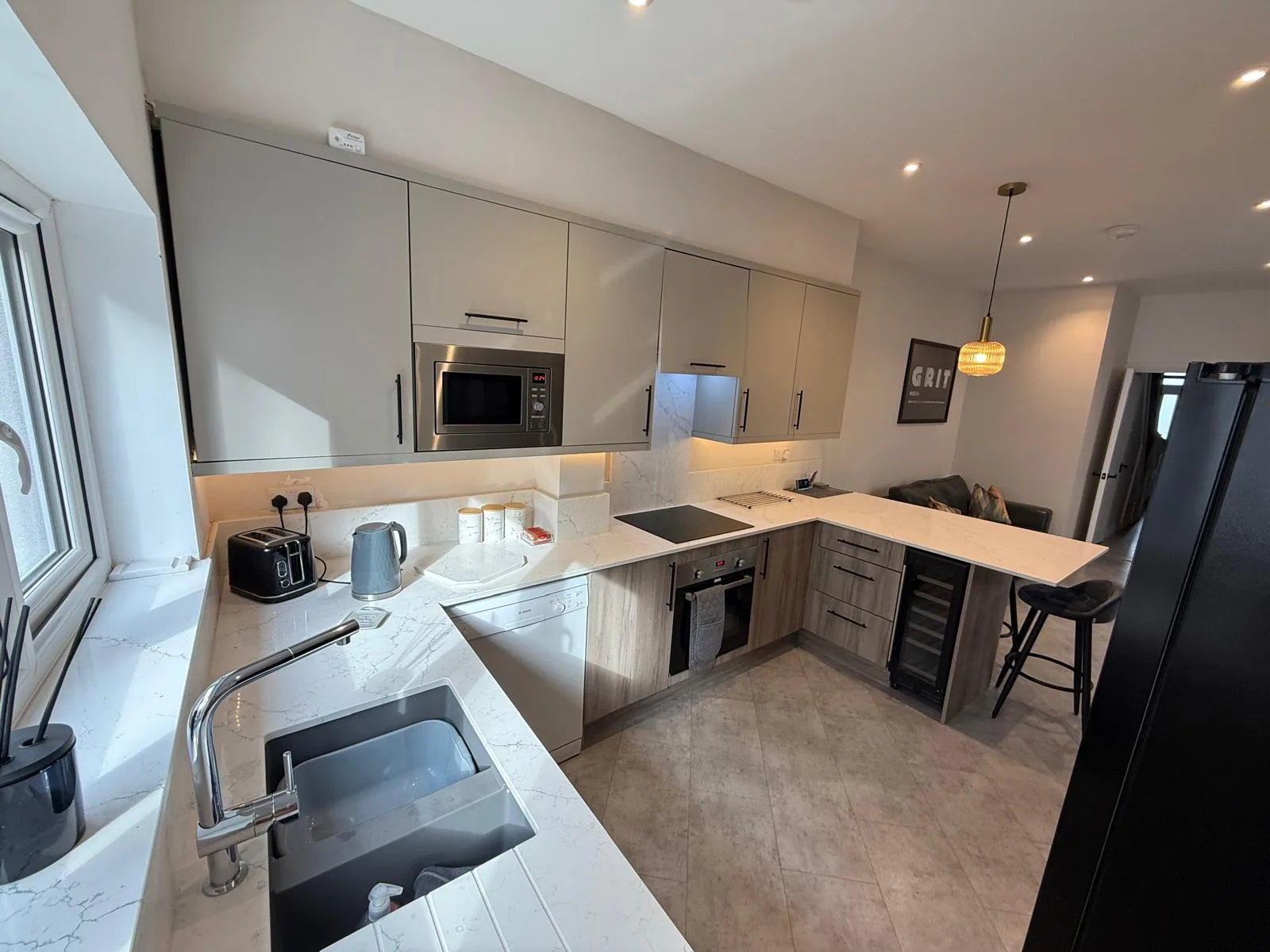
Half of what we get asked about stone worktop supply and fitting in Greenford Green could be answered by a tape measure and ten minutes in the room in question. Interwar semis and terraces north of the A40, mostly unextended, with straight runs of 3m to 3.5m, the boiler still mounted on the kitchen wall and the back door in the corner. You will get a firm figure for your Greenford Green kitchen once it has been templated, and that figure does not move afterwards.
A shallow bay or a squared-off rear window means the run beneath it is rarely the same depth at both ends. North light and afternoon light read a surface differently, so a sample belongs in the corner that gets the worst of it rather than the best. A finish is a decision about cleaning as much as about looks.
The under-stair cupboard opens off the kitchen in most of them, and its door swing is the reason a corner run stops where it does. These kitchens are usually knocked through to the dining room, so the surface is read from two sides at once and the figure has to carry across the pieces rather than restart at every join. One full slab and no second is the sweet spot on price.
The kinds of building we work in here are Interwar semi, 1930s terrace and postwar infill. That mix is why two jobs on the same road can run completely differently.
True everywhere
Worktops, in short
- Supply is £110 to £550 per square metre across the 181 surfaces we fit.
- That figure is the slab. Fabrication, edges, cut-outs and fitting are quoted separately.
- Four free quartz samples are posted out, because photographs of stone lie.
- The material is guaranteed 25 years and the workmanship 5.
- Borough
- Ealing
- Postcodes
- UB6
- Covered on
- our west London run
- Fitted
- 5–10 working days from template
The place
Why Greenford Green is its own job
A plan drawn off a floor plan will not tell you what a fit in Greenford Green actually involves, so we come and look. Quiet estate roads with drives and verges, approached off Greenford Road. The A40 slip roads are the pinch point at either end of the day. Wall-hung boilers directly above the worktop mean the upstand has to stop short and the splashback gets cut around the pipe run rather than behind it. Both go on the drawing, and the drawing is what the workshop cuts to.
The work
What worktops involves
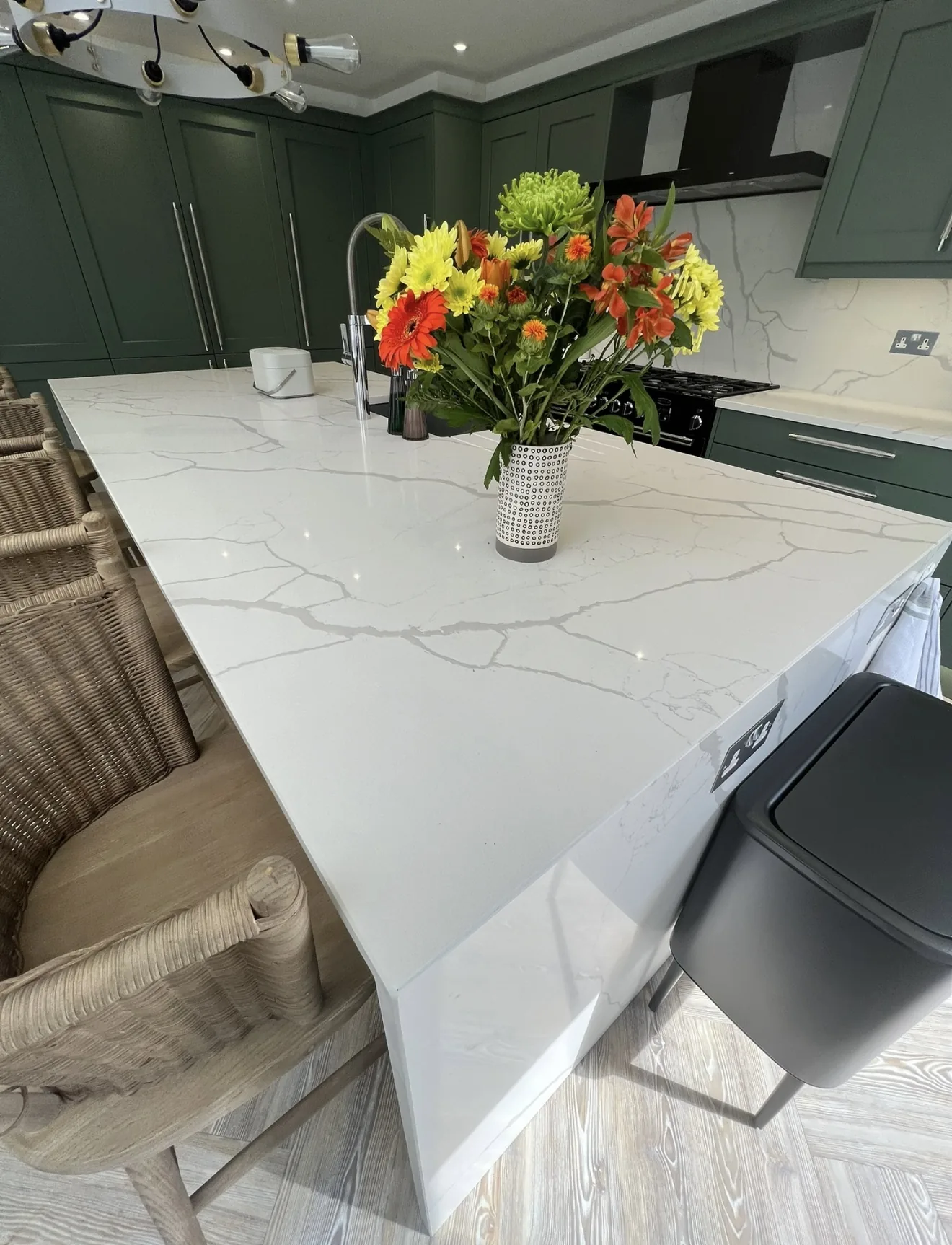
Quartz, granite and sintered surfaces such as Dekton are all supplied, and the choice between them is made on heat, sunlight, porosity and the light in the room rather than on price alone. Run lengths, join positions and the direction of the veining are agreed at that visit, since where a join falls is a decision about the pattern as much as about the length. You get an itemised figure that shows what the slab cost, what the edges cost and what the openings cost, so the layout can be adjusted before anything is cut.
Photographs of stone lie, and they lie hardest about how a colour behaves under a domestic bulb, which is why four quartz samples go in the post free of charge. A hot pan straight off a burner is safe on granite and on sintered stone, and it is the one habit that will permanently mark an engineered top. These kitchens are read from the dining half of the room as well as the working half, so continuity of figure across the pieces matters more than it would in a closed room. The slab is quoted; the cut list is what you pay.
The money
What it costs in Greenford Green
The rate per square metre buys stone and nothing else, so the machining, the openings, the polished edges and the fitting are set out beside it rather than folded into it. Two facing runs mean two sets of edges and two scribes in a small span, which is why a compact galley rarely prices as cheaply as its area suggests. That £110 to £550 per square metre buys the slab and nothing else. Templating, machining, edges, cut-outs and the fitting day are counted and charged one by one. Nothing about the stone is folded into a rate and hidden there.
Get it priced
1930s and inter-war semis
The building, and what it does to the job
Where the boxing stands proud of the finished wall the upstand behind it has to be broken into separate lengths, because one piece cannot pass it. A deep scribe eats into the back of the piece, which is quietly important on a stone with directional figure, since the pattern moves backwards as that depth comes off. Reach across an unsupported span is a thickness question.
1930s and inter-war semis
What Greenford Green asks for
Around here this is occasional rather than routine. The routine ones are worktop replacement, worktop splashbacks & upstands and worktop installation. That is a comment on the buildings and on nothing else.
1930s and inter-war semis
The carry, and what it rules out
Where the van cannot turn on the plot it has to arrive already facing the right way, so the approach along the street is part of the plan. Any stone reads two or three shades deeper when it is wet, so nothing about a colour is ever settled outdoors on a grey morning. Stone arrives finished, because a kerb is not a polishing shop.
Access
Getting stone into a Greenford Green kitchen
Quiet estate roads with drives and verges, approached off Greenford Road. The A40 slip roads are the pinch point at either end of the day.
Tell us what the approach looks like when you book the template and it gets built into the day rather than discovered on it. Where the route is genuinely tight, it changes how the pieces are cut, which is a fabrication decision rather than a delivery one.
5–10 working days
From template to fitted, working days from template. The same on this patch as every other.
west London patch
Greenford Green is covered on our west London run, along with the rest of Ealing.
We come to you
Templated in your kitchen, cut in our workshop, fitted by our own installers.
Access told straight
If the route forces an extra join, you hear that at quote stage, not on the day.
Questions
Questions we get asked in Greenford Green
If yours is not here, ring and ask. You get a straight answer rather than a call-back from a salesperson.
Do you cover Greenford Green?
Yes. Greenford Green is on the patch, and the postcodes we work here are UB6. It is worked on our west London run, along with the rest of Ealing. A drive behind an electric gate depends on somebody being in to open it and on the gate staying open while the load comes off. Whatever the standing allows, the stone leaves that van finished, because every edge, cut-out and internal radius is machined at the works and none of it is open to reconsideration at the kerb. A natural surface is sealed at the end of its own fitting day. Nothing needs visiting and nothing needs collecting: the template is in your kitchen and so is the fit.
What is different about worktops in Greenford Green?
The chimney breast served a back boiler and is usually still standing, so there is a shallow recess on one side of the room. Side light from the garden is what lets a stone with movement in it actually be seen, which is why a busier granite or a veined quartz earns its keep here and a flat single colour rarely does. Warm stone beside painted timber, cool grey rarely. A boxed soil stack or service riser in the corner of a run eats into the worktop depth and has to be scribed around rather than cut square. Every notch and every scribe is machined into the piece before it leaves the works, and a hard sintered surface is the least forgiving of a tight internal corner, so one is always cut with a generous radius. Speckle hides the resin line a mitre leaves behind.
Is access a problem in Greenford Green?
Where the van stands level with the front of the house a piece gets handled twice instead of five times, and stone breaks on handling rather than on the road. That caps the longest piece, and a run split into two lengths nests differently on the slab, which moves the yield and moves the figure with it. Vein direction is settled before the slab is broken into pieces. Some drives are wide enough for the van and too short for the tail lift, because the tail lift needs its own clear metre behind the vehicle. A granite kitchen ends its day with a sealer, and a sealer wants a dry face and a quiet hour afterwards, so that hour is written into the day rather than borrowed from it. Dust from a sintered slab belongs at the works, not on a street.
Do you get much worktops work in Greenford Green?
Not really, and there is no sense dressing it up. What the research on this patch actually lists is worktop replacement, worktop splashbacks & upstands and worktop installation. That is a statement about the local housing rather than about the work. It gets quoted, cut and fitted exactly as it would anywhere else on the patch. Extension budgets are usually well spent by the time the worktop is ordered, which is where the choice between quartz and a thinner sintered stone actually gets made. Where several kitchens are ordered together the sensible move is to take them all off one batch, because two slabs of the same name bought six months apart will not sit happily in the same building. Movement across three metres is not visible on a hand sample. Rear and side-return extensions are where the islands appear, and an island is the piece that decides whether one slab does the kitchen or two. Volume work tends to live at the entry end of the range, and the entry end is genuine stone rather than a compromise, since the lowest supply figure we quote is a sintered surface and not a thin laminate pretending to be one. A repeated specification is worth deciding slowly, once.
What makes one Greenford Green kitchen dearer than the next?
An aisle under a metre stops being a working space the moment two people are in it, and the depth of the tops either side is what decides whether that happens. A shape like that nests kindly on a slab, so more of what gets bought ends up on the units and the rate per square metre behaves much as the brochure says it will. Two mitres and three lengths is bench work, not surface area. Stone is £110 to £550 per square metre supply only, and the templating, the fabrication and the fitting each carry their own line.
What holds a template up more often than anything else?
Boxing is rarely the same depth at worktop height as it is at floor level, so measuring it low down is the usual reason a top will not sit back. A hob dropped into the middle of a length puts sustained warmth at the lip of a cut-out, and an engineered surface will yellow there across ten years where a natural one takes it without comment. Every notch is machined on the bench and none on site. Confirm the depth of the units, the total run lengths and whether an island or peninsula is going in, and tell us the colour temperature of the lighting. Because the money comes out of a household rather than a maintenance budget, phasing is common: tops now, island or splashbacks later, quoted so the second visit still matches the first. That changes which questions are worth asking about the stone, because somebody staying put wants to know how a honed face marks in five years and somebody selling wants to know how it photographs next spring. The middle band is where most fitted surfaces honestly sit.
Why would a Greenford Green kitchen need a join at all?
Slabs come in finite sizes, so a long run needs a join whatever the room looks like. Dark and heavily veined stone shows a join more than a pale even one, which is worth knowing before the slab is picked. A join sits over a cabinet gable. It never spans a gap and never runs through a cut-out. A dishwasher door on one side and an oven door on the other cannot both stand open in a narrow aisle, so which appliance goes where matters more in this shape than in any other. An island is the piece that decides whether one slab covers the kitchen or two, and a second slab arrives as a step in the figure rather than a gentle slope. A single straight run is the cheapest stone you will ever buy.
Is taking the old top off part of the job?
Old tops are screwed or glued from underneath, so the drawer boxes come out before the worktop does. Disposal means it goes in the van, not into the garden to wait for a collection. Old laminate is light and awkward rather than heavy, so it is usually the easier half of the day. Where the drive falls away from the house the trolley wants to run, and where it climbs the same load has to be pushed the whole way up. Sintered surfaces are the hardest of the three to machine and the messiest to cut wet, which is precisely why none of that happens on a public pavement. The offcut is yours if you want it and ours if you do not.
What if I have already sourced the slab?
The workmanship guarantee is the same either way. It does not extend to a material we did not supply. Delivery to the workshop has to be arranged and dated, since nothing is nested until it is there. How much slab you hold matters: upstands and any remake have to come out of the same batch. A new extension slab is not automatically level, and that wants checking before templating rather than after the stone is cut. Adding an island is what moves most of these projects from one slab to two, and that jump is the single largest step in any worktop quotation. Drawing lengths and room lengths are rarely the same lengths.
What is not included in the quoted figure?
Cut-outs, edge profile and join count are itemised, so taking one out removes a line rather than starting an argument. Material is quoted supply only and templating, fabrication and fitting sit on their own lines, so it is visible which part is stone and which is labour. Plumbing, gas and electrical work are not in the figure, because we do not do them. Anything that has to stay accessible, a stopcock, a gas meter, a riser panel, is marked on the template so the stone is cut around it instead of over it. A run that sits under strong sun for hours every afternoon suits a surface built to be stable in daylight, because a resin-bound stone is made for indoor use and sustained sunlight is the one thing it was never designed around. Water standing daily is what makes porosity matter.
Reviews
5.0 from 26 Google reviews
Every one of these is on our Google profile under the reviewer’s own name. Nothing here is written by us, and the link goes straight to the source.
I recently had my kitchen worktop and splashback done by Karem from Worktop WorX and i am very pleased with the result. From the initial consultation and measurements to the final installation, the whole process was smooth and professional. The attention for details and the quality made the difference and everything was finished to a high standard. I definitely recommend Worktop WorX to anyone looking for reliable and high quality kitchen work
Alexandru Balint
Google review
Really impressed with the quality and finish of these worktops. Great range of materials, precise fabrication, and smooth communication throughout. The whole process was easy and the final result looks fantastic. Highly recommend!
Nastasia Drago
Google review
We installed new kitchen and got the worktop and splash back from them. Their professional work and commitment was wonderful. Quality of work compared to price was way too good. Thank you guys.
MD Matinur Rahman
Google review
Related
More around Greenford Green
Other work we do in Greenford Green
- Bathroom worktops in Greenford Green
- Bar tops in Greenford Green
- Restaurant table tops in Greenford Green
- Reception counters in Greenford Green
- Worktop replacement in Greenford Green
- Worktop installation in Greenford Green
- Worktop splashbacks & upstands in Greenford Green
- Worktop fabrication in Greenford Green
Next step
Worktops in Greenford Green, priced properly
Plans, a sketch or photographs with rough run lengths is enough to start. You get an itemised written quote and the template dates we can offer on this patch.
25-year material warranty and a 5-year workmanship guarantee, both stated on your quote.