
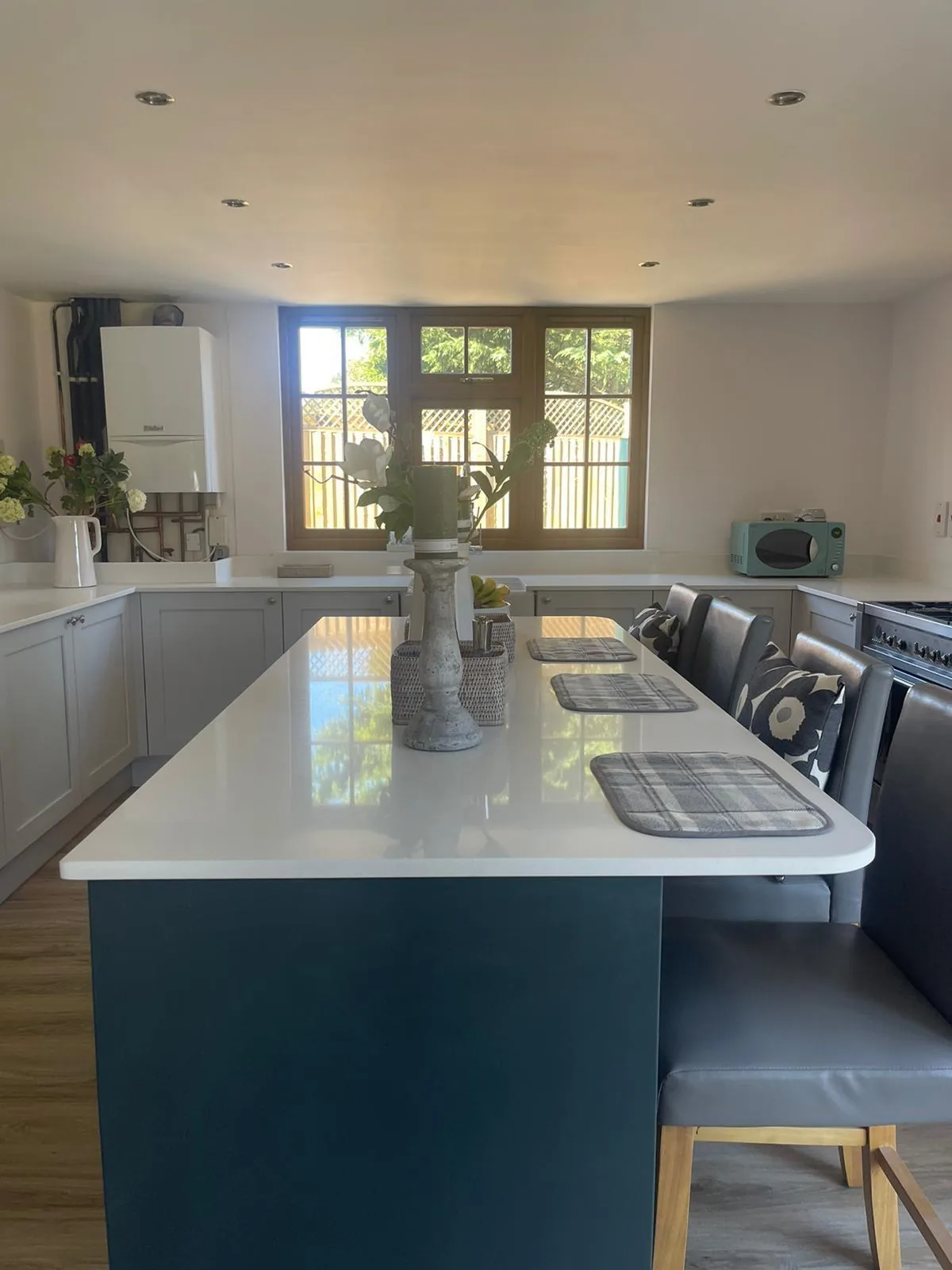
Greenwich · SE10
Worktops in Greenwich
The surface itself: which stone, what it costs by the square metre, and what the room does to that number.
- 5.0from 26 Google reviews
- 25-year material · 5-year workmanship
- Fitted 5-10 working days from template
Greenwich kitchens
The kitchens we meet in Greenwich
The single biggest variable in what stone worktop supply and fitting costs in Greenwich is not the material you pick but the room you are asking it to fit. Most of the town-centre stock is narrow three-storey Georgian and early Victorian terraces where the kitchen sits in the back addition or on the lower ground floor, so runs are short, 2.4m to 3m, and rarely straight. Where the side return has been opened the kitchen becomes an L with a small peninsula rather than a true island. You will get a firm figure for your Greenwich kitchen once it has been templated, and that figure does not move afterwards.
Nothing in a house of this age is square, and the kitchen is usually the part that has been altered most often. Water settles more than taste does: how much a body absorbs, and how quickly, decides whether sealing becomes part of your year. Colour gets chosen under kitchen lights, never under showroom ones.
The original scullery gully is still live in the yard outside the back door, and new waste from the sink joins a drain laid for a copper and a stone sink. Alcoves either side of the old breast chop the run into short lengths, and a kitchen made of short lengths is the case where buying a slab outright beats buying the square metres, because the remainder is paid for in both. Open-plan surfaces are furniture before they are work surfaces.
Around here the stock is Georgian terrace, early Victorian terrace, Edwardian mansion flat and 1980s riverside infill. They fail in different places, which is why the survey looks at different things.
True everywhere
Worktops, in short
- Supply is £110 to £550 per square metre across the 181 surfaces we fit.
- The material is guaranteed 25 years and the workmanship 5.
- Quartz runs £130 to £500 per square metre, granite £121 to £550 and Dekton £110 to £366.
- Templating is done in the room itself, once the units are fixed and level.
- Borough
- Greenwich
- Postcodes
- SE10
- Covered on
- our south east London run
- Fitted
- 5–10 working days from template
The place
Why Greenwich is its own job
There is nothing clever about a fit in Greenwich going smoothly, only a survey that asked the right things beforehand. The one-way system, the pedestrianised streets around the market and resident-permit-only bays mean a slab usually has to be walked in from wherever the van can legally stop, through a narrow Georgian front door and often down a tight winder stair to a lower-ground kitchen. Nothing here is square, template off the fitted units rather than the walls, and check the stair turn will take a 3m piece before quoting it as one. Both go on the drawing, and the drawing is what the workshop cuts to.
The work
What worktops involves
The material carries a twenty five year guarantee and the fitting workmanship five years, and both are handed over in writing with the paperwork for the slab. Run lengths, join positions and the direction of the veining are agreed at that visit, since where a join falls is a decision about the pattern as much as about the length. You get an itemised figure that shows what the slab cost, what the edges cost and what the openings cost, so the layout can be adjusted before anything is cut.
The order of decisions matters: body, then gauge, then finish, then edge, then the apertures, because each one narrows what the next is allowed to be. Where a surface will meet strong sun for hours a day, sintered stone holds its colour indefinitely and an engineered one is simply outside what it was designed for. Breasts and alcoves break the run into short lengths, which is the condition where buying the slab whole makes more sense than buying the metres. Chosen under your own bulbs, not under ours.
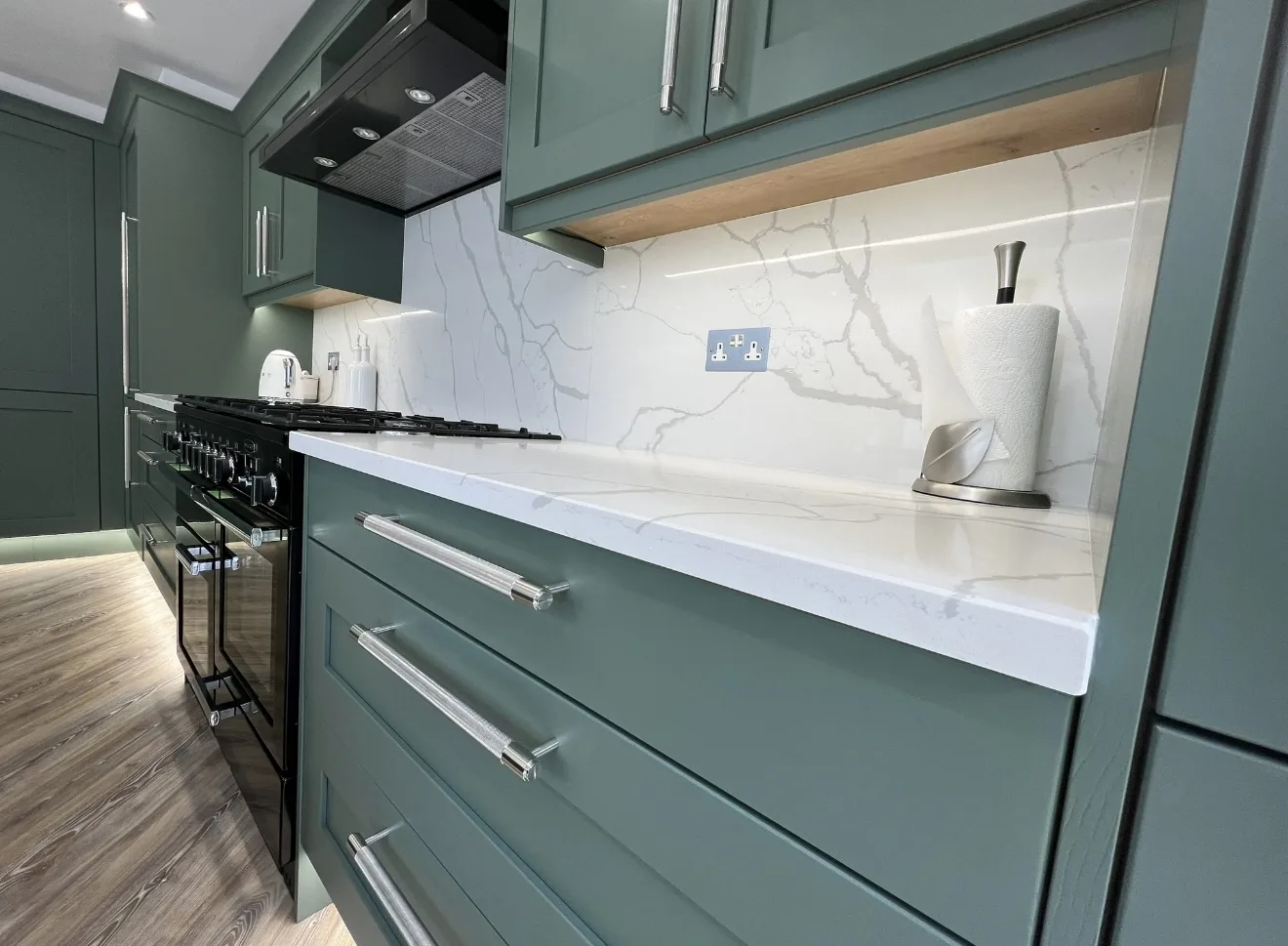
The money
What it costs in Greenwich
Two rooms of identical floor area can differ by more than double on the stone alone, and the reason is almost never the size of either of them. An L has a return, and a return rarely nests neatly on a slab, so the yield question arrives earlier than it does on a straight run. Material runs from £110 to £550 per square metre supply only, and the template, fabrication and fitting are quoted on their own lines. You see what the offcut costs before you agree to the layout.
Get it priced
period detached houses and villas
The carry, and what it rules out
The van is not staying on a main road for the day, so once the stone is off it goes and parks properly somewhere else. Where something genuinely has to be eased on site it is done wet and under extraction, since dry cutting quartz burns the resin in it and leaves a mark that will not polish out. The packaging and the spent cartridges leave with the crew.
period detached houses and villas
Greenwich in the housing figures
In this corner of the borough, much of what is standing is recent build. Extensions finished in spring fill the yards, so a reservation placed early holds a consignment that would otherwise be gone by templating. Depth of shade matters more in a poorly lit kitchen than any figure in the stone.
period detached houses and villas
What Greenwich asks for
Infrequent work for this area, though we do it whenever it is asked for. Worktop replacement and worktop fabrication are the commoner calls. Nothing about the method or the standard varies with frequency.
Access
Getting stone into a Greenwich kitchen
The one-way system, the pedestrianised streets around the market and resident-permit-only bays mean a slab usually has to be walked in from wherever the van can legally stop, through a narrow Georgian front door and often down a tight winder stair to a lower-ground kitchen.
Tell us what the approach looks like when you book the template and it gets built into the day rather than discovered on it. Where the route is genuinely tight, it changes how the pieces are cut, which is a fabrication decision rather than a delivery one.
5–10 working days
From template to fitted, working days from template. The same on this patch as every other.
south east London patch
Greenwich is covered on our south east London run.
We come to you
Templated in your kitchen, cut in our workshop, fitted by our own installers.
Access told straight
If the route forces an extra join, you hear that at quote stage, not on the day.
Questions
Questions we get asked in Greenwich
If yours is not here, ring and ask. You get a straight answer rather than a call-back from a salesperson.
Is Greenwich far enough out to be a problem for you?
Yes. Greenwich is on the patch, and the postcodes we work here are SE10. It is worked on our south east London run, along with the rest of the borough. A red route means no stopping, and no stopping means exactly that, so the stone comes in from a side street or from a bay behind the property. Whatever the standing allows, the stone leaves that van finished, because every edge, cut-out and internal radius is machined at the works and none of it is open to reconsideration at the kerb. Dry cutting quartz burns the resin and the burn does not polish out. The measuring and the fitting are both done at the property, so there is nothing to visit or collect.
Why would worktops in Greenwich be any different from anywhere else?
The rear door swings inward across the end of the run, so the last few hundred millimetres of worktop are only reachable with the door shut. The kitchen in one of these sits in the back addition and takes its daylight from one end, so the working half of the run is the darker half and a pale stone with a honed or matt face does more there than any colour with depth in it. True walls and standard carcasses give the best yield there is. A scribe has a working limit, and past twenty millimetres or so the back edge starts eating depth the run cannot spare. Every notch and every scribe is machined into the piece before it leaves the works, and a hard sintered surface is the least forgiving of a tight internal corner, so one is always cut with a generous radius. A tight inside corner is where brittle material gives up.
What is the carry like in Greenwich?
Counting hands matters more than counting metres on a staircase, because a piece two people lift off a van still wants three on the flight and a fourth watching the trailing corner. That caps the longest piece, and a run split into two lengths nests differently on the slab, which moves the yield and moves the figure with it. Speckle forgives a joint that a sweeping figure never would. Where the frontage is a clearway the unload happens away from the door and the carry gets longer, which is a crew and time question rather than a stone one. A granite kitchen ends its day with a sealer, and a sealer wants a dry face and a quiet hour afterwards, so that hour is written into the day rather than borrowed from it. A honed face marks on grit, so nothing is set down bare.
Does Greenwich actually ask for worktops?
Not really, and claiming otherwise would cost nothing and mean nothing. What the research on this patch actually lists is worktop replacement and worktop fabrication. It reflects the local housing rather than any difference in the work. It is quoted, cut and fitted here the same way it is anywhere else on the patch. Extension budgets are usually well spent by the time the worktop is ordered, which is where the choice between quartz and a thinner sintered stone actually gets made. Where several kitchens are ordered together the sensible move is to take them all off one batch, because two slabs of the same name bought six months apart will not sit happily in the same building. Movement across three metres is not visible on a hand sample. Rear and side-return extensions are where the islands appear, and an island is the piece that decides whether one slab does the kitchen or two. Volume work tends to live at the entry end of the range, and the entry end is genuine stone rather than a compromise, since the lowest supply figure we quote is a sintered surface and not a thin laminate pretending to be one. A repeated specification is worth deciding slowly, once.
Where does the money go on a Greenwich worktop?
Where the return runs into a wall that is out of square, the corner is templated as the angle it really is rather than as ninety degrees. A shape like that nests kindly on a slab, so more of what gets bought ends up on the units and the rate per square metre behaves much as the brochure says it will. Yield is a property of the room as much as of the slab. Supply-only material is £110 to £550 per square metre, and templating, fabrication and fitting are quoted separately rather than rolled in.
What needs to be ready before you come to Greenwich?
Walls that bow along their length are the normal condition rather than the exception, and a straight-cut back edge will show a shadow gap at one end and touch at the other. A hob dropped into the middle of a length puts sustained warmth at the lip of a cut-out, and an engineered surface will yellow there across ten years where a natural one takes it without comment. The wall decides the scribe and the scribe decides the depth. Send the run lengths, say where the sink and hob will sit, and tell us which way the room faces and what lighting is going in above the working run. Two flats with an identical layout can want entirely different things from the same run of worktop, which is why the quote follows the run rather than the address. That changes which questions are worth asking about the stone, because somebody staying put wants to know how a honed face marks in five years and somebody selling wants to know how it photographs next spring. A chip in natural stone can be filled and polished in place.
Is templating a separate visit from fitting?
Templating and fitting are two visits, not one, and the gap between them is when the stone is actually cut. The design and quotation visit comes first. It is free and carries no obligation. Nothing is measured until the sink, the tap and the hob are in the room to measure against. The kitchen normally sits in the back addition or a later side return, which puts the run against the oldest and least straight wall in the building. Which stone belongs on top of all that is a separate question from the building itself, and it is the one with a figure attached, because supply alone runs from £110 to £550 per square metre before a single cut has been made. Stone is bought whole and paid for whole, offcut and all.
Why would a Greenwich kitchen need a join at all?
There are only ever a few legal positions, and the one taken is furthest from the light. Each join is an item on the drawing, so the layout and the figure move together. Veining carries through a join where both pieces come off the same slab, which is decided at nesting. A mitred corner is cut and dressed as a matched pair, and if either leg shifts by a millimetre on site the joint opens along its whole length rather than at one end. An island is the piece that decides whether one slab covers the kitchen or two, and a second slab arrives as a step in the figure rather than a gentle slope. Two mitres and three lengths is bench work, not surface area.
What happens when the route into a Greenwich kitchen is tighter than the worktop?
The alternative to a join is a shorter run, which is usually the wrong thing to trade away. Splitting a run costs a join, and that is the price of getting stone into the room at all. A piece travels on edge, never flat, because on edge is how stone of that length carries its own weight. Suction lifters earn their keep on a straight flight and become a liability on a winder, where a handle standing out from the face is one more thing to catch on a wall. Where a seam becomes unavoidable the choice of stone starts to matter, because a fine even speckle closes a joint almost invisibly and a broad vein simply will not. No colour and no edge is adjustable once a piece is machined.
What maintenance does a worktop need in a Greenwich kitchen?
Day to day all three want soap and water; abrasive creams and scouring pads are what dull a polished surface. Marble is the one people underestimate. It is porous, like granite, and wants sealing. The bead where the sink and hob meet the stone is siliconed rather than sealed, and wants watching. Sash windows in the addition sit low and the sill can land under standard worktop height, so the top is notched round it or the run stops short of it. Rooms in these houses run long and narrow with the only honest daylight at the garden end, so a pale honed surface does more for the working half of the kitchen than any colour with depth in it. A kitchen with no window of its own needs tone rather than colour.
Reviews
5.0 from 26 Google reviews
Every one of these is on our Google profile under the reviewer’s own name. Nothing here is written by us, and the link goes straight to the source.
Excellent work and highly recommend. Very professional and did an outstanding job with my worktop. Karem responded very quickly and swiftly, top guy!
Faisal K
Google review
Perfect service,the best on this job
Kleant Istrefi
Google review
I recently had my kitchen worktop and splashback done by Karem from Worktop WorX and i am very pleased with the result. From the initial consultation and measurements to the final installation, the whole process was smooth and professional. The attention for details and the quality made the difference and everything was finished to a high standard. I definitely recommend Worktop WorX to anyone looking for reliable and high quality kitchen work
Alexandru Balint
Google review
Related
More around Greenwich
Other work we do in Greenwich
Next step
Worktops in Greenwich, priced properly
Plans, a sketch or photographs with rough run lengths is enough to start. You get an itemised written quote and the template dates we can offer on this patch.
25-year material warranty and a 5-year workmanship guarantee, both stated on your quote.