
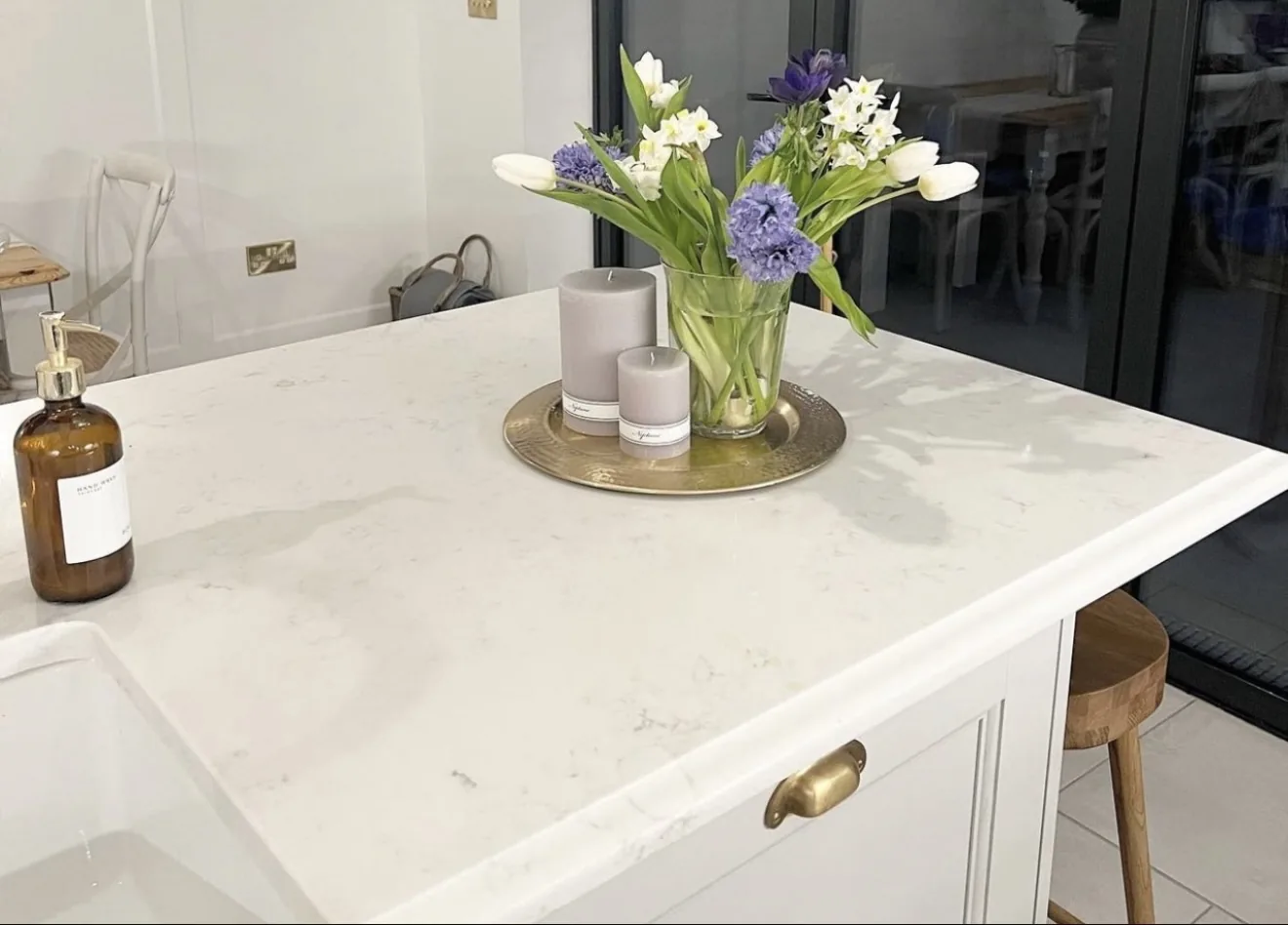
Harrow · HA1 HA2
Worktops in West Harrow
The surface itself: which stone, what it costs by the square metre, and what the room does to that number.
- 5.0from 26 Google reviews
- 25-year material · 5-year workmanship
- Fitted 5-10 working days from template
West Harrow kitchens
The kitchens we meet in West Harrow
In West Harrow, what the local housing does to stone worktop supply and fitting is worth knowing before you commit to anything. Edwardian and early interwar terraces with a rear kitchen in the back addition, and gardens deep enough that a modest single-storey extension is common but a full-width one is not. Finished kitchens run about 3.5m along one wall with a short peninsula, and the utility usually ends up under the stairs or in a lean-to. Nothing above needs settling before you get in touch. It gets settled with a tape measure, in your kitchen, in West Harrow.
A side passage and a back door mean the stone rarely has to come through the house, which changes the job more than most people expect. Quartz, granite and sintered stone each let you down in a different way, and choosing well is mostly a matter of knowing which of those three failures this room will provoke. Edges are charged along their length, not across the surface.
The stack serving the bathroom above comes down the rear elevation in cast iron, and its branch settles where a sink waste can reasonably be picked up. Runs here are usually long enough to want a full slab and short enough not to need a second, which is the most economical position on the whole price list. A kitchen with no window of its own needs tone rather than colour.
The fabric of the place is Edwardian terrace, 1920s semi and small 1960s block. Two of those can sit on the same street and quote a long way apart.
True everywhere
Worktops, in short
- Supply is £110 to £550 per square metre across the 181 surfaces we fit.
- That figure is the slab. Fabrication, edges, cut-outs and fitting are quoted separately.
- Four free quartz samples are posted out, because photographs of stone lie.
- The material is guaranteed 25 years and the workmanship 5.
- Borough
- Harrow
- Postcodes
- HA1, HA2
- Covered on
- our north west London run
- Fitted
- 5–10 working days from template
The place
Why West Harrow is its own job
Every area has its own complications, and in West Harrow these are the ones that decide the day. Terraced streets with a few dropped kerbs and mostly free but crowded parking, and side alleys of around 750mm shared with the neighbour, which usually works for a slab on edge if the gate is removable. The shared side alley is the deciding factor on these terraces, so confirm the gate width and whether the neighbour's fence can be dropped before promising a single-piece top. None of that is a surprise if somebody has actually looked. That is what the survey is for.
The work
What worktops involves
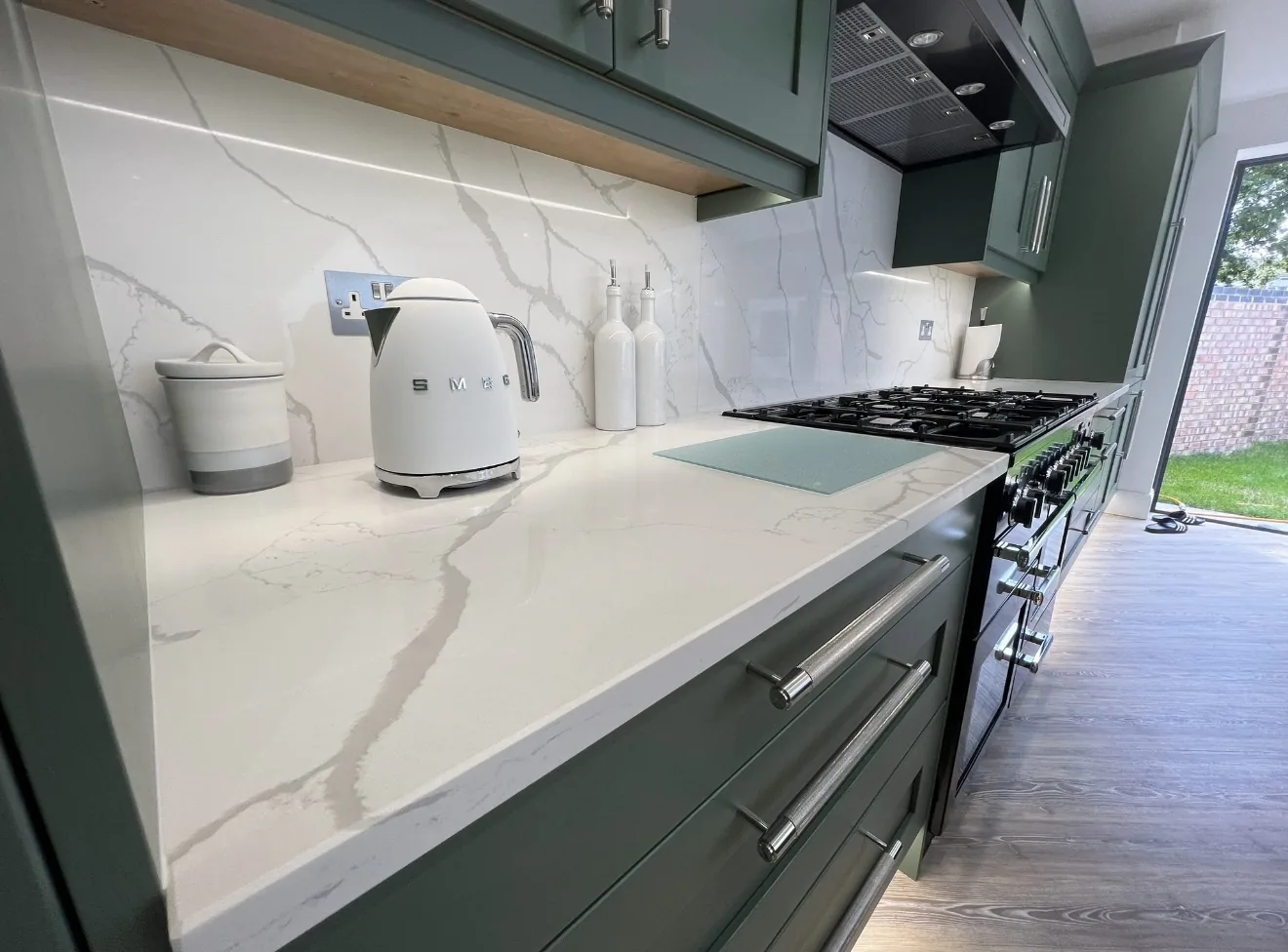
Worktop supply and fitting covers the stone itself, machined to your room: the surface, the polished edges, the openings for sink, hob and tap, and the fitting of the finished pieces. Run lengths, join positions and the direction of the veining are agreed at that visit, since where a join falls is a decision about the pattern as much as about the length. You get an itemised figure that shows what the slab cost, what the edges cost and what the openings cost, so the layout can be adjusted before anything is cut.
Photographs of stone lie, and they lie hardest about how a colour behaves under a domestic bulb, which is why four quartz samples go in the post free of charge. A mitred edge lets a thin slab present a thick front face, and the mitre is glued, clamped and polished on the bench where the join can be made to disappear. A run of this length usually fits one slab, and staying inside one slab is the cheapest decision available on any kitchen. Machined to the millimetre and guaranteed by the decade, not the year.
The money
What it costs in West Harrow
A worktop is priced from the cut list rather than the floor area, because the slab is bought whole and the run lengths decide how much of it ends up on your units. Two facing runs mean two sets of edges and two scribes in a small span, which is why a compact galley rarely prices as cheaply as its area suggests. The stone is quoted at £110 to £550 per square metre supply only, and the labour is kept out of it deliberately, because a blended rate hides the lines you would otherwise question. You see what the offcut costs before you agree to the layout.
Get it priced
Victorian and Edwardian terraces
The carry, and what it rules out
Rear access usually lets us fit longer pieces whole, so the join count ends up decided by the slab rather than by the building. Where the break count climbs, the cost follows it, because every additional seam is two more finished edges, a colour matched resin and another hour of bench time. The pieces either side of a break come off adjoining slab.
Victorian and Edwardian terraces
What West Harrow asks for
It would be overstating it to call this a speciality on this patch. Worktop replacement and worktop installation are far commoner. None of that changes the survey, the cut list or the fit.
Victorian and Edwardian terraces
West Harrow in the housing figures
In West Harrow, almost nothing has gone up in the last fifteen years, which makes the carcass check the first question rather than the last. Households that cook hard every day push the shortlist towards heat tolerance and away from anything that scorches. The honest saving lives in the colour, not in the thickness.
Access
Getting stone into a West Harrow kitchen
Terraced streets with a few dropped kerbs and mostly free but crowded parking, and side alleys of around 750mm shared with the neighbour, which usually works for a slab on edge if the gate is removable.
Tell us what the approach looks like when you book the template and it gets built into the day rather than discovered on it. Where the route is genuinely tight, it changes how the pieces are cut, which is a fabrication decision rather than a delivery one.
5–10 working days
From template to fitted, working days from template. The same on this patch as every other.
north west London patch
West Harrow is covered on our north west London run, along with the rest of Harrow.
We come to you
Templated in your kitchen, cut in our workshop, fitted by our own installers.
Access told straight
If the route forces an extra join, you hear that at quote stage, not on the day.
Questions
Questions we get asked in West Harrow
If yours is not here, ring and ask. You get a straight answer rather than a call-back from a salesperson.
Do you cover West Harrow?
Yes. West Harrow is on the patch, and the postcodes we work here are HA1, HA2. It is worked on our north west London run, along with the rest of Harrow. With no scheme to work with there is nothing to book and nobody to ring, so the only levers left are an early arrival and a word with the neighbours. Whatever the standing allows, the stone leaves that van finished, because every edge, cut-out and internal radius is machined at the works and none of it is open to reconsideration at the kerb. Wet stone reads darker, which is why colour is judged indoors. Your part of it happens entirely at home, with nothing to travel to and nothing to bring back.
What do the kitchens in West Harrow do to worktops?
The pantry was a half-brick enclosure in the corner of the room, and where it has been taken out the wall behind it is made good brickwork rather than original plaster. These kitchens are usually knocked through to the dining room, so the surface is read from two sides at once and the figure has to carry across the pieces rather than restart at every join. A galley nests efficiently and frees money for better stone. Two walls each a degree out give an internal corner two degrees out, and the whole of that error lands in the mitre. Every notch and every scribe is machined into the piece before it leaves the works, and a hard sintered surface is the least forgiving of a tight internal corner, so one is always cut with a generous radius. Every notch is machined on the bench and none on site.
Do you have trouble getting long pieces into West Harrow kitchens?
Garden routes carry their own hazards: a drain cover, a step up to a patio, wet decking, or a lawn that will not take a loaded trolley. That caps the longest piece, and a run split into two lengths nests differently on the slab, which moves the yield and moves the figure with it. Weight per square metre belongs to the material, not to the length. Unrestricted kerbside is straightforward as long as the space in front of the property is actually clear when the van arrives. A granite kitchen ends its day with a sealer, and a sealer wants a dry face and a quiet hour afterwards, so that hour is written into the day rather than borrowed from it. Nothing is ever colour matched outdoors under a grey sky.
Is worktops what West Harrow is known for?
No, not particularly, and it would be easy to say otherwise. What the research on this patch actually lists is worktop replacement and worktop installation. That is the local housing talking rather than anything about the job. It is priced, cut and fitted no differently here than anywhere else we cover. A new extension slab is not automatically level, and that wants checking before templating rather than after the stone is cut. Where several kitchens are ordered together the sensible move is to take them all off one batch, because two slabs of the same name bought six months apart will not sit happily in the same building. The island is usually what turns one slab into two. The junction between the original room and the extension is the point to watch, because the two floors rarely sit at the same height. Volume work tends to live at the entry end of the range, and the entry end is genuine stone rather than a compromise, since the lowest supply figure we quote is a sintered surface and not a thin laminate pretending to be one. Where tenants change often, a surface with nothing to seal wins.
What decides the price of a worktop in West Harrow?
Walls at both ends mean two scribes on every piece, and a run that has to drop between two fixed points has no tolerance left to give away. A shape like that nests kindly on a slab, so more of what gets bought ends up on the units and the rate per square metre behaves much as the brochure says it will. Cut-outs take material out of the piece that carries the sink. The stone is £110 to £550 per square metre supply only, and templating, fabrication and fitting are quoted separately.
What do I need to sort out first?
A scribe has a working limit, and past twenty millimetres or so the back edge starts eating depth the run cannot spare. A hob dropped into the middle of a length puts sustained warmth at the lip of a cut-out, and an engineered surface will yellow there across ten years where a natural one takes it without comment. Water standing daily is what makes porosity matter. Confirm the depth of the units, the total run lengths and whether an island or peninsula is going in, and tell us the colour temperature of the lighting. An owner paying for this directly tends to want the reasoning as much as the number, so a quote that explains why a join sits where it does is worth more than a cheaper one that does not. That changes which questions are worth asking about the stone, because somebody staying put wants to know how a honed face marks in five years and somebody selling wants to know how it photographs next spring. A surface chosen for a photograph rarely survives the cooking.
Will you fit stone onto units that are not level?
The check comes before the measuring rather than after, because the whole drawing is set out from that plane. A sloping floor is not the problem. The plane the unit tops finish in is. Where a run meets an appliance, level decides whether that appliance door still clears the stone above it. Walls that bow along their length are the normal condition rather than the exception, and a straight-cut back edge will show a shadow gap at one end and touch at the other. A run that sits under strong sun for hours every afternoon suits a surface built to be stable in daylight, because a resin-bound stone is made for indoor use and sustained sunlight is the one thing it was never designed around. Brittle stone and narrow returns are a poor pairing.
Which materials need sealing and which do not?
Upkeep is settled when the slab is chosen, since it belongs to the material rather than the fabrication. Bleach and limescale remover harm a polished finish rather than clean it, whichever material is on the units. Topping a seal up is a wipe-on job with a cloth. The scullery floor was quarry tile bedded on concrete and it is often still under a laminate, sitting lower than the boards in the room it now joins. Side light from the garden is what lets a stone with movement in it actually be seen, which is why a busier granite or a veined quartz earns its keep here and a flat single colour rarely does. Plain stone takes the seam that a long carry forces.
How do you cut out for an undermounted sink?
We seat and seal the sink and hob on the day; water, waste, gas and electrics are for your plumber and electrician. Each cut-out is priced on its own line, so a range, a bowl and a half, a boiling tap and a drainer are four items rather than one. Undermount bowls are cut and polished in the workshop and dry-fitted to the stone on the bench before anything is loaded. An aisle under a metre stops being a working space the moment two people are in it, and the depth of the tops either side is what decides whether that happens. An island is the piece that decides whether one slab covers the kitchen or two, and a second slab arrives as a step in the figure rather than a gentle slope. Extra depth sounds free and frequently buys another slab.
What if something breaks during the fit?
The rest of the kitchen still goes in. One damaged piece does not hold up the pieces either side. Every piece is dry-assembled on the bench before it is loaded, so a fabrication mistake is found in the workshop rather than in your kitchen. Chips at an edge or a corner are the usual form, because that is where stone is least supported. A side gate hung to open outward against a fence post is narrower in use than it measures, and lifting the gate off its hinges is usually the quickest win on the route. Where a seam becomes unavoidable the choice of stone starts to matter, because a fine even speckle closes a joint almost invisibly and a broad vein simply will not. A hard route shortens the list to lighter, thinner surfaces.
Reviews
5.0 from 26 Google reviews
Every one of these is on our Google profile under the reviewer’s own name. Nothing here is written by us, and the link goes straight to the source.
Karem did an excellent job on my kitchen. He was professional, reliable, and paid great attention to detail. The finish looks amazing and has completely transformed my kitchen. Thank you! Would highly recommend his work!
Catalina Radu
Google review
Excellent work and highly recommend. Very professional and did an outstanding job with my worktop. Karem responded very quickly and swiftly, top guy!
Faisal K
Google review
Perfect service,the best on this job
Kleant Istrefi
Google review
Related
More around West Harrow
Other work we do in West Harrow
Next step
Worktops in West Harrow, priced properly
Plans, a sketch or photographs with rough run lengths is enough to start. You get an itemised written quote and the template dates we can offer on this patch.
25-year material warranty and a 5-year workmanship guarantee, both stated on your quote.