
Wandsworth · SW11
Worktops in Between the Commons
The surface itself: which stone, what it costs by the square metre, and what the room does to that number.
- 5.0from 26 Google reviews
- 25-year material · 5-year workmanship
- Fitted 5-10 working days from template
Between the Commons kitchens
The kitchens we meet in Between the Commons
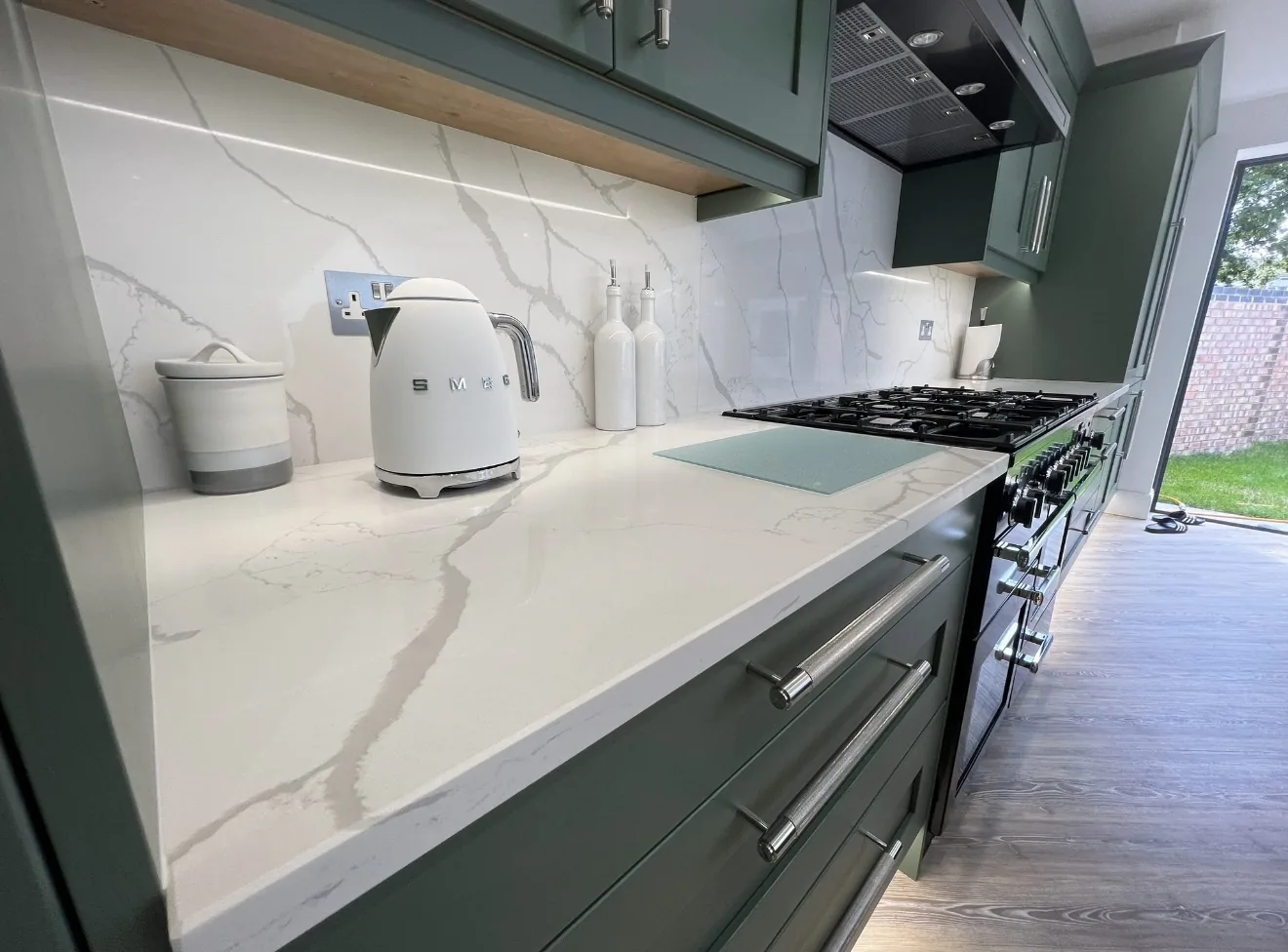
We turn down very few worktop jobs in Between the Commons, but we do insist on seeing the kitchen first, and the reason for that is in the rooms themselves. This is the densest concentration of side-return and full-width rear extensions in the borough, the alley is infilled, the rear wall is pushed back, and the result is a 4m to 5m wide kitchen with a long run plus a 2.4m to 3m island under a flat rooflight. Islands almost always carry a hob and a mitred end panel. A worktop that fits is a worktop that was measured. The description is background, the template is the actual instruction.
Party wall settlement pulls the floor down at one side of the room, so a long run reads level at one end and not at the other. Edge profile is the last few millimetres anybody ever touches, and it is charged along the length rather than across the area, which is why it lands as a surprise. A finish is a decision about cleaning as much as about looks.
The addition is a brick narrower than the house it hangs off, which leaves a stub of the original rear wall standing square to the run at the doorway end. The alcoves either side of a breast break the run into short pieces, and short pieces are exactly where buying a full slab outright starts to beat buying stone by the metre. Honed hides the dust an older house makes all year.
The mix here is Late Victorian terrace and Edwardian terrace. Two of those can sit on the same street and quote a long way apart.
True everywhere
Worktops, in short
- Supply is £110 to £550 per square metre across the 181 surfaces we fit.
- Dekton and sintered stone hold their colour under heat and direct sunlight.
- That figure is the slab. Fabrication, edges, cut-outs and fitting are quoted separately.
- Four free quartz samples are posted out, because photographs of stone lie.
- Borough
- Wandsworth
- Postcodes
- SW11
- Covered on
- our south west London run
- Fitted
- 5–10 working days from template
The place
Why Between the Commons is its own job
We would rather tell you what a fit in Between the Commons is going to involve now than discover it with a slab in the hallway. Uniform terraces with small front gardens, permit-only parking that is full by 9am, and no vehicle access to the rear at all. Everything goes down the hallway past the stairs, and the hall width of roughly 950mm sets the maximum slab width that can be turned. The island is the whole job here, get the exact spine position and the overhang for stools agreed on site before templating, because clients change their mind about seating after the units land. It is our problem to solve, and solving it starts with a tape measure.
The work
What worktops involves
Up to four quartz samples are posted out free so a colour can be lived with under your own lighting before a slab is reserved in your name. A natural stone is sealed before the kitchen is handed back, and you are told plainly which products will dull the finish and which will not touch it. You get an itemised figure that shows what the slab cost, what the edges cost and what the openings cost, so the layout can be adjusted before anything is cut.
The surface is machined to a template of the actual room and fitted five to ten working days afterwards, so specification closes before the workshop starts cutting. Veining is a batch property, not a catalogue property, and two slabs bearing one name can differ more than two names taken from the same quarry. In a house of this age the kitchen stretches away from its only window, so the shortlist closes around a pale honed face before anybody names a colour. The slab is quoted; the cut list is what you pay.
The money
What it costs in Between the Commons
The remainder of a slab is part of the price whether it is fitted or left behind, and that is the honest reason short awkward lengths cost what they do. Overhangs, a waterfall end and seating all add machining, and an island is where those decisions cluster. That £110 to £550 per square metre buys the slab and nothing else. Templating, machining, edges, cut-outs and the fitting day are counted and charged one by one. The slab, then the machining, then the fitting, each on its own line.
Get it priced
Victorian and Edwardian terraces
The shape of the run
Sockets set into the end panel keep the top clear, but they sit below the stone and are cut into the panel by the fitter rather than machined into the worktop. A shape like that nests kindly on a slab, so more of what gets bought ends up on the units and the rate per square metre behaves much as the brochure says it will. A single straight run is the cheapest stone you will ever buy.
Victorian and Edwardian terraces
What Between the Commons asks for
This is not the commonest thing we do here. Worktop installation come up more. It is a fact about the local building stock, not about the standard or the price of the work.
Victorian and Edwardian terraces
The carry, and what it rules out
A hall radiator or a coat hook at shoulder height takes a hundred millimetres off the usable width, and a hundred millimetres is often the entire margin. A jumbo format is the one thing a tight approach rules out absolutely, and ruling it out means accepting a joint in a run that could have been whole. Speckle forgives a joint that a sweeping figure never would.
Access
Getting stone into a Between the Commons kitchen
Uniform terraces with small front gardens, permit-only parking that is full by 9am, and no vehicle access to the rear at all. Everything goes down the hallway past the stairs, and the hall width of roughly 950mm sets the maximum slab width that can be turned.
Tell us what the approach looks like when you book the template and it gets built into the day rather than discovered on it. Where the route is genuinely tight, it changes how the pieces are cut, which is a fabrication decision rather than a delivery one.
5–10 working days
From template to fitted, working days from template. The same on this patch as every other.
south west London patch
Between the Commons is covered on our south west London run, along with the rest of Wandsworth.
We come to you
Templated in your kitchen, cut in our workshop, fitted by our own installers.
Access told straight
If the route forces an extra join, you hear that at quote stage, not on the day.
Questions
Questions we get asked in Between the Commons
If yours is not here, ring and ask. You get a straight answer rather than a call-back from a salesperson.
Do your own fitters come out to Between the Commons?
Yes. Between the Commons is on the patch, and the postcodes we work here are SW11. It is worked on our south west London run, along with the rest of Wandsworth. Where a marked loading box sits on the red route the stop is legal but timed, so the unload runs as one movement with every hand on it. Whatever the standing allows, the stone leaves that van finished, because every edge, cut-out and internal radius is machined at the works and none of it is open to reconsideration at the kerb. Pieces are unloaded in laying order so the figure runs true. Your part of it happens entirely at home, with nothing to travel to and nothing to bring back.
What do the kitchens in Between the Commons do to worktops?
The lean-to roof drains into a valley gutter against the addition next door, and a long leak there shows at the head of the kitchen wall rather than on the ceiling. The kitchen in one of these sits in the back addition and takes its daylight from one end, so the working half of the run is the darker half and a pale stone with a honed or matt face does more there than any colour with depth in it. Seen from both sides, the figure has to run continuously. Where a run finishes into a reveal, the depth of that reveal is taken at worktop height and nowhere else. Every notch and every scribe is machined into the piece before it leaves the works, and a hard sintered surface is the least forgiving of a tight internal corner, so one is always cut with a generous radius. Every notch is machined on the bench and none on site.
Do you have trouble getting long pieces into Between the Commons kitchens?
Where the hall runs straight through to the back the piece can be walked in flat, and it is only the two door frames that have to be cleared. That caps the longest piece, and a run split into two lengths nests differently on the slab, which moves the yield and moves the figure with it. No colour and no edge is adjustable once a piece is machined. A bus lane along the frontage brings its own hours with it, and stopping in one is enforced the same way the red route is. A granite kitchen ends its day with a sealer, and a sealer wants a dry face and a quiet hour afterwards, so that hour is written into the day rather than borrowed from it. A reserved slab is a slab nobody else is allowed to buy.
Do you get much worktops work in Between the Commons?
No, not particularly, and it would be easy to say otherwise. What the research on this patch actually lists is worktop installation. That is the local housing talking rather than anything about the job. It is priced, cut and fitted no differently here than anywhere else we cover. Extension work runs late far more often than it runs early, and the worktop is close to the last thing in, so the date agreed at the start is rarely the date that happens. Volume work tends to live at the entry end of the range, and the entry end is genuine stone rather than a compromise, since the lowest supply figure we quote is a sintered surface and not a thin laminate pretending to be one. The island is usually what turns one slab into two. Where a family has been living around a building site for months, the finish date carries more weight than any other part of the specification. Adding an island is what moves most of these projects from one slab to two, and that jump is the single largest step in any worktop quotation. Where tenants change often, a surface with nothing to seal wins.
What decides the price of a worktop in Between the Commons?
A pop-up socket in the surface is one more cut-out through the full thickness, and it wants the same clear space beneath it that a sink does. An island is the piece that decides whether one slab covers the kitchen or two, and a second slab arrives as a step in the figure rather than a gentle slope. Nesting is where the quiet savings on a kitchen live. The material band is £110 to £550 per square metre supply only, and templating, fabrication and fitting are quoted on their own lines.
What do I need to sort out first?
Sill height gets settled with the template on site, because it is one of the few dimensions nobody has measured before we arrive. A hob dropped into the middle of a length puts sustained warmth at the lip of a cut-out, and an engineered surface will yellow there across ten years where a natural one takes it without comment. Water standing daily is what makes porosity matter. Send the run lengths, say where the sink and hob will sit, and tell us which way the room faces and what lighting is going in above the working run. Some doors in a building need a consent letter and some need nothing at all, so the first question is which arrangement applies here rather than which one is usual. Where nobody will be around to maintain it, the surface is chosen for indifference: an engineered top asks for nothing beyond a cloth, while a natural one wants sealing and someone willing to do it. Staying put and selling on ask different questions of a stone.
Can you get a full-length top into an upstairs kitchen in Between the Commons?
A piece travels on edge, never flat, because on edge is how stone of that length carries its own weight. The alternative to a join is a shorter run, which is usually the wrong thing to trade away. Every piece goes in by hand and stone does not bend, so the tightest turn on the route sets the longest piece. Turning a heavy piece on edge indoors needs floor space at both ends of the turn, so the hall is cleared of furniture before anything comes off the van. Where a seam becomes unavoidable the choice of stone starts to matter, because a fine even speckle closes a joint almost invisibly and a broad vein simply will not. Yield drops the moment the building dictates awkward lengths.
Is removal and disposal included on a Between the Commons job?
Taking the old tops off and disposing of them is its own line on the quote rather than something folded into the stone price. Disposal means it goes in the van, not into the garden to wait for a collection. An old stone top is heavier coming out than the new one is going in, and leaves in sections. The van is not staying on a main road for the day, so once the stone is off it goes and parks properly somewhere else. The unused stone rides back unless you want it, and a granite remnant makes a chopping board, a hearth or a window board instead of becoming waste. Cutting is done wet and extracted, never dry on a pavement.
Which materials need sealing and which do not?
Quartz carries resin, so a hot pan wants a trivet, while granite and sintered stone will take one without complaint. Where a top takes wine, oil and lemon most days, the non-porous materials ask least of the household. Day to day all three want soap and water; abrasive creams and scouring pads are what dull a polished surface. The bathroom upstairs sits directly over the kitchen, so its waste comes down in a boxed corner from floor to ceiling that no worktop is going to move. Alcoves either side of the old breast chop the run into short lengths, and a kitchen made of short lengths is the case where buying a slab outright beats buying the square metres, because the remainder is paid for in both. Side light flatters movement and wastes a flat colour.
What if something breaks during the fit?
Most breakages happen on the carry, which is why the route is walked and measured before anything comes off the van. Door frames and the stair route are protected too, since most contact happens on the way in. A dropped pan years later is a different question, and stone is remade rather than filled either way. Two people will walk a two-metre piece in through a front door; the same hall with a three-metre piece wants four, purely because nobody can let go halfway. Sintered stone at twelve millimetres weighs roughly half what thirty millimetre granite weighs, so a punishing route can genuinely rule one material in and another out. Where a break is unavoidable it goes into the quietest part of the pattern.
Reviews
5.0 from 26 Google reviews
Every one of these is on our Google profile under the reviewer’s own name. Nothing here is written by us, and the link goes straight to the source.
Really impressed with the quality and finish of these worktops. Great range of materials, precise fabrication, and smooth communication throughout. The whole process was easy and the final result looks fantastic. Highly recommend!
Nastasia Drago
Google review
We installed new kitchen and got the worktop and splash back from them. Their professional work and commitment was wonderful. Quality of work compared to price was way too good. Thank you guys.
MD Matinur Rahman
Google review
I am really happy with my worktop. It is beautiful and the service provided was second to none. I totally recommend.
Magaly R
Google review
Related
More around Between the Commons
Other work we do in Between the Commons
- Bathroom worktops in Between the Commons
- Bar tops in Between the Commons
- Restaurant table tops in Between the Commons
- Reception counters in Between the Commons
- Worktop replacement in Between the Commons
- Worktop installation in Between the Commons
- Worktop splashbacks & upstands in Between the Commons
- Worktop fabrication in Between the Commons
Next step
Worktops in Between the Commons, priced properly
Plans, a sketch or photographs with rough run lengths is enough to start. You get an itemised written quote and the template dates we can offer on this patch.
25-year material warranty and a 5-year workmanship guarantee, both stated on your quote.