
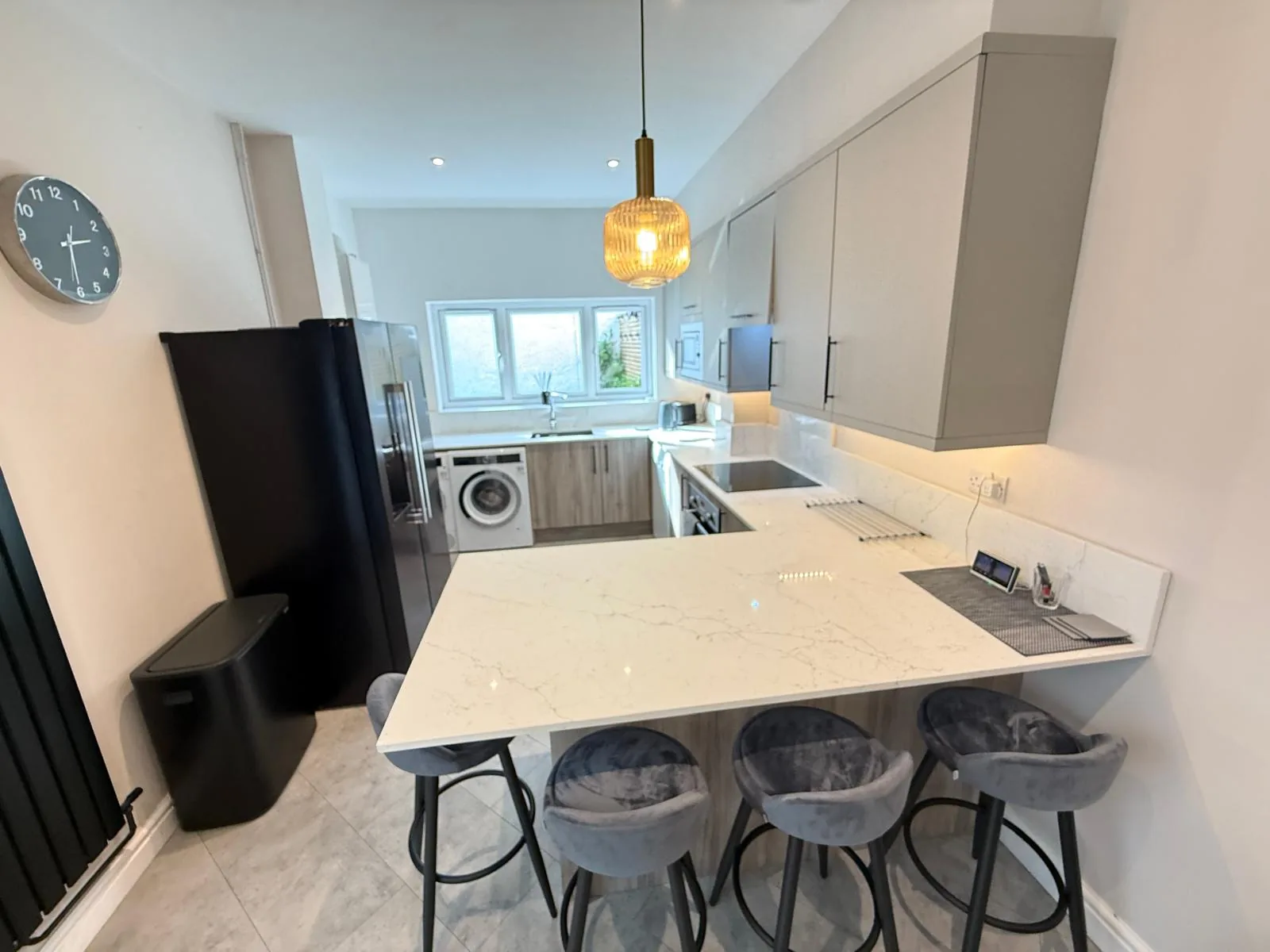
Camden · NW1 NW3
Worktops in Chalk Farm
The surface itself: which stone, what it costs by the square metre, and what the room does to that number.
- 5.0from 26 Google reviews
- 25-year material · 5-year workmanship
- Fitted 5-10 working days from template
Chalk Farm kitchens
The kitchens we meet in Chalk Farm
Before you settle on a material, it is worth understanding how stone worktop supply and fitting in Chalk Farm is shaped by the room it has to go into. Smaller Victorian terraces and mews cottages, so kitchens are compact and often on the ground floor of a two-storey mews with the living space above, which means 2.5-3m of run, sink under a rear window and no island. A handful of former industrial buildings near the railway have been converted and those get the only long open-plan runs in the area. Send through a photograph or two and the rough run length. We will tell you what you are probably dealing with.
A steel goes in where the original back wall came out, and the ceiling steps down under it at the point the run passes beneath. A colour name is a label attached to a consignment rather than a property of the rock, which is why the reference number on the paperwork outlives the name printed beside it. What the room does to the number is most of the number.
Mews are cobbled and tight, so a long-wheelbase van may not get down at all and the carry starts at the entrance to the mews. Daylight arrives from more than one direction, which means a colour can be judged fairly here and a stone with real movement holds up instead of disappearing. Save on the colour before you save on the thickness.
On these streets the housing is Victorian terrace, mews cottage, ex-local-authority block and warehouse conversion. The wall build-up is different in each, and the scribe follows the wall.
True everywhere
Worktops, in short
- Supply is £110 to £550 per square metre across the 181 surfaces we fit.
- Dekton and sintered stone hold their colour under heat and direct sunlight.
- That figure is the slab. Fabrication, edges, cut-outs and fitting are quoted separately.
- Four free quartz samples are posted out, because photographs of stone lie.
- Borough
- Camden
- Postcodes
- NW1, NW3
- Covered on
- our central and north London run
- Fitted
- 5–10 working days from template
The place
Why Chalk Farm is its own job
If a firm has never fitted in Chalk Farm, the things that decide the day will only turn up once the van is parked. Streets around the railway bridges are narrow with sharp corners and the CPZ leaves almost no loading space, while Chalk Farm Road itself is bus lanes and market overspill. Mews cottages have a single narrow door straight off the cobbles and an immediate turn into the kitchen. In a mews cottage the door width and the 90-degree turn just beyond it decide every piece size, so walk the swept path with a board before committing to a one-piece top. We would rather lose the job at the quote than lose your morning on the day of the fit.
The work
What worktops involves
Up to four quartz samples are posted out free so a colour can be lived with under your own lighting before a slab is reserved in your name. The pieces are cut and polished at the works with radiused internal corners at every opening, so nothing is machined into a finished surface inside your house. You are left with a worktop machined to the room as found, so the back edge follows the wall instead of leaving a shadow gap at one end of the run.
Stone expands and contracts slightly with warmth, and the gapped joints, the free upstands and the silicone behind a splash return all exist to let it. Veining is a batch property, not a catalogue property, and two slabs bearing one name can differ more than two names taken from the same quarry. A kitchen this size runs to two slabs, and the second slab changes the question from what it costs to which one you want. Chosen under your own bulbs, not under ours.
The money
What it costs in Chalk Farm
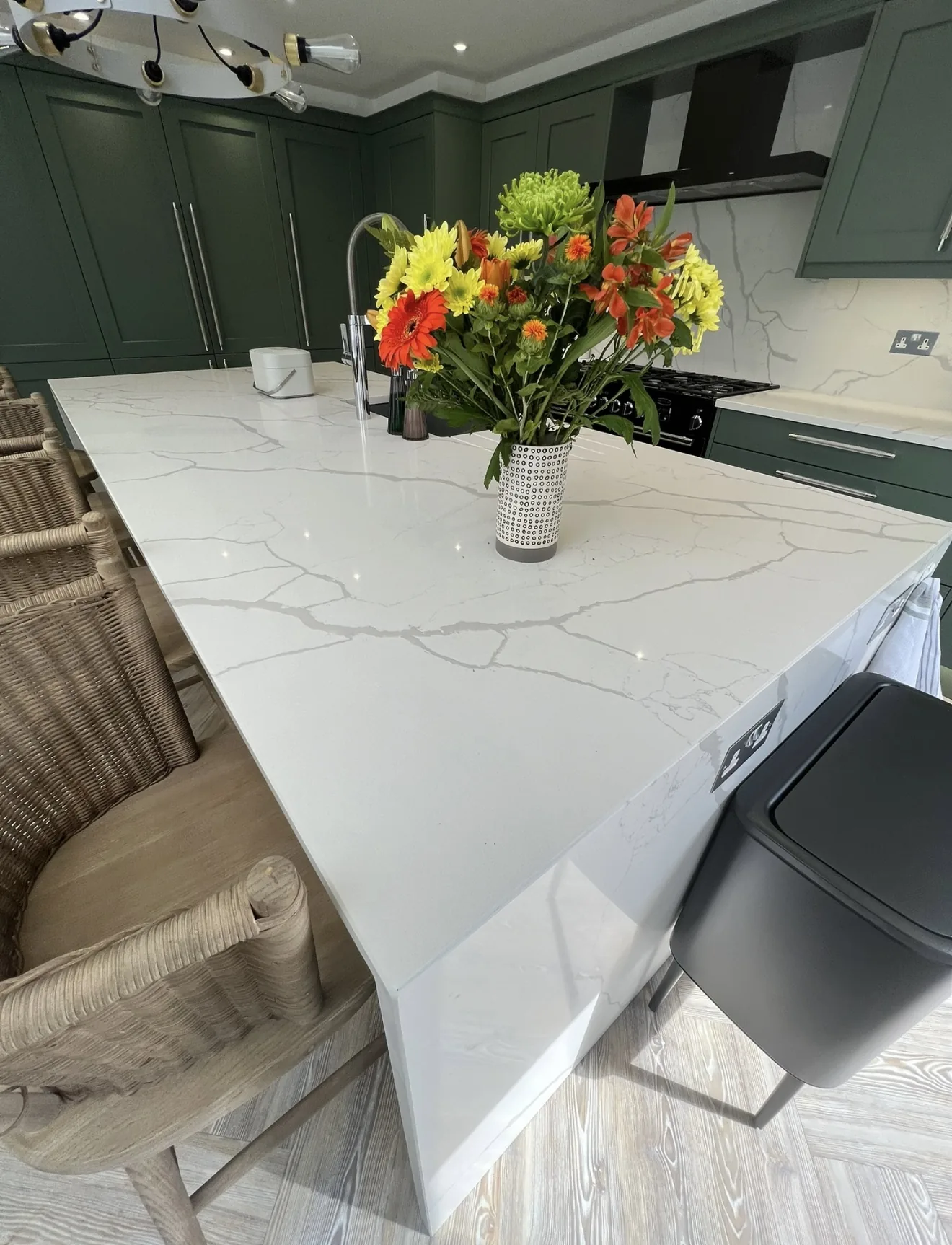
Edge work is charged along the length of every exposed face, which is why an island with four finished sides prices differently from a run with one. Two facing runs mean two sets of edges and two scribes in a small span, which is why a compact galley rarely prices as cheaply as its area suggests. Thickness on its own can move the supply figure a long way inside the £110 to £550 range, and it changes the machining as well, which is why the two are never given as one number. You see what the offcut costs before you agree to the layout.
Get it priced
Victorian and Edwardian terraces
What Chalk Farm asks for
Two flats with an identical layout can want entirely different things from the same run of worktop, which is why the quote follows the run rather than the address. An owner who genuinely cooks will meet thermal shock eventually, and knowing which of the three bodies forgives it is worth more than knowing which photographs best. A surface nobody maintains should not need maintaining.
This is not the commonest thing we do here. Worktop replacement and worktop installation come up more. It is a fact about the local building stock, not about the standard or the price of the work.
Victorian and Edwardian terraces
Chalk Farm in the housing figures
Locally houses are the minority and blocks are the norm. A route that forces short lengths rearranges the nesting, and nesting is where the gap between two quotations usually hides. Compact kitchens make the band matter more than the metres.
Access
Getting stone into a Chalk Farm kitchen
Streets around the railway bridges are narrow with sharp corners and the CPZ leaves almost no loading space, while Chalk Farm Road itself is bus lanes and market overspill. Mews cottages have a single narrow door straight off the cobbles and an immediate turn into the kitchen.
Tell us what the approach looks like when you book the template and it gets built into the day rather than discovered on it. Where the route is genuinely tight, it changes how the pieces are cut, which is a fabrication decision rather than a delivery one.
5–10 working days
From template to fitted, working days from template. The same on this patch as every other.
central and north London patch
Chalk Farm is covered on our central and north London run, along with the rest of Camden.
We come to you
Templated in your kitchen, cut in our workshop, fitted by our own installers.
Access told straight
If the route forces an extra join, you hear that at quote stage, not on the day.
Questions
Questions we get asked in Chalk Farm
If yours is not here, ring and ask. You get a straight answer rather than a call-back from a salesperson.
Is Chalk Farm on your patch?
Yes. Chalk Farm is on the patch, and the postcodes we work here are NW1, NW3. It is worked on our central and north London run, along with the rest of Camden. The van is not staying on a main road for the day, so once the stone is off it goes and parks properly somewhere else. Whatever the standing allows, the stone leaves that van finished, because every edge, cut-out and internal radius is machined at the works and none of it is open to reconsideration at the kerb. Remnants become chopping boards, hearths and window boards. Everything that involves you happens in your kitchen, so there is nothing to visit and nothing to collect.
What is different about worktops in Chalk Farm?
Most are conversions of stabling or garaging, so the structure is a mix of original brick and later steel. A kitchen of this size runs to two slabs almost every time, and once a second slab is in the quotation the question shifts from rate per square metre to which slab you actually want to live with. Two slabs change the question from price to preference. An alcove is commonly wider at the back than at the front, so a piece cut to the opening drops in and then stands off the rear wall. Every notch and every scribe is machined into the piece before it leaves the works, and a hard sintered surface is the least forgiving of a tight internal corner, so one is always cut with a generous radius. Short lengths are where a full slab starts to pay for itself.
Is access a problem in Chalk Farm?
Where the staircase comes down into the hall the bottom treads project into the width, and nothing about that can be moved for the day. That caps the longest piece, and a run split into two lengths nests differently on the slab, which moves the yield and moves the figure with it. Where a break is unavoidable it goes into the quietest part of the pattern. A red route means no stopping, and no stopping means exactly that, so the stone comes in from a side street or from a bay behind the property. A granite kitchen ends its day with a sealer, and a sealer wants a dry face and a quiet hour afterwards, so that hour is written into the day rather than borrowed from it. Colour matched resin is mixed to the slab, not to a chart.
Does Chalk Farm actually ask for worktops?
Not to any real extent, and it would be easy to imply it was. What the research on this patch actually lists is worktop replacement and worktop installation. It describes the kitchens on this patch, not the work that goes into them. Same quoting, same cutting, same fitting as anywhere else on the patch. Rear and side-return extensions are where the islands appear, and an island is the piece that decides whether one slab does the kitchen or two. Where several kitchens are ordered together the sensible move is to take them all off one batch, because two slabs of the same name bought six months apart will not sit happily in the same building. Heavy daily cooking is an argument for natural stone. A new extension slab is not automatically level, and that wants checking before templating rather than after the stone is cut. Volume work tends to live at the entry end of the range, and the entry end is genuine stone rather than a compromise, since the lowest supply figure we quote is a sintered surface and not a thin laminate pretending to be one. A small kitchen still buys the remainder of the slab.
What makes one Chalk Farm kitchen dearer than the next?
The two runs are rarely the same length, and the shorter one often carries the sink, which puts the cut-outs in the piece with the least material to spare. A shape like that nests kindly on a slab, so more of what gets bought ends up on the units and the rate per square metre behaves much as the brochure says it will. Runs in view together come off adjoining areas of one slab. Material sits between £110 and £550 per square metre supply only, and templating, fabrication and fitting are quoted line by line.
What holds a template up more often than anything else?
The face of a breast is rarely flat, and a top returning onto it picks up that bow across the last few hundred millimetres of its length. A hob dropped into the middle of a length puts sustained warmth at the lip of a cut-out, and an engineered surface will yellow there across ten years where a natural one takes it without comment. The narrowest return in the kitchen is its weakest stone. Send the island dimensions and the perimeter run lengths, say whether a waterfall end is wanted, and tell us which slab you would like reserved. Some doors in a building need a consent letter and some need nothing at all, so the first question is which arrangement applies here rather than which one is usual. That changes which questions are worth asking about the stone, because somebody staying put wants to know how a honed face marks in five years and somebody selling wants to know how it photographs next spring. Hard use by people who did not choose it points at sintered stone.
Is a drainer groove worth it in a small Chalk Farm kitchen?
Machining is permanent. If a later kitchen moves the sink, the grooves stay where they were cut. A groove set is its own item on the quote rather than something rolled in with the sink cut-out. Grooves are machined into the surface rather than applied to it, so there is nothing to come loose later. Sliding or folding doors take the whole garden wall, so a long stretch of the room has glass where a wall would otherwise carry the units. Which stone belongs on top of all that is a separate question from the building itself, and it is the one with a figure attached, because supply alone runs from £110 to £550 per square metre before a single cut has been made. Edges are charged along their length, not across the surface.
What maintenance does a worktop need in a Chalk Farm kitchen?
The bead where the sink and hob meet the stone is siliconed rather than sealed, and wants watching. Topping a seal up is a wipe-on job with a cloth. Quartz and sintered stone never need sealing: quartz is non-porous and sintered stone has effectively zero porosity. Rooms are small and stacked over three levels, and the staircase is the tightest thing in the building. There is usually an island, and the island takes the liveliest part of the stone while the perimeter is allowed to stay quiet, which is a decision made at the slab rather than on paper. The island earns the liveliest part of the stone.
Can a Chalk Farm worktop be done in one piece?
A finished join is typically two to three millimetres, colour-matched and sanded flush. A join is glued and clamped flush on the day, so it is fixed rather than something to be undone. Slabs come in finite sizes, so a long run needs a join whatever the room looks like. A tall bank of housings at one end takes a chunk out of the working run, so the usable length of that side is always less than the length of the wall behind it. An island is the piece that decides whether one slab covers the kitchen or two, and a second slab arrives as a step in the figure rather than a gentle slope. Edge metreage climbs with corners, not with floor area.
Upstands or a full-height splashback?
The joint between splashback and worktop is siliconed, never grouted, so it can move a little without cracking. What decides between them is usually the wall: what it is built of, how flat it is, and where the sockets ended up. Socket and switch positions have to be final before templating, because the openings are machined rather than chopped out on the wall. The kitchen is often on the first floor above the garage, so everything goes up a staircase built into a very narrow plan. Kitchens of this size nearly always run to two slabs, and once a second slab is in the quotation the question changes from price per square metre to which slab you actually want. Movement needs length, and length is what these rooms have.
Reviews
5.0 from 26 Google reviews
Every one of these is on our Google profile under the reviewer’s own name. Nothing here is written by us, and the link goes straight to the source.
Karem did a fantastic job at installing my antique bronze mirror for my coffee/drinks unit. He was really professional and his communication throughout was clear.
Kals
Google review
We have a new kitchen. Our builder recommended Worktop Worx for our worktop. Now we have an amazing worktop very good price too. Really recommend. They were really good to us. 10/10
j thomas
Google review
We recently had the Arctic Starburst worktop installed by Worktop WorX and it looks amazing. The subtle sparkle really catches the light and gives the kitchen a clean, modern feel. The Arctic Starburst surface feels high quality, durable, and is easy to keep clean. The finish and installation from Worktop WorX were spot on. Really happy with the result and would definitely recommend both Arctic Starburst and Worktop WorX to anyone upgrading their kitchen.
Han Lee
Google review · Arctic Starburst
Related
More around Chalk Farm
Other work we do in Chalk Farm
Next step
Worktops in Chalk Farm, priced properly
Plans, a sketch or photographs with rough run lengths is enough to start. You get an itemised written quote and the template dates we can offer on this patch.
25-year material warranty and a 5-year workmanship guarantee, both stated on your quote.