
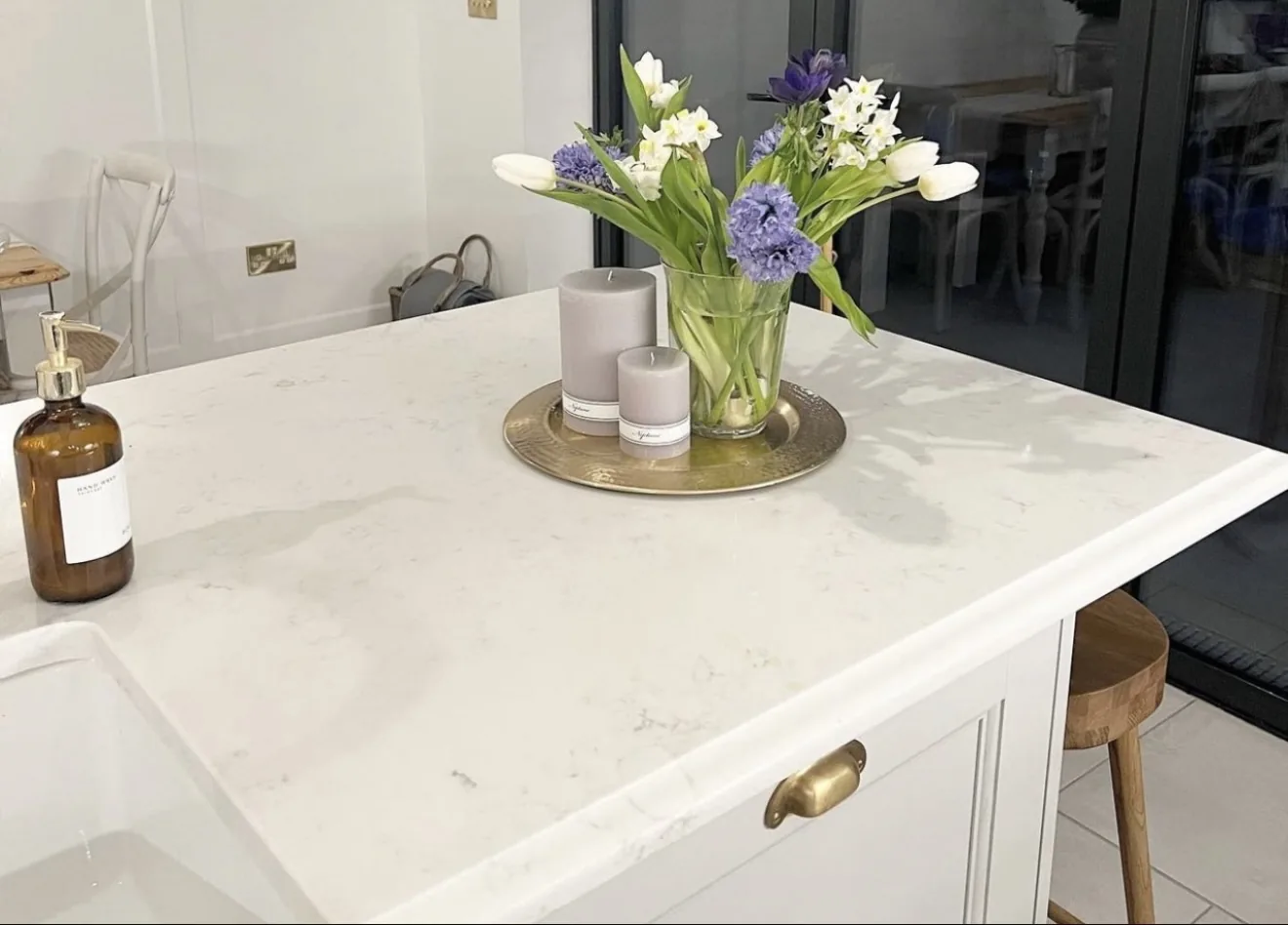
Hackney · E8
Worktops in Dalston
The surface itself: which stone, what it costs by the square metre, and what the room does to that number.
- 5.0from 26 Google reviews
- 25-year material · 5-year workmanship
- Fitted 5-10 working days from template
Dalston kitchens
The kitchens we meet in Dalston
The worktop jobs we are called out to in Dalston tend to arrive with a history, and reading that history is half of getting the measurements right. Above-shop flats along the main roads with tiny internal kitchens, Victorian terraces split into flats behind them, and newer towers with open-plan kitchens. The commonest job by far is a 2.4-3m replacement run in a converted flat where nothing structural can be moved. If that sounds like guesswork, it is not: it is measured on the day, in your kitchen, before anything is cut.
An under-stairs cupboard eats one end of most of these kitchens, and the run stops at a door that has to keep opening. Heat is worth settling before anything else, since granite takes a pan straight off a burner and an engineered surface holds a scorch for the rest of its life. What sings in a bright room can go dead in a dark one.
Ceilings in the principal rooms are three metres or more, so a full-height panel behind a hob is a taller piece here than the same kitchen would need anywhere else. The kitchen in one of these sits in the back addition and takes its daylight from one end, so the working half of the run is the darker half and a pale stone with a honed or matt face does more there than any colour with depth in it. Seen from both sides, the figure has to run continuously.
The mix here is Victorian terrace, above-shop flat, post-war estate and new-build tower. Two of those can sit on the same street and quote a long way apart.
True everywhere
Worktops, in short
- Supply is £110 to £550 per square metre across the 181 surfaces we fit.
- Fitting happens five to ten working days after the template is taken.
- Quartz is engineered, so its pattern repeats and a long kitchen matches itself end to end.
- Granite comes out of the ground porous, which is why it gets sealed.
- Borough
- Hackney
- Postcodes
- E8
- Covered on
- our east London run
- Fitted
- 5–10 working days from template
The place
Why Dalston is its own job
Because we work across Dalston rather than one street of it, we know which questions are worth asking up front. Kingsland High Street is on the A10 red route so nothing stops on it, and loading has to go to side streets that are permit-only and frequently filtered. Above-shop flats have a narrow street door beside the shopfront and a steep straight stair with a turn at the top. Above-shop stairs plus a right angle at the landing usually force a two-piece top on a 3m run, so quote the join up front instead of discovering it on the day. Every one of those is a question we ask on the design visit, long before anybody talks about a deposit.
The work
What worktops involves
Up to four quartz samples are posted out free so a colour can be lived with under your own lighting before a slab is reserved in your name. Where a slab is being reserved for you, it can be seen whole before it is cut, which is the only reliable way to judge movement across three metres of stone. You keep the offcut if you want it, which is where the chopping board, the shelf and the spare piece for a future repair come from.
Every surface begins either as a block sawn from a quarry or as powder pressed and fired, and that fork explains most of the behaviour that follows it. Dekton and sintered stone cover £110 to £366 across 65 surfaces, so the hardest material available is also the one that opens the range. In a house of this age the kitchen stretches away from its only window, so the shortlist closes around a pale honed face before anybody names a colour. Chosen under your own bulbs, not under ours.
The money
What it costs in Dalston
Edge work is charged along the length of every exposed face, which is why an island with four finished sides prices differently from a run with one. In a galley the runs are short and the cut-outs are close together, so the fixed operations carry more of the total than the stone does. The supply band of £110 to £550 per square metre is known the day you choose a colour. What is not known until the template is the piece count and the number of cut-outs. Finished edges are counted by the metre, not by the surface.
Get it priced
Victorian and Edwardian terraces
What Dalston asks for
Conversions put kitchens where the services could be made to reach rather than where they belong, so runs are short and interrupted. Where kitchens are built to a repeat specification the waste factor is worth modelling once, because the same awkward shape multiplies across every property. A repeated specification is worth deciding slowly, once.
The housing on this patch does not throw up much of this. It throws up worktop replacement, worktop splashbacks & upstands and worktop installation. When it does come up, it gets the same template, the same bench and the same crew.
Victorian and Edwardian terraces
Dalston in the housing figures
Across this patch the inter-war years left little behind, so the familiar bay-and-return plan is rare on these jobs. Rooms in that housing are narrow and poorly lit at the working end, which is what makes a pale soft face worth more than a bold colour. Serious daily cooking narrows the sensible choices to a handful of materials.
Access
Getting stone into a Dalston kitchen
Kingsland High Street is on the A10 red route so nothing stops on it, and loading has to go to side streets that are permit-only and frequently filtered. Above-shop flats have a narrow street door beside the shopfront and a steep straight stair with a turn at the top.
Tell us what the approach looks like when you book the template and it gets built into the day rather than discovered on it. Where the route is genuinely tight, it changes how the pieces are cut, which is a fabrication decision rather than a delivery one.
5–10 working days
From template to fitted, working days from template. The same on this patch as every other.
east London patch
Dalston is covered on our east London run, along with the rest of Hackney.
We come to you
Templated in your kitchen, cut in our workshop, fitted by our own installers.
Access told straight
If the route forces an extra join, you hear that at quote stage, not on the day.
Questions
Questions we get asked in Dalston
If yours is not here, ring and ask. You get a straight answer rather than a call-back from a salesperson.
Do you actually work in Dalston, or just list it?
Yes. Dalston is on the patch, and the postcodes we work here are E8. It is worked on our east London run, along with the rest of Hackney. A bus lane along the frontage brings its own hours with it, and stopping in one is enforced the same way the red route is. Whatever the standing allows, the stone leaves that van finished, because every edge, cut-out and internal radius is machined at the works and none of it is open to reconsideration at the kerb. Thirty millimetre stone unloads slowly and thin stone does not. Your part of it happens entirely at home, with nothing to travel to and nothing to bring back.
Does the housing in Dalston change how worktops works?
A villa cut into flats leaves kitchens in rooms that were never kitchens, with services run to wherever they could physically be made to reach. Alcoves either side of the old breast chop the run into short lengths, and a kitchen made of short lengths is the case where buying a slab outright beats buying the square metres, because the remainder is paid for in both. Side light flatters movement and wastes a flat colour. The stone carries the scribe because the wall cannot be persuaded, so back edges are cut oversize and eased in rather than dropped straight down. Every notch and every scribe is machined into the piece before it leaves the works, and a hard sintered surface is the least forgiving of a tight internal corner, so one is always cut with a generous radius. The obstruction is templated as found and cut as templated.
How does the stone actually reach a kitchen in Dalston?
Pendant fittings over the stairwell and anything hung on the half-landing come down first, because a piece on edge sweeps a wider arc than the people carrying it. That caps the longest piece, and a run split into two lengths nests differently on the slab, which moves the yield and moves the figure with it. Vein direction is settled before the slab is broken into pieces. The van is not staying on a main road for the day, so once the stone is off it goes and parks properly somewhere else. A granite kitchen ends its day with a sealer, and a sealer wants a dry face and a quiet hour afterwards, so that hour is written into the day rather than borrowed from it. The packaging and the spent cartridges leave with the crew.
Does Dalston actually ask for worktops?
No, not particularly, and it would be easy to say otherwise. What the research on this patch actually lists is worktop replacement, worktop splashbacks & upstands and worktop installation. That is the local housing talking rather than anything about the job. It is priced, cut and fitted no differently here than anywhere else we cover. In a converted house the flat entrance and the internal doorway are usually tighter than the communal stairs, and that is easy to overlook. Where several kitchens are ordered together the sensible move is to take them all off one batch, because two slabs of the same name bought six months apart will not sit happily in the same building. Drawing lengths and room lengths are rarely the same lengths. Party-wall and lease conditions in a converted building set when noisy work can happen, which shapes the fitting day more than the kitchen does. Volume work tends to live at the entry end of the range, and the entry end is genuine stone rather than a compromise, since the lowest supply figure we quote is a sintered surface and not a thin laminate pretending to be one. The cheapest stone we fit is sintered, and it is still stone.
What am I actually paying for, line by line?
A full-depth tall unit projects past the worktop line, and the run has to be scribed against its side panel instead of carrying on past it. A shape like that nests kindly on a slab, so more of what gets bought ends up on the units and the rate per square metre behaves much as the brochure says it will. A pale honed face earns its keep in a room short of daylight. The supply-only figure for material runs £110 to £550 per square metre, and templating, fabrication and fitting are lines of their own.
Is there anything I have to finish before the template in Dalston?
A room can be out of square in both directions at once, so the wall that leans is also the wall that runs downhill, and one scribe cannot answer both. A hob dropped into the middle of a length puts sustained warmth at the lip of a cut-out, and an engineered surface will yellow there across ten years where a natural one takes it without comment. Movement in a stone needs length to read as anything at all. Send the run lengths, say where the sink and hob will sit, and tell us which way the room faces and what lighting is going in above the working run. The same building type can arrive as a careful one-off kitchen or as a fast turnaround, and the honest answer is that they are priced differently. That changes which questions are worth asking about the stone, because somebody staying put wants to know how a honed face marks in five years and somebody selling wants to know how it photographs next spring. The middle band is where most fitted surfaces honestly sit.
Will you fit stone onto units that are not level?
A sloping floor is not the problem. The plane the unit tops finish in is. Stone does not flex, so a run that rocks on its carcasses rocks just as badly once it is stone. Units have to be fixed down as well as levelled. A loose carcass moves under stone. Plaster thickness varies over the height of a wall, so the line at worktop height is not the line at skirting level, and the units decide which one matters. A run that sits under strong sun for hours every afternoon suits a surface built to be stable in daylight, because a resin-bound stone is made for indoor use and sustained sunlight is the one thing it was never designed around. A tight inside corner is where brittle material gives up.
Can you fit stone I have already bought for a Dalston kitchen?
Templating, fabrication and fitting are the same three lines whether the stone came from us or from you. Stone cut to somebody else’s drawing cannot usefully be re-cut to yours. Delivery to the workshop has to be arranged and dated, since nothing is nested until it is there. Several units in one building are fitted out to the same drawing, so an error on that drawing is an error repeated in every flat. Adding an island is what moves most of these projects from one slab to two, and that jump is the single largest step in any worktop quotation. Batch matching is the only honest way to match a surface.
How do you cut out for an undermounted sink?
The tap hole is drilled in the workshop too, and its position depends on how far the tap has to swing. If the sink or hob changes after the template, the drawing changes first and nothing is cut meanwhile. Undermount bowls are cut and polished in the workshop and dry-fitted to the stone on the bench before anything is loaded. Where the sink and the hob face each other across the aisle, everything carried between them crosses the walkway, and that is the one movement the shape cannot design out. A mitred corner asks the pattern to turn through a right angle, which an even speckle does without comment and a marble-look stone makes a performance of. The shape sets the cut list and the cut list sets the stone bill.
Can you get a full-length top into an upstairs kitchen in Dalston?
The carry route is measured before anything is cut, so a piece that will not make the turn is split at the drawing stage rather than discovered on the day. Every piece goes in by hand and stone does not bend, so the tightest turn on the route sets the longest piece. A communal flight is out of use while a piece is on it, so the carry is timed so nobody is trying to pass on a half-landing. Where a seam becomes unavoidable the choice of stone starts to matter, because a fine even speckle closes a joint almost invisibly and a broad vein simply will not. Every extra seam buys two more polished edges and a resin match.
Reviews
5.0 from 26 Google reviews
Every one of these is on our Google profile under the reviewer’s own name. Nothing here is written by us, and the link goes straight to the source.
Great work, super helpful team. I'd definitely recommend!
Andreea Tanase
Google review
Great experience from this company, I am happy with the materials, fitting and the team.
Rrahim Brati
Google review
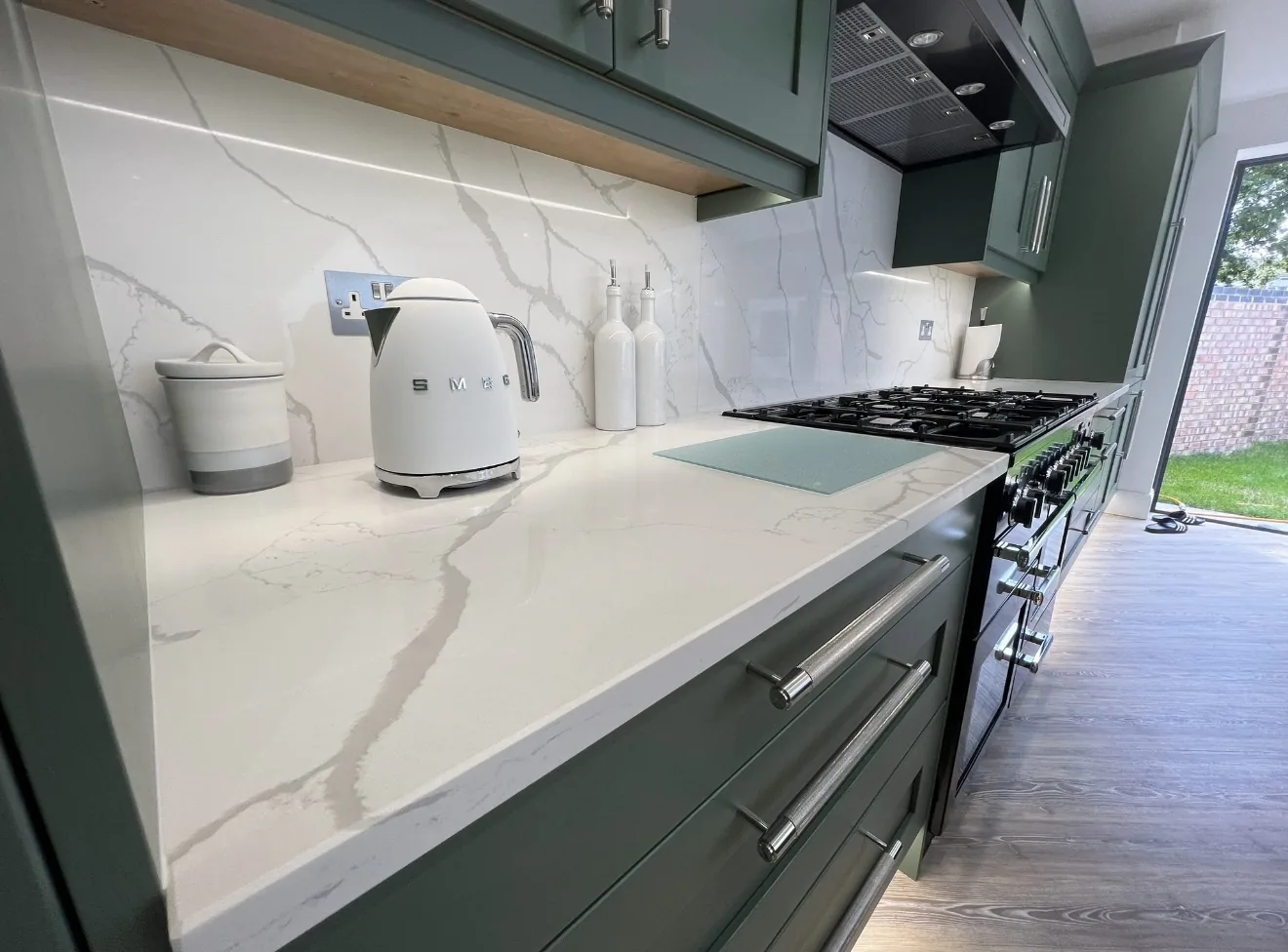
Absolutely delighted with our new worktop from Worktop WorX. The Capri White finish looks incredible, clean, modern, and really brightens up the whole kitchen while pairing beautifully with the darker cabinetry. The quality of the worktop is outstanding, with a flawless finish and seamless installation that really shows the attention to detail. It’s not only stylish but also feels incredibly durable and practical for everyday use. Cam handled everything from start to finish and made the whole process smooth and stress-free. Professional, reliable, and clearly takes pride in the work. Highly recommend Worktop WorX. We couldn’t be happier with the result!
Dawid Myszor
Google review · Capri White
Related
More around Dalston
Other work we do in Dalston
Next step
Worktops in Dalston, priced properly
Plans, a sketch or photographs with rough run lengths is enough to start. You get an itemised written quote and the template dates we can offer on this patch.
25-year material warranty and a 5-year workmanship guarantee, both stated on your quote.