
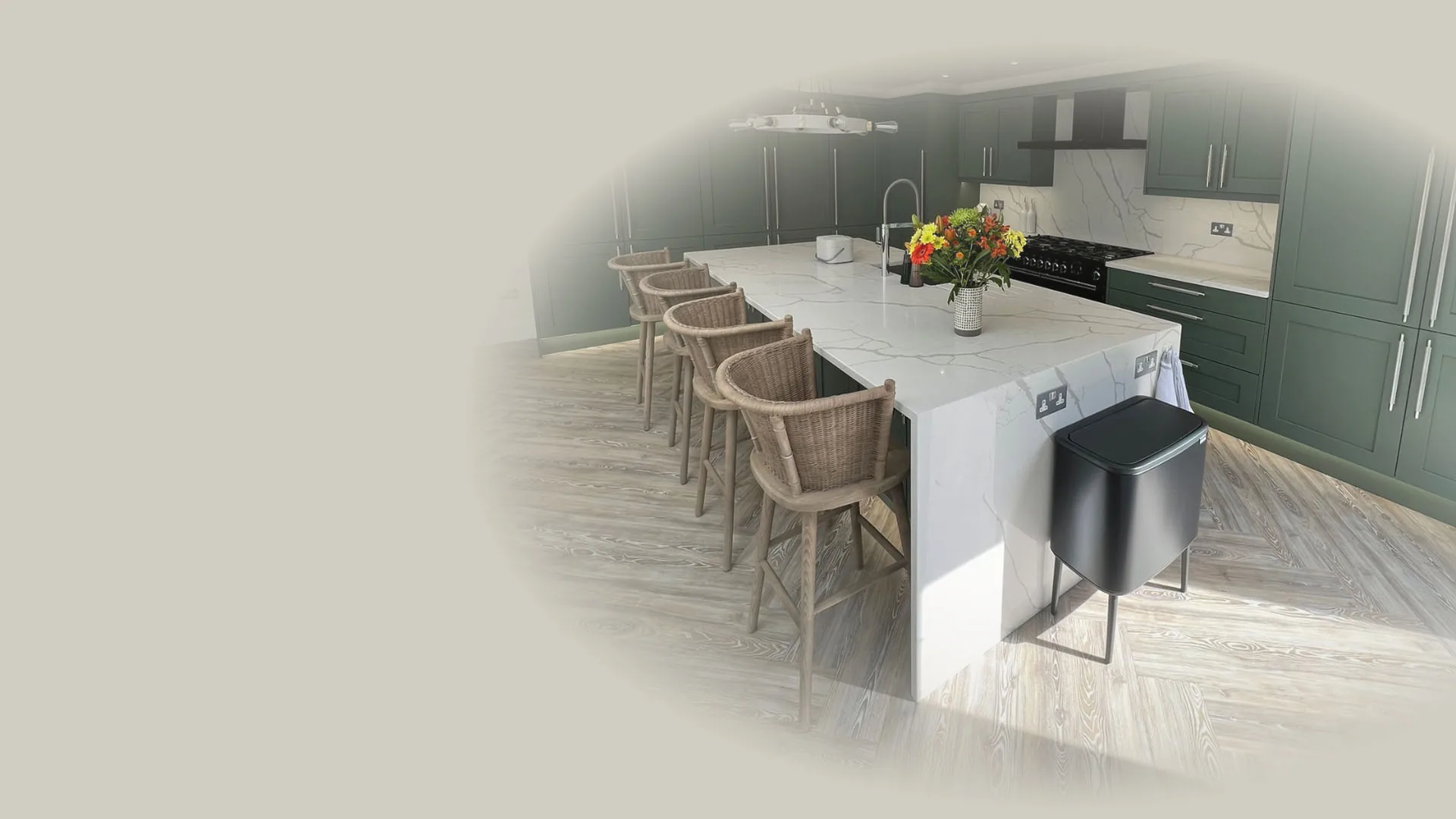
Hackney · E8
Worktops in London Fields
The surface itself: which stone, what it costs by the square metre, and what the room does to that number.
- 5.0from 26 Google reviews
- 25-year material · 5-year workmanship
- Fitted 5-10 working days from template
London Fields kitchens
The kitchens we meet in London Fields
The worktop jobs we do in London Fields follow the same process every time, and it is the kitchen rather than the process that decides how the day actually goes. Victorian terraces facing the park, many reverted to whole houses, where a side-return or rear extension creates a kitchen-diner with a 4m run and an island. Behind the market the converted industrial buildings give large open-plan kitchens with long single runs and few obstructions. Photographs of the run and a rough length are usually enough for us to say which of those you are looking at.
An under-stairs cupboard eats one end of most of these kitchens, and the run stops at a door that has to keep opening. Finish counts as much as colour once the light in a room is poor, because a polish hands every reflection back to you and a honed face quietly absorbs them. A week with a sample on the units beats an hour in a showroom.
Where a side return has been infilled, the join between old brick and new blockwork lands mid-run and the two faces are never in one plane. Ceilings are tall and the joinery is usually painted, which is the setting where a thirty millimetre edge looks right and a slim one reads as a saving somebody made. Seen from both sides, the figure has to run continuously.
Most of what we quote on here is Victorian terrace, warehouse conversion, above-shop flat and post-war infill. What the units are screwed to varies between them, and that decides the fixings.
True everywhere
Worktops, in short
- Supply is £110 to £550 per square metre across the 181 surfaces we fit.
- Dekton and sintered stone hold their colour under heat and direct sunlight.
- That figure is the slab. Fabrication, edges, cut-outs and fitting are quoted separately.
- Four free quartz samples are posted out, because photographs of stone lie.
- Borough
- Hackney
- Postcodes
- E8
- Covered on
- our east London run
- Fitted
- 5–10 working days from template
The place
Why London Fields is its own job
Templating in London Fields is as much about the way in and the state of the walls as it is about the measurements. The streets around the park are permit-only, filtered and busy with pedestrians and cyclists, and market days make the Broadway Market end effectively impassable for a van. Extension jobs usually allow a carry through the house or via a side gate straight into the rear. On extension jobs check for a side gate first, because going in through the garden avoids the hall and the stair entirely and makes a one-piece island top possible. All of it is priced before you commit to anything, and the itemised quote shows exactly where the awkward parts of the job are and what they add.
The work
What worktops involves
Up to four quartz samples are posted out free so a colour can be lived with under your own lighting before a slab is reserved in your name. The pieces are cut and polished at the works with radiused internal corners at every opening, so nothing is machined into a finished surface inside your house. You keep the offcut if you want it, which is where the chopping board, the shelf and the spare piece for a future repair come from.
Photographs of stone lie, and they lie hardest about how a colour behaves under a domestic bulb, which is why four quartz samples go in the post free of charge. Slabs are calibrated to a nominal gauge, so a nominal twenty is seldom exactly twenty, and the tolerance is taken up at the joint rather than argued over. Breasts and alcoves break the run into short lengths, which is the condition where buying the slab whole makes more sense than buying the metres. Heat, water and sunlight sort the shortlist quickly.
The money
What it costs in London Fields
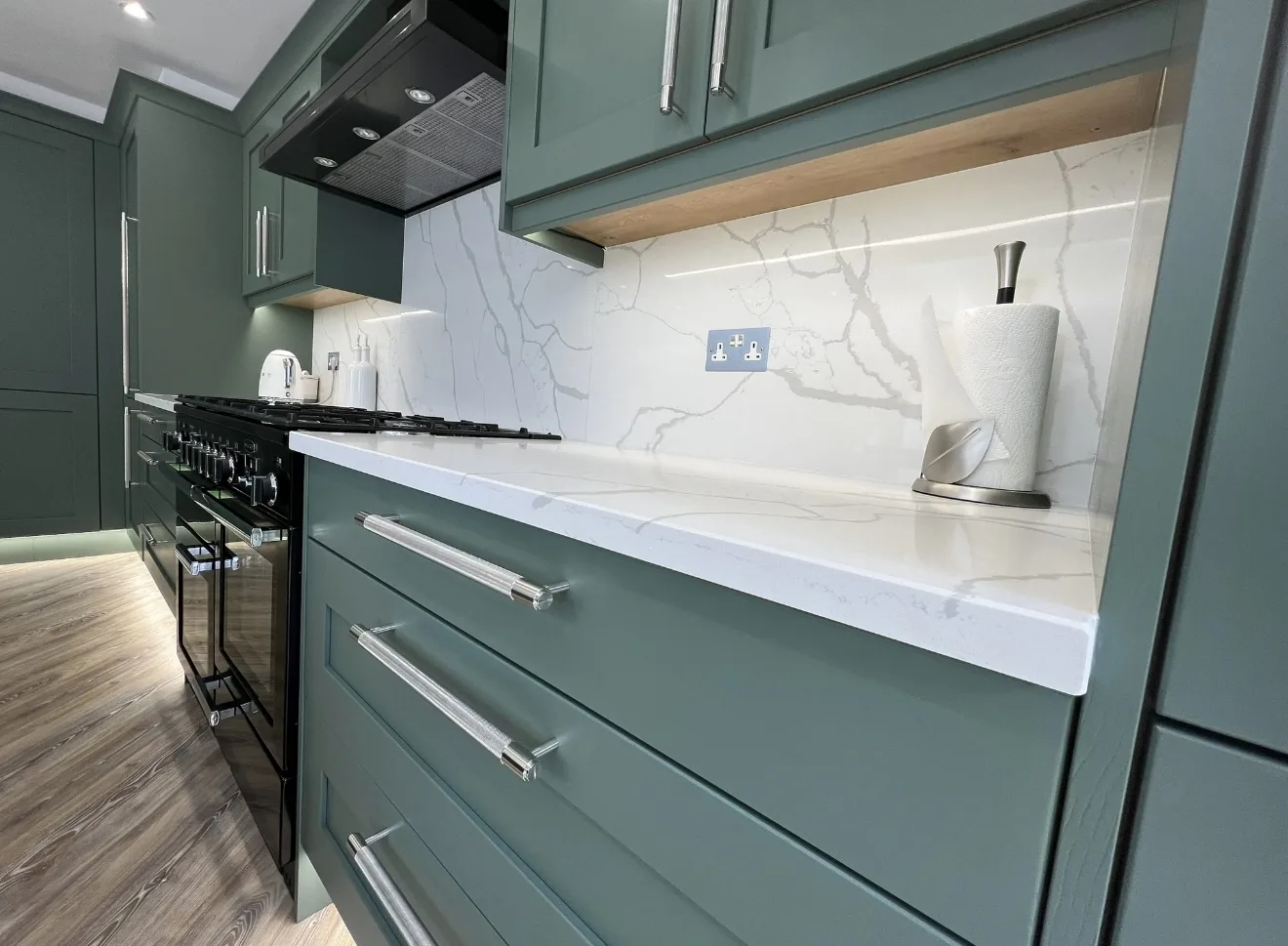
The remainder of a slab is part of the price whether it is fitted or left behind, and that is the honest reason short awkward lengths cost what they do. Two facing runs mean two sets of edges and two scribes in a small span, which is why a compact galley rarely prices as cheaply as its area suggests. Two quotes can agree on a supply rate of £110 to £550 per square metre and still land a long way apart, because the cut-outs, the joins and the edge profile are priced after it. Priced off the cut list, never off the floor plan.
Get it priced
Victorian and Edwardian terraces
The carry, and what it rules out
Where an event closes the road entirely, the van cannot be moved once it is in, which is a different problem from not being able to park at all. Thirty millimetre granite comes off a tail lift a good deal more slowly than twelve millimetre sintered stone, so the material quietly sets how long the vehicle needs to stand. Remnants become chopping boards, hearths and window boards.
Victorian and Edwardian terraces
London Fields in the housing figures
On these streets landlords hold the greater part of the stock. On a room that size the cut-outs cost more than the area. Where people stay for decades the upkeep argument is really about citrus, descaler and whether anybody will reseal a porous face each year. Serious daily cooking narrows the sensible choices to a handful of materials.
Victorian and Edwardian terraces
What London Fields asks for
This is not the commonest thing we do here. Worktop installation come up more. It is a fact about the local building stock, not about the standard or the price of the work.
Access
Getting stone into a London Fields kitchen
The streets around the park are permit-only, filtered and busy with pedestrians and cyclists, and market days make the Broadway Market end effectively impassable for a van. Extension jobs usually allow a carry through the house or via a side gate straight into the rear.
Tell us what the approach looks like when you book the template and it gets built into the day rather than discovered on it. Where the route is genuinely tight, it changes how the pieces are cut, which is a fabrication decision rather than a delivery one.
5–10 working days
From template to fitted, working days from template. The same on this patch as every other.
east London patch
London Fields is covered on our east London run, along with the rest of Hackney.
We come to you
Templated in your kitchen, cut in our workshop, fitted by our own installers.
Access told straight
If the route forces an extra join, you hear that at quote stage, not on the day.
Questions
Questions we get asked in London Fields
If yours is not here, ring and ask. You get a straight answer rather than a call-back from a salesperson.
Is London Fields far enough out to be a problem for you?
Yes. London Fields is on the patch, and the postcodes we work here are E8. It is worked on our east London run, along with the rest of Hackney. A market day closes the street to traffic for the morning and hands it back in the afternoon, which moves the visit rather than cancelling it. Whatever the standing allows, the stone leaves that van finished, because every edge, cut-out and internal radius is machined at the works and none of it is open to reconsideration at the kerb. Colour matched resin is mixed to the slab, not to a chart. The measuring and the fitting are both done at the property, so there is nothing to visit or collect.
What is different about worktops in London Fields?
A semi has a side passage, and whether it is wide enough to carry a piece flat and turn it in at the back door is the first thing worth measuring. Alcoves either side of the old breast chop the run into short lengths, and a kitchen made of short lengths is the case where buying a slab outright beats buying the square metres, because the remainder is paid for in both. Side light flatters movement and wastes a flat colour. The stone carries the scribe because the wall cannot be persuaded, so back edges are cut oversize and eased in rather than dropped straight down. A hob dropped into the middle of a length puts sustained warmth at the lip of a cut-out, and an engineered surface will yellow there across ten years where a natural one takes it without comment. Strong daylight is an argument for a surface built to take it.
Is access a problem in London Fields?
Where the garden is level and the back door is wide the pieces get staged outside on trestles and brought in one at a time as the fitters are ready for them. That caps the longest piece, and a run split into two lengths nests differently on the slab, which moves the yield and moves the figure with it. No colour and no edge is adjustable once a piece is machined. A timed school street shuts the road either side of the school day, so the van goes in between those two windows or it does not go in. A granite kitchen ends its day with a sealer, and a sealer wants a dry face and a quiet hour afterwards, so that hour is written into the day rather than borrowed from it. Thirty millimetre stone unloads slowly and thin stone does not.
Is worktops what London Fields is known for?
Not especially, and pretending otherwise would be simple enough. What the research on this patch actually lists is worktop installation. It is a fact about the local housing rather than about the work. The job is quoted, cut and fitted the same way wherever on the patch it lands. Extension budgets are usually well spent by the time the worktop is ordered, which is where the choice between quartz and a thinner sintered stone actually gets made. Where several kitchens are ordered together the sensible move is to take them all off one batch, because two slabs of the same name bought six months apart will not sit happily in the same building. The material is guaranteed for twenty five years, so choose once. Rear and side-return extensions are where the islands appear, and an island is the piece that decides whether one slab does the kitchen or two. Volume work tends to live at the entry end of the range, and the entry end is genuine stone rather than a compromise, since the lowest supply figure we quote is a sintered surface and not a thin laminate pretending to be one. Two slabs bought a season apart are two different stones.
What makes one London Fields kitchen dearer than the next?
Where the sink and the hob face each other across the aisle, everything carried between them crosses the walkway, and that is the one movement the shape cannot design out. A shape like that nests kindly on a slab, so more of what gets bought ends up on the units and the rate per square metre behaves much as the brochure says it will. A bold vein and a busy shape are an expensive pair. Supply-only material is £110 to £550 per square metre, and templating, fabrication and fitting are quoted separately rather than rolled in.
What holds a template up more often than anything else?
A room can be out of square in both directions at once, so the wall that leans is also the wall that runs downhill, and one scribe cannot answer both. A run that sits under strong sun for hours every afternoon suits a surface built to be stable in daylight, because a resin-bound stone is made for indoor use and sustained sunlight is the one thing it was never designed around. A deep scribe moves the pattern back along with the depth. Send the run lengths, say where the sink and hob will sit, and tell us which way the room faces and what lighting is going in above the working run. The same building type can arrive as a careful one-off kitchen or as a fast turnaround, and the honest answer is that they are priced differently. That changes which questions are worth asking about the stone, because somebody staying put wants to know how a honed face marks in five years and somebody selling wants to know how it photographs next spring. One stone across a portfolio is worth more than a small saving.
Can a London Fields worktop be done in one piece?
There are only ever a few legal positions, and the one taken is furthest from the light. A mitred join at a corner is a different job from a butt join along a run, and they are not priced the same. An island often runs in one piece where a wall run cannot. A run that stops in mid-air at the open end needs a finished end rather than a cut one, and that end takes the same edge work as the whole front. An island is the piece that decides whether one slab covers the kitchen or two, and a second slab arrives as a step in the figure rather than a gentle slope. Every return end is another polished face to pay for.
Can the price change after templating?
What is quoted is what the drawing says, and the figure does not move unless the drawing does. Nothing is payable until the template, and the template measures the room as it stands rather than estimating from a plan. Two kitchens the same length can be far apart, because material, edge and cut-outs move independently of size. Plaster thickness varies over the height of a wall, so the line at worktop height is not the line at skirting level, and the units decide which one matters. A deep scribe eats into the back of the piece, which is quietly important on a stone with directional figure, since the pattern moves backwards as that depth comes off. Thirty millimetres bridges a gap that twenty millimetres will not.
Does my sink have to be on site before you template in London Fields?
Nothing is cut out in the kitchen. Cutting a bowl on site is how worktops get cracked. Undermount bowls are cut and polished in the workshop and dry-fitted to the stone on the bench before anything is loaded. The sink, tap and hob have to be physically in the room at the template, not merely ordered, because the cut-out is machined to the item itself. Where a run finishes hard against a wall the last few millimetres are scribed, and where it finishes in open floor it is cut square and polished, which is two different jobs on one length. A mitred corner asks the pattern to turn through a right angle, which an even speckle does without comment and a marble-look stone makes a performance of. The island is usually the piece that opens the second slab.
Upstands or a full-height splashback?
An upstand covers the gap where the worktop meets a wall that is not flat, which is its real job. The joint between splashback and worktop is siliconed, never grouted, so it can move a little without cracking. Both are templated after the worktop is down and settled, because they are cut to the wall itself. The rear room is generous with a chimney breast in one corner, so the run gains a return and two scribed ends whatever the plan drew. Rooms in these houses run long and narrow with the only honest daylight at the garden end, so a pale honed surface does more for the working half of the kitchen than any colour with depth in it. One full slab and no second is the sweet spot on price.
Reviews
5.0 from 26 Google reviews
Every one of these is on our Google profile under the reviewer’s own name. Nothing here is written by us, and the link goes straight to the source.
We recently had a Calacatta Gold worktop installed by Worktop Worx and are really pleased with the result. It has completely transformed our kitchen, much brighter, modern, and high-end compared to our old wooden surface. The team were professional, efficient, and the finish is excellent with great attention to detail. The worktop looks amazing and is very practical for everyday use. Highly recommend Worktop Worx for anyone looking for quality quartz worktops.
RO74 TVX
Google review · Calacatta Gold
We had a fantastic experience with Worktop WorX from start to finish. The team was professional, friendly, and delivered excellent workmanship. We chose the beautiful Capri White worktop, and it has completely transformed our kitchen with its elegant, high-end look.
Noni
Google review · Capri White
Karem did a fantastic job at installing my antique bronze mirror for my coffee/drinks unit. He was really professional and his communication throughout was clear.
Kals
Google review
Related
More around London Fields
Other work we do in London Fields
Next step
Worktops in London Fields, priced properly
Plans, a sketch or photographs with rough run lengths is enough to start. You get an itemised written quote and the template dates we can offer on this patch.
25-year material warranty and a 5-year workmanship guarantee, both stated on your quote.