
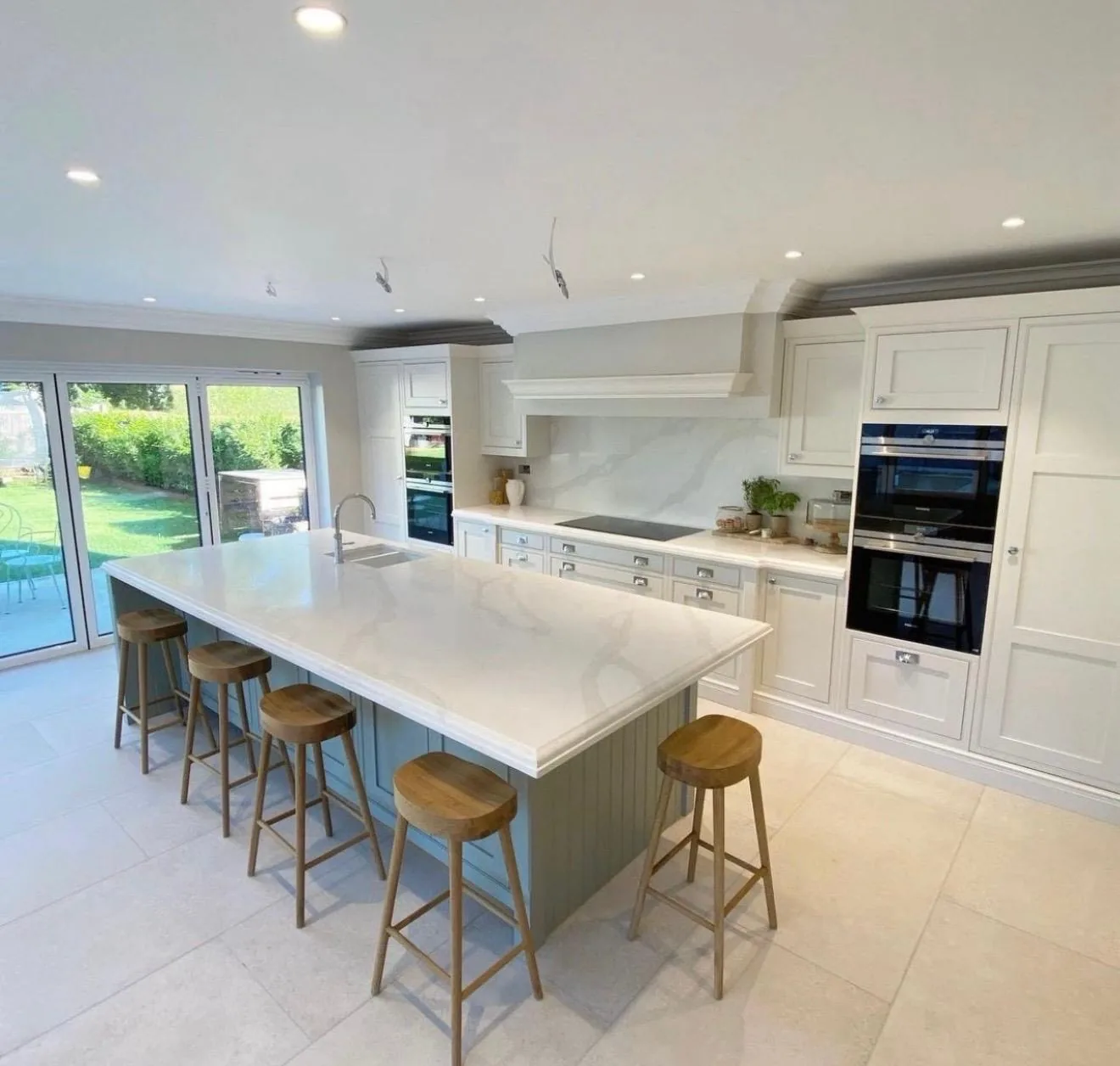
Richmond upon Thames · KT1
Worktops in Hampton Wick
The surface itself: which stone, what it costs by the square metre, and what the room does to that number.
- 5.0from 26 Google reviews
- 25-year material · 5-year workmanship
- Fitted 5-10 working days from template
Hampton Wick kitchens
The kitchens we meet in Hampton Wick
Understanding stone worktop supply and fitting in Hampton Wick means understanding the kitchens it happens in, which is a more interesting subject than most people expect. Small Georgian and Victorian cottages in a compact village layout, with kitchens often only 2m to 2.6m of run and a doorway at each end, so the design is about tall storage and a single well-planned run rather than an island. Work out none of it yourself. Tell us the address in Hampton Wick and roughly what you are replacing, and we will take it from there.
Injected damp courses and re-rendered lower walls leave the bottom metre standing proud of everything above it. Colour behaves differently in a room like that, which is why a sample sits on the units for a week and gets judged under the lights that will be on when somebody is cooking. Colour gets chosen under kitchen lights, never under showroom ones.
A small room puts the sink, hob and tap cut-outs close together on one short length, and the bridge of stone left between them decides whether it can be cut in one piece. Ceilings are tall and the joinery is usually painted, which is the setting where a thirty millimetre edge looks right and a slim one reads as a saving somebody made. Short pieces are the argument for buying a slab outright.
On these streets the housing is Georgian cottage, Victorian terrace, Victorian villa and modern riverside flats. Each of those puts the services somewhere else, and the cut-outs follow.
True everywhere
Worktops, in short
- Supply is £110 to £550 per square metre across the 181 surfaces we fit.
- Quartz is engineered, so its pattern repeats and a long kitchen matches itself end to end.
- Granite comes out of the ground porous, which is why it gets sealed.
- Dekton and sintered stone hold their colour under heat and direct sunlight.
- Borough
- Richmond upon Thames
- Postcodes
- KT1
- Covered on
- our south west London run
- Fitted
- 5–10 working days from template
The place
Why Hampton Wick is its own job
Most of the work of a fit in Hampton Wick happens before the van is loaded, in what we have already checked and allowed for. The village sits at the foot of Kingston Bridge, so traffic queues through it most of the day, the streets are narrow with residents' bays, and many cottages open straight onto the pavement with no front garden to stage the load in. Doors opening straight onto the street mean the slab goes from tailgate to threshold in one move, so the van has to be right at the door or the job stalls. Whatever the building does to a straight line, it is measured on the template and drawn before anything is cut.
The work
What worktops involves
Worktop supply and fitting covers the stone itself, machined to your room: the surface, the polished edges, the openings for sink, hob and tap, and the fitting of the finished pieces. Where a slab is being reserved for you, it can be seen whole before it is cut, which is the only reliable way to judge movement across three metres of stone. You get an itemised figure that shows what the slab cost, what the edges cost and what the openings cost, so the layout can be adjusted before anything is cut.
Thickness, finish and edge are three separate decisions that most households take as one, and each of the three moves the quotation on its own. Sealing a natural surface takes an hour and wants repeating roughly once a year, using a penetrating sealer rather than anything that leaves a film on top. Painted period joinery and tall ceilings carry a thicker front edge comfortably, and a slim one tends to look apologetic beside them. Chosen under your own bulbs, not under ours.
The money
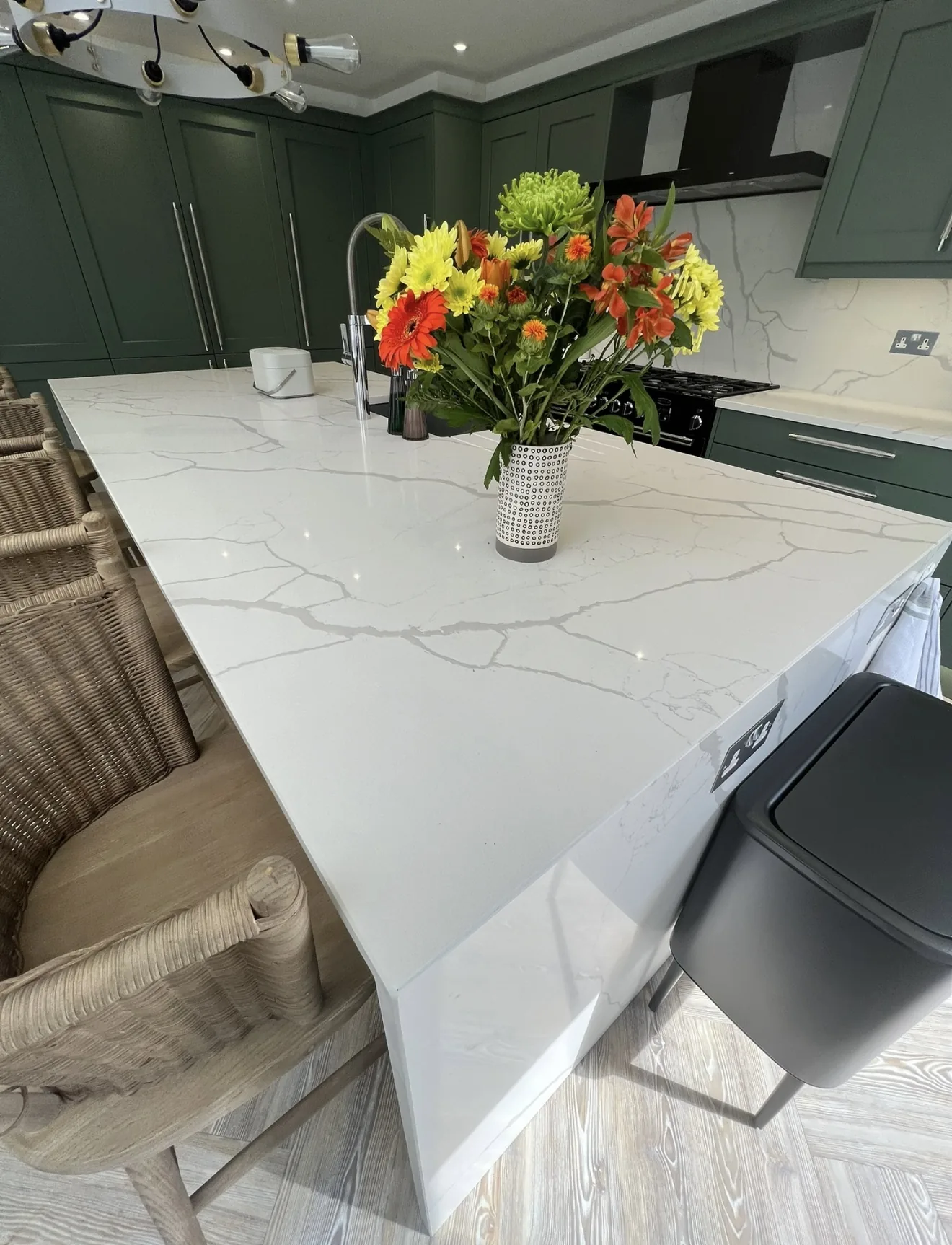
What it costs in Hampton Wick
Material band is the single largest lever on the total, and moving up a band on a small kitchen costs less than most people assume because there is little area to multiply. Two facing runs mean two sets of edges and two scribes in a small span, which is why a compact galley rarely prices as cheaply as its area suggests. Take £110 to £550 per square metre as a floor to reason from rather than a quote, since it covers material alone and every operation is added to it as a named line. Nothing about the stone is folded into a rate and hidden there.
Get it priced
period detached houses and villas
The shape of the run
A doorway partway along one wall breaks that side into two separate pieces, and two short pieces cost more between them than the single long one they replace. Upstands come off the same slab as the surface, so a room ringed in them quietly eats the area that would otherwise have covered an island. Yield is a property of the room as much as of the slab.
period detached houses and villas
What Hampton Wick asks for
It would be overstating it to call this a speciality on this patch. Worktop replacement and worktop installation are far commoner. None of that changes the survey, the cut list or the fit.
period detached houses and villas
Hampton Wick in the housing figures
On these streets the council tax banding runs higher here than across most of London. Where a scheme is phased across seasons the dye lot drifts underneath it, which is why a whole requirement is reserved at once even if it is cut in stages. Two rooms of one size can sit a long way apart on price.
Access
Getting stone into a Hampton Wick kitchen
The village sits at the foot of Kingston Bridge, so traffic queues through it most of the day, the streets are narrow with residents' bays, and many cottages open straight onto the pavement with no front garden to stage the load in.
Tell us what the approach looks like when you book the template and it gets built into the day rather than discovered on it. Where the route is genuinely tight, it changes how the pieces are cut, which is a fabrication decision rather than a delivery one.
5–10 working days
From template to fitted, working days from template. The same on this patch as every other.
south west London patch
Hampton Wick is covered on our south west London run, along with the rest of Richmond upon Thames.
We come to you
Templated in your kitchen, cut in our workshop, fitted by our own installers.
Access told straight
If the route forces an extra join, you hear that at quote stage, not on the day.
Questions
Questions we get asked in Hampton Wick
If yours is not here, ring and ask. You get a straight answer rather than a call-back from a salesperson.
Which postcodes do you cover around Hampton Wick?
Yes. Hampton Wick is on the patch, and the postcodes we work here are KT1. It is worked on our south west London run, along with the rest of Richmond upon Thames. Unrestricted kerbside is straightforward as long as the space in front of the property is actually clear when the van arrives. Whatever the standing allows, the stone leaves that van finished, because every edge, cut-out and internal radius is machined at the works and none of it is open to reconsideration at the kerb. Thirty millimetre stone unloads slowly and thin stone does not. Nothing needs visiting and nothing needs collecting: the template is in your kitchen and so is the fit.
What is different about worktops in Hampton Wick?
There is no back addition on these, so the kitchen is the original rear room and the run is one wall long with a door at each end of it. Alcoves either side of the old breast chop the run into short lengths, and a kitchen made of short lengths is the case where buying a slab outright beats buying the square metres, because the remainder is paid for in both. A tall room carries a thick edge; a low one does not. A run can measure dead right at both ends and still belly out in the middle, which only appears once the template plots the intermediate points. Every notch and every scribe is machined into the piece before it leaves the works, and a hard sintered surface is the least forgiving of a tight internal corner, so one is always cut with a generous radius. Sealing suits stone that drinks; nothing else needs it.
Is access a problem in Hampton Wick?
Turning a heavy piece on edge indoors needs floor space at both ends of the turn, so the hall is cleared of furniture before anything comes off the van. That caps the longest piece, and a run split into two lengths nests differently on the slab, which moves the yield and moves the figure with it. Thin sintered stone weighs about half what thick granite does. On a street with no restrictions the constraint is other residents rather than a warden, so it is worth putting a cone or a car out early. A granite kitchen ends its day with a sealer, and a sealer wants a dry face and a quiet hour afterwards, so that hour is written into the day rather than borrowed from it. The packaging and the spent cartridges leave with the crew.
Is worktops what Hampton Wick is known for?
Not to any real extent, and it would be easy to imply it was. What the research on this patch actually lists is worktop replacement and worktop installation. It describes the kitchens on this patch, not the work that goes into them. Same quoting, same cutting, same fitting as anywhere else on the patch. An open-plan extension puts the worktop in the middle of the living space, so it is looked at from the sofa as well as worked on. Where several kitchens are ordered together the sensible move is to take them all off one batch, because two slabs of the same name bought six months apart will not sit happily in the same building. A repeated specification is worth deciding slowly, once. Extension budgets are usually well spent by the time the worktop is ordered, which is where the choice between quartz and a thinner sintered stone actually gets made. Volume work tends to live at the entry end of the range, and the entry end is genuine stone rather than a compromise, since the lowest supply figure we quote is a sintered surface and not a thin laminate pretending to be one. Drawing lengths and room lengths are rarely the same lengths.
What makes one Hampton Wick kitchen dearer than the next?
Handles on opposing runs meet in the middle of the aisle, so a deep edge profile specified on both sides takes width out of the standing space twice over. A shape like that nests kindly on a slab, so more of what gets bought ends up on the units and the rate per square metre behaves much as the brochure says it will. Two mitres and three lengths is bench work, not surface area. Material sits between £110 and £550 per square metre supply only, and templating, fabrication and fitting are quoted line by line.
What holds a template up more often than anything else?
Where a corner is a couple of degrees off, a mitre cut to a theoretical ninety degrees opens on the wall side and there is no closing it afterwards. A hob dropped into the middle of a length puts sustained warmth at the lip of a cut-out, and an engineered surface will yellow there across ten years where a natural one takes it without comment. A dark plain face shows every made-good line on the run. Send the run lengths, say where the sink and hob will sit, and tell us which way the room faces and what lighting is going in above the working run. The same building type can arrive as a careful one-off kitchen or as a fast turnaround, and the honest answer is that they are priced differently. That changes which questions are worth asking about the stone, because somebody staying put wants to know how a honed face marks in five years and somebody selling wants to know how it photographs next spring. Cleaning spray, not showroom light, should decide the finish.
Can the price change after templating?
What moves the figure after templating is a change you make: a different edge, an extra cut-out, a bigger sink chosen late. Taking the old tops away is a line rather than an assumption, so it comes off if you do not want it. Every run, cut-out, edge, join and groove set is a line, which is what makes it comparable with anyone else’s. The stone carries the scribe because the wall cannot be persuaded, so back edges are cut oversize and eased in rather than dropped straight down. A run that sits under strong sun for hours every afternoon suits a surface built to be stable in daylight, because a resin-bound stone is made for indoor use and sustained sunlight is the one thing it was never designed around. Internal corners are cut with a radius because square ones crack.
Do you take the old worktop away?
Disposal means it goes in the van, not into the garden to wait for a collection. An old stone top is heavier coming out than the new one is going in, and leaves in sections. The sink and hob are lifted out with the old top and kept aside if you are reusing them. A free-parking street with cars both sides can still leave the van forty metres away, and that distance is carry, not driving. Sintered surfaces are the hardest of the three to machine and the messiest to cut wet, which is precisely why none of that happens on a public pavement. Dry cutting quartz burns the resin and the burn does not polish out.
Is one material less trouble than another for a Hampton Wick kitchen?
Quartz and sintered stone never need sealing: quartz is non-porous and sintered stone has effectively zero porosity. Topping a seal up is a wipe-on job with a cloth. Granite is porous to varying degrees, so it is sealed when we fit it and topped up over the life of the worktop. That rear wall carries the back door and the only window, which leaves very little uninterrupted length for a sink run. Rooms in these houses run long and narrow with the only honest daylight at the garden end, so a pale honed surface does more for the working half of the kitchen than any colour with depth in it. Honed hides the dust an older house makes all year.
What happens when the route into a Hampton Wick kitchen is tighter than the worktop?
Where there is a lift, whether it can be booked out and padded matters as much as its size. The lift, if there is one, is measured on the diagonal, because that is the dimension a long piece actually uses. A piece travels on edge, never flat, because on edge is how stone of that length carries its own weight. Two people will walk a two-metre piece in through a front door; the same hall with a three-metre piece wants four, purely because nobody can let go halfway. Where a seam becomes unavoidable the choice of stone starts to matter, because a fine even speckle closes a joint almost invisibly and a broad vein simply will not. Flexing a porcelain length round a turn is how one breaks.
Reviews
5.0 from 26 Google reviews
Every one of these is on our Google profile under the reviewer’s own name. Nothing here is written by us, and the link goes straight to the source.
I recently had my kitchen worktop and splashback done by Karem from Worktop WorX and i am very pleased with the result. From the initial consultation and measurements to the final installation, the whole process was smooth and professional. The attention for details and the quality made the difference and everything was finished to a high standard. I definitely recommend Worktop WorX to anyone looking for reliable and high quality kitchen work
Alexandru Balint
Google review
Really impressed with the quality and finish of these worktops. Great range of materials, precise fabrication, and smooth communication throughout. The whole process was easy and the final result looks fantastic. Highly recommend!
Nastasia Drago
Google review
We installed new kitchen and got the worktop and splash back from them. Their professional work and commitment was wonderful. Quality of work compared to price was way too good. Thank you guys.
MD Matinur Rahman
Google review
Related
More around Hampton Wick
Other work we do in Hampton Wick
Next step
Worktops in Hampton Wick, priced properly
Plans, a sketch or photographs with rough run lengths is enough to start. You get an itemised written quote and the template dates we can offer on this patch.
25-year material warranty and a 5-year workmanship guarantee, both stated on your quote.