
Richmond upon Thames · TW2
Worktops in Heathfield
The surface itself: which stone, what it costs by the square metre, and what the room does to that number.
- 5.0from 26 Google reviews
- 25-year material · 5-year workmanship
- Fitted 5-10 working days from template
Heathfield kitchens
The kitchens we meet in Heathfield
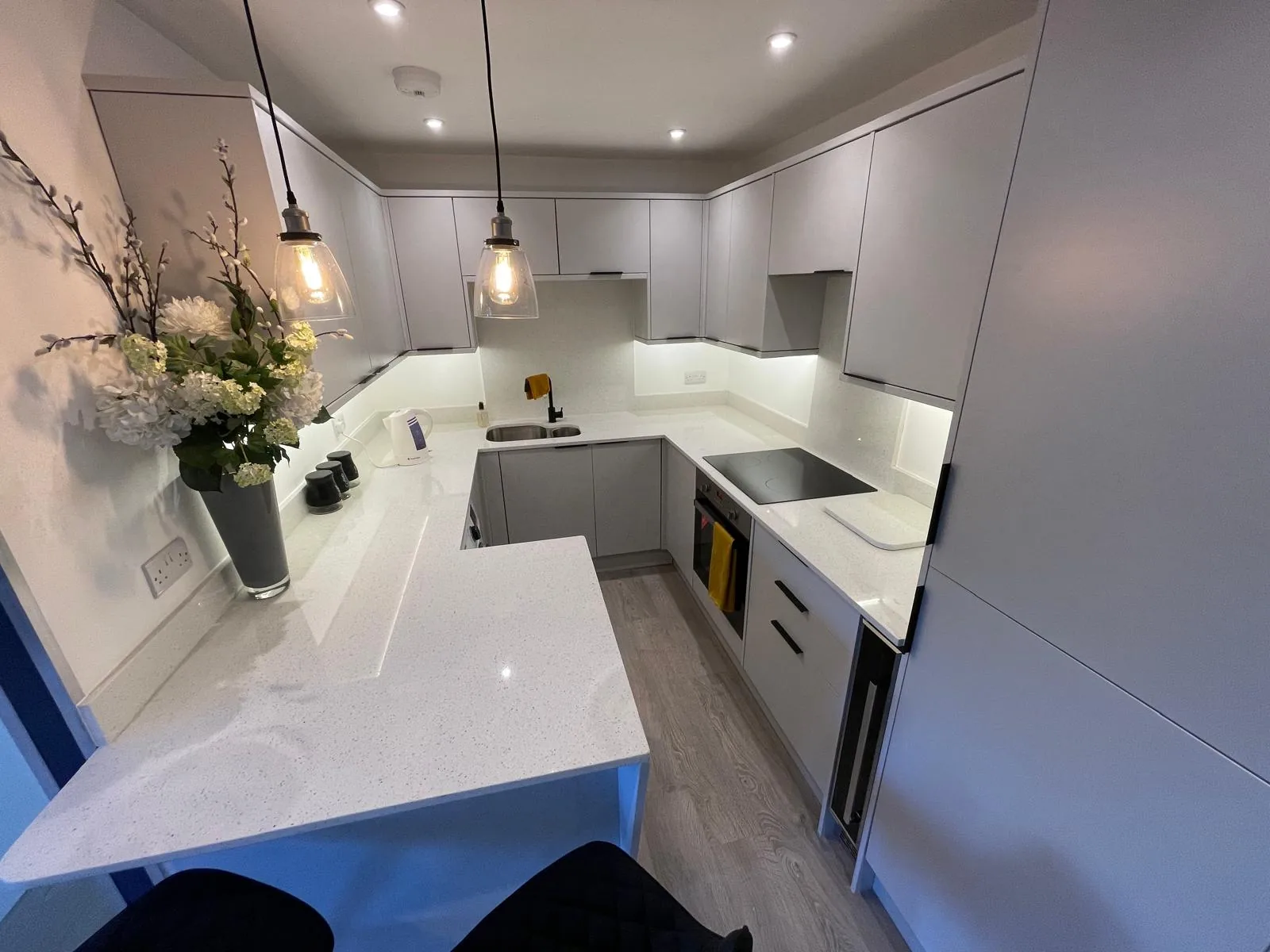
Most of the worktop jobs we do in Heathfield land in one of a few kinds of kitchen, and which one you have changes the job long before the stone is ordered. Postwar and interwar family housing with practical, compact kitchens - most keep the original footprint of roughly 2.2m by 3.2m, and the work is a refit within it with a 3m run, a return by the back door and a full splashback behind the hob. Book the design and quotation visit, and someone will be at your Heathfield address with a tape, the colour range and no obligation attached.
A shallow bay or a squared-off rear window means the run beneath it is rarely the same depth at both ends. Run lengths are what turn a rate per square metre into a bill, since a slab is bought whole and the part of it nobody uses is paid for all the same. The surface outlasts the doors beneath it, usually twice over.
The chimney breast served a back boiler and is usually still standing, so there is a shallow recess on one side of the room. These rooms take good side light from the garden, which flatters a stone with movement in it and is largely wasted on a flat single colour. A compact kitchen puts the band ahead of the metreage.
On this patch the buildings are 1930s semi, postwar council-built housing, 1960s terrace and modern flats. The differences between them show up at template, not at enquiry.
True everywhere
Worktops, in short
- Supply is £110 to £550 per square metre across the 181 surfaces we fit.
- Granite comes out of the ground porous, which is why it gets sealed.
- Dekton and sintered stone hold their colour under heat and direct sunlight.
- That figure is the slab. Fabrication, edges, cut-outs and fitting are quoted separately.
- Borough
- Richmond upon Thames
- Postcodes
- TW2
- Covered on
- our south west London run
- Fitted
- 5–10 working days from template
The place
Why Heathfield is its own job
We are in Heathfield most weeks, and it is the building rather than the stone that decides how a job here runs. Bounded by the A316 and the Duke of Northumberland's River, so approach roads are limited and the estate layout is loops and cul-de-sacs; parking is on-street or on short driveways with a turning head that fits a van. These kitchens have a back door mid-run, so the top ends at a doorway and the end grain has to be finished properly instead of hidden by a unit. None of that changes the price once the template is done. The number we agree at the template is the number you pay.
The work
What worktops involves
The material carries a twenty five year guarantee and the fitting workmanship five years, and both are handed over in writing with the paperwork for the slab. The pieces are cut and polished at the works with radiused internal corners at every opening, so nothing is machined into a finished surface inside your house. You end up knowing what your surface will and will not tolerate: the hot pan, the sunlight through the window and the spray under the sink.
Across the 181 surfaces fitted, supply is £110 to £550 per square metre: quartz £130 to £500, granite £121 to £550, Dekton £110 to £366. Thermal shock is a genuine risk at a narrow bridge of stone, where a frozen dish set down beside a hot pan across the same span is how a hairline begins. Garden light comes in from the side here, which is the condition that lets a stone with movement in it actually be seen. The slab is quoted; the cut list is what you pay.
The money
What it costs in Heathfield
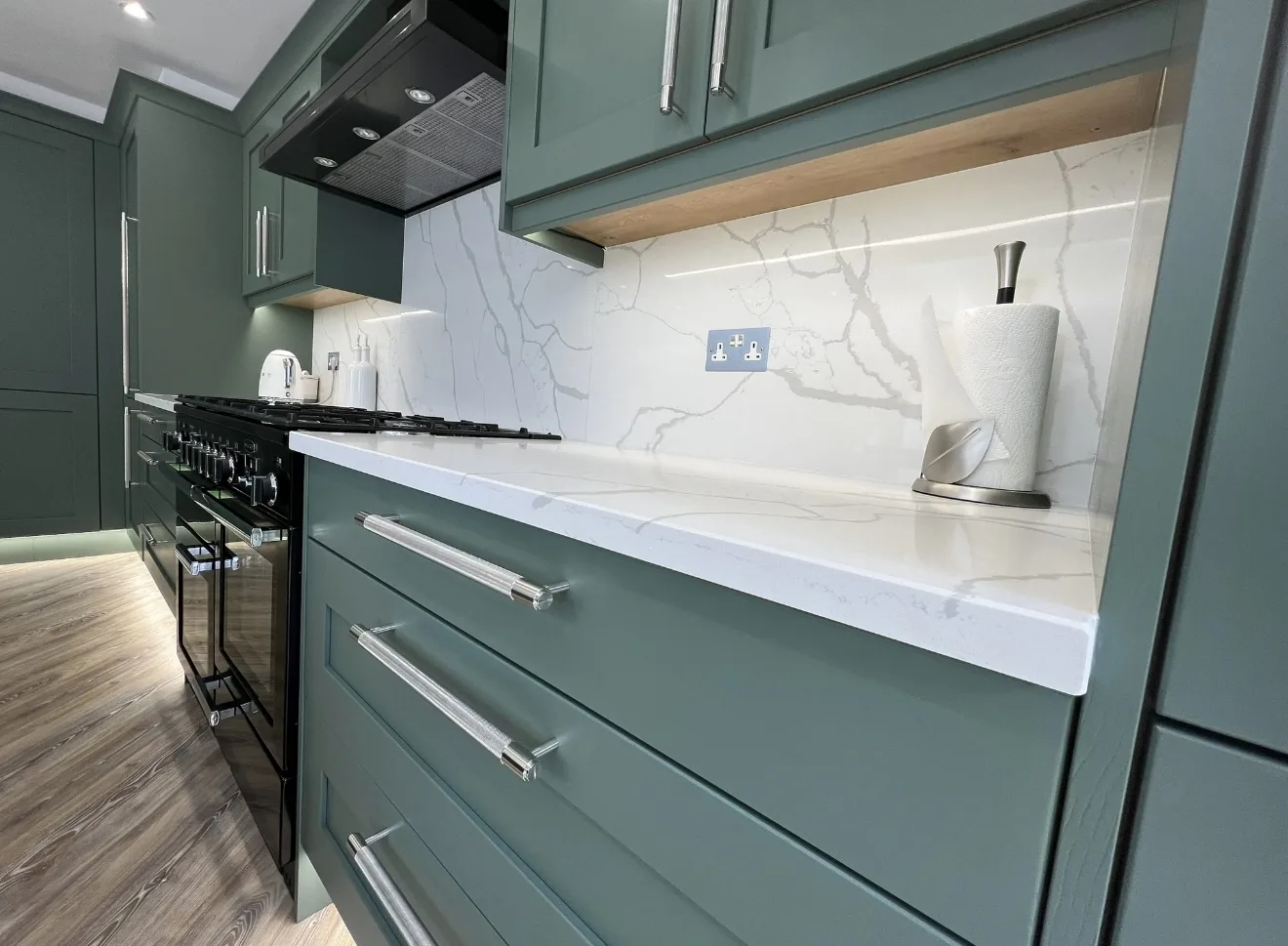
The remainder of a slab is part of the price whether it is fitted or left behind, and that is the honest reason short awkward lengths cost what they do. Short lengths nest well and waste little, so the material line is usually the kindest part of a galley quote. Multiplying your worktop area by something between £110 and £550 gives you a material bill rather than a job cost, and the two are far enough apart to be worth keeping separate. Nothing about the stone is folded into a rate and hidden there.
Get it priced
1930s and inter-war semis
The carry, and what it rules out
Where the drive is shared, the half-hour the van spends in the way is agreed with the neighbour in advance rather than apologised for at the time. Sealer wants warmth and ventilation as well as a dry face, so a cold damp morning moves the last hour of a granite kitchen rather than cancelling it. Dust from a sintered slab belongs at the works, not on a street.
1930s and inter-war semis
What Heathfield asks for
The stock here does not generate much of this. What it generates is worktop replacement, worktop installation and worktop splashbacks & upstands. The job itself is surveyed, quoted and fitted exactly as it would be anywhere else we work.
1930s and inter-war semis
Heathfield in the housing figures
Locally most of the stock dates from the building boom of the twenties and thirties. Older housing of that kind was planned around a chimney, so the usable lengths arrive in pieces and the pieces decide how much of a slab is ever seen. Opening a second slab is a jump, and extra length is only a gentle climb.
Access
Getting stone into a Heathfield kitchen
Bounded by the A316 and the Duke of Northumberland's River, so approach roads are limited and the estate layout is loops and cul-de-sacs; parking is on-street or on short driveways with a turning head that fits a van.
Tell us what the approach looks like when you book the template and it gets built into the day rather than discovered on it. Where the route is genuinely tight, it changes how the pieces are cut, which is a fabrication decision rather than a delivery one.
5–10 working days
From template to fitted, working days from template. The same on this patch as every other.
south west London patch
Heathfield is covered on our south west London run, along with the rest of Richmond upon Thames.
We come to you
Templated in your kitchen, cut in our workshop, fitted by our own installers.
Access told straight
If the route forces an extra join, you hear that at quote stage, not on the day.
Questions
Questions we get asked in Heathfield
If yours is not here, ring and ask. You get a straight answer rather than a call-back from a salesperson.
Which postcodes do you cover around Heathfield?
Yes. Heathfield is on the patch, and the postcodes we work here are TW2. It is worked on our south west London run, along with the rest of Richmond upon Thames. A step up from the drive to the threshold turns the last two metres into a lift, and a lift is where two pairs of hands become the minimum. Whatever the standing allows, the stone leaves that van finished, because every edge, cut-out and internal radius is machined at the works and none of it is open to reconsideration at the kerb. The offcut is yours if you want it and ours if you do not. The measuring and the fitting are both done at the property, so there is nothing to visit or collect.
What is different about worktops in Heathfield?
An inter-war terrace is wider than a Victorian one and shallower than a semi, so the kitchen is a compact square room rather than a galley. Side light from the garden is what lets a stone with movement in it actually be seen, which is why a busier granite or a veined quartz earns its keep here and a flat single colour rarely does. Cool artificial light turns a warm stone grey. Alcove pieces get cut oversize on both scribe edges, with the true wall angles carried on the template drawing rather than assumed. Every notch and every scribe is machined into the piece before it leaves the works, and a hard sintered surface is the least forgiving of a tight internal corner, so one is always cut with a generous radius. Every notch is machined on the bench and none on site.
Is access a problem in Heathfield?
A loading bay or a red route puts a clock on the unload, so the pieces come off in the order they will be fitted rather than the order they were loaded. That caps the longest piece, and a run split into two lengths nests differently on the slab, which moves the yield and moves the figure with it. The route rewrites the cut list, and the cut list is the price. Where the van cannot turn on the plot it has to arrive already facing the right way, so the approach along the street is part of the plan. A granite kitchen ends its day with a sealer, and a sealer wants a dry face and a quiet hour afterwards, so that hour is written into the day rather than borrowed from it. A sealer needs a dry face and a quiet hour after it.
Do you get much worktops work in Heathfield?
Not really, and claiming otherwise would cost nothing and mean nothing. What the research on this patch actually lists is worktop replacement, worktop installation and worktop splashbacks & upstands. It reflects the local housing rather than any difference in the work. It is quoted, cut and fitted here the same way it is anywhere else on the patch. Extension budgets are usually well spent by the time the worktop is ordered, which is where the choice between quartz and a thinner sintered stone actually gets made. Where several kitchens are ordered together the sensible move is to take them all off one batch, because two slabs of the same name bought six months apart will not sit happily in the same building. Drawing lengths and room lengths are rarely the same lengths. Rear and side-return extensions are where the islands appear, and an island is the piece that decides whether one slab does the kitchen or two. Volume work tends to live at the entry end of the range, and the entry end is genuine stone rather than a compromise, since the lowest supply figure we quote is a sintered surface and not a thin laminate pretending to be one. The cheapest stone we fit is sintered, and it is still stone.
What makes one Heathfield kitchen dearer than the next?
A full-depth tall unit projects past the worktop line, and the run has to be scribed against its side panel instead of carrying on past it. A shape like that nests kindly on a slab, so more of what gets bought ends up on the units and the rate per square metre behaves much as the brochure says it will. A single straight run is the cheapest stone you will ever buy. Supply-only material is £110 to £550 per square metre, and templating, fabrication and fitting are quoted separately rather than rolled in.
What holds a template up more often than anything else?
Where a breast interrupts a long wall the join can often go there, so it reads as a natural break rather than a line in the middle of a worktop. A hob dropped into the middle of a length puts sustained warmth at the lip of a cut-out, and an engineered surface will yellow there across ten years where a natural one takes it without comment. Water standing daily is what makes porosity matter. Confirm the depth of the units, the total run lengths and whether an island or peninsula is going in, and tell us the colour temperature of the lighting. One owner can take a date next week while the flat below needs three weeks of notice, so several kitchens in one building end up scheduled by the slowest permission. That changes which questions are worth asking about the stone, because somebody staying put wants to know how a honed face marks in five years and somebody selling wants to know how it photographs next spring. Cleaning spray, not showroom light, should decide the finish.
Is taking the old top off part of the job?
Old laminate is light and awkward rather than heavy, so it is usually the easier half of the day. Disposal means it goes in the van, not into the garden to wait for a collection. What comes out goes by the same route the new stone comes in by, which is why that route is walked before anything is lifted. A drive behind an electric gate depends on somebody being in to open it and on the gate staying open while the load comes off. Sintered surfaces are the hardest of the three to machine and the messiest to cut wet, which is precisely why none of that happens on a public pavement. Wet stone reads darker, which is why colour is judged indoors.
Do you check the carcasses before templating in Heathfield?
If the carcasses are corrected, the template is taken again, since a drawing off units that then moved is worthless. An island is where this usually shows, standing free with no wall to level against. Units have to be fixed down as well as levelled. A loose carcass moves under stone. The returns into a breast recess are the tightest scribes in the room, and they are eased in rather than forced. A run that sits under strong sun for hours every afternoon suits a surface built to be stable in daylight, because a resin-bound stone is made for indoor use and sustained sunlight is the one thing it was never designed around. Brittle stone and narrow returns are a poor pairing.
What if a worktop will not physically fit through the building?
Splitting a run costs a join, and that is the price of getting stone into the room at all. Where there is a lift, whether it can be booked out and padded matters as much as its size. A piece travels on edge, never flat, because on edge is how stone of that length carries its own weight. The van gets close to the door and the stone comes off the tail lift onto a trolley, which is about the shortest carry we ever get. Where a seam becomes unavoidable the choice of stone starts to matter, because a fine even speckle closes a joint almost invisibly and a broad vein simply will not. Speckle forgives a joint that a sweeping figure never would.
Does my sink have to be on site before you template in Heathfield?
Each cut-out is priced on its own line, so a range, a bowl and a half, a boiling tap and a drainer are four items rather than one. A boiling tap needs a hole of its own and a cupboard below for the tank, so the units change too. Where the hob lands is set out against the units and the wall behind, not off the kitchen plan. Where the sink and the hob face each other across the aisle, everything carried between them crosses the walkway, and that is the one movement the shape cannot design out. An island is the piece that decides whether one slab covers the kitchen or two, and a second slab arrives as a step in the figure rather than a gentle slope. Nesting is where the quiet savings on a kitchen live.
Reviews
5.0 from 26 Google reviews
Every one of these is on our Google profile under the reviewer’s own name. Nothing here is written by us, and the link goes straight to the source.
Nice work from worktop worx. Highly recommended
Rasika Kumarage
Google review
Lovely team, business and quality motivated, prompt delivery with installation. Affordable prices. Wide range of worktops available. High recommendation
Loreta Skalisiene
Google review
Great service. Super quick and easy communication. I love my new worktop 🥹🥹
Sara Arghir
Google review
Related
More around Heathfield
Other work we do in Heathfield
Next step
Worktops in Heathfield, priced properly
Plans, a sketch or photographs with rough run lengths is enough to start. You get an itemised written quote and the template dates we can offer on this patch.
25-year material warranty and a 5-year workmanship guarantee, both stated on your quote.