
Lewisham · SE13 SE4
Worktops in Ladywell
The surface itself: which stone, what it costs by the square metre, and what the room does to that number.
- 5.0from 26 Google reviews
- 25-year material · 5-year workmanship
- Fitted 5-10 working days from template
Ladywell kitchens
The kitchens we meet in Ladywell
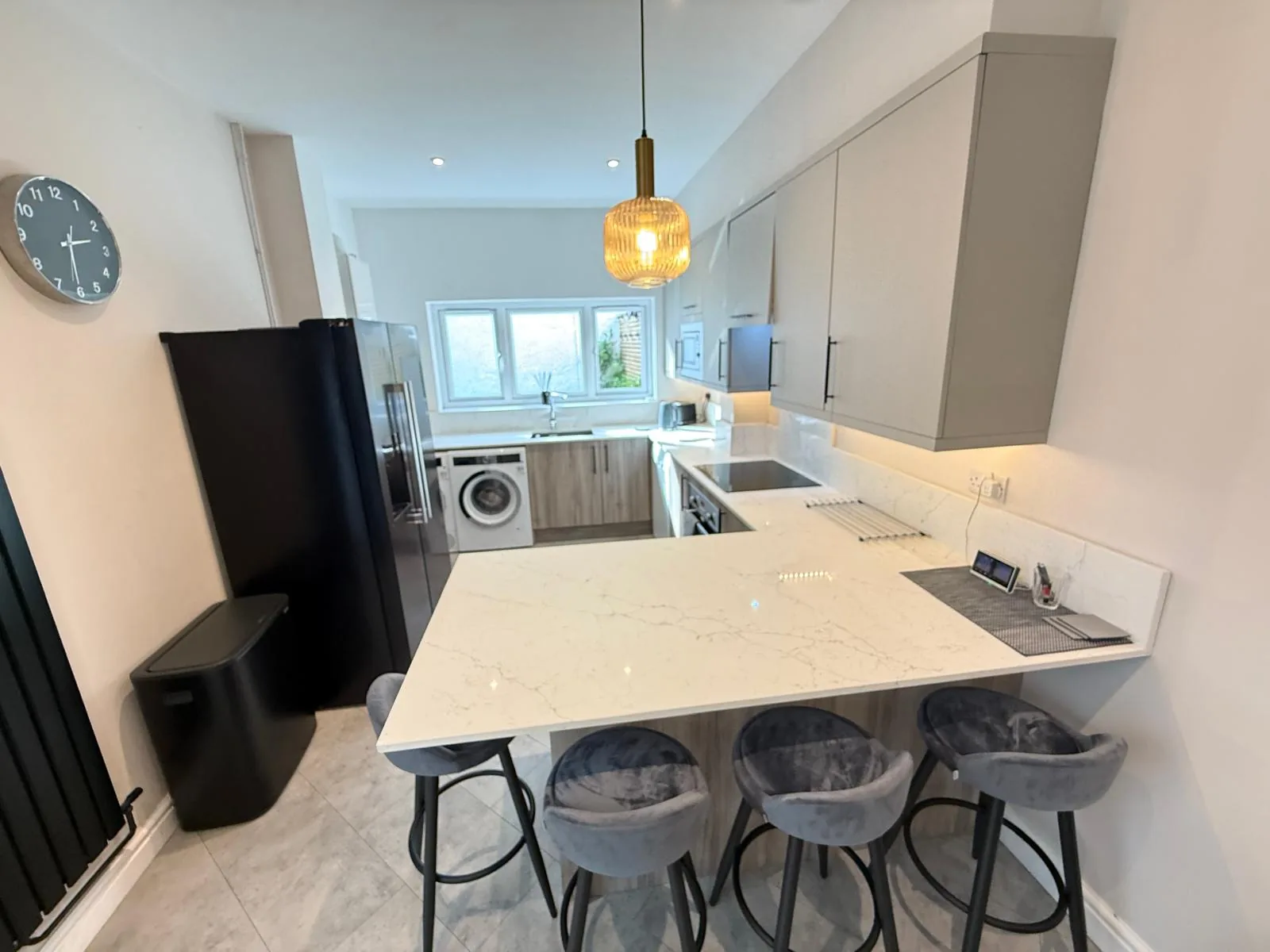
We plan the worktop jobs in Ladywell around access, ceiling height and what the kitchen has already been through, none of which shows up in a phone call. Conservation-area Victorian terraces and semis, many split into upper and lower flats, lower flats get the garden and a rear extension with a proper kitchen-diner, upper flats keep a compact galley over the back addition with a sloping ceiling at one end. Plenty of kitchens do not match either description exactly, which is what the measured survey is there to sort out.
There is usually a step down into the back addition, so the kitchen floor and the hall floor are not the same level and neither of them is flat. Heat is worth settling before anything else, since granite takes a pan straight off a burner and an engineered surface holds a scorch for the rest of its life. A week with a sample on the units beats an hour in a showroom.
These were built late enough to have a damp course and proper footings, so the front of the house is close to true and the rear addition holding the kitchen is the part that has dropped. The alcoves either side of a breast break the run into short pieces, and short pieces are exactly where buying a full slab outright starts to beat buying stone by the metre. A compact kitchen puts the band ahead of the metreage.
On these streets the housing is Victorian terrace, Victorian semi-detached villa, 1930s flats and postwar infill. None of them is harder than the others; they are awkward in different ways.
True everywhere
Worktops, in short
- Supply is £110 to £550 per square metre across the 181 surfaces we fit.
- Quartz is engineered, so its pattern repeats and a long kitchen matches itself end to end.
- Granite comes out of the ground porous, which is why it gets sealed.
- Dekton and sintered stone hold their colour under heat and direct sunlight.
- Borough
- Lewisham
- Postcodes
- SE13, SE4
- Covered on
- our south east London run
- Fitted
- 5–10 working days from template
The place
Why Ladywell is its own job
Fitting stone in Ladywell is a question of what the building will allow, and we would rather find that out early. Narrow streets parked on both sides and a level crossing that periodically closes the route through; most flats are walk-ups with a shared front door and a straight but narrow stair. First-floor flat kitchens over a back addition mean a stair carry and usually a piece that has to be turned on the half-landing. A plan on paper will not tell you any of it. A tape measure in the room will.
The work
What worktops involves
Up to four quartz samples are posted out free so a colour can be lived with under your own lighting before a slab is reserved in your name. Where a slab is being reserved for you, it can be seen whole before it is cut, which is the only reliable way to judge movement across three metres of stone. You are left with a worktop machined to the room as found, so the back edge follows the wall instead of leaving a shadow gap at one end of the run.
Worktops come down to three materials, and what separates them is temperament rather than prestige: engineered quartz, natural granite, and sintered surfaces fired hard enough to live outdoors. Every opening is machined at the works with radiused internal corners, because that curve is what stops a crack running out of the corner of a sink aperture. Breasts and alcoves break the run into short lengths, which is the condition where buying the slab whole makes more sense than buying the metres. Heat, water and sunlight sort the shortlist quickly.
The money
What it costs in Ladywell
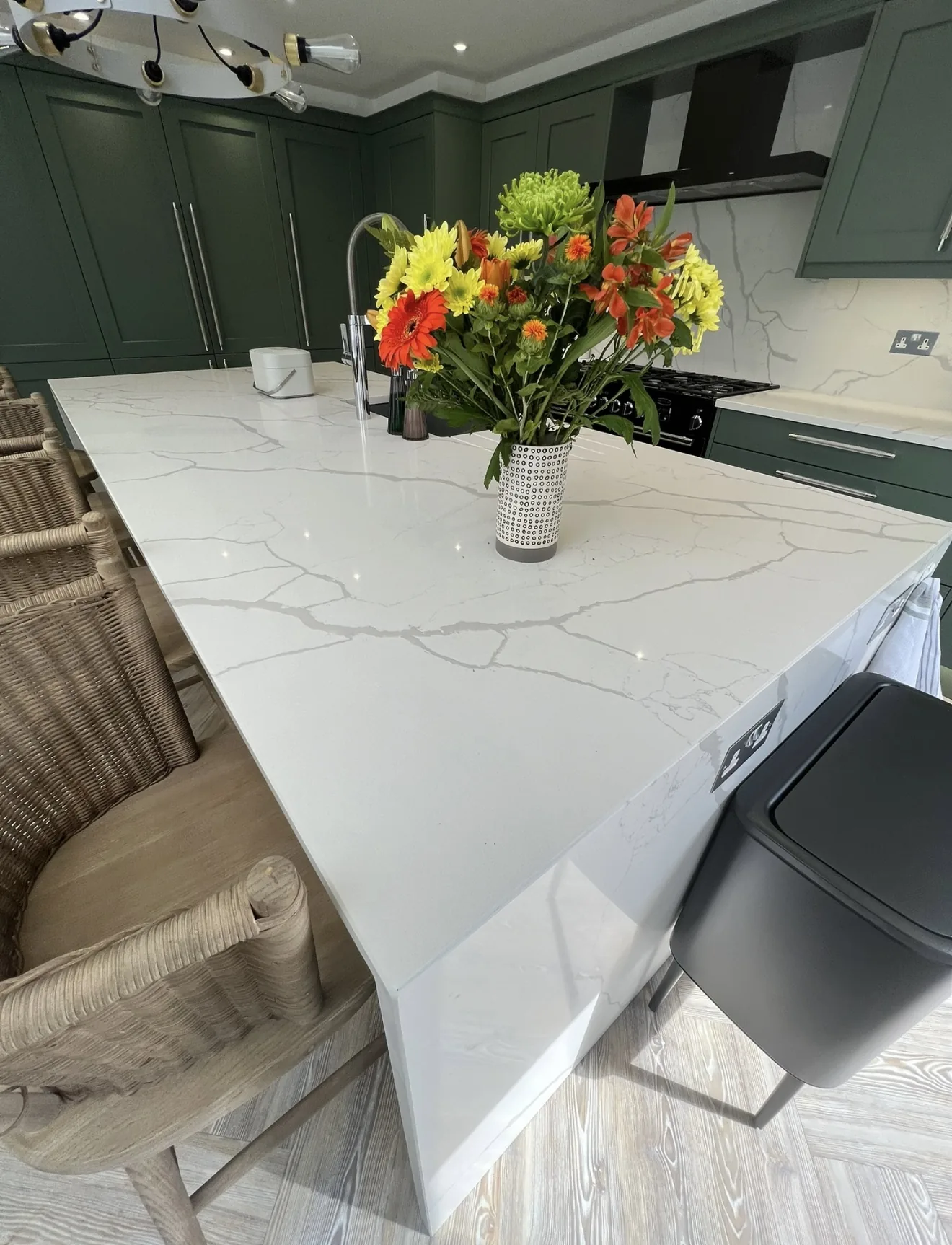
A worktop is priced from the cut list rather than the floor area, because the slab is bought whole and the run lengths decide how much of it ends up on your units. Two facing runs mean two sets of edges and two scribes in a small span, which is why a compact galley rarely prices as cheaply as its area suggests. Supply-only material sits between £110 and £550 per square metre, which is one input into the quote rather than the quote. Priced off the cut list, never off the floor plan.
Get it priced
Victorian and Edwardian terraces
What Ladywell asks for
Party-wall and lease conditions in a converted building set when noisy work can happen, which shapes the fitting day more than the kitchen does. Rooms built for hard daily cooking push the shortlist towards bodies indifferent to thermal shock and away from anything holding a resin binder. Two slabs bought a season apart are two different stones.
The housing on this patch does not throw up much of this. It throws up worktop replacement and worktop fabrication. When it does come up, it gets the same template, the same bench and the same crew.
Victorian and Edwardian terraces
Ladywell in the housing figures
Locally upper-band homes are rare in the stock. Every survey starts from a blank sheet. Where a scheme is phased across seasons the dye lot drifts underneath it, which is why a whole requirement is reserved at once even if it is cut in stages. Old fabric buys deep scribes, and deep scribes buy slab.
Access
Getting stone into a Ladywell kitchen
Narrow streets parked on both sides and a level crossing that periodically closes the route through; most flats are walk-ups with a shared front door and a straight but narrow stair.
Tell us what the approach looks like when you book the template and it gets built into the day rather than discovered on it. Where the route is genuinely tight, it changes how the pieces are cut, which is a fabrication decision rather than a delivery one.
5–10 working days
From template to fitted, working days from template. The same on this patch as every other.
south east London patch
Ladywell is covered on our south east London run, along with the rest of Lewisham.
We come to you
Templated in your kitchen, cut in our workshop, fitted by our own installers.
Access told straight
If the route forces an extra join, you hear that at quote stage, not on the day.
Questions
Questions we get asked in Ladywell
If yours is not here, ring and ask. You get a straight answer rather than a call-back from a salesperson.
Which postcodes do you cover around Ladywell?
Yes. Ladywell is on the patch, and the postcodes we work here are SE13, SE4. It is worked on our south east London run, along with the rest of Lewisham. On a street with no restrictions the constraint is other residents rather than a warden, so it is worth putting a cone or a car out early. Whatever the standing allows, the stone leaves that van finished, because every edge, cut-out and internal radius is machined at the works and none of it is open to reconsideration at the kerb. A honed face marks on grit, so nothing is set down bare. Nothing needs visiting and nothing needs collecting: the template is in your kitchen and so is the fit.
Why would worktops in Ladywell be any different from anywhere else?
The kitchen occupies the ground floor of the addition with a garden door at the far end, so there is a second way in that is narrower than the front door and a great deal shorter. The kitchen in one of these sits in the back addition and takes its daylight from one end, so the working half of the run is the darker half and a pale stone with a honed or matt face does more there than any colour with depth in it. Cool artificial light turns a warm stone grey. A cill projecting forward of the plaster line pushes the back edge out, and the units then stand off the wall by that amount for the whole length. Every notch and every scribe is machined into the piece before it leaves the works, and a hard sintered surface is the least forgiving of a tight internal corner, so one is always cut with a generous radius. Sealing suits stone that drinks; nothing else needs it.
What is the carry like in Ladywell?
A steep pitch shortens the tread and lengthens the reach, which leaves whoever is below carrying most of the weight for the full flight. That caps the longest piece, and a run split into two lengths nests differently on the slab, which moves the yield and moves the figure with it. Where a break is unavoidable it goes into the quietest part of the pattern. A free-parking street with cars both sides can still leave the van forty metres away, and that distance is carry, not driving. A granite kitchen ends its day with a sealer, and a sealer wants a dry face and a quiet hour afterwards, so that hour is written into the day rather than borrowed from it. The last hour on a granite kitchen belongs to the sealer.
Is Ladywell really a worktops area?
Not to any real extent, and it would be easy to imply it was. What the research on this patch actually lists is worktop replacement and worktop fabrication. It describes the kitchens on this patch, not the work that goes into them. Same quoting, same cutting, same fitting as anywhere else on the patch. Several units in one building are fitted out to the same drawing, so an error on that drawing is an error repeated in every flat. Where several kitchens are ordered together the sensible move is to take them all off one batch, because two slabs of the same name bought six months apart will not sit happily in the same building. Buying for hard use is a different exercise from buying for looks. A converted flat is measured off the original house, so no two units in the same building have quite the same kitchen run. Volume work tends to live at the entry end of the range, and the entry end is genuine stone rather than a compromise, since the lowest supply figure we quote is a sintered surface and not a thin laminate pretending to be one. The remainder of a slab is bought whether it is fitted or not.
Where does the money go on a Ladywell worktop?
Two parallel runs with a walkway between them is the most efficient shape there is on a slab, because both pieces nest as straight lengths with almost no waste. A shape like that nests kindly on a slab, so more of what gets bought ends up on the units and the rate per square metre behaves much as the brochure says it will. Nesting is where the quiet savings on a kitchen live. Stone is £110 to £550 per square metre supply only, and the templating, the fabrication and the fitting each carry their own line.
What needs to be ready before you come to Ladywell?
Where the sill lands inside the height an upstand would occupy there is no upstand, and the stone either dies into the reveal or stops short of it. A hob dropped into the middle of a length puts sustained warmth at the lip of a cut-out, and an engineered surface will yellow there across ten years where a natural one takes it without comment. A dark plain face shows every made-good line on the run. Send the run lengths, say where the sink and hob will sit, and tell us which way the room faces and what lighting is going in above the working run. One owner can take a date next week while the flat below needs three weeks of notice, so several kitchens in one building end up scheduled by the slowest permission. That changes which questions are worth asking about the stone, because somebody staying put wants to know how a honed face marks in five years and somebody selling wants to know how it photographs next spring. A week under your own lights is how a colour declares itself.
What is the order of events on a Ladywell kitchen?
The fitting itself is one visit: a plain run is a morning, an island with splashbacks takes most of the day. Nothing is measured until the sink, the tap and the hob are in the room to measure against. The same firm templates and fits. Nobody else is brought in to install. Sash windows sit low in the rear wall, and the sill often lands below the height a worktop wants to run past. Which stone belongs on top of all that is a separate question from the building itself, and it is the one with a figure attached, because supply alone runs from £110 to £550 per square metre before a single cut has been made. Thickness changes the look and the figure in the same breath.
Do you take the old worktop away?
What comes out goes by the same route the new stone comes in by, which is why that route is walked before anything is lifted. An old stone top is heavier coming out than the new one is going in, and leaves in sections. Disposal means it goes in the van, not into the garden to wait for a collection. Where the van can pull up level with the gate the pieces are handled the fewest times, which is what actually protects them. Sintered surfaces are the hardest of the three to machine and the messiest to cut wet, which is precisely why none of that happens on a public pavement. What stands on the van is finished stone, not raw slab.
What is the difference between an upstand and a splashback?
It is quoted by area like the worktop, so a long run is a material line rather than a trim. Ordered later from a different batch, the match is not reliable where the two pieces meet. If it is a decision for later, say so at the template: the match is a question about the batch. The chimney breast has almost always been taken out of the kitchen with the stack left standing above it, so that bay of wall is newer plasterwork on a different plane. Alcoves either side of the old breast chop the run into short lengths, and a kitchen made of short lengths is the case where buying a slab outright beats buying the square metres, because the remainder is paid for in both. Open-plan surfaces are furniture before they are work surfaces.
Do you cut drainer grooves on Ladywell kitchens?
The bowl position has to be settled before templating, since the grooves are set out from it. They read strongly across a dark stone and are nearly invisible on a pale one, so look before deciding. Grooves are machined in the workshop at the same time as the bowl cut-out, because they cannot be done well in a kitchen. The side return was an outside toilet and a coal store before it was ever a kitchen, and the walls left over from that are half a brick thick. The surface is where the money actually moves: across the 181 kitchens fitted the median is £220 per square metre, and half of them land between £165 and £300. Veining is a question of scale, and a postcard has no scale.
Reviews
5.0 from 26 Google reviews
Every one of these is on our Google profile under the reviewer’s own name. Nothing here is written by us, and the link goes straight to the source.
We recently had our kitchen worktops supplied and fitted by Worktop WorX using Laurent Gold sintered stone, and we couldn’t be happier with the result. The finish, quality, and attention to detail were outstanding from start to finish. Karem was incredibly helpful throughout the whole process professional, knowledgeable, and always available to answer any questions. The new worktops have completely transformed our kitchen and look amazing. Highly recommend Worktop WorX to anyone looking for high quality kitchen worktops, bespoke workmanship, and excellent customer service.
Gabriel Tivadar
Google review · Laurent Gold sintered stone
Kareem did the countertops dur8ng my kitchen remodel, and I was so impressed that I had him back to do the laundry room as well, which tells you everything you need to know. He is an absolute gem. Shows up when he says he will (which, let’s be honest, is rarer than it should be), does beautifully work, and clearly takes real pride in what he does. The countertops look fantastic, and he even went above and beyond, using leftover quartz to create an extra counter in my bathroom. Genius. He’s kind, professional, reasonably priced, and just gets on with it. No fuss, no drama, just a job very well done. I wouldn’t hesitate to recommend him and will absolutely be using him again if the need arises. Happy to answer any questions.
Susie Wiggins
Google review
Karim is excellent, he did superb job with Templeting and fitting my kitchen, highly recommend
M Sg
Google review
Related
More around Ladywell
Other work we do in Ladywell
Next step
Worktops in Ladywell, priced properly
Plans, a sketch or photographs with rough run lengths is enough to start. You get an itemised written quote and the template dates we can offer on this patch.
25-year material warranty and a 5-year workmanship guarantee, both stated on your quote.