
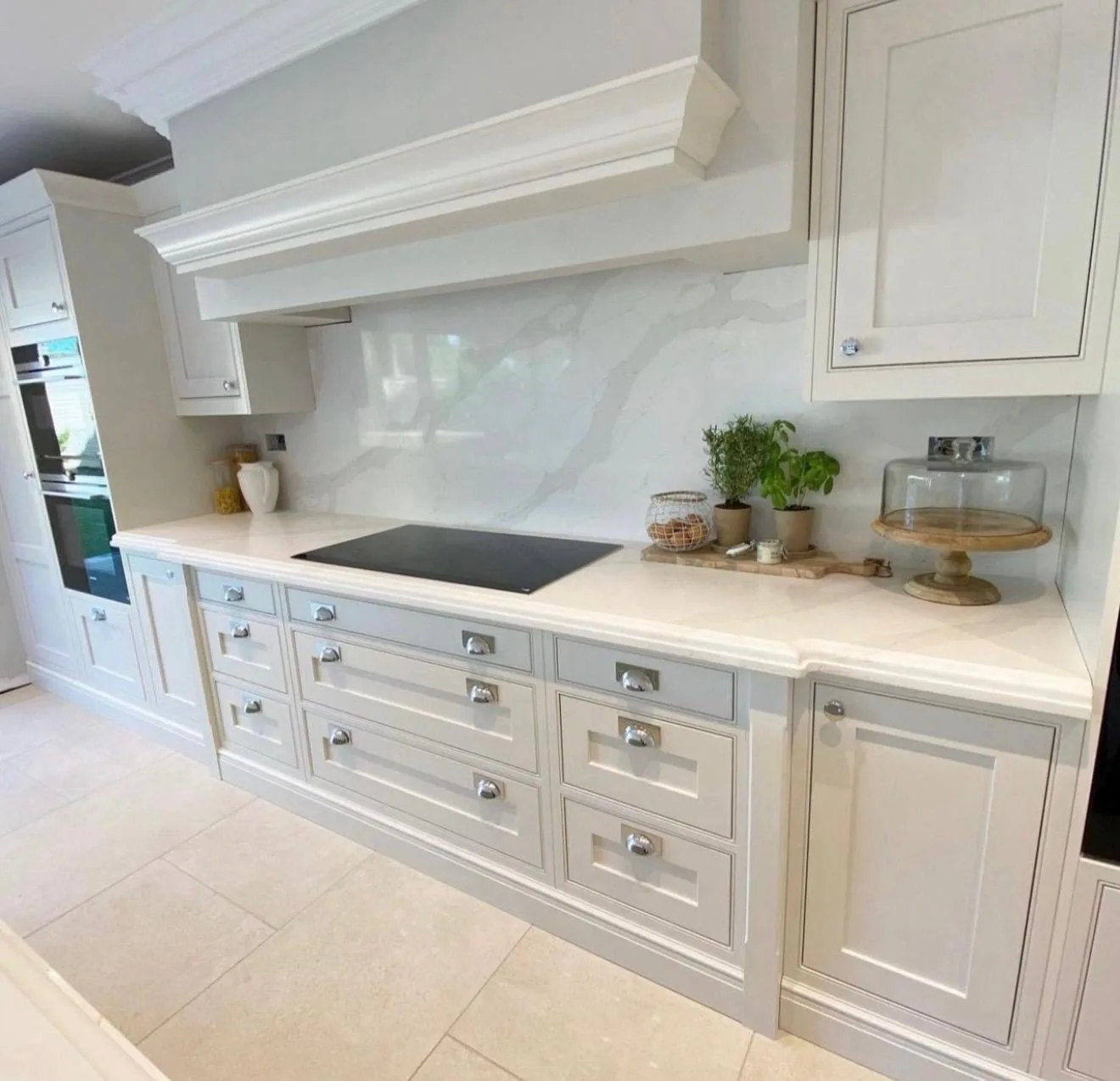
Sutton · SM6
Worktops in Roundshaw
The surface itself: which stone, what it costs by the square metre, and what the room does to that number.
- 5.0from 26 Google reviews
- 25-year material · 5-year workmanship
- Fitted 5-10 working days from template
Roundshaw kitchens
The kitchens we meet in Roundshaw
Understanding stone worktop supply and fitting in Roundshaw means understanding the kitchens it happens in, which is a more interesting subject than most people expect. Built on the old Croydon Airport land and largely rebuilt since, so the housing is modern-estate standard: compact kitchens of around 2.7m in an open-plan or semi-open layout, with a washing machine in the run because there is no utility. A worktop that fits is a worktop that was measured. The description is background, the template is the actual instruction.
The balcony door frequently opens off the kitchen, which puts a threshold, a draught and a well-used route through one end of the run. Run lengths are what turn a rate per square metre into a bill, since a slab is bought whole and the part of it nobody uses is paid for all the same. Edges are charged along their length, not across the surface.
The window cill clears a worktop by very little, which settles how tall the upstand under it can be before anyone has drawn a thing. These kitchens work hard, which argues for surfaces that ask for nothing: engineered stone for its consistency, sintered stone where heat and scratching are daily. Seen from both sides, the figure has to run continuously.
The houses and blocks behind these jobs are 1970s estate housing, 1990s-2000s rebuilt estate housing, low-rise flats and housing association terrace. The run length that is easy in one is a join in another.
True everywhere
Worktops, in short
- Supply is £110 to £550 per square metre across the 181 surfaces we fit.
- Quartz runs £130 to £500 per square metre, granite £121 to £550 and Dekton £110 to £366.
- Templating is done in the room itself, once the units are fixed and level.
- Fitting happens five to ten working days after the template is taken.
- Borough
- Sutton
- Postcodes
- SM6
- Covered on
- our south London run
- Fitted
- 5–10 working days from template
The place
Why Roundshaw is its own job
Most of the work of a fit in Roundshaw happens before the van is loaded, in what we have already checked and allowed for. Parking courts and pedestrian decks rather than roadside frontage, controlled bollards on some routes, and communal entrances to the flatted blocks with an intercom. With the washing machine in the worktop run the cut-outs sit close together, so the piece needs a support rail across the appliance gap or it will flex when the machine spins. It is our problem to solve, and solving it starts with a tape measure.
The work
What worktops involves
Worktop supply and fitting covers the stone itself, machined to your room: the surface, the polished edges, the openings for sink, hob and tap, and the fitting of the finished pieces. Fitting follows the template by five to ten working days, and the pieces arrive finished, with joins bonded in a resin mixed to the colour of the slab. You end up knowing what your surface will and will not tolerate: the hot pan, the sunlight through the window and the spray under the sink.
Two published figures describe how a body deals with water: how much it absorbs, and how fast. Between them they decide whether sealing is in your future. Colour under the kitchen lights is the thing samples exist to settle, and a warm bulb will pull a cool grey brown while a cool one drains a cream stone of everything generous in it. Even daylight through generous windows means a mid-tone reads properly instead of going flat. Chosen under your own bulbs, not under ours.
The money
What it costs in Roundshaw
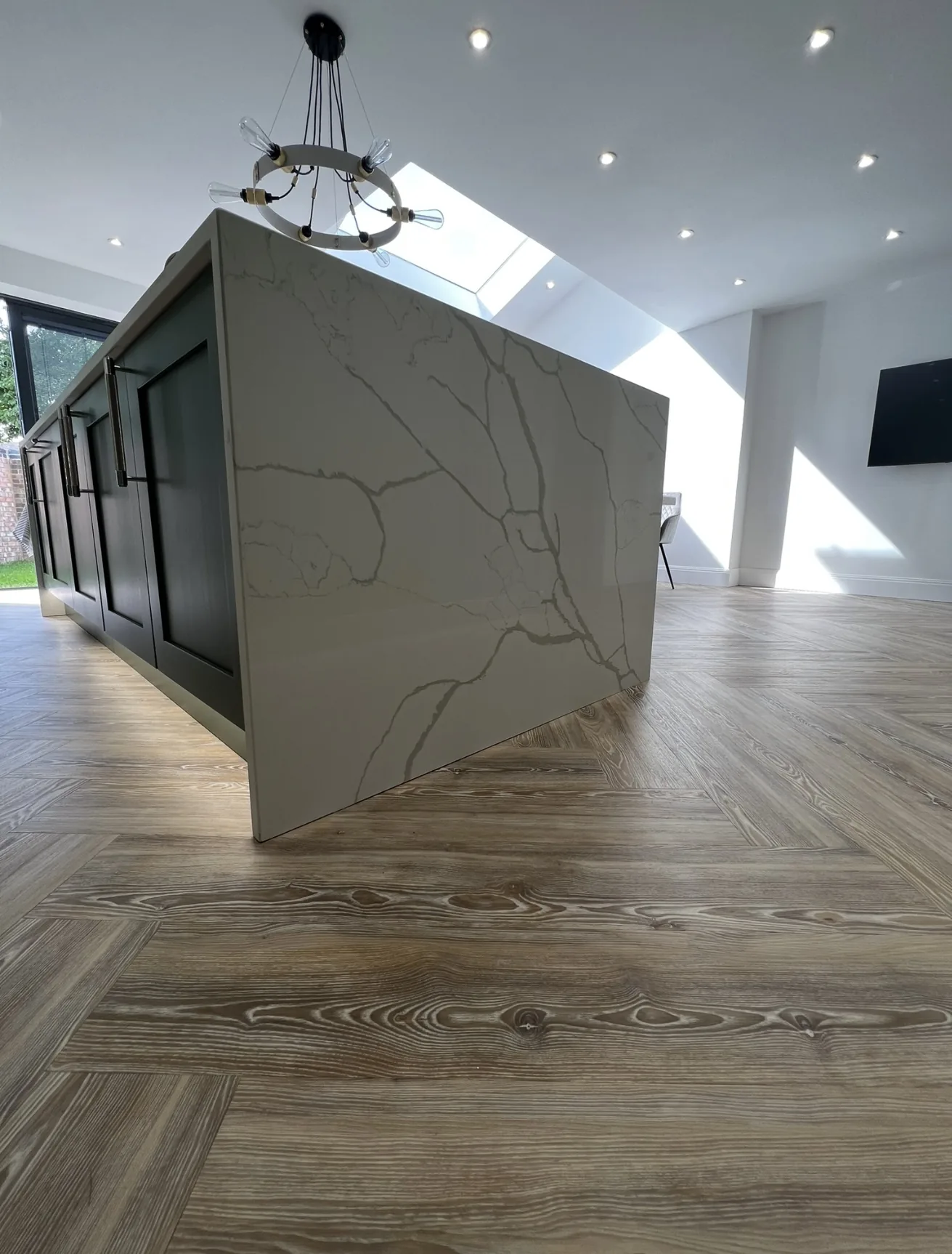
A worktop is priced from the cut list rather than the floor area, because the slab is bought whole and the run lengths decide how much of it ends up on your units. Two facing runs mean two sets of edges and two scribes in a small span, which is why a compact galley rarely prices as cheaply as its area suggests. For a rough sense of the material, £110 to £550 per square metre supply only is the honest span. Treat it as one line of a quote that will carry several more. The slab, then the machining, then the fitting, each on its own line.
Get it priced
ex-local-authority flats and estates
What Roundshaw asks for
Residents are given written notice before anyone attends, and that notice period rather than the workshop is what governs the earliest sensible start. That changes which questions are worth asking about the stone, because somebody staying put wants to know how a honed face marks in five years and somebody selling wants to know how it photographs next spring. A surface chosen for a photograph rarely survives the cooking.
It would be overstating it to call this a speciality on this patch. Worktop replacement, worktop installation and worktop splashbacks & upstands are far commoner. None of that changes the survey, the cut list or the fit.
ex-local-authority flats and estates
Roundshaw in the housing figures
Taken across Roundshaw and the roads either side of it, the housing went up after the First World War, so the walls run truer than the London average. Boxed pipework behind a run eats into the allowance left for dressing to a wall, and that allowance is what keeps a template honest where the plaster wanders. Whatever the building imposes turns up in the stone bill.
Access
Getting stone into a Roundshaw kitchen
Parking courts and pedestrian decks rather than roadside frontage, controlled bollards on some routes, and communal entrances to the flatted blocks with an intercom.
Tell us what the approach looks like when you book the template and it gets built into the day rather than discovered on it. Where the route is genuinely tight, it changes how the pieces are cut, which is a fabrication decision rather than a delivery one.
5–10 working days
From template to fitted, working days from template. The same on this patch as every other.
south London patch
Roundshaw is covered on our south London run, along with the rest of Sutton.
We come to you
Templated in your kitchen, cut in our workshop, fitted by our own installers.
Access told straight
If the route forces an extra join, you hear that at quote stage, not on the day.
Questions
Questions we get asked in Roundshaw
If yours is not here, ring and ask. You get a straight answer rather than a call-back from a salesperson.
Is Roundshaw on your patch?
Yes. Roundshaw is on the patch, and the postcodes we work here are SM6. It is worked on our south London run, along with the rest of Sutton. Where parking runs down both sides the road is left as a single lane, and a van standing in it has to be somewhere it does not stop a bin lorry. A granite kitchen ends its day with a sealer, and a sealer wants a dry face and a quiet hour afterwards, so that hour is written into the day rather than borrowed from it. The face is uncovered once, and that once is at handover. Both visits happen in your kitchen, the template and the fit, so there is nothing to visit and nothing to collect.
Does the housing in Roundshaw change how worktops works?
The hot water cylinder sits in a cupboard opening off the kitchen or the landing above it, and the pipework to it drops through the corner of the room. Kitchens in this stock are compact and worked hard, so the surface is chosen for indifference rather than for attention: quartz where consistency matters, sintered stone where heat and scratching are daily events. Side light flatters movement and wastes a flat colour. Where the boxing stands proud of the finished wall the upstand behind it has to be broken into separate lengths, because one piece cannot pass it. Every notch and every scribe is machined into the piece before it leaves the works, and a hard sintered surface is the least forgiving of a tight internal corner, so one is always cut with a generous radius. Movement in a stone needs length to read as anything at all.
How does the stone actually reach a kitchen in Roundshaw?
Sign-in at the gate, a permit on the dash and a named contact are usually wanted before anything comes off the van. That caps the longest piece, and a run split into two lengths nests differently on the slab, which moves the yield and moves the figure with it. Vein direction is settled before the slab is broken into pieces. With no scheme to work with there is nothing to book and nobody to ring, so the only levers left are an early arrival and a word with the neighbours. Sintered surfaces are the hardest of the three to machine and the messiest to cut wet, which is precisely why none of that happens on a public pavement. Stone arrives finished, because a kerb is not a polishing shop.
Does Roundshaw actually ask for worktops?
Not particularly. It would be easy to say yes and leave it there. What the research on this patch actually lists is worktop replacement, worktop installation and worktop splashbacks & upstands. That is about what people have here rather than how it gets done. It is quoted, cut and fitted exactly the same way here as anywhere else on the patch. A new extension slab is not automatically level, and that wants checking before templating rather than after the stone is cut. Where several kitchens are ordered together the sensible move is to take them all off one batch, because two slabs of the same name bought six months apart will not sit happily in the same building. Repeat work rewards a single decision taken carefully. The junction between the original room and the extension is the point to watch, because the two floors rarely sit at the same height. Volume work tends to live at the entry end of the range, and the entry end is genuine stone rather than a compromise, since the lowest supply figure we quote is a sintered surface and not a thin laminate pretending to be one. A surface for a let flat is chosen for the next tenant, not this one.
What am I actually paying for, line by line?
Galley runs are usually short enough to come out of a single slab, so the material band you choose does more to the total than the room shape does. A shape like that nests kindly on a slab, so more of what gets bought ends up on the units and the rate per square metre behaves much as the brochure says it will. The number follows the layout far more closely than the floor plan. Material runs £110 to £550 per square metre supply only, and templating, fabrication and fitting each get their own line.
Is there anything I have to finish before the template in Roundshaw?
A boxed soil stack or service riser in the corner of a run eats into the worktop depth and has to be scribed around rather than cut square. A hob dropped into the middle of a length puts sustained warmth at the lip of a cut-out, and an engineered surface will yellow there across ten years where a natural one takes it without comment. A tight inside corner is where brittle material gives up. Send the run lengths, a photograph of each corner so we can see the boxings, and tell us how the kitchen is used day to day. A leaseholder paying for their own kitchen inside managed stock still needs the freeholder to consent, and that consent is about the building and the common parts rather than about the worktop. Where nobody will be around to maintain it, the surface is chosen for indifference: an engineered top asks for nothing beyond a cloth, while a natural one wants sealing and someone willing to do it. The guarantee is only useful to whoever can find it.
What happens if my units are not level?
A long top on units that were shimmed once and never checked is the commonest version of this, and it is cheap to fix beforehand. Stone does not flex, so a run that rocks on its carcasses rocks just as badly once it is stone. Units have to be fitted, fixed and level before templating, and it is better to hear that at the template than on the fitting day. Boxing is rarely the same depth at worktop height as it is at floor level, so measuring it low down is the usual reason a top will not sit back. A run that sits under strong sun for hours every afternoon suits a surface built to be stable in daylight, because a resin-bound stone is made for indoor use and sustained sunlight is the one thing it was never designed around. The wall decides the scribe and the scribe decides the depth.
Who decides where a join falls?
Each join is an item on the drawing, so the layout and the figure move together. Dark and heavily veined stone shows a join more than a pale even one, which is worth knowing before the slab is picked. There are only ever a few legal positions, and the one taken is furthest from the light. The walkway between the two runs is fixed by the units either side, so any overhang added to one worktop comes straight off the space somebody has to stand in. An island is the piece that decides whether one slab covers the kitchen or two, and a second slab arrives as a step in the figure rather than a gentle slope. A clean nest on the slab is the cheapest thing a shape can do.
Do you quote Roundshaw jobs by the square metre?
The design and quotation visit is free and carries no obligation, so a figure exists before any commitment. What is quoted is what the drawing says, and the figure does not move unless the drawing does. Material is quoted supply only and templating, fabrication and fitting sit on their own lines, so it is visible which part is stone and which is labour. Anything that has to stay accessible, a stopcock, a gas meter, a riser panel, is marked on the template so the stone is cut around it instead of over it. A deep scribe eats into the back of the piece, which is quietly important on a stone with directional figure, since the pattern moves backwards as that depth comes off. Sealing suits stone that drinks; nothing else needs it.
What do you need from me for the sink and hob cut-outs?
A piece with a bowl and a hob cut into it is the fragile one, and it is handled accordingly. Two bowls means two cut-outs and a bridge of stone between them, which decides where the sink can go. The tap hole is drilled in the workshop too, and its position depends on how far the tap has to swing. Both runs are in view at the same time, so the two pieces are taken off the same area of slab and the veining is set to run the same way on each side. A mitred corner asks the pattern to turn through a right angle, which an even speckle does without comment and a marble-look stone makes a performance of. One slab or two is the biggest single jump in any quotation.
Reviews
5.0 from 26 Google reviews
Every one of these is on our Google profile under the reviewer’s own name. Nothing here is written by us, and the link goes straight to the source.
We have a new kitchen. Our builder recommended Worktop Worx for our worktop. Now we have an amazing worktop very good price too. Really recommend. They were really good to us. 10/10
j thomas
Google review
We recently had the Arctic Starburst worktop installed by Worktop WorX and it looks amazing. The subtle sparkle really catches the light and gives the kitchen a clean, modern feel. The Arctic Starburst surface feels high quality, durable, and is easy to keep clean. The finish and installation from Worktop WorX were spot on. Really happy with the result and would definitely recommend both Arctic Starburst and Worktop WorX to anyone upgrading their kitchen.
Han Lee
Google review · Arctic Starburst
Great work, super helpful team. I'd definitely recommend!
Andreea Tanase
Google review
Related
More around Roundshaw
Other work we do in Roundshaw
Next step
Worktops in Roundshaw, priced properly
Plans, a sketch or photographs with rough run lengths is enough to start. You get an itemised written quote and the template dates we can offer on this patch.
25-year material warranty and a 5-year workmanship guarantee, both stated on your quote.