Havering · RM7

Worktops in Rush Green

The surface itself: which stone, what it costs by the square metre, and what the room does to that number.

  • 25-year material · 5-year workmanship
  • Fitted 5-10 working days from template

Get a fixed quote +44 7830 847489

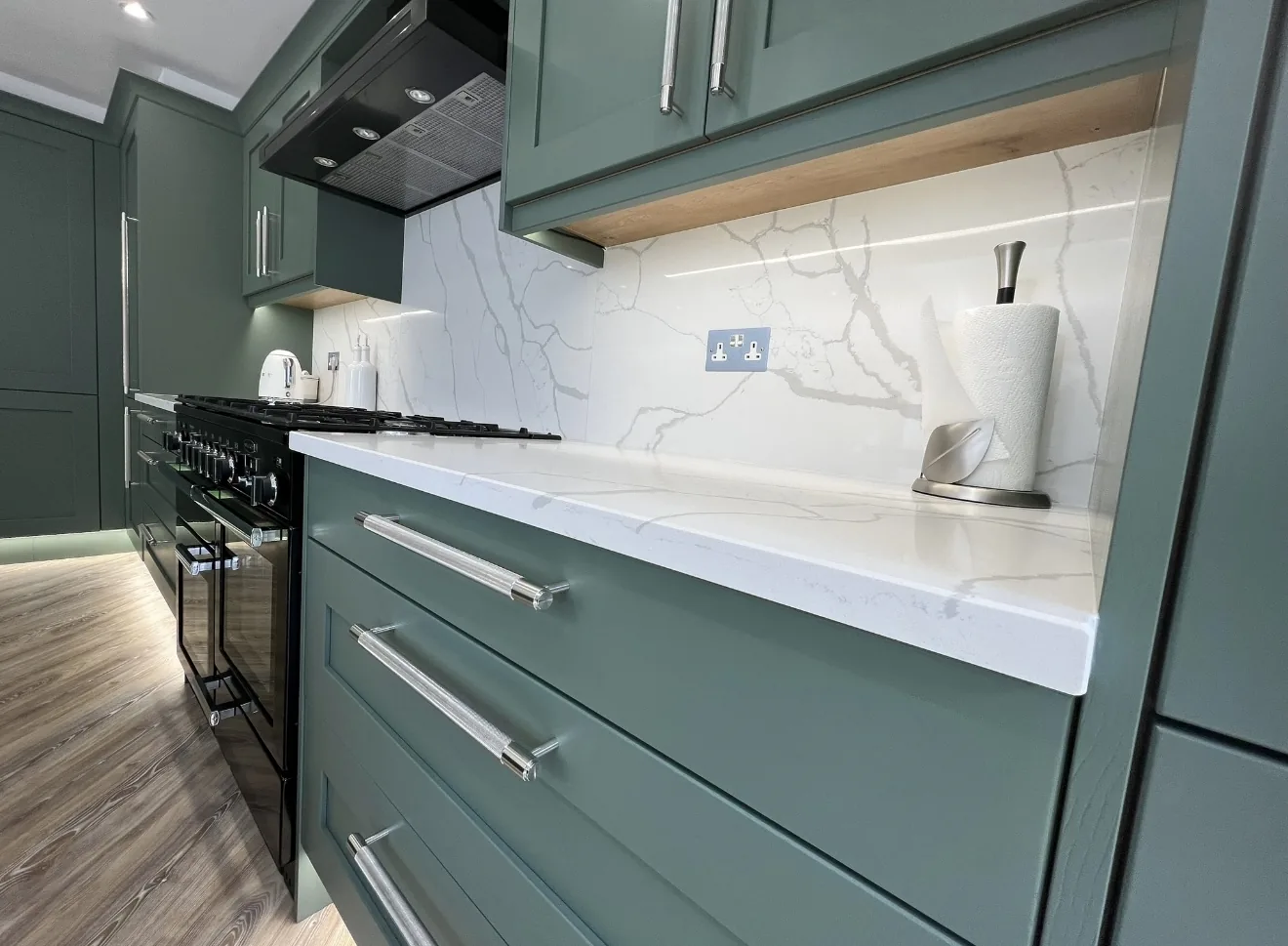
Kitchen worktop fitted by Worktop WorX

Rush Green kitchens

The kitchens we meet in Rush Green

If stone worktop supply and fitting in Rush Green is on your list this year, the useful starting point is not the colour but the shape of the room. Uniform inter-war semis and terraces on the Dagenham border where kitchens are compact and largely unaltered, so a lot of the work is a practical refresh: new tops, new sink, matching upstands, keeping the existing units. Where a rear extension has gone in, it is usually a shallow one adding a metre and moving the sink to the new back wall. Neither case is harder than the other for us. Both start with somebody standing in the kitchen with a tape.

The plaster is a thick float and set over brick that has blown in patches, so a wall sounds solid in one place and hollow a hand-span away. Gloss level is the decision nobody notices making, because a mirror face under a row of downlights throws hard bright spots the length of the run. A week with a sample on the units beats an hour in a showroom.

The larder had a cold shelf and an air brick straight through to the outside, and that brick is usually still open behind whatever now stands in front of it. These kitchens are usually knocked through to the dining room, so the surface is read from two sides at once and the figure has to carry across the pieces rather than restart at every join. Side light flatters movement and wastes a flat colour.

Locally the mix runs to 1930s semi, 1930s terrace and post-war infill. The age of the shell tells us more than the age of the kitchen does.

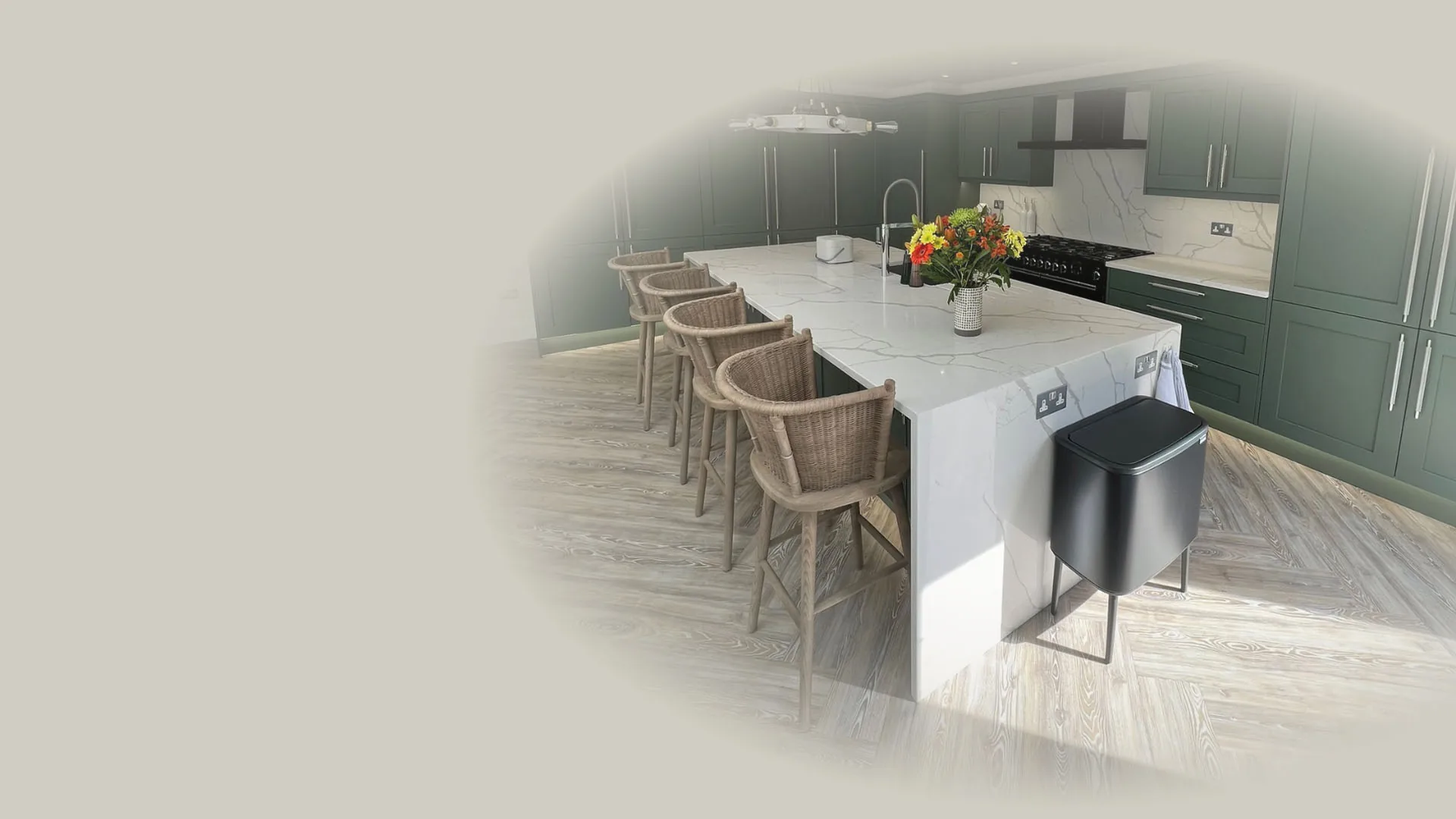
Worktop join finished flush against a wall
  • 1930s semi
  • 1930s terrace
  • post-war infill

True everywhere

Worktops, in short

  • Supply is £110 to £550 per square metre across the 181 surfaces we fit.
  • Granite comes out of the ground porous, which is why it gets sealed.
  • Dekton and sintered stone hold their colour under heat and direct sunlight.
  • That figure is the slab. Fabrication, edges, cut-outs and fitting are quoted separately.
Borough
Havering
Postcodes
RM7
Covered on
our east London run
Fitted
5–10 working days from template

The place

Why Rush Green is its own job

The part of a Rush Green job that goes wrong is almost never the stone, it is what nobody looked at first. Straightforward suburban streets with dropped kerbs on many houses and a shared side passage between semi pairs, though the main roads through here carry hospital traffic and are not somewhere to unload. Shared side passages between semi pairs are legally the neighbour's half as well, so we ask before wheeling a slab down one. The point of the free visit is that we see the Rush Green job for ourselves rather than guessing at it from an email.

The work

What worktops involves

Quartz, granite and sintered surfaces such as Dekton are all supplied, and the choice between them is made on heat, sunlight, porosity and the light in the room rather than on price alone. A natural stone is sealed before the kitchen is handed back, and you are told plainly which products will dull the finish and which will not touch it. You end up knowing what your surface will and will not tolerate: the hot pan, the sunlight through the window and the spray under the sink.

Worktops come down to three materials, and what separates them is temperament rather than prestige: engineered quartz, natural granite, and sintered surfaces fired hard enough to live outdoors. Where a surface will meet strong sun for hours a day, sintered stone holds its colour indefinitely and an engineered one is simply outside what it was designed for. Garden light comes in from the side here, which is the condition that lets a stone with movement in it actually be seen. Heat, water and sunlight sort the shortlist quickly.

Corners and joins See the options

The money

What it costs in Rush Green

The rate per square metre buys stone and nothing else, so the machining, the openings, the polished edges and the fitting are set out beside it rather than folded into it. Two facing runs mean two sets of edges and two scribes in a small span, which is why a compact galley rarely prices as cheaply as its area suggests. The stone itself is £110 to £550 per square metre supply only; everything done to it is priced separately and shown separately. A band of stone moves the total more than a metre of run does.

1930s and inter-war semis

The carry, and what it rules out

Block paving bedded on sand can rut under a fully loaded van, and that is said to the customer beforehand rather than explained afterwards. Resin filled fissures in a natural slab are inspected in daylight at the works and never under a street lamp, since that is the only honest way to see them. A reserved slab is a slab nobody else is allowed to buy.

1930s and inter-war semis

What Rush Green asks for

The research on this patch does not put this among the three commonest jobs. Worktop replacement, worktop installation and worktop splashbacks & upstands do. That changes how often we are here, not how the work is done.

1930s and inter-war semis

Rush Green in the housing figures

In Rush Green, almost no homes fall in the upper council tax bands. The rooms therefore start closer to true than in most of London. Conversions produce small kitchens, and a small kitchen still buys the remainder of whatever slab it comes off. Movement needs a long unbroken length to be worth paying for.

Access

Getting stone into a Rush Green kitchen

Tell us what the approach looks like when you book the template and it gets built into the day rather than discovered on it. Where the route is genuinely tight, it changes how the pieces are cut, which is a fabrication decision rather than a delivery one.

5–10 working days

From template to fitted is 5–10 working days from template. The same on this patch as every other.

East London patch

Rush Green is covered on our east London run, along with the rest of Havering.

We come to you

Templated in your kitchen, cut in our workshop, fitted by our own installers.

Access told straight

If the route forces an extra join, you hear that at quote stage, not on the day.

Questions

Questions we get asked in Rush Green

If yours is not here, ring and ask. You get a straight answer rather than a call-back from a salesperson.

01

Do you actually work in Rush Green, or just list it?

Yes. Rush Green is on the patch, and the postcodes we work here are RM7. It is worked on our east London run, along with the rest of Havering. Where the drive is shared, the half-hour the van spends in the way is agreed with the neighbour in advance rather than apologised for at the time. Whatever the standing allows, the stone leaves that van finished, because every edge, cut-out and internal radius is machined at the works and none of it is open to reconsideration at the kerb. Cutting is done wet and extracted, never dry on a pavement. You never have to visit anything or collect anything: we template in your kitchen and fit in your kitchen.

02

What is different about worktops in Rush Green?

Where the dividing wall has come out there is a steel over the opening and a nib of the old wall left at each end, and a run turning that corner has to clear both nibs. Side light from the garden is what lets a stone with movement in it actually be seen, which is why a busier granite or a veined quartz earns its keep here and a flat single colour rarely does. One full slab and no second is the sweet spot on price. The returns into a breast recess are the tightest scribes in the room, and they are eased in rather than forced. Every notch and every scribe is machined into the piece before it leaves the works, and a hard sintered surface is the least forgiving of a tight internal corner, so one is always cut with a generous radius. A tight inside corner is where brittle material gives up.

03

Is access a problem in Rush Green?

The side passage is the measurement that matters, because a piece has to be carried flat down it and then turned in at the back door, and the turn is always tighter than the passage. That caps the longest piece, and a run split into two lengths nests differently on the slab, which moves the yield and moves the figure with it. Quiet stone closes a joint; dramatic stone announces it. A step up from the drive to the threshold turns the last two metres into a lift, and a lift is where two pairs of hands become the minimum. A granite kitchen ends its day with a sealer, and a sealer wants a dry face and a quiet hour afterwards, so that hour is written into the day rather than borrowed from it. Remnants become chopping boards, hearths and window boards.

04

Do you get much worktops work in Rush Green?

Not especially, and pretending otherwise would be simple enough. What the research on this patch actually lists is worktop replacement, worktop installation and worktop splashbacks & upstands. It is a fact about the local housing rather than about the work. The job is quoted, cut and fitted the same way wherever on the patch it lands. Where a family has been living around a building site for months, the finish date carries more weight than any other part of the specification. Where several kitchens are ordered together the sensible move is to take them all off one batch, because two slabs of the same name bought six months apart will not sit happily in the same building. Repeat work rewards a single decision taken carefully. An open-plan extension puts the worktop in the middle of the living space, so it is looked at from the sofa as well as worked on. Volume work tends to live at the entry end of the range, and the entry end is genuine stone rather than a compromise, since the lowest supply figure we quote is a sintered surface and not a thin laminate pretending to be one. A surface for a let flat is chosen for the next tenant, not this one.

05

What makes one Rush Green kitchen dearer than the next?

Where the sink and the hob face each other across the aisle, everything carried between them crosses the walkway, and that is the one movement the shape cannot design out. A shape like that nests kindly on a slab, so more of what gets bought ends up on the units and the rate per square metre behaves much as the brochure says it will. The number follows the layout far more closely than the floor plan. Material alone is £110 to £550 per square metre, and templating, fabrication and fitting are never folded into that figure.

06

What holds a template up more often than anything else?

An alcove is commonly wider at the back than at the front, so a piece cut to the opening drops in and then stands off the rear wall. A hob dropped into the middle of a length puts sustained warmth at the lip of a cut-out, and an engineered surface will yellow there across ten years where a natural one takes it without comment. The wall decides the scribe and the scribe decides the depth. Confirm the depth of the units, the total run lengths and whether an island or peninsula is going in, and tell us the colour temperature of the lighting. An owner paying for this directly tends to want the reasoning as much as the number, so a quote that explains why a join sits where it does is worth more than a cheaper one that does not. That changes which questions are worth asking about the stone, because somebody staying put wants to know how a honed face marks in five years and somebody selling wants to know how it photographs next spring. Neutral mid-tones survive a change of owner better than statements.

07

How many visits does a Rush Green worktop take?

The template produces a drawing, and the workshop cuts to that drawing once you agree it. A template on a normal kitchen takes two to three hours in the room. Nothing changes hands until after the template. The kitchen door opens inwards into the middle of a run, so the usable length of that wall stops well short of the corner. Which stone belongs on top of all that is a separate question from the building itself, and it is the one with a figure attached, because supply alone runs from £110 to £550 per square metre before a single cut has been made. Thickness changes the look and the figure in the same breath.

08

What happens when the route into a Rush Green kitchen is tighter than the worktop?

The lift, if there is one, is measured on the diagonal, because that is the dimension a long piece actually uses. An external stair, a side return or a rear garden counts as carry and is measured the same way. A piece travels on edge, never flat, because on edge is how stone of that length carries its own weight. Rear access usually lets us fit longer pieces whole, so the join count ends up decided by the slab rather than by the building. Where a seam becomes unavoidable the choice of stone starts to matter, because a fine even speckle closes a joint almost invisibly and a broad vein simply will not. Thin sintered stone weighs about half what thick granite does.

09

Do you do undermounted sinks in Rush Green?

Two bowls means two cut-outs and a bridge of stone between them, which decides where the sink can go. The sink, tap and hob have to be physically in the room at the template, not merely ordered, because the cut-out is machined to the item itself. A boiling tap needs a hole of its own and a cupboard below for the tank, so the units change too. A run that stops in mid-air at the open end needs a finished end rather than a cut one, and that end takes the same edge work as the whole front. An island is the piece that decides whether one slab covers the kitchen or two, and a second slab arrives as a step in the figure rather than a gentle slope. A clean nest on the slab is the cheapest thing a shape can do.

10

Is a full-height stone splashback worth doing?

What decides between them is usually the wall: what it is built of, how flat it is, and where the sockets ended up. If it is a decision for later, say so at the template: the match is a question about the batch. Both are templated after the worktop is down and settled, because they are cut to the wall itself. The windows were steel to begin with and have been swapped for plastic in openings lined out to suit, so the reveal is now deeper than the brickwork behind it. A knocked-through room means the surface is read from the dining side as well as the working side, so the figure has to run continuously and the pieces are taken from adjoining slab. A compact kitchen puts the band ahead of the metreage.

Reviews

5.0 from 26 Google reviews

Every one of these is on our Google profile under the reviewer’s own name. Nothing here is written by us, and the link goes straight to the source.

Read all 26 See them on Google

★★★★★
“Great service. Super quick and easy communication. I love my new worktop 🥹🥹”
Sara ArghirGoogle review
★★★★★
“Professional, polite and friendly service. Very pleased with finished product.”
costas andrewsGoogle review
★★★★★
“I used Karem’s services 5 years ago for purchasing and fitting the quartz worktop in my then brand new kitchen. The price was reasonable and the service reliable and spot on, no delays in fitting, misunderstanding or excuses. I recommended him to a friend, who also used his services and they were happy too! If I need to order new kitchen work top again, I would definitely use him again. Thanks Karem!”
shoshencenceGoogle review · quartz

Next step

Worktops in Rush Green, priced properly

Plans, a sketch or photographs with rough run lengths is enough to start. You get an itemised written quote and the template dates we can offer on this patch.

25-year material warranty and a 5-year workmanship guarantee, both stated on your quote.