
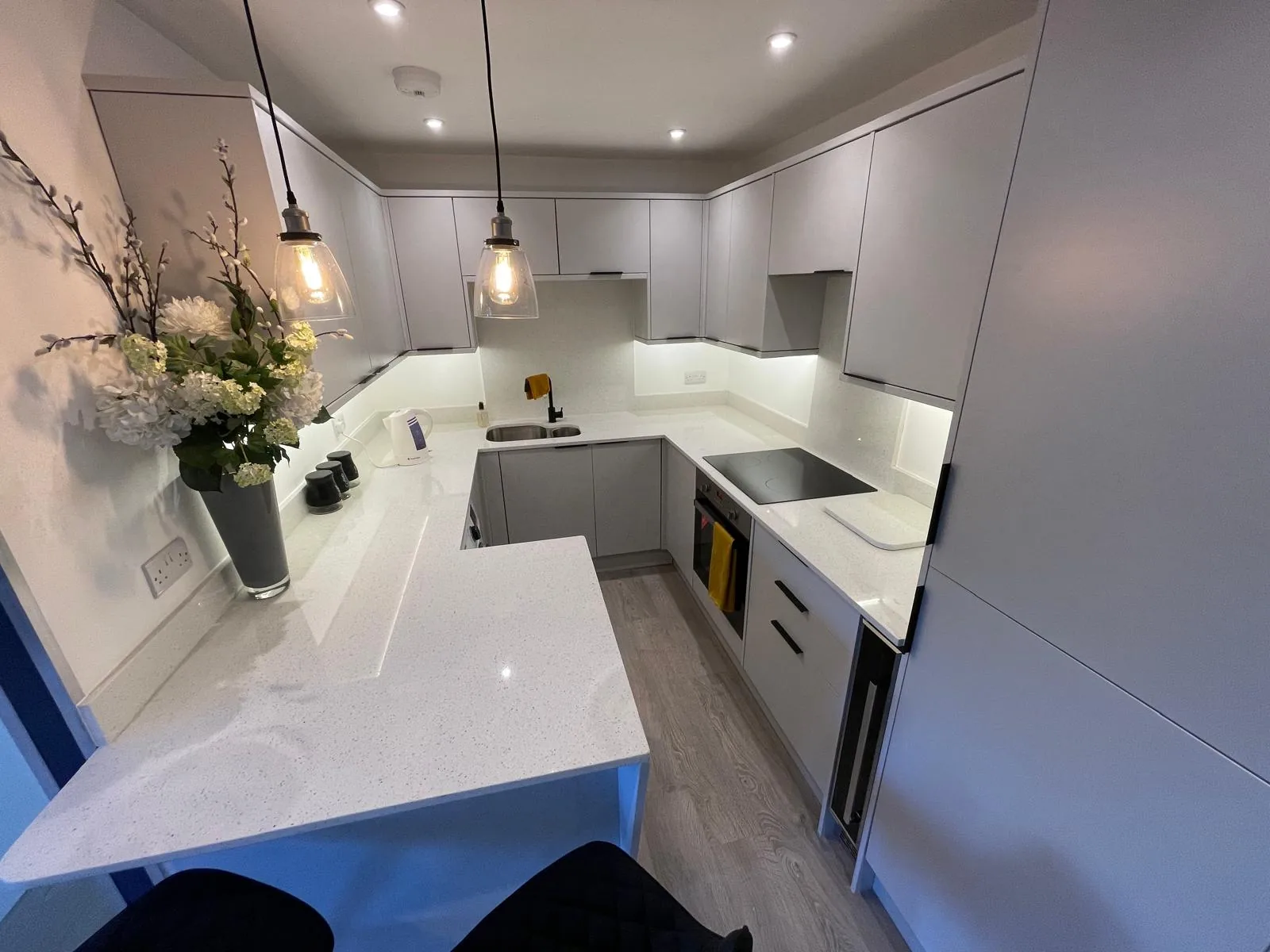
Croydon · CR0
Worktops in Addington
The surface itself: which stone, what it costs by the square metre, and what the room does to that number.
- 5.0from 26 Google reviews
- 25-year material · 5-year workmanship
- Fitted 5-10 working days from template
Addington kitchens
The kitchens we meet in Addington
The reason stone worktop supply and fitting in Addington is quoted per kitchen rather than per metre comes down to the range of rooms these worktops end up in. The village core has small period cottages with tight kitchens and low ceilings, while the surrounding 1960s-70s detached houses have square kitchens with integral garages behind, commonly converted into a utility with a second worktop run. Once the template is taken the figure stops moving. Everything before that is an estimate and is described as one.
Plaster over blockwork is thin and hollow in patches, so anything fixed back to the wall needs a sound spot found first. Batches move through a yard continuously, so a slab reserved this month and a slab bought next spring can carry one name and still not be the same stone. Veining is a question of scale, and a postcard has no scale.
Post-war terraces have a short straight hall to the kitchen, which is a good deal kinder than the houses they replaced. Coming off a laminate top changes the thickness at the front edge, and twenty millimetres reads closer to what the room is used to than thirty ever will. Hard-working kitchens suit surfaces that ask for nothing.
Around here the stock is old village cottage, 1960s detached, 1970s detached and modern executive housing. They were built to different tolerances, and the stone has to absorb that.
True everywhere
Worktops, in short
- Supply is £110 to £550 per square metre across the 181 surfaces we fit.
- Templating is done in the room itself, once the units are fixed and level.
- Fitting happens five to ten working days after the template is taken.
- Quartz is engineered, so its pattern repeats and a long kitchen matches itself end to end.
- Borough
- Croydon
- Postcodes
- CR0
- Covered on
- our south London run
- Fitted
- 5–10 working days from template
The place
Why Addington is its own job
A quote for Addington that ignores how the slab gets in is a quote that will change on the day. The village lanes are narrow with a sharp bend and no pavement in places, and the tram runs through on its own alignment, so unloading has to be off the carriageway. The 1960s houses often have the kitchen a step above the hall on a raised slab, which changes the finished worktop height, so we set out from the cabinet tops rather than a stated 900mm. Access, levels and out-of-square walls all land on the same quote as the stone, itemised line by line.
The work
What worktops involves
Quartz, granite and sintered surfaces such as Dekton are all supplied, and the choice between them is made on heat, sunlight, porosity and the light in the room rather than on price alone. Run lengths, join positions and the direction of the veining are agreed at that visit, since where a join falls is a decision about the pattern as much as about the length. You are left with joins that read as a shadow line, because the pieces either side come off adjoining slab and the resin is mixed to the stone.
Hardness and brittleness are different things, and the body that best resists a blade is frequently the one least willing to carry an unsupported corner. A polished face returns light and shows smears; honed absorbs it and shows fingermarks less; a textured or matt face sits between the two and hides both reasonably well. Coming off a thick laminate top, twenty millimetres reads closer to the old surface than thirty does against the tiling and the window board. Three materials, three temperaments, and a shortlist that writes itself.
The money
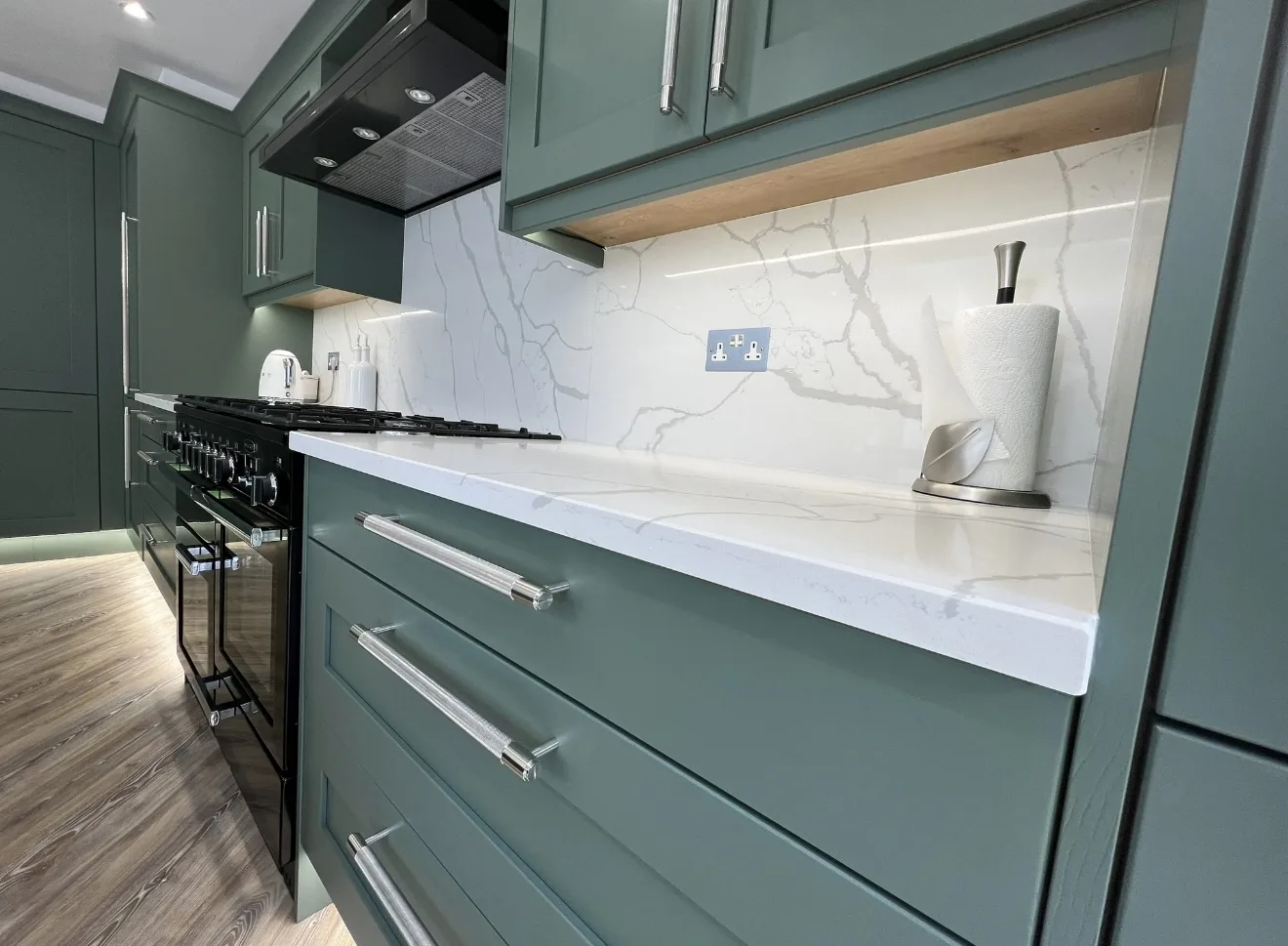
What it costs in Addington
Edge work is charged along the length of every exposed face, which is why an island with four finished sides prices differently from a run with one. Two facing runs mean two sets of edges and two scribes in a small span, which is why a compact galley rarely prices as cheaply as its area suggests. The supply band of £110 to £550 per square metre is known the day you choose a colour. What is not known until the template is the piece count and the number of cut-outs. A band of stone moves the total more than a metre of run does.
Get it priced
period detached houses and villas
The carry, and what it rules out
Off-street parking means the van stays put all day, so tools, packers and the offcut we would rather have than not are all within reach. Nothing is trimmed at the kerb, so a mismeasured scribe is a workshop problem and a fresh piece, which is exactly why a template is checked twice before it is cut. Dry cutting quartz burns the resin and the burn does not polish out.
period detached houses and villas
What Addington asks for
Around here this is occasional rather than routine. The routine ones are worktop installation and worktop replacement. That is a comment on the buildings and on nothing else.
period detached houses and villas
Addington in the housing figures
In the streets around Addington, most of the housing went up between the late forties and the early eighties. A short run leaves nowhere to hide a join. Older housing of that kind was planned around a chimney, so the usable lengths arrive in pieces and the pieces decide how much of a slab is ever seen. Movement needs a long unbroken length to be worth paying for.
Access
Getting stone into an Addington kitchen
The village lanes are narrow with a sharp bend and no pavement in places, and the tram runs through on its own alignment, so unloading has to be off the carriageway.
Tell us what the approach looks like when you book the template and it gets built into the day rather than discovered on it. Where the route is genuinely tight, it changes how the pieces are cut, which is a fabrication decision rather than a delivery one.
5–10 working days
From template to fitted, working days from template. The same on this patch as every other.
south London patch
Addington is covered on our south London run, along with the rest of Croydon.
We come to you
Templated in your kitchen, cut in our workshop, fitted by our own installers.
Access told straight
If the route forces an extra join, you hear that at quote stage, not on the day.
Questions
Questions we get asked in Addington
If yours is not here, ring and ask. You get a straight answer rather than a call-back from a salesperson.
Do you cover Addington?
Yes. Addington is on the patch, and the postcodes we work here are CR0. It is worked on our south London run, along with the rest of Croydon. A drive that shelves towards the house needs the van chocked and the trolley controlled, since a loaded A-frame gathers speed quickly on a slope. Whatever the standing allows, the stone leaves that van finished, because every edge, cut-out and internal radius is machined at the works and none of it is open to reconsideration at the kerb. A honed face marks on grit, so nothing is set down bare. The measuring and the fitting are both done at the property, so there is nothing to visit or collect.
Why would worktops in Addington be any different from anywhere else?
Walls look modern and are not: block or breeze with a skim that has been patched over decades, so dry-laying and scribing still apply. These kitchens are small and roughly square, so the run is short, the join count is low and the material band accounts for almost all of the figure rather than the bench time. Even light lets a mid-tone hold its own. A wall line that runs level over a floor that does not means the finish closes up on the plinth at one end, which is joinery rather than something the stone can answer. Every notch and every scribe is machined into the piece before it leaves the works, and a hard sintered surface is the least forgiving of a tight internal corner, so one is always cut with a generous radius. Every notch is machined on the bench and none on site.
What is the carry like in Addington?
An inward-opening door swinging back against the wall leaves less clear opening than the frame measures, and a storm porch in front of it is tighter again. That caps the longest piece, and a run split into two lengths nests differently on the slab, which moves the yield and moves the figure with it. The route rewrites the cut list, and the cut list is the price. Gravel and block paving both look like hard standing and neither takes a loaded trolley, so the run from tail lift to door gets boarded. A granite kitchen ends its day with a sealer, and a sealer wants a dry face and a quiet hour afterwards, so that hour is written into the day rather than borrowed from it. The last hour on a granite kitchen belongs to the sealer.
Would you call Addington a worktops area?
Not really, and claiming otherwise would cost nothing and mean nothing. What the research on this patch actually lists is worktop installation and worktop replacement. It reflects the local housing rather than any difference in the work. It is quoted, cut and fitted here the same way it is anywhere else on the patch. An annexe kitchen is often built to keep a parent independent, so worktop height and reach matter as much as the material does. Volume work tends to live at the entry end of the range, and the entry end is genuine stone rather than a compromise, since the lowest supply figure we quote is a sintered surface and not a thin laminate pretending to be one. Two slabs bought a season apart are two different stones. A family adding a self-contained unit is paying for the whole conversion, and the worktop is one line in a much longer job. Adding an island is what moves most of these projects from one slab to two, and that jump is the single largest step in any worktop quotation. Buying for hard use is a different exercise from buying for looks.
Where does the money go on an Addington worktop?
A galley that is also the route to the back door is a corridor first and a kitchen second, and what the shape can take is set by the traffic going through it. A shape like that nests kindly on a slab, so more of what gets bought ends up on the units and the rate per square metre behaves much as the brochure says it will. Finished ends cost by the metre, however short the run is. Supply only, material is £110 to £550 per square metre, with templating, fabrication and fitting quoted on their own lines.
What needs to be ready before you come to Addington?
Where two pieces meet over a fall in the floor the join has to be flush to the hand as well as true to the level, because the eye reads the join and forgives the room. A hob dropped into the middle of a length puts sustained warmth at the lip of a cut-out, and an engineered surface will yellow there across ten years where a natural one takes it without comment. Water standing daily is what makes porosity matter. Measure the run between the walls, note the cill height above the units, and tell us the thickness of the top that is coming off. An owner living in the house makes the decisions and lives with them, so the specification tends to go towards the material rather than towards the lowest total. That changes which questions are worth asking about the stone, because somebody staying put wants to know how a honed face marks in five years and somebody selling wants to know how it photographs next spring. Repairability is a fair question to ask before choosing.
What is the order of events on an Addington kitchen?
The template produces a drawing, and the workshop cuts to that drawing once you agree it. The template is taken in your kitchen after the units are in and fixed, never before. Nothing is measured until the sink, the tap and the hob are in the room to measure against. Small, roughly square kitchens with a back door and a window in the middle of the run: short lengths, few joins, and a lot to work around. Which stone belongs on top of all that is a separate question from the building itself, and it is the one with a figure attached, because supply alone runs from £110 to £550 per square metre before a single cut has been made. Heat tolerance is a property of the material, not a claim about it.
What happens when the route into an Addington kitchen is tighter than the worktop?
The alternative to a join is a shorter run, which is usually the wrong thing to trade away. What decides it is not the width of the stairwell but the length of piece that can be turned in it. An external stair, a side return or a rear garden counts as carry and is measured the same way. A step up off the pavement means the piece is lifted to the threshold before it is carried anywhere, and that first lift is the one that wants four hands. Where a seam becomes unavoidable the choice of stone starts to matter, because a fine even speckle closes a joint almost invisibly and a broad vein simply will not. Speckle forgives a joint that a sweeping figure never would.
What is not included in the quoted figure?
The quote is written from the template drawing. Before that it works from what you have described. Every run, cut-out, edge, join and groove set is a line, which is what makes it comparable with anyone else’s. What is quoted is what the drawing says, and the figure does not move unless the drawing does. Floors settle, and once base units are packed and levelled properly the stone sits true while everything else in the room admits it is not. A run that sits under strong sun for hours every afternoon suits a surface built to be stable in daylight, because a resin-bound stone is made for indoor use and sustained sunlight is the one thing it was never designed around. Brittle stone and narrow returns are a poor pairing.
What happens if a worktop is damaged getting into an Addington property?
A remake goes back through the same cutting and polishing, so it is a return visit rather than a patch. The workmanship guarantee runs 5 years on every kitchen we fit. Door frames and the stair route are protected too, since most contact happens on the way in. A Victorian hall arch sits lower than the ceiling either side of it, and it is the point a piece carried on edge meets first. Sintered stone at twelve millimetres weighs roughly half what thirty millimetre granite weighs, so a punishing route can genuinely rule one material in and another out. No colour and no edge is adjustable once a piece is machined.
Reviews
5.0 from 26 Google reviews
Every one of these is on our Google profile under the reviewer’s own name. Nothing here is written by us, and the link goes straight to the source.
Great experience from this company, I am happy with the materials, fitting and the team.
Rrahim Brati
Google review
Absolutely delighted with our new worktop from Worktop WorX. The Capri White finish looks incredible, clean, modern, and really brightens up the whole kitchen while pairing beautifully with the darker cabinetry. The quality of the worktop is outstanding, with a flawless finish and seamless installation that really shows the attention to detail. It’s not only stylish but also feels incredibly durable and practical for everyday use. Cam handled everything from start to finish and made the whole process smooth and stress-free. Professional, reliable, and clearly takes pride in the work. Highly recommend Worktop WorX. We couldn’t be happier with the result!
Dawid Myszor
Google review · Capri White
Excellent service and top quality workmanship. The worktop looks absolutely amazing and the attention to detail is impressive. The team was professional, punctual, and very easy to work with. Highly recommended for anyone looking for a premium kitchen worktop! 👌
Costin Roman
Google review
Related
More around Addington
Other work we do in Addington
Next step
Worktops in Addington, priced properly
Plans, a sketch or photographs with rough run lengths is enough to start. You get an itemised written quote and the template dates we can offer on this patch.
25-year material warranty and a 5-year workmanship guarantee, both stated on your quote.