
Kensington and Chelsea · SW10
Worktops in Chelsea Harbour
The surface itself: which stone, what it costs by the square metre, and what the room does to that number.
- 5.0from 26 Google reviews
- 25-year material · 5-year workmanship
- Fitted 5-10 working days from template
Chelsea Harbour kitchens
The kitchens we meet in Chelsea Harbour
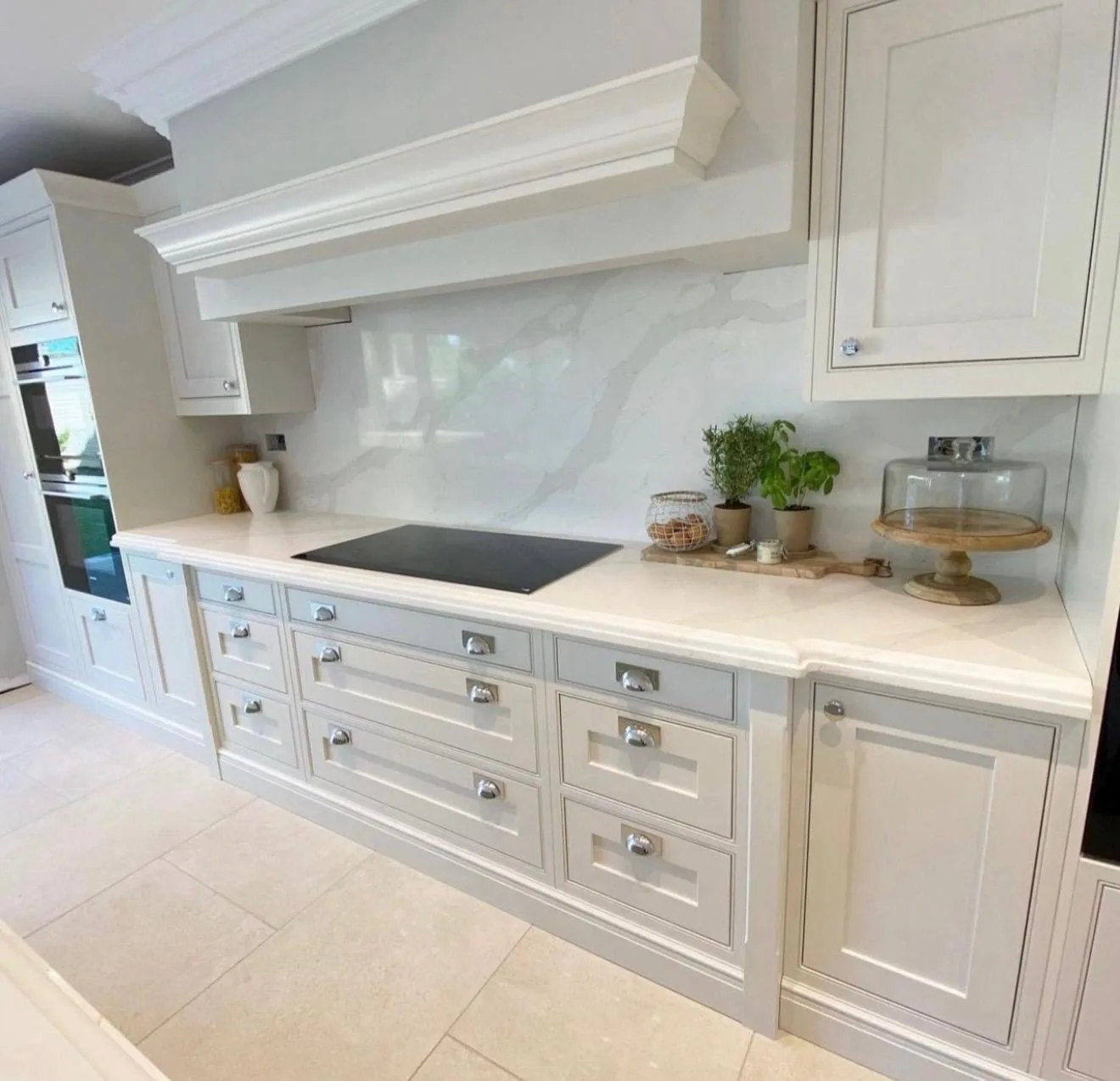
Getting stone worktop supply and fitting in Chelsea Harbour right is mostly a matter of knowing what you are dealing with before the order goes in, and that means looking properly. Purpose-built apartments with kitchens designed into the plan from the start - a galley or L against a service core, typically 3-3.4m plus an island or peninsula of 1.8-2.4m, and no chimney breasts or period quirks to work around. Replacements here are usually swapping tired 1990s granite for new large-format slabs, keeping sink and hob in place because the services are all in a fixed riser. Send through a photograph or two and the rough run length. We will tell you what you are probably dealing with.
These kitchens give three metres of usable wall and no more, so a dimension out by a few millimetres costs a whole run rather than a piece. Heat is worth settling before anything else, since granite takes a pan straight off a burner and an engineered surface holds a scorch for the rest of its life. Yield is the word behind most quotations people did not expect.
A refuse chute or a service duct takes a corner of the kitchen in several of the standard plans, and neither of them moves. Windows are generous here and the light is even, so a mid-tone holds up without having to be pale simply to survive the room. A low seam count is what makes a small kitchen good value.
The buildings themselves are mostly late 1980s marina apartment tower, podium-deck apartment block, hotel and serviced residence and design centre and mixed-use building. The join count is decided by which of those the room sits in.
True everywhere
Worktops, in short
- Supply is £110 to £550 per square metre across the 181 surfaces we fit.
- The material is guaranteed 25 years and the workmanship 5.
- Quartz runs £130 to £500 per square metre, granite £121 to £550 and Dekton £110 to £366.
- Templating is done in the room itself, once the units are fixed and level.
- Borough
- Kensington and Chelsea
- Postcodes
- SW10
- Covered on
- our west London run
- Fitted
- 5–10 working days from template
The place
Why Chelsea Harbour is its own job
The practical side of a worktop in Chelsea Harbour is settled long before anyone chooses a colour, and it is worth saying out loud. Estate management controls the whole site: security barrier at the entrance, visitor and contractor registration, a designated loading bay and a booked goods lift with a fitted protection kit. Almost everything is above ground on a podium over parking, so there is a long level trolley run from the lift lobby to the flat door, and residents' corridors have carpet that needs boarding. Straightforward stone, bureaucratic building - book the goods lift and the bay a week out or you will be standing at the barrier with a full van. We would rather lose the job at the quote than lose your morning on the day of the fit.
The work
What worktops involves
The material carries a twenty five year guarantee and the fitting workmanship five years, and both are handed over in writing with the paperwork for the slab. Fitting follows the template by five to ten working days, and the pieces arrive finished, with joins bonded in a resin mixed to the colour of the slab. You are left with a worktop machined to the room as found, so the back edge follows the wall instead of leaving a shadow gap at one end of the run.
Quartz is crushed stone bound in resin, so it arrives consistent and predictable, and that same resin is why it objects to a hot pan and to standing sunlight. Twenty millimetres and thirty millimetres are the two thicknesses that matter, and twenty with a laminated front edge gives the look of thirty without the slab cost of it. The runs are short, so the material band is where any real saving sits, and thickness is the wrong place to look for one. Three materials, three temperaments, and a shortlist that writes itself.
The money
What it costs in Chelsea Harbour
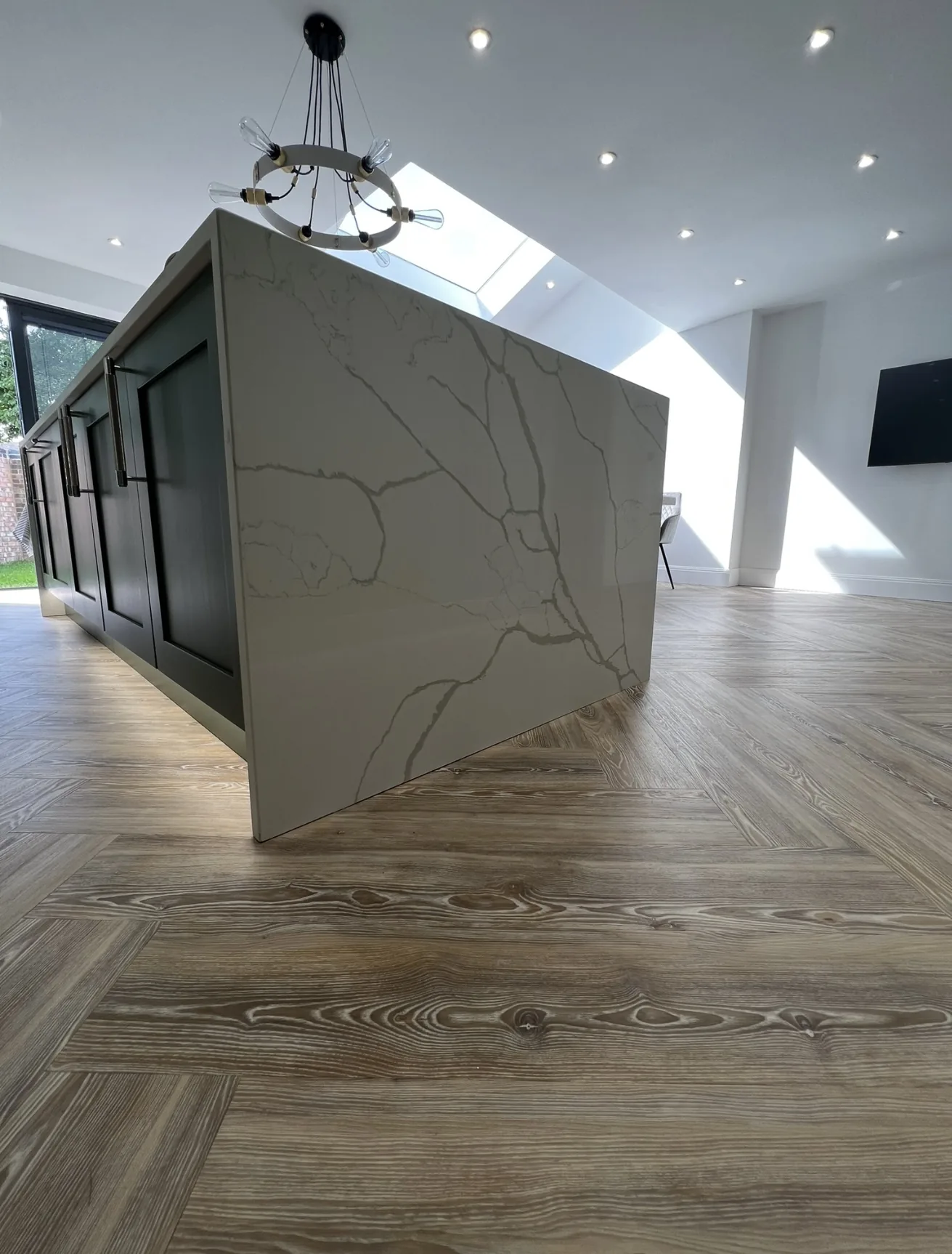
Two rooms of identical floor area can differ by more than double on the stone alone, and the reason is almost never the size of either of them. Overhangs, a waterfall end and seating all add machining, and an island is where those decisions cluster. Nothing about the £110 to £550 supply range changes once the template is done. What the template settles is the piece count and the operations, and that is where the figure firms up. The slab, then the machining, then the fitting, each on its own line.
Get it priced
Victorian and Edwardian terraces
What Chelsea Harbour asks for
Infrequent work for this area, though we do it whenever it is asked for. Worktop replacement, worktop installation and worktop fabrication are the commoner calls. Nothing about the method or the standard varies with frequency.
Victorian and Edwardian terraces
The carry, and what it rules out
Pieces get staged in the ground floor lobby and sent up singly, which needs somewhere to stand them where nobody will walk into them. That caps the longest piece, and a run split into two lengths nests differently on the slab, which moves the yield and moves the figure with it. A forced seam is a material decision before it is a fitting one.
Victorian and Edwardian terraces
The shape of the run
If the island is a few hundred millimetres longer than the usable length of a slab, a second slab gets bought to gain that overhang, and the whole slab is paid for rather than the part used. Going deeper than the standard six hundred millimetres sounds harmless and frequently adds a slab, since slab width decides how many full-depth lengths can be taken off one piece. Every return end is another polished face to pay for.
Access
Getting stone into a Chelsea Harbour kitchen
Estate management controls the whole site: security barrier at the entrance, visitor and contractor registration, a designated loading bay and a booked goods lift with a fitted protection kit. Almost everything is above ground on a podium over parking, so there is a long level trolley run from the lift lobby to the flat door, and residents' corridors have carpet that needs boarding.
Tell us what the approach looks like when you book the template and it gets built into the day rather than discovered on it. Where the route is genuinely tight, it changes how the pieces are cut, which is a fabrication decision rather than a delivery one.
5–10 working days
From template to fitted, working days from template. The same on this patch as every other.
west London patch
Chelsea Harbour is covered on our west London run, along with the rest of Kensington and Chelsea.
We come to you
Templated in your kitchen, cut in our workshop, fitted by our own installers.
Access told straight
If the route forces an extra join, you hear that at quote stage, not on the day.
Questions
Questions we get asked in Chelsea Harbour
If yours is not here, ring and ask. You get a straight answer rather than a call-back from a salesperson.
Do you cover Chelsea Harbour?
Yes. Chelsea Harbour is on the patch, and the postcodes we work here are SW10. It is worked on our west London run, along with the rest of Kensington and Chelsea. Time-limited bays are camera-enforced across a lot of managed estates, so the unload runs to the clock and the van moves off afterwards. Whatever the standing allows, the stone leaves that van finished, because every edge, cut-out and internal radius is machined at the works and none of it is open to reconsideration at the kerb. The packaging and the spent cartridges leave with the crew. Both visits happen in your kitchen, the template and the fit, so there is nothing to visit and nothing to collect.
What do the kitchens in Chelsea Harbour do to worktops?
A tower block runs one or two lifts for many floors, so a lift out of service postpones a job rather than making it harder. Kitchens in this stock are compact and worked hard, so the surface is chosen for indifference rather than for attention: quartz where consistency matters, sintered stone where heat and scratching are daily events. Long narrow rooms want a pale face at the working end. The face of a breast is rarely flat, and a top returning onto it picks up that bow across the last few hundred millimetres of its length. Every notch and every scribe is machined into the piece before it leaves the works, and a hard sintered surface is the least forgiving of a tight internal corner, so one is always cut with a generous radius. Short lengths are where a full slab starts to pay for itself.
Do you have trouble getting long pieces into Chelsea Harbour kitchens?
The step and the gap at the car threshold catch a trolley wheel, so the piece comes off the trolley and goes in by hand. Where a seam becomes unavoidable the choice of stone starts to matter, because a fine even speckle closes a joint almost invisibly and a broad vein simply will not. Quiet stone closes a joint; dramatic stone announces it. A dedicated loading bay or service yard is the easiest arrangement in a managed building, provided the slot is booked and someone has the key to the shutter. A granite kitchen ends its day with a sealer, and a sealer wants a dry face and a quiet hour afterwards, so that hour is written into the day rather than borrowed from it. Dry cutting quartz burns the resin and the burn does not polish out.
Does Chelsea Harbour actually ask for worktops?
Not particularly. It would be easy to say yes and leave it there. What the research on this patch actually lists is worktop replacement, worktop installation and worktop fabrication. That is about what people have here rather than how it gets done. It is quoted, cut and fitted exactly the same way here as anywhere else on the patch. Landlord work is scheduled around void periods, so the whole thing is a fixed window and the template date matters as much as the fitting date. Where several kitchens are ordered together the sensible move is to take them all off one batch, because two slabs of the same name bought six months apart will not sit happily in the same building. The entry end of the range is real stone, not a compromise. Quartz suits let property well: no sealing, no annual maintenance, and nothing an incoming tenant has to be told to look after. Volume work tends to live at the entry end of the range, and the entry end is genuine stone rather than a compromise, since the lowest supply figure we quote is a sintered surface and not a thin laminate pretending to be one. The island is usually what turns one slab into two.
What decides the price of a worktop in Chelsea Harbour?
On a heavily veined stone the island and the run behind it are nested off the same area of slab so the movement relates across the room. A shape like that nests kindly on a slab, so more of what gets bought ends up on the units and the rate per square metre behaves much as the brochure says it will. The island is usually the piece that opens the second slab. Material runs £110 to £550 per square metre supply only, and templating, fabrication and fitting each get their own line.
What do I need to sort out first?
Old breasts carry a bulge low down where the original opening was closed up, and the units stand off it before the stone is measured at all. A hob dropped into the middle of a length puts sustained warmth at the lip of a cut-out, and an engineered surface will yellow there across ten years where a natural one takes it without comment. The narrowest return in the kitchen is its weakest stone. Send the run lengths, a photograph of each corner so we can see the boxings, and tell us how the kitchen is used day to day. A street with houses in single occupation next to the same houses cut into flats produces two completely different jobs from the same elevation. That changes which questions are worth asking about the stone, because somebody staying put wants to know how a honed face marks in five years and somebody selling wants to know how it photographs next spring. Hard use by people who did not choose it points at sintered stone.
When do I pay for a Chelsea Harbour worktop?
Two kitchens the same length can be far apart, because material, edge and cut-outs move independently of size. Plumbing, gas and electrical work are not in the figure, because we do not do them. Taking the old tops away is a line rather than an assumption, so it comes off if you do not want it. Two alcove pieces will not swap over however similar they look, so they are marked left and right at the bench and stay that way to the van. A run that sits under strong sun for hours every afternoon suits a surface built to be stable in daylight, because a resin-bound stone is made for indoor use and sustained sunlight is the one thing it was never designed around. Porous or sealed is a decision about the next ten years.
What if something breaks during the fit?
The workmanship guarantee runs 5 years on every kitchen we fit. A piece is never laid flat across a gap while it is moved, because that is how stone cracks unaided. A remake goes back through the same cutting and polishing, so it is a return visit rather than a patch. Where a basement car park is the only way up from the parking level the carry starts below ground, and two lifts in one building rarely share the same internal dimensions. Sintered stone at twelve millimetres weighs roughly half what thirty millimetre granite weighs, so a punishing route can genuinely rule one material in and another out. Thin sintered stone weighs about half what thick granite does.
Will you fit stone onto units that are not level?
The check comes before the measuring rather than after, because the whole drawing is set out from that plane. Levelling belongs in the carcasses, on their own legs and packers. Packing takes up small variation. It is not there to hide something that belongs in the units. A chimney breast left in place splits a wall into two alcoves, and the two are rarely the same width and rarely parallel to each other. A deep scribe eats into the back of the piece, which is quietly important on a stone with directional figure, since the pattern moves backwards as that depth comes off. A short upstand shows a fragment of pattern, never a run of it.
How do you cut out for an undermounted sink?
If the sink or hob changes after the template, the drawing changes first and nothing is cut meanwhile. Each cut-out is priced on its own line, so a range, a bowl and a half, a boiling tap and a drainer are four items rather than one. Nothing is cut out in the kitchen. Cutting a bowl on site is how worktops get cracked. Seating overhangs past roughly 300mm will not carry on the carcass alone, so flat steel bar or a plywood substrate has to be built into the units first. An island is the piece that decides whether one slab covers the kitchen or two, and a second slab arrives as a step in the figure rather than a gentle slope. Depth beyond the standard is a slab question, not a trim question.
Reviews
5.0 from 26 Google reviews
Every one of these is on our Google profile under the reviewer’s own name. Nothing here is written by us, and the link goes straight to the source.
Karem did an excellent job on my kitchen. He was professional, reliable, and paid great attention to detail. The finish looks amazing and has completely transformed my kitchen. Thank you! Would highly recommend his work!
Catalina Radu
Google review
Excellent work and highly recommend. Very professional and did an outstanding job with my worktop. Karem responded very quickly and swiftly, top guy!
Faisal K
Google review
Perfect service,the best on this job
Kleant Istrefi
Google review
Related
More around Chelsea Harbour
Other work we do in Chelsea Harbour
- Bathroom worktops in Chelsea Harbour
- Bar tops in Chelsea Harbour
- Restaurant table tops in Chelsea Harbour
- Reception counters in Chelsea Harbour
- Worktop replacement in Chelsea Harbour
- Worktop installation in Chelsea Harbour
- Worktop splashbacks & upstands in Chelsea Harbour
- Worktop fabrication in Chelsea Harbour
Next step
Worktops in Chelsea Harbour, priced properly
Plans, a sketch or photographs with rough run lengths is enough to start. You get an itemised written quote and the template dates we can offer on this patch.
25-year material warranty and a 5-year workmanship guarantee, both stated on your quote.