
Hammersmith and Fulham · SW6
Worktops in Imperial Wharf
The surface itself: which stone, what it costs by the square metre, and what the room does to that number.
- 5.0from 26 Google reviews
- 25-year material · 5-year workmanship
- Fitted 5-10 working days from template
Imperial Wharf kitchens
The kitchens we meet in Imperial Wharf
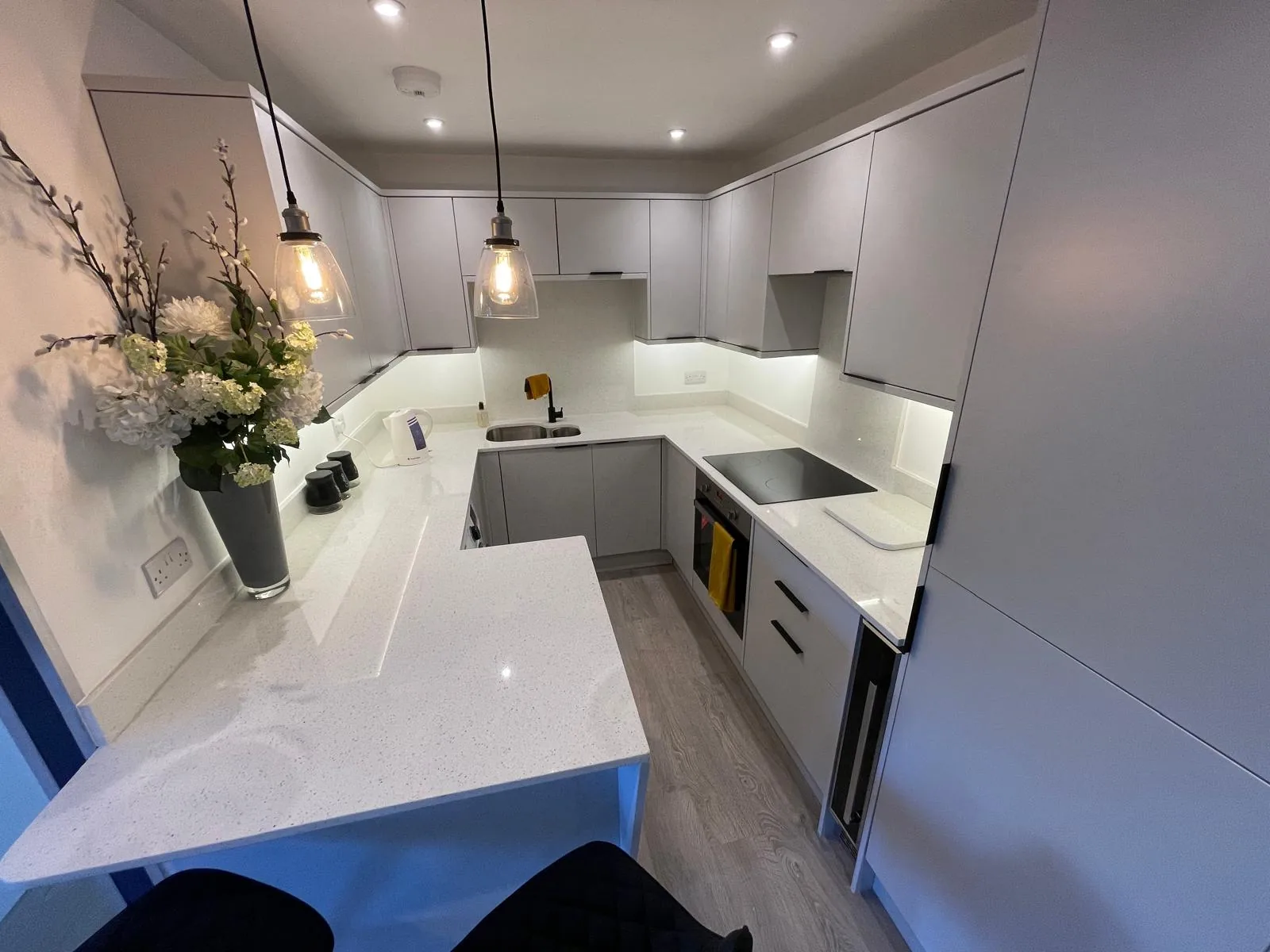
If you are weighing up stone worktop supply and fitting in Imperial Wharf, the first thing worth knowing is that the building decides more than the brochure does. Entirely purpose-built apartment stock with kitchens planned as part of the living space, generally a 3-3.4m run against the service wall plus an island or peninsula of 2-2.4m, sitting over a fixed riser. The frequent job now is replacing the original 2000s granite or composite with lighter large-format quartz or sintered stone, matching existing cut-outs so the plumbing does not move. The survey is the part where guessing stops. Everything after it is worked from real measurements taken in your own Imperial Wharf kitchen.
Riser panels, wall boxes and the boiler cupboard sit in fixed positions the developer will not move for a worktop. Weight arrives as a figure per square metre and turns into a question about the floor, which is worth asking in any building where a timber span carries the kitchen. A finish is a decision about cleaning as much as about looks.
A balcony door is the only other opening in the flat and it leads nowhere useful, so everything comes in through the front door. Carcasses are standard and the walls are true, so the run nests simply on the slab and the yield is about as good as this trade gets. A galley nests efficiently and frees money for better stone.
On this patch the buildings are 2000s riverside apartment tower, podium-deck apartment block, modern townhouse and mixed-use block over a landscaped estate. They were built to different tolerances, and the stone has to absorb that.
True everywhere
Worktops, in short
- Supply is £110 to £550 per square metre across the 181 surfaces we fit.
- Dekton and sintered stone hold their colour under heat and direct sunlight.
- That figure is the slab. Fabrication, edges, cut-outs and fitting are quoted separately.
- Four free quartz samples are posted out, because photographs of stone lie.
- Borough
- Hammersmith and Fulham
- Postcodes
- SW6
- Covered on
- our west London run
- Fitted
- 5–10 working days from template
The place
Why Imperial Wharf is its own job
What makes Imperial Wharf its own case is not the stone, it is getting to it and what it has to sit against. Gated estate with a security barrier, contractor registration, a designated loading bay and a goods lift that must be booked and lined before use, plus estate rules on working hours. From the lift lobby the route to the flat is a long carpeted corridor across a podium, so floor protection is mandatory and the trolley run is significant. Sintered stone and thin porcelain are the usual upgrade here, and those need a rigid transport frame and a full set of suction lifters - they do not forgive being flexed on a long corridor carry. It goes on the drawing, you agree the drawing, and the workshop cuts to that. Nothing is decided on the day.
The work
What worktops involves
Up to four quartz samples are posted out free so a colour can be lived with under your own lighting before a slab is reserved in your name. Run lengths, join positions and the direction of the veining are agreed at that visit, since where a join falls is a decision about the pattern as much as about the length. You are left with a worktop machined to the room as found, so the back edge follows the wall instead of leaving a shadow gap at one end of the run.
Everything beneath the headline figure is cut list: run lengths, joins, openings, edge metreage and how the pieces fall across a slab. Dye lots drift. A consignment is reserved against a batch reference rather than a colour name, and that reference is what a later repair or a second phase is matched to. The worktop is visible from the sofa, so it is chosen as part of the room rather than as equipment hidden behind a door. The slab is quoted; the cut list is what you pay.
The money
What it costs in Imperial Wharf
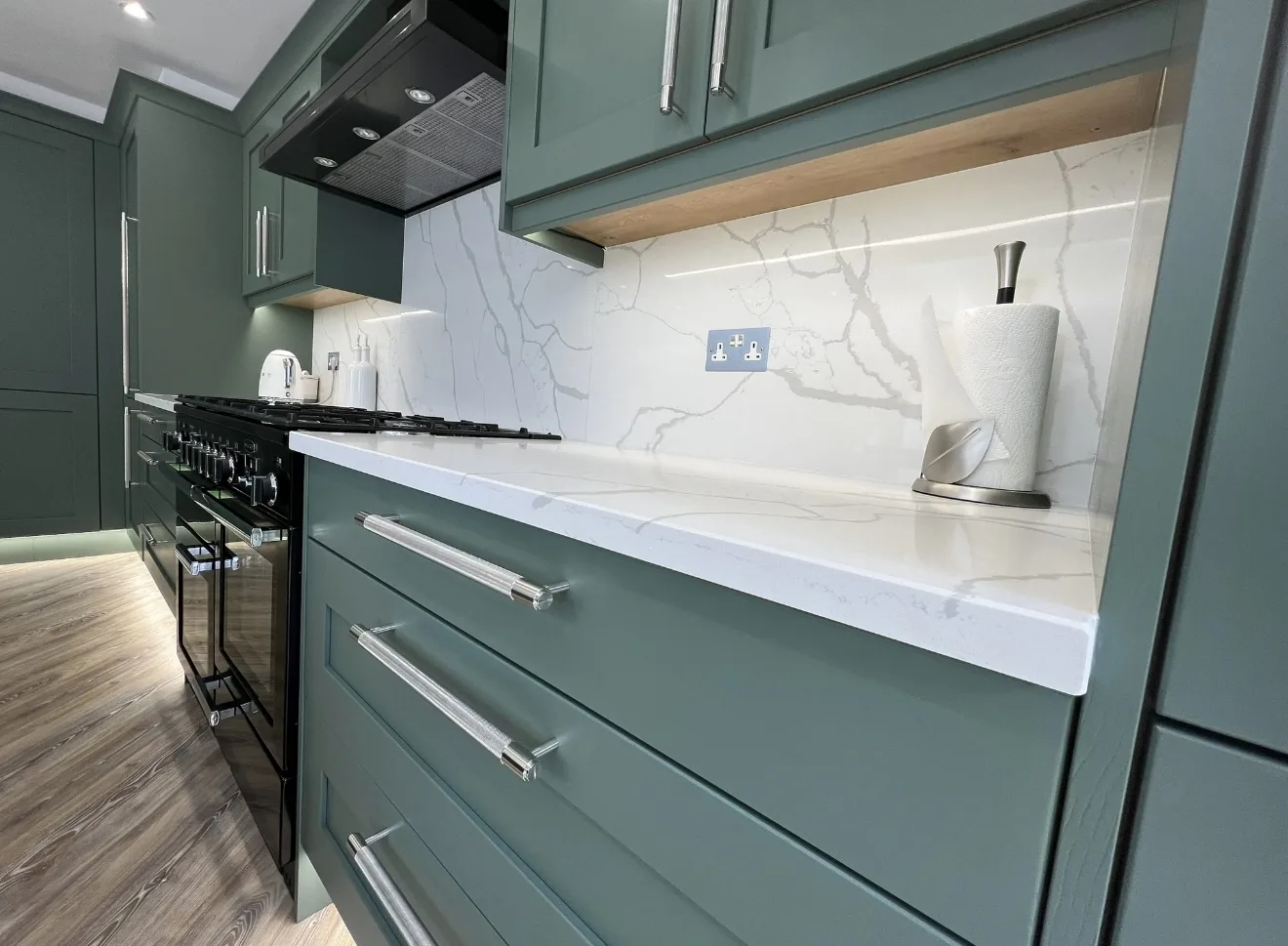
The rate per square metre buys stone and nothing else, so the machining, the openings, the polished edges and the fitting are set out beside it rather than folded into it. In a galley the runs are short and the cut-outs are close together, so the fixed operations carry more of the total than the stone does. For a rough sense of the material, £110 to £550 per square metre supply only is the honest span. Treat it as one line of a quote that will carry several more. Nothing about the stone is folded into a rate and hidden there.
Get it priced
Victorian and Edwardian terraces
The shape of the run
An aisle under a metre stops being a working space the moment two people are in it, and the depth of the tops either side is what decides whether that happens. Cabinet runs are rarely as straight as a drawing claims, so the template records what is actually there and a nominal length and a cut length stop agreeing. A single straight run is the cheapest stone you will ever buy.
Victorian and Edwardian terraces
The building, and what it does to the job
Where the boxing stands proud of the finished wall the upstand behind it has to be broken into separate lengths, because one piece cannot pass it. A cill sitting low above the units caps the upstand height, and the shallow band that results is cut from the same slab so the tone agrees along the wall. Speckle hides the resin line a mitre leaves behind.
Victorian and Edwardian terraces
What Imperial Wharf asks for
The housing on this patch does not throw up much of this. It throws up worktop replacement, worktop installation and worktop fabrication. When it does come up, it gets the same template, the same bench and the same crew.
Access
Getting stone into an Imperial Wharf kitchen
Gated estate with a security barrier, contractor registration, a designated loading bay and a goods lift that must be booked and lined before use, plus estate rules on working hours. From the lift lobby the route to the flat is a long carpeted corridor across a podium, so floor protection is mandatory and the trolley run is significant.
Tell us what the approach looks like when you book the template and it gets built into the day rather than discovered on it. Where the route is genuinely tight, it changes how the pieces are cut, which is a fabrication decision rather than a delivery one.
5–10 working days
From template to fitted, working days from template. The same on this patch as every other.
west London patch
Imperial Wharf is covered on our west London run, along with the rest of Hammersmith and Fulham.
We come to you
Templated in your kitchen, cut in our workshop, fitted by our own installers.
Access told straight
If the route forces an extra join, you hear that at quote stage, not on the day.
Questions
Questions we get asked in Imperial Wharf
If yours is not here, ring and ask. You get a straight answer rather than a call-back from a salesperson.
Do your own fitters come out to Imperial Wharf?
Yes. Imperial Wharf is on the patch, and the postcodes we work here are SW6. It is worked on our west London run, along with the rest of Hammersmith and Fulham. The goods lift has its own booking sheet, and a bay slot without a lift slot only gets the stone as far as the lobby. Whatever the standing allows, the stone leaves that van finished, because every edge, cut-out and internal radius is machined at the works and none of it is open to reconsideration at the kerb. Stone is delivered machined, sealed and covered, in that order. The measuring and the fitting are both done at the property, so there is nothing to visit or collect.
Why would worktops in Imperial Wharf be any different from anywhere else?
Sprinkler heads and extract ducts are coordinated into the ceiling, so an extractor over an island goes where the services already allow. Kitchens in these blocks are compact and open to the living space, so the surface is furniture as much as work surface and a quiet consistent stone carries that better than a dramatic one. Plain stone takes the seam that a long carry forces. A boxed soil stack or service riser in the corner of a run eats into the worktop depth and has to be scribed around rather than cut square. Every notch and every scribe is machined into the piece before it leaves the works, and a hard sintered surface is the least forgiving of a tight internal corner, so one is always cut with a generous radius. Every notch is machined on the bench and none on site.
What is the carry like in Imperial Wharf?
Sign-in at the gate, a permit on the dash and a named contact are usually wanted before anything comes off the van. That caps the longest piece, and a run split into two lengths nests differently on the slab, which moves the yield and moves the figure with it. A hard route shortens the list to lighter, thinner surfaces. A bay shared across a parade of shops turns over all day, so the arrival time matters more than the length of the booking does. A granite kitchen ends its day with a sealer, and a sealer wants a dry face and a quiet hour afterwards, so that hour is written into the day rather than borrowed from it. The face is uncovered once, and that once is at handover.
Is Imperial Wharf really a worktops area?
Not really, and claiming otherwise would cost nothing and mean nothing. What the research on this patch actually lists is worktop replacement, worktop installation and worktop fabrication. It reflects the local housing rather than any difference in the work. It is quoted, cut and fitted here the same way it is anywhere else on the patch. A specification repeated across several plots has to be repeatable, which quietly rules out the natural stones where no two slabs match. Where several kitchens are ordered together the sensible move is to take them all off one batch, because two slabs of the same name bought six months apart will not sit happily in the same building. Two slabs bought a season apart are two different stones. Replacing one plot years after handover is the problem nobody plans for, because a quartz colour can be reordered and a granite block cannot. Volume work tends to live at the entry end of the range, and the entry end is genuine stone rather than a compromise, since the lowest supply figure we quote is a sintered surface and not a thin laminate pretending to be one. Buying for hard use is a different exercise from buying for looks.
Where does the money go on an Imperial Wharf worktop?
A dishwasher door on one side and an oven door on the other cannot both stand open in a narrow aisle, so which appliance goes where matters more in this shape than in any other. A shape like that nests kindly on a slab, so more of what gets bought ends up on the units and the rate per square metre behaves much as the brochure says it will. Nesting is where the quiet savings on a kitchen live. Supply-only material is £110 to £550 per square metre, and templating, fabrication and fitting are quoted separately rather than rolled in.
What needs to be ready before you come to Imperial Wharf?
Boxing is rarely the same depth at worktop height as it is at floor level, so measuring it low down is the usual reason a top will not sit back. A hob dropped into the middle of a length puts sustained warmth at the lip of a cut-out, and an engineered surface will yellow there across ten years where a natural one takes it without comment. Water standing daily is what makes porosity matter. Send the kitchen layout with run lengths and the peninsula projection if there is one, and tell us what the lift will take as a single piece. One owner can take a date next week while the flat below needs three weeks of notice, so several kitchens in one building end up scheduled by the slowest permission. That changes which questions are worth asking about the stone, because somebody staying put wants to know how a honed face marks in five years and somebody selling wants to know how it photographs next spring. Stone is a fixture and outlasts the agreement over the room.
What happens when the route into an Imperial Wharf kitchen is tighter than the worktop?
A join added to get stone into the room is a different thing from a join added because the slab ran out, and the quote says which is which. If a piece cannot be got in at all, we say so at the template rather than on the day. Where the parking court sits behind the block the carry crosses open ground and gets boarded, because loaded trolleys and block paving do not agree. Where a seam becomes unavoidable the choice of stone starts to matter, because a fine even speckle closes a joint almost invisibly and a broad vein simply will not. Damage in transit lands on corners, so corners get eased.
Do you take the old worktop away?
What comes out goes by the same route the new stone comes in by, which is why that route is walked before anything is lifted. If you want the old top kept for a garage or a utility, say so and it stays on site. The template can be taken with the old top still down, which is why one visit covers both. Building management is often the real gate rather than the bay itself, since the barrier, the shutter and the lift each need someone with a fob. Sintered surfaces are the hardest of the three to machine and the messiest to cut wet, which is precisely why none of that happens on a public pavement. Stone arrives finished, because a kerb is not a polishing shop.
Is a drainer groove worth it in a small Imperial Wharf kitchen?
The alternative stands on the surface, so the choice is losing worktop permanently or only while you are draining. Machining is permanent. If a later kitchen moves the sink, the grooves stay where they were cut. A groove set needs a clear stretch of worktop beside the bowl, so it competes with the run for length instead of being free surface. The room is square, the walls are plumb and the floor is flat, so almost every complication in the job belongs to the building rather than the kitchen. Which stone belongs on top of all that is a separate question from the building itself, and it is the one with a figure attached, because supply alone runs from £110 to £550 per square metre before a single cut has been made. Yield is the word behind most quotations people did not expect.
Can the price change after templating?
Ask for the lines rather than the total. One number for a kitchen tells you nothing you can check. Cut-outs, edge profile and join count are itemised, so taking one out removes a line rather than starting an argument. No installed price per square metre is published, because it is not a real number. Anything that has to stay accessible, a stopcock, a gas meter, a riser panel, is marked on the template so the stone is cut around it instead of over it. A run that sits under strong sun for hours every afternoon suits a surface built to be stable in daylight, because a resin-bound stone is made for indoor use and sustained sunlight is the one thing it was never designed around. Brittle stone and narrow returns are a poor pairing.
Reviews
5.0 from 26 Google reviews
Every one of these is on our Google profile under the reviewer’s own name. Nothing here is written by us, and the link goes straight to the source.
Excellent service and top quality workmanship. The worktop looks absolutely amazing and the attention to detail is impressive. The team was professional, punctual, and very easy to work with. Highly recommended for anyone looking for a premium kitchen worktop! 👌
Costin Roman
Google review
Excellent service from start to finish. The team at Worktop Worx were professional, friendly, and really paid attention to detail. They listened to what I wanted, gave helpful advice, and delivered a high-quality finish. The worktop looks amazing and has completely transformed the space. Everything was completed on time and left clean and tidy. Highly recommended 5/5
Kam 98
Google review
We recently had our kitchen worktops supplied and fitted by Worktop WorX using Laurent Gold sintered stone, and we couldn’t be happier with the result. The finish, quality, and attention to detail were outstanding from start to finish. Karem was incredibly helpful throughout the whole process professional, knowledgeable, and always available to answer any questions. The new worktops have completely transformed our kitchen and look amazing. Highly recommend Worktop WorX to anyone looking for high quality kitchen worktops, bespoke workmanship, and excellent customer service.
Gabriel Tivadar
Google review · Laurent Gold sintered stone
Related
More around Imperial Wharf
Other work we do in Imperial Wharf
Next step
Worktops in Imperial Wharf, priced properly
Plans, a sketch or photographs with rough run lengths is enough to start. You get an itemised written quote and the template dates we can offer on this patch.
25-year material warranty and a 5-year workmanship guarantee, both stated on your quote.