
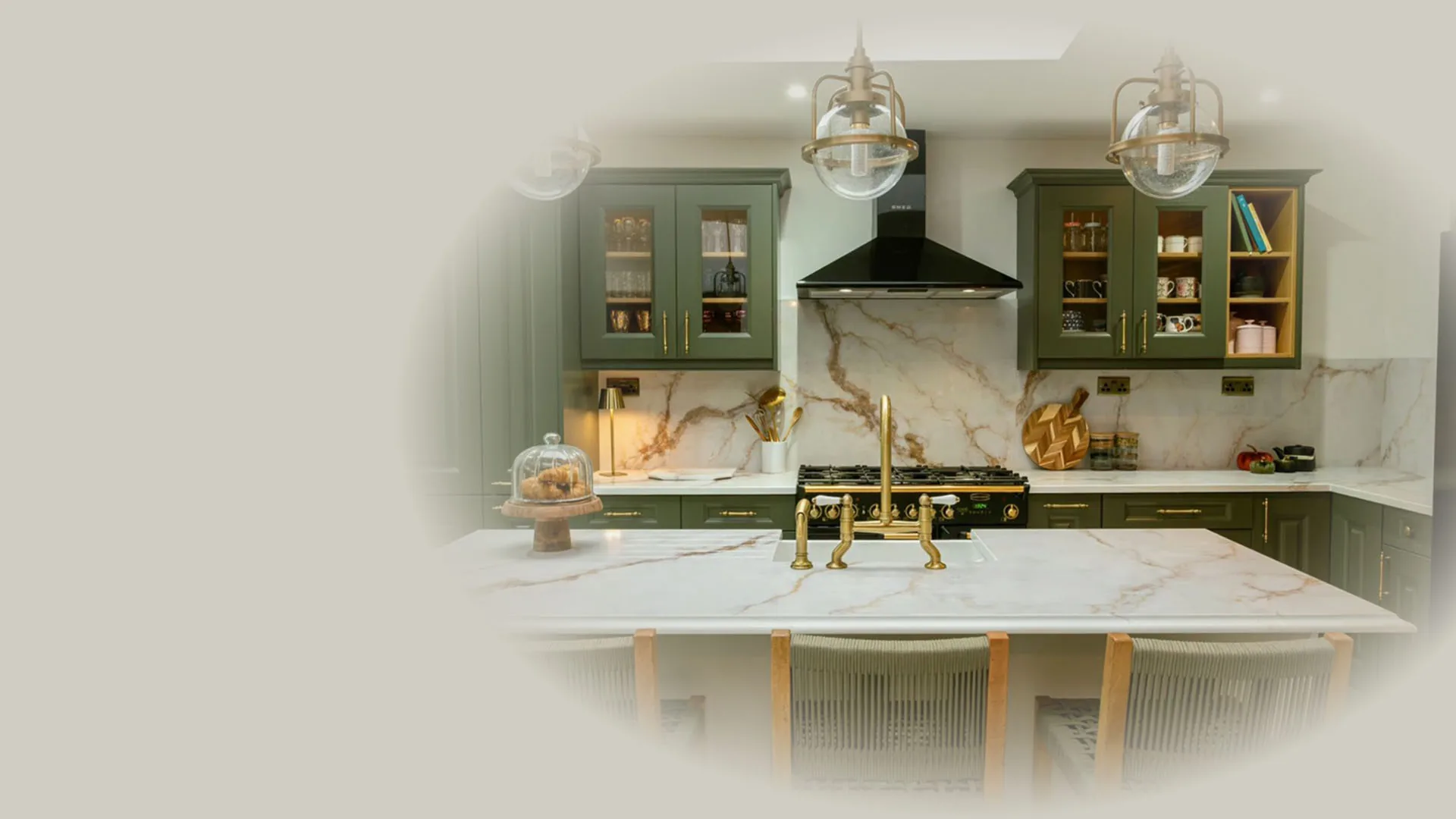
Camden · NW3
Worktops in Hampstead
The surface itself: which stone, what it costs by the square metre, and what the room does to that number.
- 5.0from 26 Google reviews
- 25-year material · 5-year workmanship
- Fitted 5-10 working days from template
Hampstead kitchens
The kitchens we meet in Hampstead
Anyone who has already replaced a kitchen in Hampstead will tell you that stone worktop supply and fitting is decided by the room long before anyone opens a colour chart. Two very different jobs sit side by side: listed Georgian townhouses where the kitchen is still in the semi-basement with low ceilings, stone floors and structural piers breaking up every run, and larger detached villas where the kitchen has moved to a rear garden room with a genuine island. Basement runs are short and interrupted by chimney breasts, so the cutting list is long even when the room is not. Work out none of it yourself. Tell us the address in Hampstead and roughly what you are replacing, and we will take it from there.
Original quarry tile is often still down under two or three later floor coverings, which is why the finished floor height is rarely what anyone expects. North light and afternoon light read a surface differently, so a sample belongs in the corner that gets the worst of it rather than the best. Colour gets chosen under kitchen lights, never under showroom ones.
Walls are thick, lime-plastered and built in a soft brick, so they take a scribe well and take a fixing badly. The alcoves either side of a breast break the run into short pieces, and short pieces are exactly where buying a full slab outright starts to beat buying stone by the metre. A low seam count is what makes a small kitchen good value.
The stock behind these kitchens runs to Georgian townhouse, Victorian villa, Arts and Crafts house, 1930s modernist block and mansion block. Which of those you have decides most of what follows.
True everywhere
Worktops, in short
- Supply is £110 to £550 per square metre across the 181 surfaces we fit.
- Dekton and sintered stone hold their colour under heat and direct sunlight.
- That figure is the slab. Fabrication, edges, cut-outs and fitting are quoted separately.
- Four free quartz samples are posted out, because photographs of stone lie.
- Borough
- Camden
- Postcodes
- NW3
- Covered on
- our central and north London run
- Fitted
- 5–10 working days from template
The place
Why Hampstead is its own job
Anyone can cut a worktop to size, and what decides the day in Hampstead is whether the rest of it was thought through. Steep hills, single-track lanes, cobbled and stepped sections that no van gets near, and a CPZ with almost no loading space anywhere near the Village. Lower-ground kitchens are reached down an external area staircase with a tight quarter turn at the bottom, which is normally the narrowest point on the whole job. Listed-building consent shapes what you can fix to a wall, so upstands often replace tiled splashbacks and the area steps dictate slab sizes long before the kitchen layout does. Whatever the building does to a straight line, it is measured on the template and drawn before anything is cut.
The work
What worktops involves
It suits a straight replacement in the same layout, a new kitchen being built around a chosen slab, and an island or peninsula being added to a run that already exists. A natural stone is sealed before the kitchen is handed back, and you are told plainly which products will dull the finish and which will not touch it. You get an itemised figure that shows what the slab cost, what the edges cost and what the openings cost, so the layout can be adjusted before anything is cut.
Granite is quarried, which makes every slab its own object. It will take a pan straight off the flame, and being porous it asks for sealing now and then. Dekton and sintered stone cover £110 to £366 across 65 surfaces, so the hardest material available is also the one that opens the range. Painted period joinery and tall ceilings carry a thicker front edge comfortably, and a slim one tends to look apologetic beside them. Chosen under your own bulbs, not under ours.
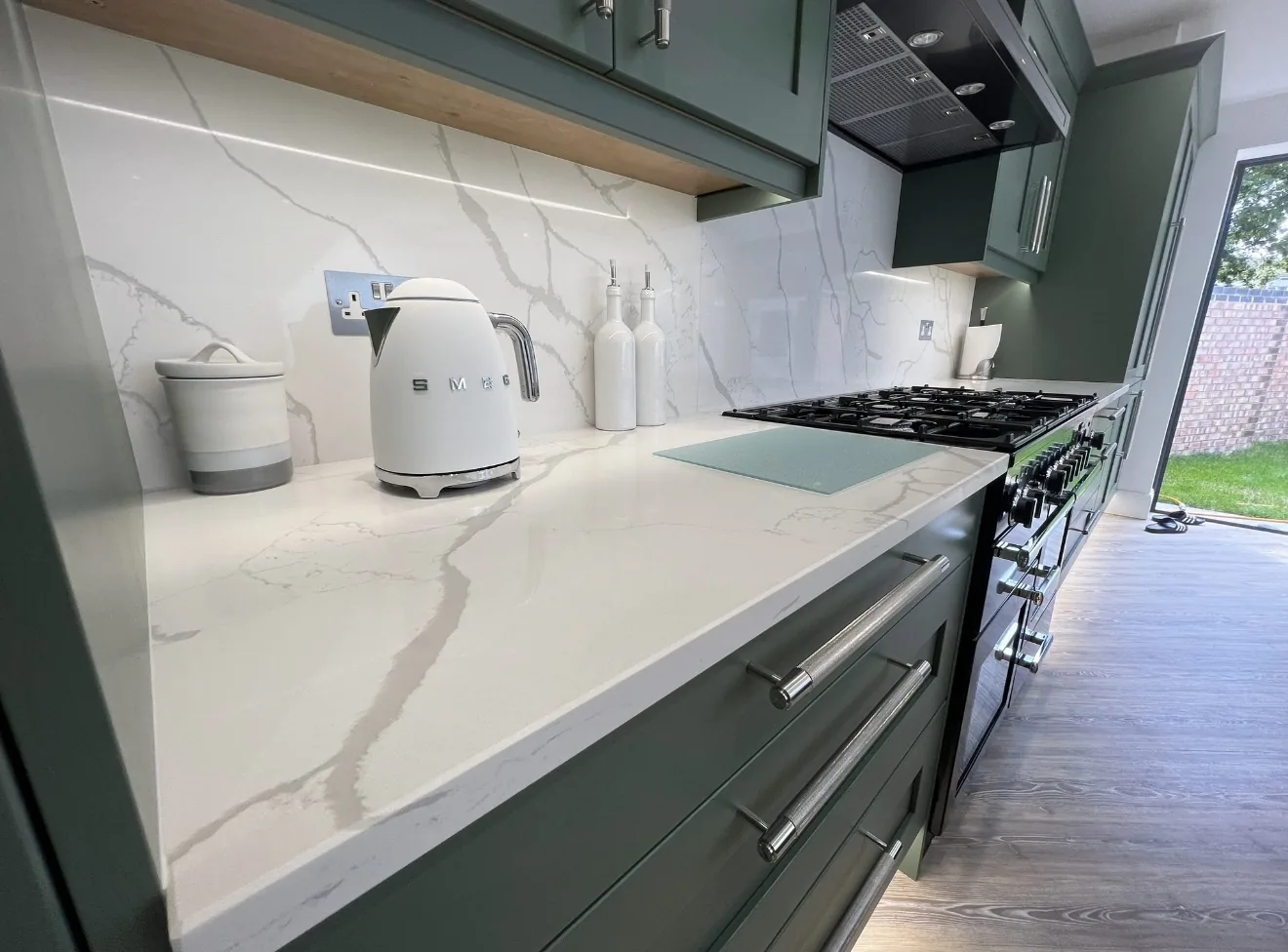
The money
What it costs in Hampstead
The remainder of a slab is part of the price whether it is fitted or left behind, and that is the honest reason short awkward lengths cost what they do. An island is a yield question before it is a design one: it either comes out of the same slab as the perimeter or it needs a second. That £110 to £550 per square metre buys the slab and nothing else. Templating, machining, edges, cut-outs and the fitting day are counted and charged one by one. You see what the offcut costs before you agree to the layout.
Get it priced
period detached houses and villas
Hampstead in the housing figures
Around here converted and purpose-built flats make up most of the stock. No two kitchens are set out alike. Loading through an upper storey puts the weight question on the joists as well as on the crew, and a thinner gauge answers both at once. Rough treatment calls for whichever material has the thickest skin.
period detached houses and villas
The shape of the run
The offcut taken out of the middle for a hob is a large usable piece, and it is worth deciding early whether it becomes an upstand or goes in the skip. Cabinet runs are rarely as straight as a drawing claims, so the template records what is actually there and a nominal length and a cut length stop agreeing. Long unbroken lengths are what make a plain stone look dear.
period detached houses and villas
What Hampstead asks for
This is not the local speciality and there is no point saying otherwise: worktop installation is what the housing here actually asks for. It is quoted, cut and fitted exactly the same way regardless.
Access
Getting stone into a Hampstead kitchen
Steep hills, single-track lanes, cobbled and stepped sections that no van gets near, and a CPZ with almost no loading space anywhere near the Village. Lower-ground kitchens are reached down an external area staircase with a tight quarter turn at the bottom, which is normally the narrowest point on the whole job.
Tell us what the approach looks like when you book the template and it gets built into the day rather than discovered on it. Where the route is genuinely tight, it changes how the pieces are cut, which is a fabrication decision rather than a delivery one.
5–10 working days
From template to fitted, working days from template. The same on this patch as every other.
central and north London patch
Hampstead is covered on our central and north London run, along with the rest of Camden.
We come to you
Templated in your kitchen, cut in our workshop, fitted by our own installers.
Access told straight
If the route forces an extra join, you hear that at quote stage, not on the day.
Questions
Questions we get asked in Hampstead
If yours is not here, ring and ask. You get a straight answer rather than a call-back from a salesperson.
Do your own fitters come out to Hampstead?
Yes. Hampstead is on the patch, and the postcodes we work here are NW3. It is worked on our central and north London run, along with the rest of Camden. Permit hours are what matters, not the permit itself, because a bay that frees up at six in the evening is no use for a template at ten. Whatever the standing allows, the stone leaves that van finished, because every edge, cut-out and internal radius is machined at the works and none of it is open to reconsideration at the kerb. What stands on the van is finished stone, not raw slab. We come to the kitchen to template and again to fit, so there is nothing to visit and nothing to collect.
Does the housing in Hampstead change how worktops works?
Rooms are tall with deep window reveals, and a run finishing into a reveal is templated to it rather than assumed square. The kitchen in one of these sits in the back addition and takes its daylight from one end, so the working half of the run is the darker half and a pale stone with a honed or matt face does more there than any colour with depth in it. Long narrow rooms want a pale face at the working end. A chimney breast left in place splits a wall into two alcoves, and the two are rarely the same width and rarely parallel to each other. Every notch and every scribe is machined into the piece before it leaves the works, and a hard sintered surface is the least forgiving of a tight internal corner, so one is always cut with a generous radius. Reach across an unsupported span is a thickness question.
How does the stone actually reach a kitchen in Hampstead?
There is no leaning a piece against a wall halfway up, so any flight longer than a dozen treads is planned around a rest point on a landing. That caps the longest piece, and a run split into two lengths nests differently on the slab, which moves the yield and moves the figure with it. Speckle forgives a joint that a sweeping figure never would. Without a bay the van ends up on a single yellow with a crew member watching it, which takes a pair of hands off the carry. A granite kitchen ends its day with a sealer, and a sealer wants a dry face and a quiet hour afterwards, so that hour is written into the day rather than borrowed from it. Nothing about the shortlist is decided on the day itself.
Is worktops what Hampstead is known for?
Not particularly, and it would be easy to pretend otherwise. What the research on this patch actually lists is worktop installation. That is a point about the buildings round here, not about the job. The quoting, the cutting and the fitting are identical here to anywhere else we work. Extension work runs late far more often than it runs early, and the worktop is close to the last thing in, so the date agreed at the start is rarely the date that happens. Where several kitchens are ordered together the sensible move is to take them all off one batch, because two slabs of the same name bought six months apart will not sit happily in the same building. A repeated specification is worth deciding slowly, once. Where a family has been living around a building site for months, the finish date carries more weight than any other part of the specification. Volume work tends to live at the entry end of the range, and the entry end is genuine stone rather than a compromise, since the lowest supply figure we quote is a sintered surface and not a thin laminate pretending to be one. Drawing lengths and room lengths are rarely the same lengths.
What am I actually paying for, line by line?
It is walked round rather than looked at from one side, so the direction the veining runs along it cannot be hidden against a wall the way it can on a perimeter run. A shape like that nests kindly on a slab, so more of what gets bought ends up on the units and the rate per square metre behaves much as the brochure says it will. The number follows the layout far more closely than the floor plan. The stone is £110 to £550 per square metre supply only, and templating, fabrication and fitting are quoted separately.
Is there anything I have to finish before the template in Hampstead?
Alcove pieces get cut oversize on both scribe edges, with the true wall angles carried on the template drawing rather than assumed. A hob dropped into the middle of a length puts sustained warmth at the lip of a cut-out, and an engineered surface will yellow there across ten years where a natural one takes it without comment. Speckle hides the resin line a mitre leaves behind. Send the run lengths, say where the sink and hob will sit, and tell us which way the room faces and what lighting is going in above the working run. A street with houses in single occupation next to the same houses cut into flats produces two completely different jobs from the same elevation. That changes which questions are worth asking about the stone, because somebody staying put wants to know how a honed face marks in five years and somebody selling wants to know how it photographs next spring. A chip in natural stone can be filled and polished in place.
Who removes the old worktop in a Hampstead kitchen?
The carcasses stay put. Only the surface changes. The sink and hob are lifted out with the old top and kept aside if you are reusing them. The tap and waste have to be disconnected by a plumber before we start and reconnected once the stone is in. Enforcement zones rarely accept a trade van unloading stone as an exemption, so this gets sorted before the date is confirmed rather than argued about afterwards. Sintered surfaces are the hardest of the three to machine and the messiest to cut wet, which is precisely why none of that happens on a public pavement. A figured slab takes longer to match than a plain one.
Does a stone worktop need sealing?
Granite is porous to varying degrees, so it is sealed when we fit it and topped up over the life of the worktop. Quartz carries resin, so a hot pan wants a trivet, while granite and sintered stone will take one without complaint. A seal is not waterproofing. It only buys time to wipe a spill up. Listing and conservation conditions apply to a good number of these, which constrains what can be altered around the kitchen rather than what goes on top of the units. Alcoves either side of the old breast chop the run into short lengths, and a kitchen made of short lengths is the case where buying a slab outright beats buying the square metres, because the remainder is paid for in both. Short pieces are the argument for buying a slab outright.
What happens if my units are not level?
Variation past what packing can take up has to be corrected in the carcasses before we cut, because the template records the units as they stand. Levelling belongs in the carcasses, on their own legs and packers. Units have to be fixed down as well as levelled. A loose carcass moves under stone. Where a breast interrupts a long wall the join can often go there, so it reads as a natural break rather than a line in the middle of a worktop. A run that sits under strong sun for hours every afternoon suits a surface built to be stable in daylight, because a resin-bound stone is made for indoor use and sustained sunlight is the one thing it was never designed around. Every notch is machined on the bench and none on site.
Can a damaged worktop be repaired in place?
A remade piece is cut from the same slab run wherever the slab allows, because a replacement from another batch will not match across a join. Chips at an edge or a corner are the usual form, because that is where stone is least supported. A dropped pan years later is a different question, and stone is remade rather than filled either way. Pendant fittings over the stairwell and anything hung on the half-landing come down first, because a piece on edge sweeps a wider arc than the people carrying it. Sintered stone at twelve millimetres weighs roughly half what thirty millimetre granite weighs, so a punishing route can genuinely rule one material in and another out. No colour and no edge is adjustable once a piece is machined.
Reviews
5.0 from 26 Google reviews
Every one of these is on our Google profile under the reviewer’s own name. Nothing here is written by us, and the link goes straight to the source.
Lovely team, business and quality motivated, prompt delivery with installation. Affordable prices. Wide range of worktops available. High recommendation
Loreta Skalisiene
Google review
Great service. Super quick and easy communication. I love my new worktop 🥹🥹
Sara Arghir
Google review
Professional, polite and friendly service. Very pleased with finished product.
costas andrews
Google review
Related
More around Hampstead
Other work we do in Hampstead
Next step
Worktops in Hampstead, priced properly
Plans, a sketch or photographs with rough run lengths is enough to start. You get an itemised written quote and the template dates we can offer on this patch.
25-year material warranty and a 5-year workmanship guarantee, both stated on your quote.