
Kensington and Chelsea · W11
Worktops in Notting Hill
The surface itself: which stone, what it costs by the square metre, and what the room does to that number.
- 5.0from 26 Google reviews
- 25-year material · 5-year workmanship
- Fitted 5-10 working days from template
Notting Hill kitchens
The kitchens we meet in Notting Hill
Booking worktop jobs in Notting Hill without a site visit is how people end up with a worktop that fits the drawing and not the wall. The Ladbroke Estate houses put the kitchen on the lower ground floor at the back, usually knocked through into a rear extension that runs out under the communal garden wall, so you get a 3.2-4m wall run plus an island of 2.4m or more. Mews conversions behind the main terraces are the opposite job entirely: a single galley run of 2.6-3.2m against one wall with a hob undercut and no room for a return. Ask for the design and quotation visit. It is free, it carries no obligation, and it settles all of this properly.
Injected damp courses and re-rendered lower walls leave the bottom metre standing proud of everything above it. Quartz, granite and sintered stone each let you down in a different way, and choosing well is mostly a matter of knowing which of those three failures this room will provoke. Heat tolerance is a property of the material, not a claim about it.
The rear room has a bay or a wide window onto the garden, so the sink length is short and the real working length is on the return. The alcoves either side of a breast break the run into short pieces, and short pieces are exactly where buying a full slab outright starts to beat buying stone by the metre. One full slab and no second is the sweet spot on price.
What the research records here is 1840s-1860s stucco-fronted townhouse, communal garden square terrace, Victorian coach-house mews and Edwardian mansion flat. They are not interchangeable, and a worktop finds the differences quickly.
True everywhere
Worktops, in short
- Supply is £110 to £550 per square metre across the 181 surfaces we fit.
- Quartz runs £130 to £500 per square metre, granite £121 to £550 and Dekton £110 to £366.
- Templating is done in the room itself, once the units are fixed and level.
- Fitting happens five to ten working days after the template is taken.
- Borough
- Kensington and Chelsea
- Postcodes
- W11
- Covered on
- our west London run
- Fitted
- 5–10 working days from template
The place
Why Notting Hill is its own job
People who have already had stone fitted in Notting Hill will know most of what follows, and will know why we ask. Almost the whole area is conservation area with single yellow and RBKC residents' bays, so a slab van gets a loading window rather than a parking space. Most houses are entered either up a raised front step or down external area steps into the lightwell, and that bottom landing is where slabs get stuck - it is often under 900mm deep with a right-angle turn straight into the kitchen door. Measure the turn at the foot of the area steps before you cut anything, because a 3m piece that clears the stair will still refuse the 90-degree swing at the bottom. Three to seven working days sit between the template and the fit, and everything difficult gets solved in that gap.
The work
What worktops involves
The stone is quoted per square metre for supply and itemised beyond that, so the slab, the edge profile, the openings and the fitting each appear as their own figure. A natural stone is sealed before the kitchen is handed back, and you are told plainly which products will dull the finish and which will not touch it. You are left with joins that read as a shadow line, because the pieces either side come off adjoining slab and the resin is mixed to the stone.
That figure per square metre buys the slab and nothing else. Machining, edge work, openings and fitting are separate lines, which is why a rate is never a bill. Weight is worth knowing before the floor is: a thick natural top runs to a considerable mass per square metre, and a timber span deserves a glance before it is loaded. In a house of this age the kitchen stretches away from its only window, so the shortlist closes around a pale honed face before anybody names a colour. Machined to the millimetre and guaranteed by the decade, not the year.
The money
What it costs in Notting Hill
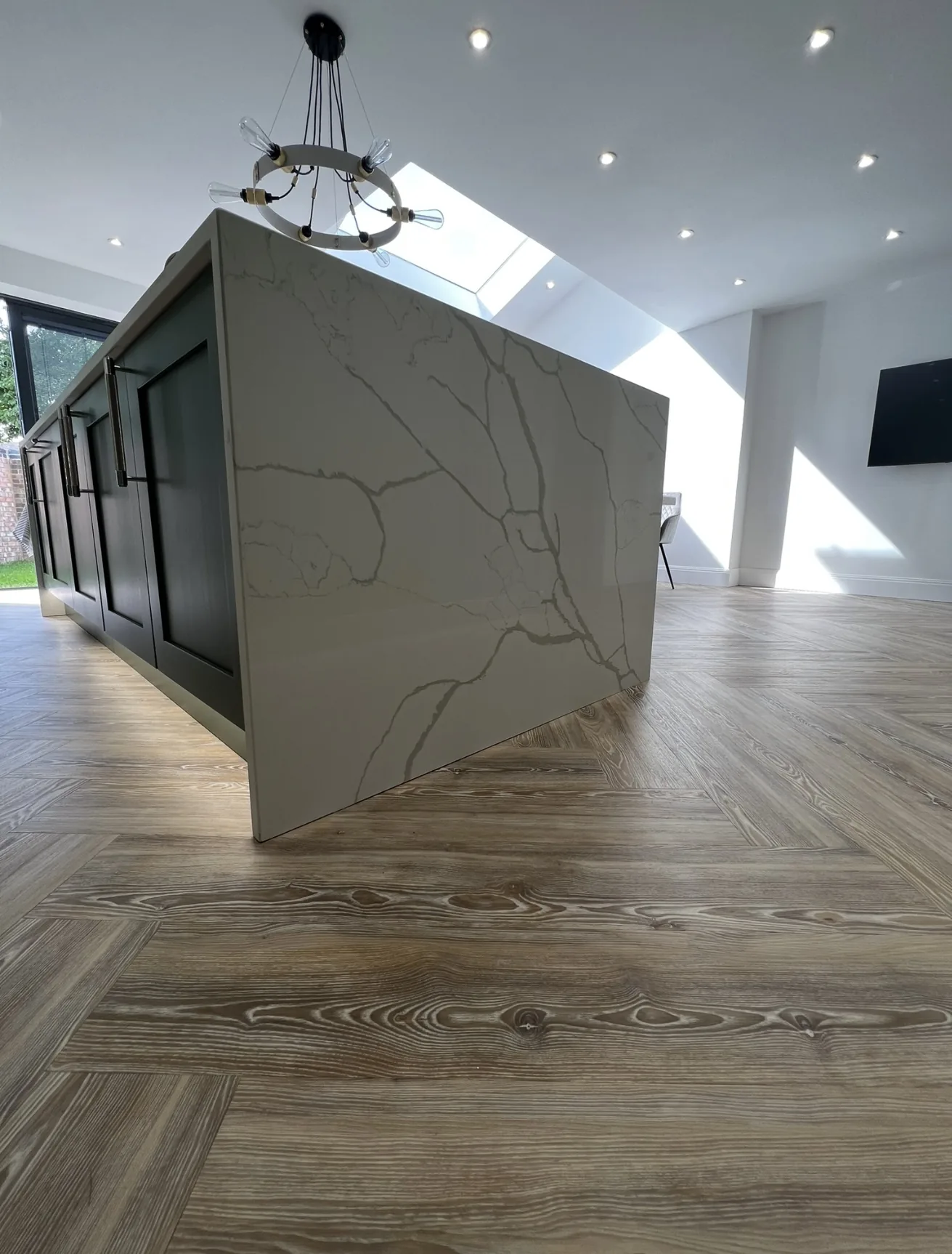
A worktop is priced from the cut list rather than the floor area, because the slab is bought whole and the run lengths decide how much of it ends up on your units. Short lengths nest well and waste little, so the material line is usually the kindest part of a galley quote. That £110 to £550 per square metre buys the slab and nothing else. Templating, machining, edges, cut-outs and the fitting day are counted and charged one by one. The slab, then the machining, then the fitting, each on its own line.
Get it priced
Victorian and Edwardian terraces
What Notting Hill asks for
Extension work runs late far more often than it runs early, and the worktop is close to the last thing in, so the date agreed at the start is rarely the date that happens. Where several kitchens are ordered together the sensible move is to take them all off one batch, because two slabs of the same name bought six months apart will not sit happily in the same building. Buying for hard use is a different exercise from buying for looks.
Honestly, this is not what we do most on this patch. Worktop fabrication and worktop installation come up more often. That is a statement about the local housing rather than about the work, and nothing about how it is quoted, cut or fitted changes because of it.
Victorian and Edwardian terraces
Notting Hill in the housing figures
Around here this is high-band housing on the council tax measure. Those walls carry a century of movement. Extensions finished in spring fill the yards, so a reservation placed early holds a consignment that would otherwise be gone by templating. Rough treatment calls for whichever material has the thickest skin.
Access
Getting stone into a Notting Hill kitchen
Almost the whole area is conservation area with single yellow and RBKC residents' bays, so a slab van gets a loading window rather than a parking space. Most houses are entered either up a raised front step or down external area steps into the lightwell, and that bottom landing is where slabs get stuck - it is often under 900mm deep with a right-angle turn straight into the kitchen door.
Tell us what the approach looks like when you book the template and it gets built into the day rather than discovered on it. Where the route is genuinely tight, it changes how the pieces are cut, which is a fabrication decision rather than a delivery one.
5–10 working days
From template to fitted, working days from template. The same on this patch as every other.
west London patch
Notting Hill is covered on our west London run, along with the rest of Kensington and Chelsea.
We come to you
Templated in your kitchen, cut in our workshop, fitted by our own installers.
Access told straight
If the route forces an extra join, you hear that at quote stage, not on the day.
Questions
Questions we get asked in Notting Hill
If yours is not here, ring and ask. You get a straight answer rather than a call-back from a salesperson.
Which postcodes do you cover around Notting Hill?
Yes. Notting Hill is on the patch, and the postcodes we work here are W11. It is worked on our west London run, along with the rest of Kensington and Chelsea. Time-limited bays are camera-enforced across a lot of managed estates, so the unload runs to the clock and the van moves off afterwards. Whatever the standing allows, the stone leaves that van finished, because every edge, cut-out and internal radius is machined at the works and none of it is open to reconsideration at the kerb. A natural surface is sealed at the end of its own fitting day. There is nothing to drive to and nothing to pick up, because both visits are to the property itself.
Does the housing in Notting Hill change how worktops works?
The external wall on the passage side has never been rendered, so it is cold, solid and honest to fix into. Alcoves either side of the old breast chop the run into short lengths, and a kitchen made of short lengths is the case where buying a slab outright beats buying the square metres, because the remainder is paid for in both. Warm stone beside painted timber, cool grey rarely. Once the carcasses are levelled the gap under the plinth varies along the run, and that varying gap is the honest record of what the floor is doing. Every notch and every scribe is machined into the piece before it leaves the works, and a hard sintered surface is the least forgiving of a tight internal corner, so one is always cut with a generous radius. A deep scribe moves the pattern back along with the depth.
How does the stone actually reach a kitchen in Notting Hill?
Boxed-in pipework running along the skirting looks harmless until a loaded trolley has to pass it. That caps the longest piece, and a run split into two lengths nests differently on the slab, which moves the yield and moves the figure with it. A hard route shortens the list to lighter, thinner surfaces. A dedicated loading bay or service yard is the easiest arrangement in a managed building, provided the slot is booked and someone has the key to the shutter. A granite kitchen ends its day with a sealer, and a sealer wants a dry face and a quiet hour afterwards, so that hour is written into the day rather than borrowed from it. Dust from a sintered slab belongs at the works, not on a street.
Is worktops what Notting Hill is known for?
Honestly, no, though it would be easy to claim otherwise. What the research on this patch actually lists is worktop fabrication and worktop installation. That says something about the housing round here, not about the work. Quote, cut and fit are the same here as on any other part of the patch. Where a family has been living around a building site for months, the finish date carries more weight than any other part of the specification. Volume work tends to live at the entry end of the range, and the entry end is genuine stone rather than a compromise, since the lowest supply figure we quote is a sintered surface and not a thin laminate pretending to be one. The remainder of a slab is bought whether it is fitted or not. An open-plan extension puts the worktop in the middle of the living space, so it is looked at from the sofa as well as worked on. Adding an island is what moves most of these projects from one slab to two, and that jump is the single largest step in any worktop quotation. A focal surface deserves to be seen at full size.
What am I actually paying for, line by line?
The catch with a galley is that both runs are seen end-on from the doorway, so any difference in overhang between the two reads immediately. A shape like that nests kindly on a slab, so more of what gets bought ends up on the units and the rate per square metre behaves much as the brochure says it will. Where the shape is broken, a repeating pattern is worth money. Material runs £110 to £550 per square metre supply only, and templating, fabrication and fitting each get their own line.
Is there anything I have to finish before the template in Notting Hill?
A wall line that runs level over a floor that does not means the finish closes up on the plinth at one end, which is joinery rather than something the stone can answer. A hob dropped into the middle of a length puts sustained warmth at the lip of a cut-out, and an engineered surface will yellow there across ten years where a natural one takes it without comment. Thirty millimetres bridges a gap that twenty millimetres will not. Send the run lengths, say where the sink and hob will sit, and tell us which way the room faces and what lighting is going in above the working run. Where ownership is split across a building, the common parts belong to someone else and the carry route is negotiated rather than assumed. That changes which questions are worth asking about the stone, because somebody staying put wants to know how a honed face marks in five years and somebody selling wants to know how it photographs next spring. A let kitchen is specified for indifference, and rightly so.
Will you fit stone onto units that are not level?
Packing takes up small variation. It is not there to hide something that belongs in the units. Variation past what packing can take up has to be corrected in the carcasses before we cut, because the template records the units as they stand. Units have to be fitted, fixed and level before templating, and it is better to hear that at the template than on the fitting day. Where two pieces meet over a fall in the floor the join has to be flush to the hand as well as true to the level, because the eye reads the join and forgives the room. A run that sits under strong sun for hours every afternoon suits a surface built to be stable in daylight, because a resin-bound stone is made for indoor use and sustained sunlight is the one thing it was never designed around. A cranked piece eats more slab than the two straights it replaces.
Does a stone worktop need sealing?
Granite tells you when the seal wants topping up: water stops beading on the surface and starts darkening it instead. Marble is the one people underestimate. It is porous, like granite, and wants sealing. Bleach and limescale remover harm a polished finish rather than clean it, whichever material is on the units. The larder under the stairs is usually still there and still opens into the kitchen, so the run stops at a door that cannot be moved. Rooms in these houses run long and narrow with the only honest daylight at the garden end, so a pale honed surface does more for the working half of the kitchen than any colour with depth in it. A compact kitchen puts the band ahead of the metreage.
Can you fit stone I have already bought for a Notting Hill kitchen?
Stone cut to somebody else’s drawing cannot usefully be re-cut to yours. The quote is itemised, so a job where you already hold the slab is the same job with the material line taken off it. Order is what matters: a slab is templated before it is cut, so an uncut slab is straightforward and one already machined for another kitchen is not. Extension budgets are usually well spent by the time the worktop is ordered, which is where the choice between quartz and a thinner sintered stone actually gets made. Quartz is the sensible default where a kitchen changes hands often, because there is nothing to seal, nothing to re-seal and nothing an incoming household has to be told about the surface. Specify before the room is finished, not afterwards.
Do I have to get rid of the old tops myself in Notting Hill?
The template can be taken with the old top still down, which is why one visit covers both. Old tops are screwed or glued from underneath, so the drawer boxes come out before the worktop does. Taking the old tops off and disposing of them is its own line on the quote rather than something folded into the stone price. Bay bookings are usually an hour or two, which is fine for unloading and no use at all as a place to leave the van for a day. Sintered surfaces are the hardest of the three to machine and the messiest to cut wet, which is precisely why none of that happens on a public pavement. The offcut is yours if you want it and ours if you do not.
Reviews
5.0 from 26 Google reviews
Every one of these is on our Google profile under the reviewer’s own name. Nothing here is written by us, and the link goes straight to the source.
Really impressed with the quality and finish of these worktops. Great range of materials, precise fabrication, and smooth communication throughout. The whole process was easy and the final result looks fantastic. Highly recommend!
Nastasia Drago
Google review
We installed new kitchen and got the worktop and splash back from them. Their professional work and commitment was wonderful. Quality of work compared to price was way too good. Thank you guys.
MD Matinur Rahman
Google review
I am really happy with my worktop. It is beautiful and the service provided was second to none. I totally recommend.
Magaly R
Google review
Related
More around Notting Hill
Other work we do in Notting Hill
Next step
Worktops in Notting Hill, priced properly
Plans, a sketch or photographs with rough run lengths is enough to start. You get an itemised written quote and the template dates we can offer on this patch.
25-year material warranty and a 5-year workmanship guarantee, both stated on your quote.